- 当前位置:
How a Double-Wall Stainless Coffee Pot Keeps Coffee Hot for Hours
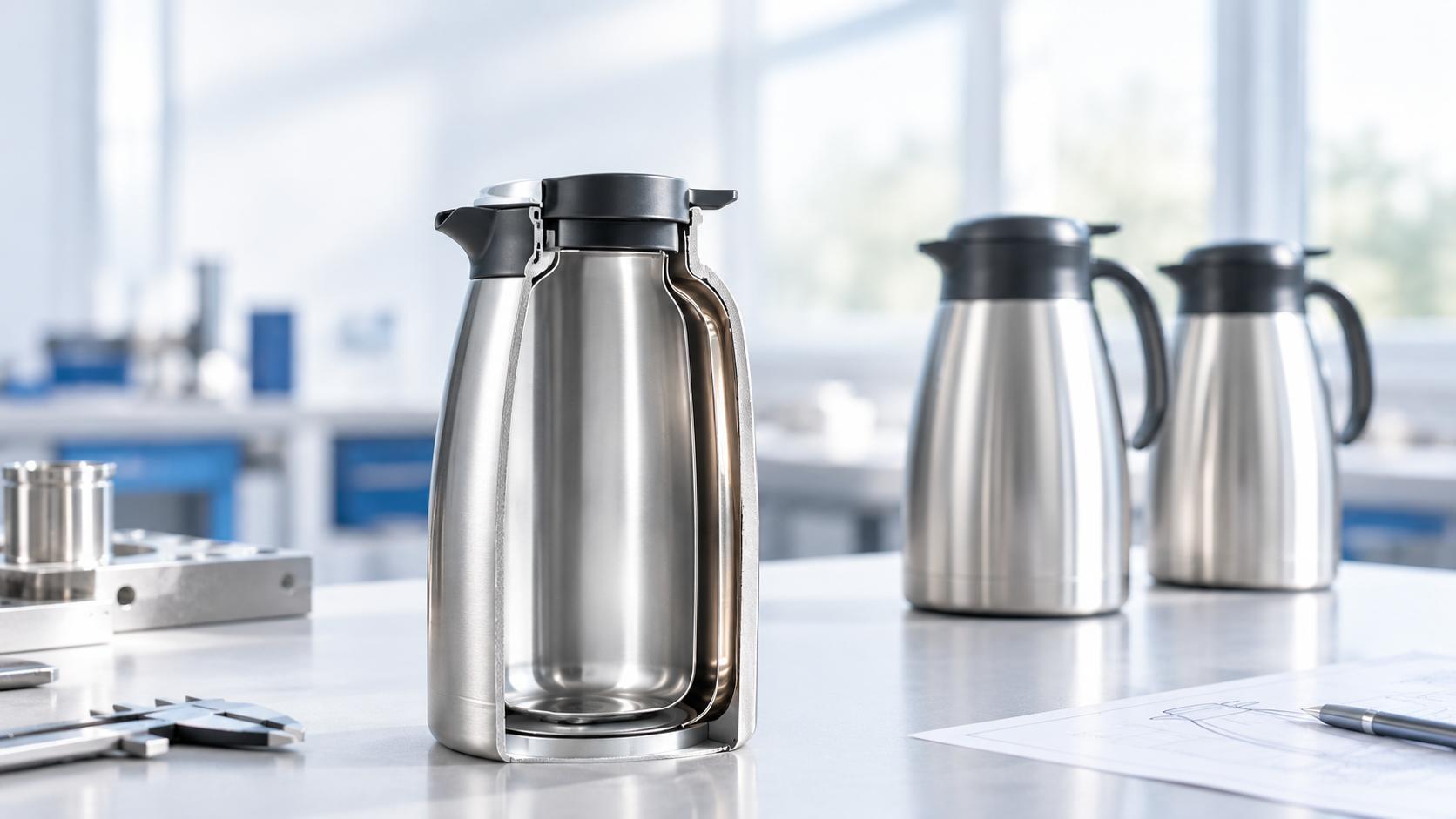
This guide explains why a double-wall stainless steel coffee pot keeps coffee hot for hours while a glass carafe goes cold within minutes, and where the heat actually goes. It covers how hot coffee loses temperature through its walls, what an evacuated double wall removes, why the lid and pour spout matter as much as the body, and how a buyer should compare thermal performance instead of trusting marketing hour claims. It also describes how ChengPeng builds insulated stainless coffee pots as part of its drinkware line. The goal is to understand the physics before choosing a pot, so a brand buys the structure that actually holds heat.
How Hot Coffee Loses Its Heat
Coffee cools through three paths: the wall of the container conducts heat to the outside air, the opening and spout let warm steam escape, and a thin layer of air next to the outer wall carries heat away. A glass carafe is thin and conductive, and its open pour path lets steam out freely, so it drops from brewing temperature to drinkable-but-cool in minutes. A ceramic mug holds heat a little better because the thick wall stores warmth, but it still radiates steadily. The reason an insulated stainless pot behaves differently is not a special coating; it is the gap between two walls.
What the Evacuated Double Wall Does
A thermal coffee pot is a double-walled stainless vessel with the air pumped out of the gap between the inner and outer shells. Because heat conduction needs molecules, the near-vacuum cuts conductive and convective heat transfer almost completely. A reflective layer on the inner wall further reduces radiant heat loss. The result is an outer wall that stays cool enough to hold comfortably while the coffee inside stays hot for hours. This is the same principle as a travel tumbler, scaled up to a litre or more, and it is why office and hospitality pots moved away from glass years ago.
Container | How it holds heat | Temperature holding | Best use | Trade-off |
Glass carafe | Thin glass, no insulation | Minutes; cools fast | Visual brew, table service | Fragile, heat escapes fast |
Ceramic pot/mug | Thick wall stores warmth | Moderate; radiates down | Slow drinking | Heavy, breakable |
Stainless double-wall vacuum | Evacuated gap blocks conduction | Hours; outer wall stays cool | Office, catering, hospitality | Higher cost, opaque |
The Lid and Spout Are the Weakest Links
Even a perfect vacuum wall loses heat through the opening. A loose lid, a wide pour spout or a flip cap left half-open lets steam escape faster than the walls ever cool the coffee. Buyers should look for a lid that seals against the rim, a pour path that closes between pours, and a handle that does not conduct heat. A thermal pot tested with the lid closed performs very differently from one left open, which is why suppliers should state their test method, not just an hour number.
· Ask whether the test was run with the lid fully closed.
· Check that the pour spout closes between servings.
· Confirm the handle stays cool to the touch after hours on the pot.
How to Compare Performance Without the Marketing Number
· Ask for starting liquid temperature, room temperature, and the end temperature used to define "still hot."
· Compare like sizes: a one-litre pot holds heat differently from a 500ml pot.
· Ask whether the pot was poured from during the test, because opening accelerates cooling.
A supplier willing to describe its method is usually a supplier who can repeat the result; one who only quotes a headline number is asking the buyer to guess.
Pre-Heating the Pot Changes Everything
A vacuum pot holds heat; it does not create it. Pouring coffee into a cold stainless wall drops the first cup several degrees immediately, because the inner shell absorbs warmth before the coffee settles. Pre-warming the pot with hot water for a minute before brewing is the single easiest way to extend holding time, and it costs nothing. Brands often print this as a short use note, which sets customer expectations and reduces the "it did not keep coffee hot" complaint that comes from a cold starting point.
· Rinse the pot with hot water before filling it with brewed coffee.
· Keep the lid closed except when pouring a serving.
What Happens When the Vacuum Fails
A stainless pot that suddenly feels warm on the outside, or that no longer holds heat, has usually lost its vacuum. The evacuated gap is sealed at the base with a small closing point, and over years of hard drops or denting that seal can weaken. This is rare in a well-made pot, but buyers should understand that "the outside should stay cool" is the working test: if the outer wall gets warm, the insulation has failed. A quality factory builds in consistent vacuum performance and tests retention before shipment.
How ChengPeng Builds Thermal Coffee Pots
Zhejiang ChengPeng Industry & Trade Co., Ltd., founded in 1999 and based in Zhejiang, develops vacuum-insulated stainless coffee pots and carafes under OEM/ODM arrangements. Zhejiang ChengPeng Industry & Trade Co., Ltd., founded in 1999 and based in Zhejiang, develops insulated stainless drinkware including thermal coffee carafes and pots under OEM/ODM arrangements. Materials are third-party tested against FDA 21 CFR, EU 10/2011 and LFGB Section 31 expectations, and the factory holds BSCI, SEDEX 4P, RCS/GRS, FSC, GSV, ISCC and SCAN audits together with ISO 9001, 45001 and 14001 systems. With 141 patents, 20-plus QC inspectors, a 99.9% on-time rate, 100-plus new designs a year and an in-house 3D printing workshop, it supplies brands including Adidas and Ralph Lauren across North America, Europe, South America and Asia; more at www.chengpeng.com.cn.
For a brand selling coffee drinkware, the practical takeaway is to lead with the structure rather than a number. A double-wall vacuum pot with a sealed lid is the product; the hours it holds heat are a result of that structure, testable on a warm day. Show the wall, the lid seal and the cool exterior, and the buyer already understands the category.
FAQ
Q1. How long does a stainless coffee pot actually keep coffee hot?
It depends on starting temperature, room temperature, lid design and how often it is poured. Structurally, a double-wall vacuum pot holds heat for hours rather than minutes; ask for the supplier test protocol rather than a single number.
Q2. Why is the outside of the pot cool even when the coffee is hot?
Because the evacuated gap stops heat from reaching the outer wall. The inner wall holds the heat, and the outer shell stays at room temperature.
Q3. Does the lid really matter that much?
Yes. The opening is where steam escapes fastest. A sealed, closing lid is what turns hours of wall insulation into real hours of heat.
Q4. Is a glass pot still a good choice?
It suits visual brewing and table service, but it cools quickly and breaks easily. For holding temperature over a long service, stainless vacuum is the practical choice.
Q5. Does a larger pot hold heat longer?
Generally, a larger volume loses heat more slowly per millilitre than a small pot, but lid quality and vacuum performance dominate the result.
Q6. How does ChengPeng develop a custom coffee pot?
The spec fixes volume, wall construction, lid design and finish, samples are approved, and third-party food-contact reports cover FDA, EU and LFGB frameworks before production.
Conclusion
A stainless coffee pot keeps coffee hot because the evacuated double wall removes the paths heat uses to escape, and because a sealing lid stops steam loss. The material on its own is not the trick; the gap and the lid are. A buyer who asks for the test method, checks the lid seal and samples the real pot buys a vessel that holds temperature, not one that only looks insulated.
When a brand writes its product page, it can state the structure plainly: double-wall vacuum stainless, sealed lid, cool-to-touch exterior, food-contact tested interior. Those facts do the selling far better than a headline hour number that every supplier repeats. A buyer reading three listings cannot compare hour claims, but they can compare wall construction, lid design and the supplier willingness to show the test method.
Ask the supplier for three things in writing: the vacuum process, the lid seal design, and a short retention test note with starting and ending temperatures. Those answers separate a real insulated pot from a decorated stainless shell.