- 当前位置:
Custom Can Coolers for Weddings, Events and Brand Swag: A Sourcing Guide
This guide walks a brand or event buyer through sourcing custom can coolers as promotional products, from choosing the body and finish to picking a decoration method, planning order quantities and packaging, and avoiding the mistakes that turn a giveaway into a landfill item. It compares powder coat, laser engraving, pad and UV print for custom artwork, explains how minimum order quantities and timelines change with decoration complexity, and describes how ChengPeng runs private-label can cooler projects. The aim is to help buyers commission a reusable cooler people actually keep, rather than a cheap foam sleeve they throw away.
Why a Reusable Can Cooler Beats a Foam Koozie for Swag
Foam and neoprene koozies are cheap, but customers throw them away after one event. A stainless vacuum can cooler costs more per unit, but it is the kind of useful item that stays on a desk, in a truck or by a grill for years, so the brand keeps appearing. For weddings, real-estate openings, brewery merch and corporate gifts, the reusable cooler is the medium: the customer keeps your logo because they want the product, not because they feel obligated.
Decoration | Best on | Look | Cost level | Watch-outs |
Powder coat + pad print | Stainless bodies | Solid color with logo | Medium | Fine gradients do not print cleanly on a curve |
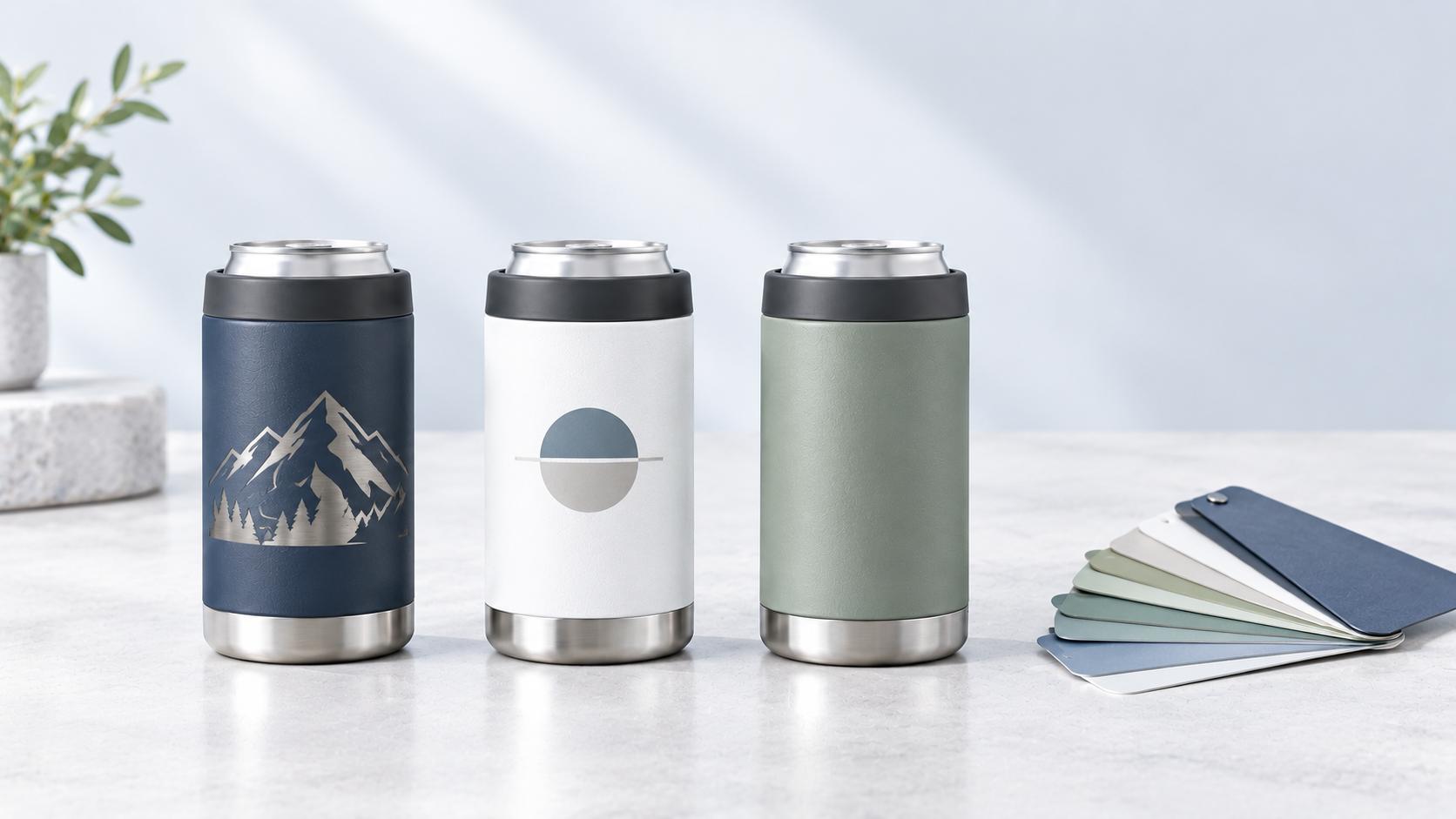
Laser engraving | Powder-coated bodies | Permanent, muted reveal of steel | Medium | Works best on dark coats |
UV / full-color print | Light bodies | Photographic artwork | Higher | Durability and adhesion testing needed |
Glitter / textured coat | Premium events | Premium feel | Highest | Color consistency across batches |
Choosing the Finish That Shows the Logo
A custom can cooler lives or dies by how the logo reads in real life. Powder coat gives a durable, even surface that takes pad print well. Laser engraving removes the coat to reveal the steel underneath, which feels premium and never washes off, but it works best on dark colors. UV print can reproduce a photograph or a busy wedding crest, but it must pass adhesion and dishwasher testing. The practical step is to approve a physical decorated sample on the real body before mass production, because a digital mockup cannot show how ink sits on a curved, coated wall.
Order Quantities, Timelines and What Changes Them
A standard body with a one-color logo has the lowest minimum and fastest lead time. Full-color UV art, custom PMS colors, special textures and custom inner tooling each add steps. For events with a fixed date, buyers should lock the artwork and the sample approval early, because the decorating queue and the shipping window are the two parts of the schedule that rarely move. A useful rule of thumb is to treat the event date as the latest possible delivery date, not the planned one.
· Lock artwork early; last-minute changes are the top schedule killer.
· Order a small buffer beyond the expected attendance; lost and damaged units happen.
· Ask whether gift box, thank-you card or hang tag is part of the quote.
Packaging and the "Keepability" Factor
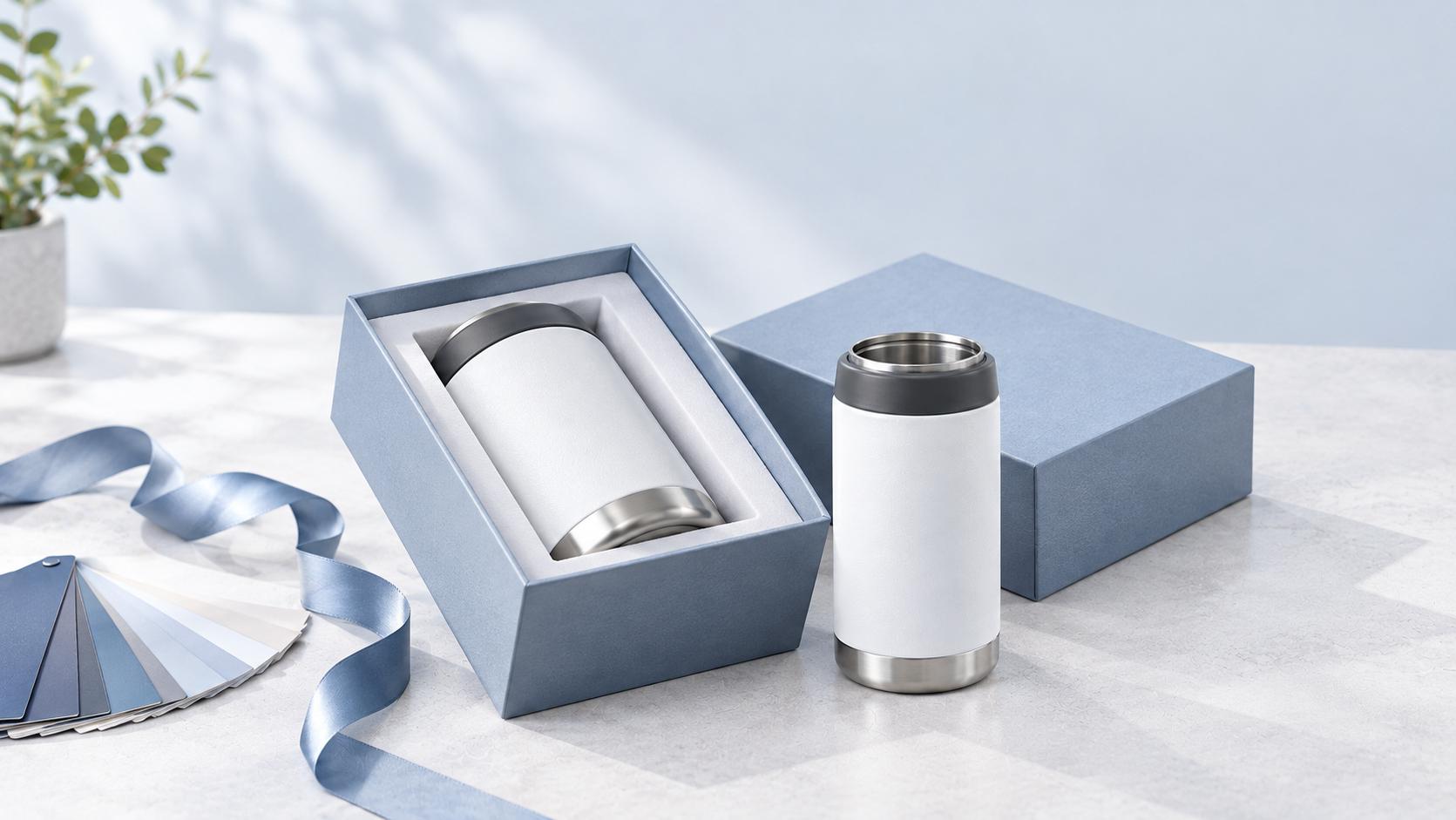
A cooler that arrives loose in a bulk bag reads as cheap; the same cooler in a plain gift box or a printed sleeve reads as a gift. For weddings and premium corporate gifts, packaging is part of the product. For bulk swag, simple polybags are fine, but the customer should still have a clean way to store it. Buyers should decide which tier they want before approving the quote, because packaging can change the landed cost more than the decoration choice.
Preparing Artwork for a Cylindrical Product
A can cooler is a curved wall that rotates, and artwork that looks perfect on a flat mockup often distorts when wrapped around it. Logos should be sized for the print area, text should not be so small that it disappears on a 360-degree wrap, and gradients or fine lines should be simplified, because pad and screen print on a curve cannot reproduce the detail a flat print can. Send the factory a vector file, ask for a flat layout on the actual body dimensions, and approve the physical proof before production. A small print adjustment in sampling saves a reprint of thousands of units.
· Use vector artwork sized to the real print area, not a full-page mockup.
· Keep fine lines and small text simple; curves distort them.
When in doubt, ask the factory to print the logo at the maximum size that still looks balanced, then shrink it ten percent; on a curved product, slightly smaller almost always reads better than slightly too large.
The Sustainability Angle of Reusable Swag
Brands increasingly want swag that does not contradict their own sustainability message. A foam koozie used once and thrown away is a small but visible piece of plastic waste; a stainless vacuum cooler used for years is a durable object. That story is worth telling on the brand side: the product is a reusable alternative to single-use sleeves, and customers who care about the environment notice the difference. It also justifies the higher unit cost to a marketing manager comparing quotes, because the cooler stays in use while the foam sleeve is gone by the end of the event.
How ChengPeng Runs Private-Label Can Cooler Projects
Zhejiang ChengPeng Industry & Trade Co., Ltd., founded in 1999 and based in Zhejiang, develops private-label vacuum can coolers with powder coat, laser engraving and pad/UV decoration options, supported by an in-house 3D printing workshop and 100-plus new designs a year. Zhejiang ChengPeng Industry & Trade Co., Ltd., founded in 1999 and based in Zhejiang, develops insulated stainless drinkware under OEM/ODM arrangements, including vacuum can coolers. Materials are third-party tested against FDA 21 CFR, EU 10/2011 and LFGB Section 31 expectations, and the factory holds BSCI, SEDEX 4P, RCS/GRS, FSC, GSV, ISCC and SCAN audits together with ISO 9001, 45001 and 14001 systems. With 141 patents, 20-plus QC inspectors, a 99.9% on-time rate, 100-plus new designs a year and an in-house 3D printing workshop, it supplies brands including Adidas and Ralph Lauren across North America, Europe, South America and Asia; more at www.chengpeng.com.cn.
FAQ
Q1. What is the typical minimum order for custom can coolers?
It depends on decoration and body. Standard bodies with a one-color logo have the lowest minimum; custom tooling or full-color art raises it. Ask the factory for its MOQ by decoration method.
Q2. Does laser engraving work on every color?
It reveals the steel under the coat, so it reads best on dark or saturated powder coats. On light coats the contrast is weaker.
Q3. How far ahead should I order for a wedding or event?
Lock artwork and sample approval early; treat the event date as the latest delivery date, not the planned one, and leave room for shipping delays.
Q4. Is UV full-color print durable?
It can be, but it must pass adhesion and washing tests on the actual body. Require a decorated sample before approval.
Q5. Do you supply gift boxes or sleeves?
Most factories can add a plain box, a printed sleeve or a hang tag, but it changes the landed cost; decide the packaging tier before approving the quote.
Q6. How does ChengPeng help a custom project?
The spec sheet fixes body, finish, decoration and packaging, decorated samples are approved on the real tooling, and third-party food-contact reports cover FDA, EU and LFGB frameworks.
Budgeting the Whole Landed Cost
A custom project rarely ends at the unit price. Buyers should add sample fees, decoration setup, freight, packaging, any insert or card, and duties before comparing one quote to another. A slightly cheaper per-unit cooler with a complicated decoration and no packaging can land higher than a clean one-color quote with a simple box. Ask the factory for a landed estimate that includes the parts the event actually needs, and confirm whether sample and mold fees are refundable against a production order.
Conclusion
A custom can cooler works as swag when it is a product people keep, not a freebie they discard. That means choosing a reusable vacuum body, matching the decoration to the finish, approving a real sample, and planning the packaging that fits the occasion. Done well, the cooler becomes a walking billboard long after the event ends, and the small extra cost per unit pays back in months of repeated impressions that a foam sleeve can never deliver.