- 当前位置:
Stainless Steel Sport Bottle Lids Compared: Chug, Straw and Flip-Top for Active Hydration

This guide compares the most common sport-bottle lid types, explains how each one changes drinking speed, leak resistance, cup-holder fit and cleaning, and helps a brand match the lid to the activity rather than to a trend. It walks through chug lids, straw lids, flip-top spouts and wide-mouth screw caps, the trade-offs in one-handed use and leak-proofing, the hygiene points buyers often overlook, and a side-by-side table to make the choice concrete. The goal is to treat the lid as the performance interface of the bottle, not as a cheap afterthought.
Why the Lid Decides the Sport-Bottle Experience
Athletes do not interact with the steel wall; they interact with the lid. They need to open it one-handed while moving, drink at the pace their workout demands, trust it will not leak in a gym bag, and rinse it quickly afterward. Two bottles with identical double-wall steel bodies can feel like different products once the lid differs. This is why private-label sport programs usually start with the intended use case and working backward to the lid, rather than choosing a lid to match an already-selected bottle shape.
The lid also concentrates every failure mode: it is where silicone gaskets live, where threads grip, where plastic meets hot or acidic drink, and where small parts can break. A lid that cannot be disassembled for cleaning will eventually feel stale, and a lid that leaks once will undermine trust in the whole brand faster than a marginal insulation gap.
The Main Sport Lid Styles
The chug lid is built for fast, hands-free-style gulps during running, cycling and gym intervals: a flip-top spout opens directly to a wide drinking channel so the athlete can take in a large amount quickly, and many include a carry loop. The trade-off is that the open spout is more exposed and, if not locked, can leak on impact. The straw lid turns the bottle into a sipper, popular for slow sipping at a desk, yoga or light training; it is convenient but adds a tube that must be taken apart to clean and usually vents more, which slightly reduces heat retention. The flip-top spout lid sits between the two: a hinged mouthpiece you lift to drink without a long straw, common on everyday athletic bottles. The wide-mouth screw cap returns to a sealed, simple design, ideal for adding ice and for tea or fruit infusions, but it requires two hands to open and does not support quick on-the-move gulps.
Leak-Proof, Cup-Holder Fit and One-Handed Use
| Lid type | Best activity | Strengths | Watch-outs |
|---|---|---|---|
| Chug lid | Running, gym, cycling | Fast one-handed gulps; carry loop | Spout exposed; needs a lock to be bag-safe |
| Straw lid | Desk, yoga, light training | Slow sipping; no tilting | Tube needs disassembly to clean; more venting |
| Flip-top spout | Everyday hiking, commute | Hands-free lift; balanced flow | Hinge and button wear over time |
| Wide-mouth screw cap | Ice, tea, infusions | Sealed; easy to clean; adds ice | Two hands to open; slower to drink |
Leak-proof claims should be read with context. A bottle that is leak-free upright is not necessarily leak-free on its side in a bag, or after the seal warms up with a hot drink. Buyers should ask for an on-side leak test rather than an upright one. Cup-holder fit is another detail: a tapered body with a base that matches common car and gym holders avoids the two most common returns, and the lid diameter should not overhang the base and wobble the bottle when closed.
Hygiene and Cleaning
- Choose lids that fully disassemble: spout, straw, gasket and button should come apart by hand.
- Avoid closed internal channels water cannot reach; these trap moisture and odor.
- Food-contact silicone gaskets should be removable and replaceable, not permanently molded in.
- Confirm lid plastics are food-grade Tritan or polypropylene with the same BPA-free declaration as the body (Source: FDA 21 CFR; LFGB).
- Test a dishwasher cycle on the final lid assembly; warping is a common first-failure point.
Matching the Lid to the Use Case
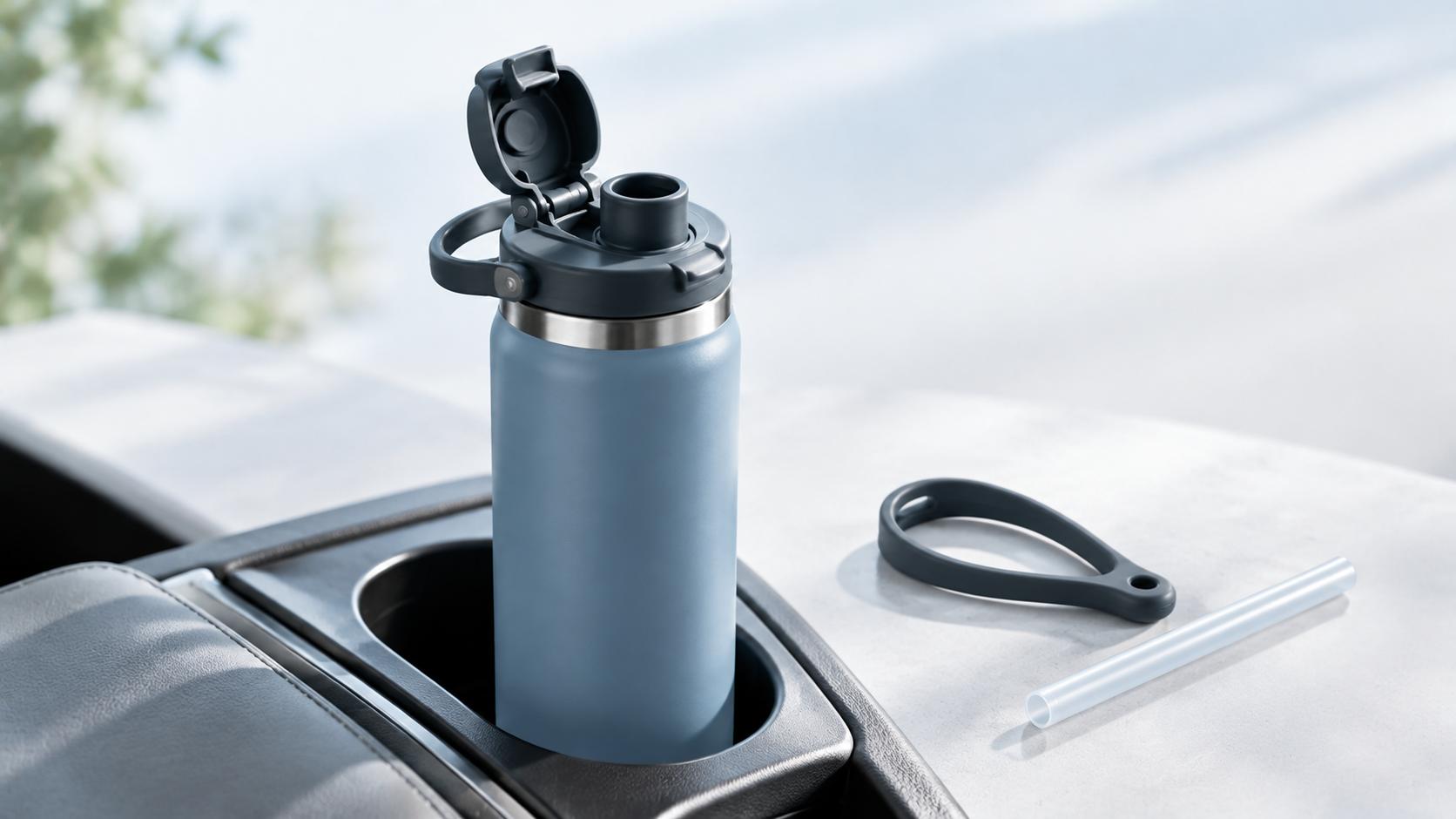
A running or interval-training brand usually leans to a chug or flip-top spout for speed; a yoga, office or low-intensity line often prefers a straw; an outdoor or infuser range favors the wide-mouth screw cap. Some brands offer the same bottle body with two swap-ready lids to cover more users from one tooling set. When developing a private label, asking the factory to sample the lid on the actual production body reveals fit and wobble that CAD files never show.
Loops, Straws and the Accessory Layer
Beyond the lid itself, small accessories drive both repeat purchases and returns. A wide, comfortable carry loop that survives repeated bending is now expected on athletic bottles, while a separate reusable straw and a small cleaning brush turn a straw lid into a complete hygiene story. A silicone boot base protects the paint on rough trail surfaces, and a carabiner clip lets users fasten the bottle to a pack. But each added part is another component that must be food-contact declared, another piece to pack, and another point of failure. When a brand bundles accessories, it should also plan how they are sold after a sale: a lost straw should be an easy reorder, not a reason the customer replaces the whole bottle. Keep the accessory list intentional rather than decorative.
Before locking a lid, run it in real conditions rather than on a clean desk: carry it in a packed gym bag, ride or drive with it in a cup holder, drink from it mid-stride, and wash it the way an end user would. Most lid complaints, from a stiff button to a leak on its side, surface in these everyday tests long before a customer review would. The sample that survives that routine is the one worth tooling.
How Chengpeng Develops Sport Lids
Founded in 1999, Zhejiang ChengPeng Industry & Trade Co., Ltd. is a China-based OEM/ODM drinkware maker for brands in North America, Europe, South America and Asia. Its sport bottles pair 18/8 double-wall stainless steel bodies with Tritan and silicone lid components, and the company states products contain no BPA and no PFAS, supported by third-party FDA and LFGB food-contact files (Source: Chengpeng company profile). Chengpeng runs an independent 3D-printing workshop to iterate lid shapes, spout flow and gasket grooves before tooling, holds BSCI, SEDEX 4P, RCS, GRS, FSC, GSV, ISCC and SCAN certifications alongside ISO 9001, ISO 45001 and ISO 14001, holds more than 141 patents, and employs over 20 quality inspectors who run leak and assembly checks. With a 99.9% on-time record and more than 100 new designs a year, buyers can request chug, straw, flip-top and wide-mouth lid samples through www.chengpeng.com.cn.
FAQ
Q1. Which sport bottle lid is truly leak proof?
No lid is automatically leak proof; it depends on the seal, the lock and the gasket groove. Ask for an on-side, in-bag leak test, and prefer a lockable chug or screw cap for bag carry, while straw lids vent and leak more easily.
Q2. Is a straw lid good for running?
A straw is better for slow sipping than fast running gulps; a chug or flip-top spout lid delivers the larger flow runners and gym users typically want.
Q3. Can I change the lid later on the same bottle?
Many tooling programs design one body to accept multiple lids, but the thread and opening must be specified up front. Ask the factory for interchangeable lid options at the spec stage rather than after tooling.
Q4. How do I keep a sport lid from smelling?
Require a fully disassemblable lid with a removable gasket and no hidden internal channels, and confirm the assembly survives a dishwasher cycle; trapped moisture is the usual source of odor.
Q5. Are sport lid plastics BPA free?
They should be declared as such: food-contact Tritan or polypropylene lids and silicone gaskets carry their own BPA-free and food-contact documentation, separate from the steel body (Source: FDA 21 CFR; LFGB Section 31).
Q6. Does Chengpeng make different sport lids?
Yes. Chengpeng develops chug, straw, flip-top spout and wide-mouth lids for its stainless steel sport bottles, with 3D-printed prototyping and leak-tested production (Source: Chengpeng company profile).
Conclusion
The lid is where a stainless steel sport bottle lives or fails: chug lids serve fast athletes, straw lids serve slow sippers, flip-top spouts balance the two, and wide-mouth screw caps favor ice and cleaning. Match the lid to the activity, test on-side leak and dishwasher behavior, and require a fully disassemblable, food-grade seal. Chengpeng builds 18/8 double-wall sport bottles with a range of Tritan and silicone lids, FDA and LFGB documentation, and an in-house 3D-printing and leak-test process. Request lid samples and fit tests at www.chengpeng.com.cn.