- 当前位置:
Specifying a Custom Stainless Steel Sport Bottle for Private Label: Sizes, Mouths and Materials
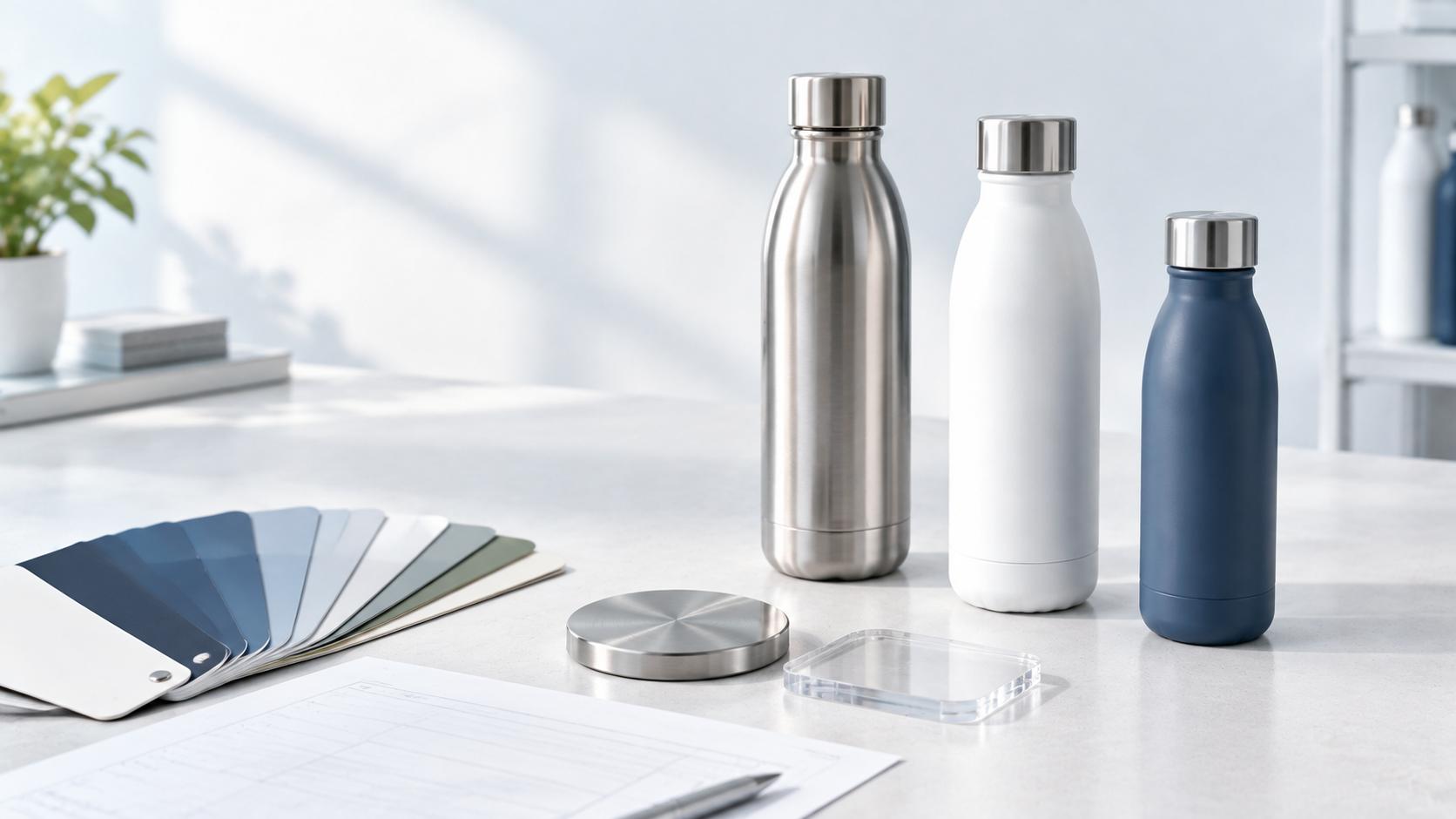
This guide walks a brand through writing a production-ready specification for a custom stainless steel sport bottle, from choosing volume and mouth type to selecting a lid, finish, decoration and food-contact documentation. It explains the fields a spec sheet must pin down before tooling, the trade-offs between narrow and wide openings, the finishes and decoration methods that hold up on steel, and the sampling, MOQ and quality steps that protect a launch. The goal is to turn a vague idea for a branded sport bottle into a precise, manufacturable order that the factory can quote once and build consistently.
Start With the End User, Not the Artwork
Private-label failures usually begin at the other end: a brand falls in love with a color or graphic and then asks the factory to put it on a bottle chosen for price. The durable sequence is the reverse. Define who carries the bottle and when, the volume they actually finish, how they open and drink, what bag or cup holder it must fit, and where it is sold; only then choose body size, mouth and lid. Decoration follows a body that already fits the user, not the other way around.
Volume, Mouth and Lid Choices
Sport bottles run in familiar ranges from compact daily sizes to larger all-day volumes, and the right size depends on activity and on whether the bottle must fit a standard car or gym cup holder. The mouth choice is functional: a narrow mouth gives a clean athletic profile and good heat retention but is harder to fill and add ice to, while a wide mouth accepts ice cubes, fruit and easy hand-washing at the cost of a slightly less insulated opening. The lid then decides drinking style: chug for fast use, straw for slow sipping, flip-top spout for everyday carry, or screw cap for sealed simplicity. Locking mechanisms, carry loops and a reusable straw are the most common accessories.
Finishes, Colors and Decoration
| Spec field | Options to decide | Notes for the buyer |
|---|---|---|
| Body material | 18/8 (304) double-wall stainless steel | Food-contact declaration required |
| Volume | Daily compact to all-day large size | Match to activity and cup-holder fit |
| Mouth opening | Narrow athletic vs wide for ice | Wide mouth easier to clean and fill |
| Lid | Chug, straw, flip-top spout, screw cap | Pick by drinking style; test leak on side |
| Finish | Brushed, matte powder coat, color spray | Check adhesion after dishwasher cycle |
| Decoration | Print, laser, engraving, powder-coat art | Ask for decoration sample before tooling |
| Gasket and seal | Food-grade silicone, removable | 21 CFR 177.2600 / LFGB silicone file |
| Packaging | White box, color box, gift box, PDQ | Retail-ready option planned early |
Materials and Food-Contact Compliance
A private-label sport bottle is a multi-material product: steel body, plastic lid, silicone gasket, possibly a straw or carry loop. Each food-contact part needs its own declaration, not one generic line. For the US, expect FDA food-contact documentation under 21 CFR; for Germany and the EU, LFGB Section 31 testing that also covers off-odor and off-taste; for California sales, the Proposition 65 warning position should be defined. Modern buyers also ask for a BPA-free and PFAS-free statement across the lid and accessories, because the steel body itself contains neither (Source: FDA 21 CFR; LFGB Section 31; California Proposition 65).
Sampling, MOQ and Quality Steps
- Approve a written spec sheet naming volume, mouth, lid, finish, decoration and accessories before tooling.
- Insist on a decorated pre-production sample that matches the final body, not a blank prototype.
- Run an on-side leak test, a dishwasher cycle and a drop check on samples.
- Confirm the inspection checklist: material, measurement, finish adhesion, leak and insulation.
- Plan retail packaging and barcoding with the same compliance pack, so reorders ship consistently.
- Align certification needs (BSCI, SEDEX, recycled-content claims) to the marketplace at the start, not after quoting.
Tooling, MOQ and Lead-Time Realities
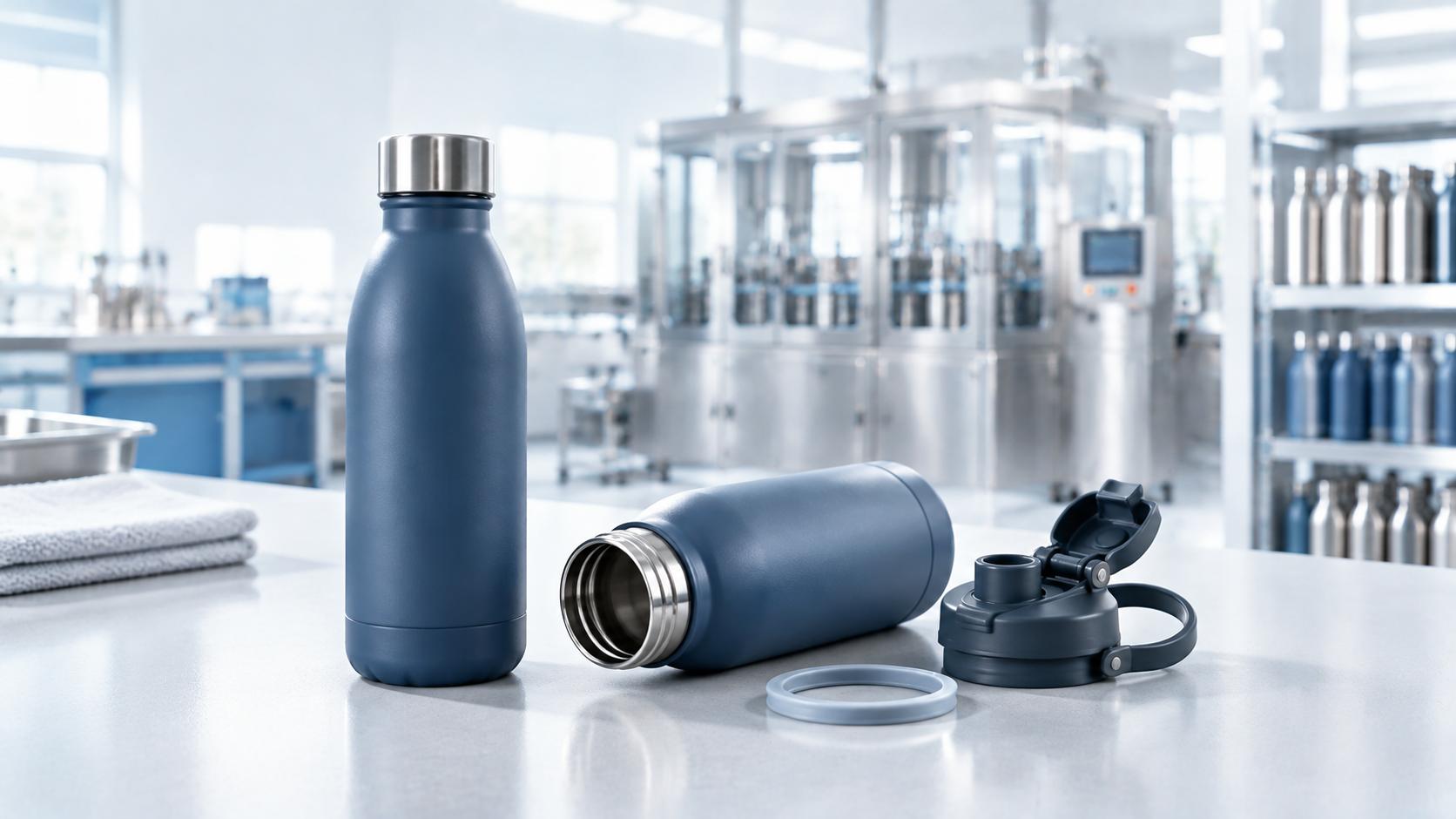
Private-label buyers often compare a custom bottle price against a catalog item and miss that tooling, mold adjustments and decoration setup change the economics. A standard body with a custom print costs less and samples faster than an entirely new shape, while a fully custom lid or bottle geometry needs 3D prototyping, mold making and several pre-production rounds. Volume targets decide which path fits: a lower trial launch can begin from existing tooling with custom colors and artwork, while a larger committed order can justify new molds. Ask the factory which bodies are already tooled, which decoration methods each supports, and how sample lead time differs from mass-production lead time, rather than benchmarking a made-to-order quote against an off-the-shelf price.
Preparing Artwork for Steel
Artwork for a stainless steel bottle behaves differently from artwork on paper or plastic. Laser engraving removes the outer coating and reveals the steel beneath, so it works best on powder-coated bodies and reads as a permanent, muted mark. Pad and screen print add color but must survive flexing, condensation and dishwashers, and fine gradients usually do not reproduce cleanly on a curved, wet surface. The practical step is to ask for a decorated pre-production sample on the real body and finish before approving the art; a digital mockup cannot show how the ink sits on a curved wall or how the laser cuts through a matte coat. Lock the decoration, the print color and the placement dimension in the spec sheet so every reorder matches.
How Chengpeng Supports Private-Label Sport Bottles
Founded in 1999, Zhejiang ChengPeng Industry & Trade Co., Ltd. is a China-based OEM/ODM drinkware manufacturer supporting brands across North America, Europe, South America and Asia. It develops custom 18/8 double-wall stainless steel sport bottles with Tritan and silicone lids, states products contain no BPA and no PFAS, and provides third-party FDA and LFGB food-contact files with production (Source: Chengpeng company profile). Chengpeng operates an independent 3D-printing workshop for fast lid and decoration iteration, holds BSCI, SEDEX 4P, RCS, GRS, FSC, GSV, ISCC and SCAN certifications together with ISO 9001, ISO 45001 and ISO 14001, holds more than 141 patents, and keeps over 20 quality inspectors on material, measurement, paint-adhesion, leak and insulation checks. The factory reports a 99.9% annual on-time delivery rate and launches more than 100 new designs each year; it has served international brands including Adidas and Ralph Lauren per the company profile. Buyers can send their use-case brief and receive a spec-driven sample through www.chengpeng.com.cn.
FAQ
Q1. What should a custom sport bottle spec sheet include?
At minimum: body material and grade, volume, mouth opening, lid type, finish and color, decoration method, gasket material, packaging, required certifications and a defined leak and insulation test. A written spec avoids re-quoting and tooling surprises.
Q2. Narrow or wide mouth for a sport bottle?
Narrow mouths give a sleek athletic profile and better retention but are harder to fill and add ice to; wide mouths take ice and infusers and clean faster, with a slightly more open drinking path. Choose by the use case.
Q3. What food-contact documents do I need?
FDA 21 CFR documentation for the US, LFGB for Germany/EU, and a Proposition 65 position for California, each covering the lid, gasket and straw as well as the steel body, plus a BPA-free and PFAS-free statement (Source: FDA 21 CFR; LFGB; California Proposition 65).
Q4. How do I avoid decoration that peels after a few washes?
Ask for a decorated pre-production sample and run a dishwasher cycle on it, and confirm the factory checks finish adhesion as part of its incoming and outgoing inspection.
Q5. Can one bottle body use more than one lid?
Yes, if the thread and opening are designed that way up front. Specifying interchangeable lids at the tooling stage lets one body serve multiple user groups.
Q6. Can Chengpeng handle a full private-label sport bottle program?
Yes. Chengpeng offers OEM/ODM development, 3D-printed prototyping, decorated samples, FDA and LFGB files, and a multi-certification quality system for sport bottle programs (Source: Chengpeng company profile).
Conclusion
A private-label stainless steel sport bottle succeeds when the spec is written around the user: the right volume for the activity, a mouth that matches filling and cleaning habits, a lid that matches drinking style, a finish and decoration proven to survive washing, and food-contact documentation covering every part. Writing these fields before tooling is what turns a quote into a repeatable product. Chengpeng supports the full OEM/ODM loop with 18/8 double-wall construction, Tritan and silicone lids, FDA and LFGB files, an in-house 3D-printing and inspection system, and a 99.9% on-time record. Send a use-case brief and request a spec-driven sample at www.chengpeng.com.cn.