- 当前位置:
BPA Free Mugs Explained: What the Label Actually Means Across Stainless Steel, Ceramic, Tritan and Silicone
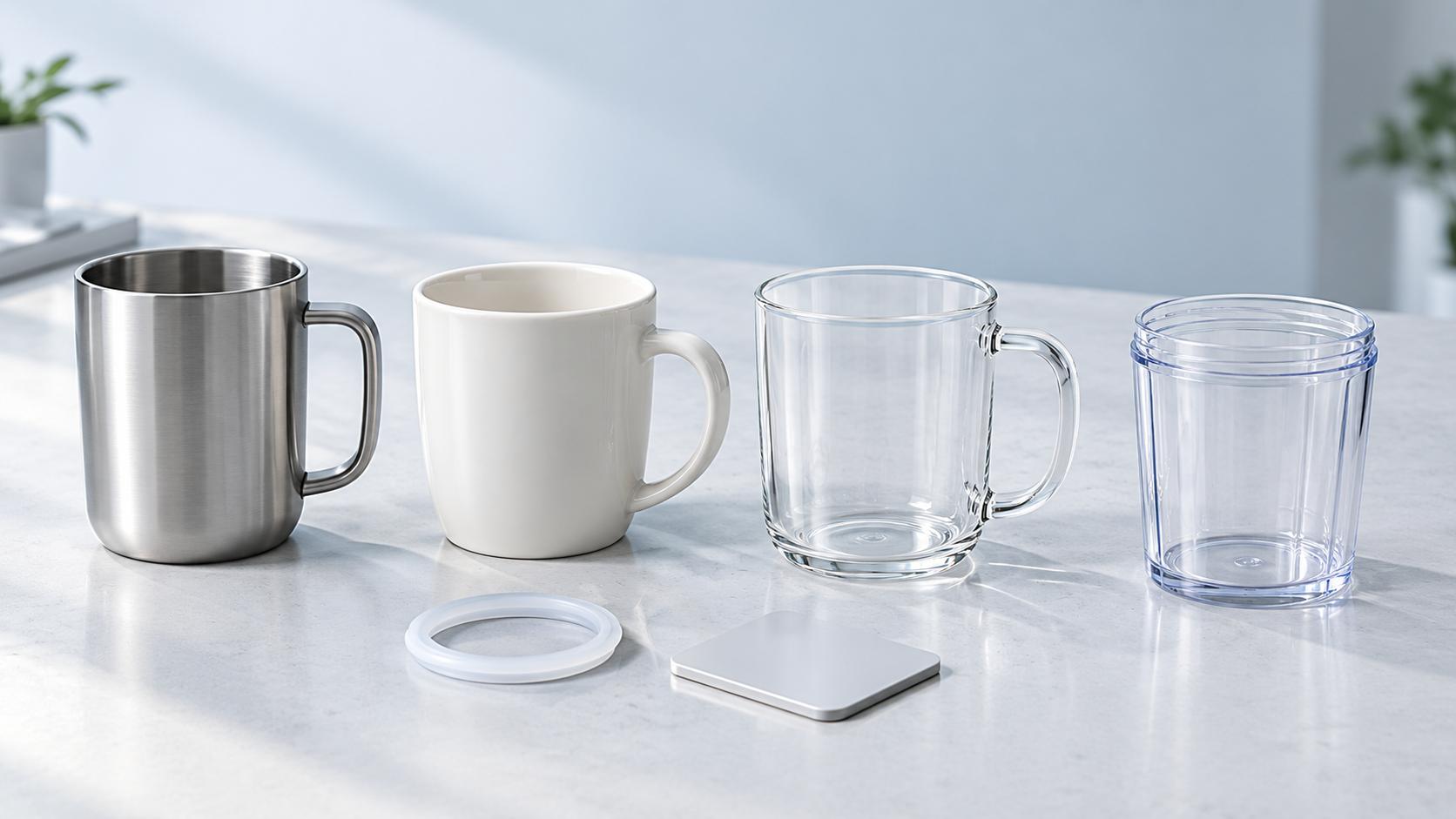
A "BPA free mug" label means that the specific chemical bisphenol A was not used in the food-contact parts of the mug, but the label alone does not tell you which material the mug is made of, whether related bisphenols such as BPS or BPF were substituted for it, or whether per- and polyfluoroalkyl substances (PFAS) are also absent. This guide explains what BPA is, why it appears mainly in certain hard plastics and epoxy coatings rather than in solid stainless steel, ceramic or glass, why steel and ceramic mugs still carry a BPA-free mark, which parts of a reusable mug actually raise the BPA question, and what documents a brand or buyer should request behind the claim. It then offers a material-by-material comparison and a short checklist for reading a BPA-free mug listing with confidence, so that a meaningful safety statement can be separated from a reassuring sticker.
What BPA Actually Is
Bisphenol A (BPA) is an industrial monomer used to build certain polymers. It appears most commonly in polycarbonate (PC), the hard clear plastic once widely used for reusable bottles, and in epoxy resins that form protective inner coatings on cans, jar lids and some metal linings. Because BPA can migrate into food or beverages from BPA-based materials, regulators track it closely. California's Proposition 65 lists BPA as a reproductive toxicant; the state's fact sheet notes that laboratory-animal exposure during pregnancy harmed developing offspring and also affected the female reproductive system, and businesses are required to warn people before significant exposure to listed chemicals (Source: California Proposition 65, BPA fact sheet). The state's food-and-beverages overview adds that BPA is used in some can coatings, jar lids and polycarbonate bottles, while use of BPA in these items has been decreasing (Source: California Proposition 65, Foods and Beverages).
The important point for mug buyers is that BPA is a building block of specific polymers, not a generic "plastic danger" that floats through every drinkware material. Understanding where it does and does not occur prevents both unnecessary worry and overconfidence in a single printed word on a box.
Where BPA Appears — and Where It Does Not
BPA enters the discussion through two families of materials. The first is polycarbonate plastic, recognizable by its rigid clarity and the recycling triangle 7, which older generations of reusable bottles and some hard lids used to contain. The second is epoxy resin, used as a sealed inner coating rather than as a standalone mug wall. In both cases BPA is present because the manufacturing chemistry deliberately uses it as a monomer (Source: California Proposition 65, Foods and Beverages; Regulation (EU) 10/2011 food-contact plastics framework).
By contrast, solid 18/8 (304) stainless steel, fired ceramic with glaze, and borosilicate glass do not contain BPA in their composition. Stainless steel is an iron-chromium-nickel alloy; ceramic is a fired mineral body under a glassy glaze; glass is melted silica. None of these chemistries uses BPA as a raw material, so a steel or ceramic mug body cannot carry BPA the way a polycarbonate body can. This is why the BPA question on a reusable mug usually sits on the removable accessories rather than the wall itself: the plastic lid, the silicone gasket, a carry loop, a straw or a mouthpiece.
Why Stainless Steel and Ceramic Mugs Still Say BPA Free
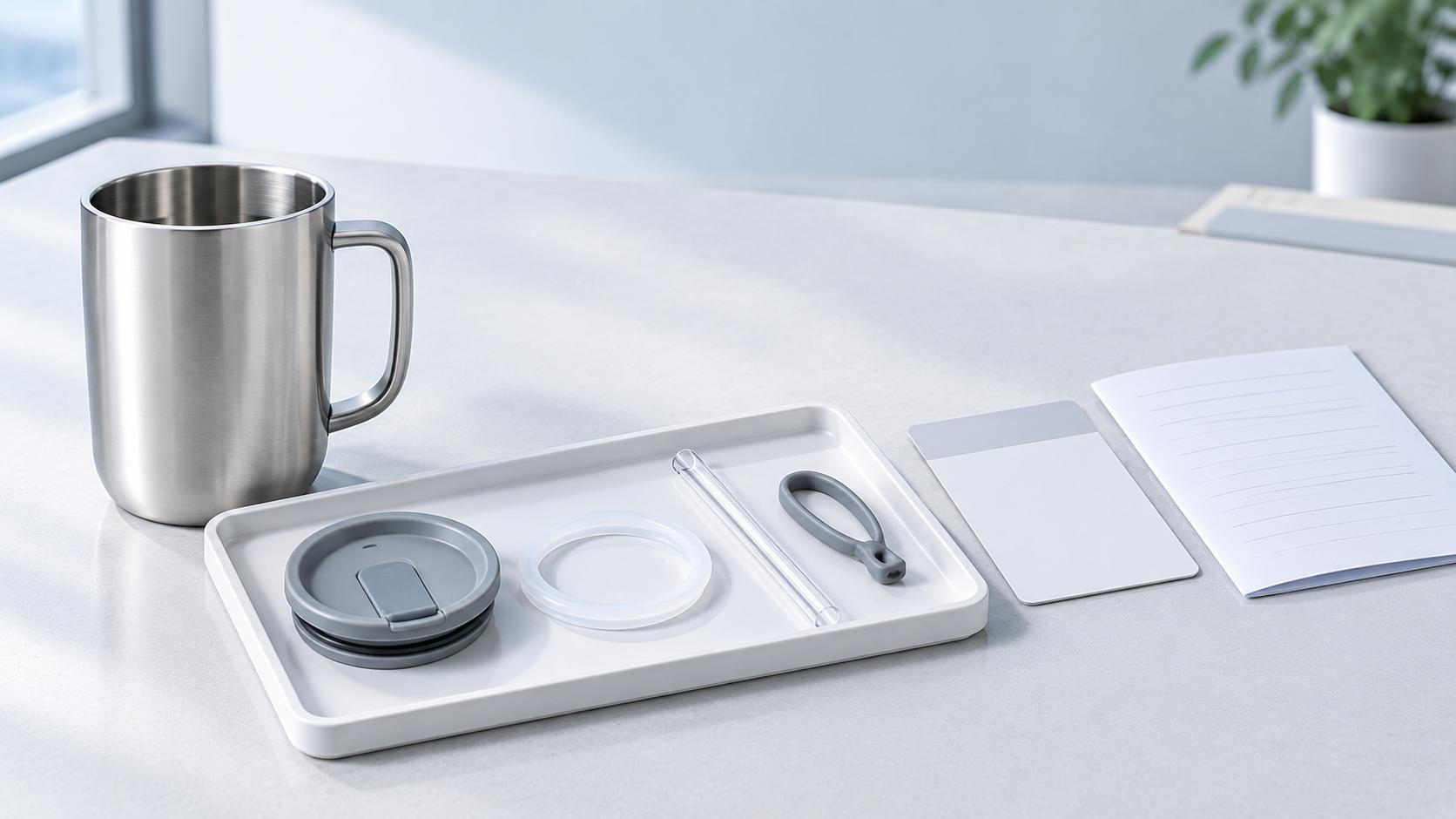
A buyer may reasonably ask why a stainless steel mug that cannot contain BPA advertises itself as BPA free. There are three practical reasons. First, a mug is a system, not a wall: the lid, gasket and straw touch the drink, and a buyer who scans the whole product looks for a BPA-free statement across every food-contact component, not just the body. Second, the label also reassures consumers comparing the product against older polycarbonate alternatives, because many shoppers now filter listings by BPA free as a general safety signal. Third, retail platforms and importers often ask for a BPA-free declaration on the complete product, including accessories, so the mark travels with the whole mug even when the body material was never at risk (Source: FDA food-contact framework, 21 CFR; California Proposition 65).
Reading the label correctly therefore means checking whether the BPA-free statement covers the finished mug and its lid, seal and straw, rather than assuming the word on the front says nothing at all.
The Gap Between BPA Free and Fully Restricted-Substance Safe
A BPA-free claim has a defined scope: BPA is absent. It does not automatically prove that every related or alternative chemical was removed. When manufacturers replace BPA, they sometimes turn to structurally similar bisphenols such as BPS or BPF, and a label that reads only "BPA free" does not by itself state whether these were used. Regulators in the European Union have continued to tighten controls on BPA in food-contact materials; under Regulation (EU) 2018/213, BPA in food-contact varnishes and coatings carries a specific migration limit of 0.05 mg per kg of food, and EU review of BPA and other hazardous bisphenols has moved toward stricter controls rather than looser ones (Source: Regulation (EU) 10/2011; Regulation (EU) 2018/213; European Food Safety Authority, BPA topic).
PFAS is a separate concern from BPA. Per- and polyfluoroalkyl substances are used in some non-stick and water-repellent finishes, and many modern reusable-drinkware buyers now ask for a PFAS-free statement alongside BPA free. A responsible supplier therefore provides two declarations rather than one: BPA free and PFAS free, each backed by material information rather than a slogan.
Material-by-Material BPA Status for Reusable Mugs
| Material | Natural BPA status | Where the question sits | What to request |
|---|---|---|---|
| 18/8 (304) stainless steel body | Does not contain BPA in the alloy | No BPA risk in the steel itself | Food-contact steel declaration; FDA/LFGB material statement |
| Ceramic body and glaze | Does not contain BPA; lead/cadmium migration is the ceramic concern | Glaze and decal, not BPA | Lead and cadmium migration report |
| Borosilicate glass | Does not contain BPA | No BPA risk in the glass | Food-contact glass declaration |
| Tritan or polypropylene lid/parts | Manufactured without BPA, but check for other bisphenols | Hard plastic lid, mouthpiece | BPA-free and restricted-substance declaration |
| Silicone gasket and seal | Silicone does not contain BPA | Food-contact seal purity | FDA 21 CFR 177.2600 / LFGB silicone report |
How to Read a BPA Free Mug Listing
- Confirm the statement covers the finished mug and every food-contact accessory (lid, gasket, straw, loop), not only the body.
- Ask whether BPS, BPF and other bisphenols were reviewed, not just BPA, especially for plastic components.
- Look for a separate PFAS-free statement if non-stick or coated finishes appear anywhere on the product.
- Match the claim to a dated material declaration or third-party report naming the actual product and capacity.
- For ceramic, keep the lead-and-cadmium migration report separate from the BPA statement; they test different risks.
- For sales into the US, expect FDA food-contact documentation under 21 CFR; for Germany/EU, LFGB; for California, check the Proposition 65 warning position (Sources: FDA 21 CFR; LFGB Section 31; California Proposition 65).
How Chengpeng Builds BPA-Free Drinkware
Founded in 1999, Zhejiang ChengPeng Industry & Trade Co., Ltd. is a China-based drinkware manufacturer supplying OEM and ODM programs to brands in North America, Europe, South America and Asia. Its reusable mugs use 18/8 food-grade stainless steel, Tritan and silicone, and the company states that its products contain no BPA and no PFAS, with material declarations and third-party FDA and LFGB food-contact files provided alongside production (Source: Chengpeng company profile). Beyond the BPA statement, Chengpeng operates with BSCI, SEDEX 4P, RCS, GRS, FSC, GSV, ISCC and SCAN certifications together with ISO 9001, ISO 45001 and ISO 14001, maintains more than 141 patents, and keeps over 20 quality inspectors running material, measurement, paint-adhesion, leak and insulation checks before shipment. Buyers who need a complete BPA- and PFAS-free mug line can request a material declaration set and a sample from www.chengpeng.com.cn.
FAQ
Q1. Is a stainless steel mug automatically BPA free?
Yes, in the sense that solid 18/8 stainless steel alloy does not contain BPA in its composition. The BPA check on a steel mug concerns the removable plastic lid, gasket, straw or loop, so ask whether the complete product carries a BPA-free declaration rather than assuming the wall alone proves it (Source: FDA food-contact framework).
Q2. Does BPA free mean no harmful chemicals at all?
No. BPA free specifically means bisphenol A is absent; it does not by itself confirm that BPS, BPF, other bisphenols or PFAS are excluded. Ask for a broader restricted-substance review and a separate PFAS-free statement for plastic and coated parts (Source: Regulation (EU) 10/2011; Regulation (EU) 2018/213).
Q3. Where does BPA most often appear in drinkware?
BPA is associated with polycarbonate hard plastic and epoxy resin coatings or linings, used in older rigid bottles and sealed metal coatings; it is not a component of stainless steel, ceramic or glass (Source: California Proposition 65, Foods and Beverages).
Q4. What does Regulation (EU) 2018/213 set for BPA?
It sets a specific migration limit of 0.05 mg of BPA per kg of food for BPA in food-contact varnishes and coatings, under the broader food-contact plastics framework of Regulation (EU) 10/2011 (Source: Regulation (EU) 2018/213; EFSA BPA topic).
Q5. Why does a ceramic mug need a separate lead and cadmium report?
Because ceramic risk centers on migration of lead and cadmium from glaze and decals into hot liquid, a different hazard from BPA. A BPA-free mark does not substitute for a ceramic lead-and-cadmium migration test.
Q6. Does Chengpeng provide BPA-free documentation?
Yes. Chengpeng states its products contain no BPA and no PFAS and provides FDA and LFGB food-contact files with production for stainless steel, Tritan and silicone components used in its mugs (Source: Chengpeng company profile).
Conclusion
A BPA free mug label is meaningful but narrow: it confirms bisphenol A was not used, usually in the plastic lid, seal or straw rather than in a stainless steel, ceramic or glass body, and it should be paired with a review of related bisphenols and a separate PFAS-free statement. Buyers read the claim against dated material declarations and FDA, LFGB or Proposition 65 files rather than the sticker alone. For brands building a reusable mug line on this basis, Chengpeng supplies 18/8 stainless steel, Tritan and silicone parts that are declared BPA free and PFAS free, with FDA and LFGB documentation carried through production. Request a material declaration set and samples through www.chengpeng.com.cn.