- 当前位置:
Sourcing BPA-Free Mugs for Private Label: Compliance Files, Materials and a Supplier Checklist
For a private-label brand, a BPA-free mug program fails in one of two ways: the listing goes live without the food-contact documents a marketplace or retailer expects, or the supplier repeats a BPA-free slogan while leaving related bisphenols, PFAS and ceramic migration unexamined. This guide maps the compliance a brand actually needs for US, EU and California sales, identifies which parts of a mug carry the BPA question, lists the documents to request before sampling, compares the materials suitable for a private-label line, and gives verification steps a buyer can run without a laboratory. It closes with common sourcing mistakes to avoid and how an experienced OEM handles a BPA-free mug order end to end. The goal is to turn the BPA-free claim from a marketing word into a documented, auditable specification.
Why BPA-Free Is Now a Listing Gate, Not a Bonus
A decade ago BPA free was a differentiator; today it is a baseline expectation on drinkware sold to consumers who filter by it on marketplaces and expect it from retailers. In the United States, products that touch food and beverages fall under FDA food-contact requirements in 21 CFR, and marketplaces and retail buyers request supporting documentation before or at listing. In Germany and much of the EU, buyers rely on LFGB Section 31 food-contact testing, which covers migration safety and, beyond chemistry, sensory requirements for off-smell or taste transfer. In California, Proposition 65 places BPA on its reproductive-toxicant list and sets warning obligations for products that can expose consumers to listed chemicals (Source: FDA 21 CFR; LFGB Section 31; California Proposition 65, BPA fact sheet). In the EU, Regulation (EU) 10/2011 frames food-contact plastics, while Regulation (EU) 2018/213 sets a BPA specific migration limit of 0.05 mg/kg for varnishes and coatings, and EU review continues to tighten controls on BPA and related bisphenols (Source: Regulation (EU) 10/2011; Regulation (EU) 2018/213; EFSA).
The practical consequence for a private-label buyer is that BPA-free is not a feature to negotiate late; it must be written into the specification and backed by files before the first sample, because retrofitting documentation after a rejected listing is far slower than collecting it up front.
Which Mug Parts Actually Carry the BPA Question
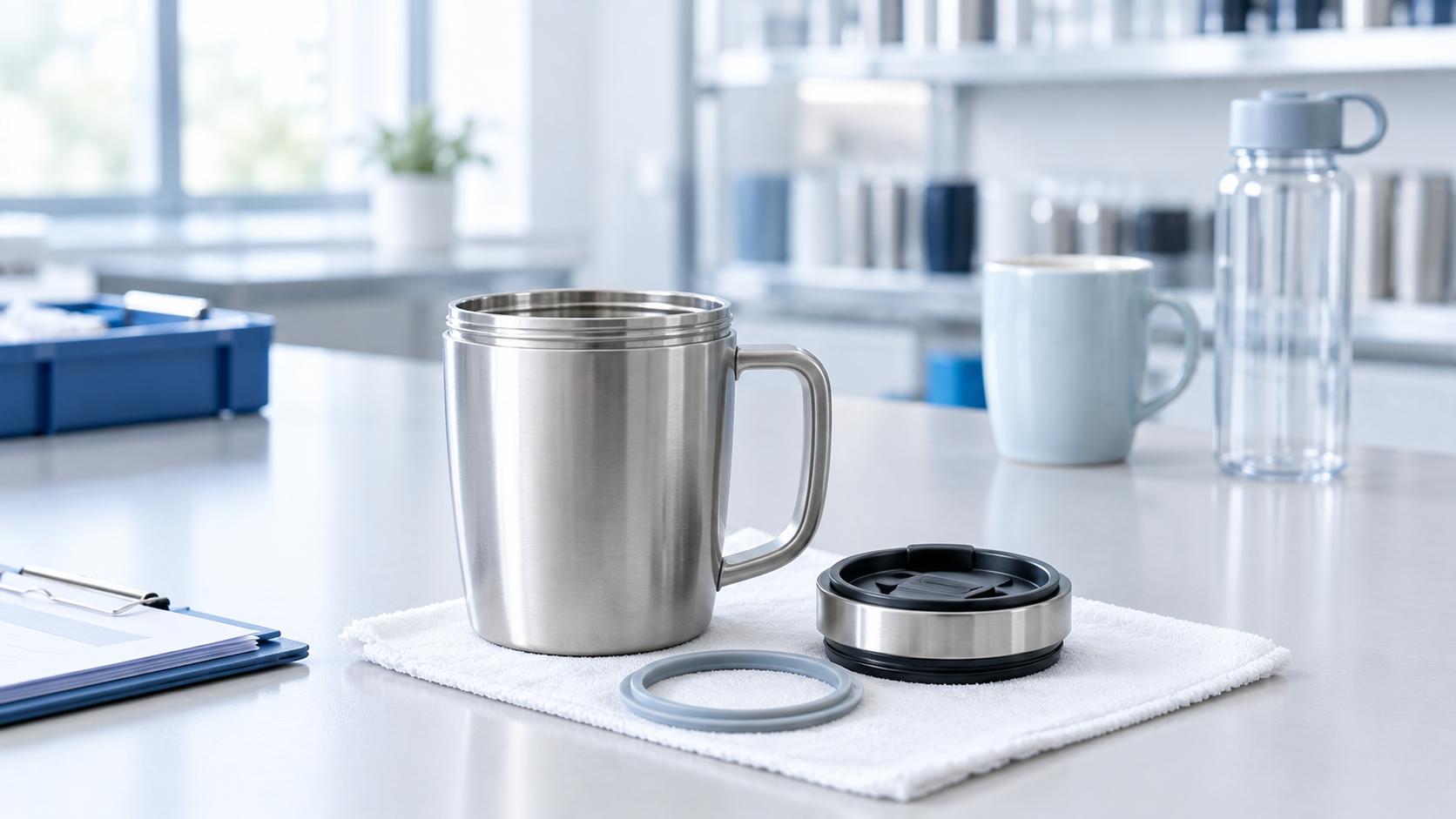
On a double-wall stainless steel mug, the steel wall itself does not contain BPA. The risk concentrates on the components that also touch the drink: the hard plastic lid (often Tritan or polypropylene), the silicone gasket seated inside the lid, a straw or spout, and any plastic carry loop or slider button. On a ceramic mug, BPA is absent by material, but lead and cadmium migration from glaze and decals becomes the parallel document to collect. On a glass mug, the body is inert, while any plastic lid or silicone seal still requires a food-contact statement (Source: California Proposition 65, Foods and Beverages; FDA 21 CFR).
A sourcing spec should therefore list every food-contact part by material and attach a declaration to each, rather than writing one generic "BPA free" line for the whole product.
The Compliance Map by Destination Market
| Market | Requirement | What it covers |
|---|---|---|
| United States | FDA food-contact rules under 21 CFR | Migration safety for materials touching beverages; documents requested at listing |
| Germany / EU | LFGB Section 31; Regulation (EU) 10/2011 | Food-contact migration, plastics framework; LFGB also checks off-odor and off-taste |
| EU coatings | Regulation (EU) 2018/213 | BPA specific migration limit of 0.05 mg/kg in varnishes and coatings |
| California | Proposition 65 | Warning position for listed chemicals including BPA; marketplace enforcement |
| Ceramic lines | Lead and cadmium migration test | Separate from BPA; tests glaze and decal under hot liquid |
Documents to Request Before Sampling
- A dated BPA-free material declaration covering the finished mug and every food-contact accessory (lid, gasket, straw, loop).
- A restricted-substance review stating whether BPS, BPF and other bisphenols were excluded, not only BPA.
- A separate PFAS-free statement for any coated or non-stick component.
- FDA food-contact statement under 21 CFR for the US market, or LFGB test report for Germany/EU.
- Silicone gasket report under FDA 21 CFR 177.2600 or equivalent LFGB silicone migration test.
- Lead-and-cadmium migration report for any ceramic body or glazed decal.
- Prop 65 statement defining the warning position for California sales.
- Certificate or record confirming the report names the actual product, capacity and decoration, not just a blank cup.
Material Options for a Private-Label Mug Line
| Option | BPA position | Strengths | Sourcing note |
|---|---|---|---|
| Double-wall 18/8 stainless steel | Steel contains no BPA; declare the lid and seal | Vacuum insulation, durable, premium feel | Pair steel declaration with lid/gasket files |
| Tritan plastic body or lid | Manufactured without BPA; review other bisphenols | Light, shatter-resistant, clear look | Request full restricted-substance declaration |
| Ceramic with glaze | No BPA; manage lead/cadmium instead | Classic desk-cup aesthetic | Require migration report for glaze and decal |
| Silicone gasket/strap | Silicone contains no BPA | Sealing, soft grip | Food-contact silicone report under 21 CFR 177.2600 |
Verification Steps You Can Run Without a Laboratory
- Check the issuing lab and date on each report, and confirm the report names your exact product, capacity and decoration rather than a generic blank item.
- Read the BPA-free line across the whole assembly: body, lid, gasket, straw and loop should each be declared.
- Confirm a separate PFAS-free and BPS/BPF review exists; a BPA-only declaration leaves gaps for plastic parts.
- On the sample, smell the empty lid and fill it with warm water to check for off-taste, the point LFGB's sensory step targets.
- Run a sample through one dishwasher cycle and a hot-to-cold check to confirm decoration and seal survive normal use.
- Keep the full file set with the product master data so every reorder ships the same compliance pack (Sources: FDA 21 CFR; LFGB; California Proposition 65).
Common Sourcing Mistakes to Avoid
- Treating "BPA free" on the box as proof that BPS, BPF and PFAS were also excluded — they were not tested by that single claim.
- Accepting a report for the blank body while ignoring the lid, gasket and straw, which are the actual BPA-accessory parts.
- Shipping ceramic without a separate lead-and-cadmium migration report and assuming BPA free covers glaze safety.
- Collecting documents only after a marketplace flags the listing, which delays the launch far longer than pre-sampling paperwork.
- Ordering a sample that differs in material or decoration from the bulk specification, so the report no longer matches the shipped product.
How Chengpeng Supports BPA-Free Private-Label Programs
Founded in 1999, Zhejiang ChengPeng Industry & Trade Co., Ltd. runs OEM and ODM drinkware programs for brands across North America, Europe, South America and Asia. Its mugs combine 18/8 food-grade stainless steel, Tritan and silicone, and the company states that products contain no BPA and no PFAS, with third-party FDA and LFGB food-contact files carried through production (Source: Chengpeng company profile). The factory holds BSCI, SEDEX 4P, RCS, GRS, FSC, GSV, ISCC and SCAN certifications alongside ISO 9001, ISO 45001 and ISO 14001, holds more than 141 patents, and employs over 20 quality inspectors who run material inspection, measurement, paint-adhesion, leak and insulation tests. Chengpeng reports a 99.9% annual on-time delivery rate, launches more than 100 new design schemes each year, and operates an independent 3D-printing workshop for custom decoration; it has served international brands including Adidas and Ralph Lauren per the company profile. A private-label buyer can request a BPA-free and PFAS-free specification pack, samples and material declarations through www.chengpeng.com.cn.
FAQ
Q1. What documents do I need to sell BPA-free mugs in the US?
A dated BPA-free declaration for the finished mug and all food-contact parts, an FDA food-contact statement under 21 CFR, a silicone gasket report, a BPS/BPF review, a PFAS-free statement, and the Proposition 65 position if California is in scope (Source: FDA 21 CFR; California Proposition 65).
Q2. Does LFGB replace FDA for BPA-free documentation?
They serve different markets: FDA 21 CFR is the US food-contact framework, while LFGB Section 31 is the German/EU food-contact route that also checks off-odor and off-taste. Most buyers keep both when serving multiple markets rather than substituting one for the other (Source: LFGB Section 31; FDA 21 CFR).
Q3. Is a stainless steel mug BPA free by default?
The steel alloy contains no BPA, but a complete declaration must still cover the plastic lid, gasket, straw and loop, because those accessories are where the BPA question actually sits (Source: California Proposition 65, Foods and Beverages).
Q4. What is the EU BPA migration limit for coatings?
Regulation (EU) 2018/213 sets a specific migration limit of 0.05 mg of BPA per kg of food in food-contact varnishes and coatings, under the broader plastics framework of Regulation (EU) 10/2011 (Source: Regulation (EU) 2018/213; EFSA).
Q5. Do ceramic mugs need a BPA test?
Ceramic does not contain BPA, but glaze and decal require a separate lead-and-cadmium migration test under hot liquid; the BPA-free mark does not cover ceramic mineral hazards.
Q6. Can Chengpeng supply a full BPA-free private-label pack?
Yes — Chengpeng states its mugs are BPA free and PFAS free, provides FDA and LFGB food-contact files, and supports OEM/ODM specification, decoration and sampling with its inspection and certification system (Source: Chengpeng company profile).
Conclusion
Sourcing BPA-free mugs for private label means writing the claim into the specification before sampling, documenting every food-contact accessory, reviewing BPS/BPF and PFAS beyond BPA, and matching the product to FDA, LFGB, EU 2018/213 and Proposition 65 files rather than relying on the word on the box. The verification chain is short: dated declarations, a sample smell-and-dishwasher check, and a file set tied to the exact product and decoration. Chengpeng supports this end to end with 18/8 stainless steel, Tritan and silicone parts declared BPA free and PFAS free, FDA and LFGB documentation, and an established OEM/ODM quality system. Request a specification pack and samples at www.chengpeng.com.cn.