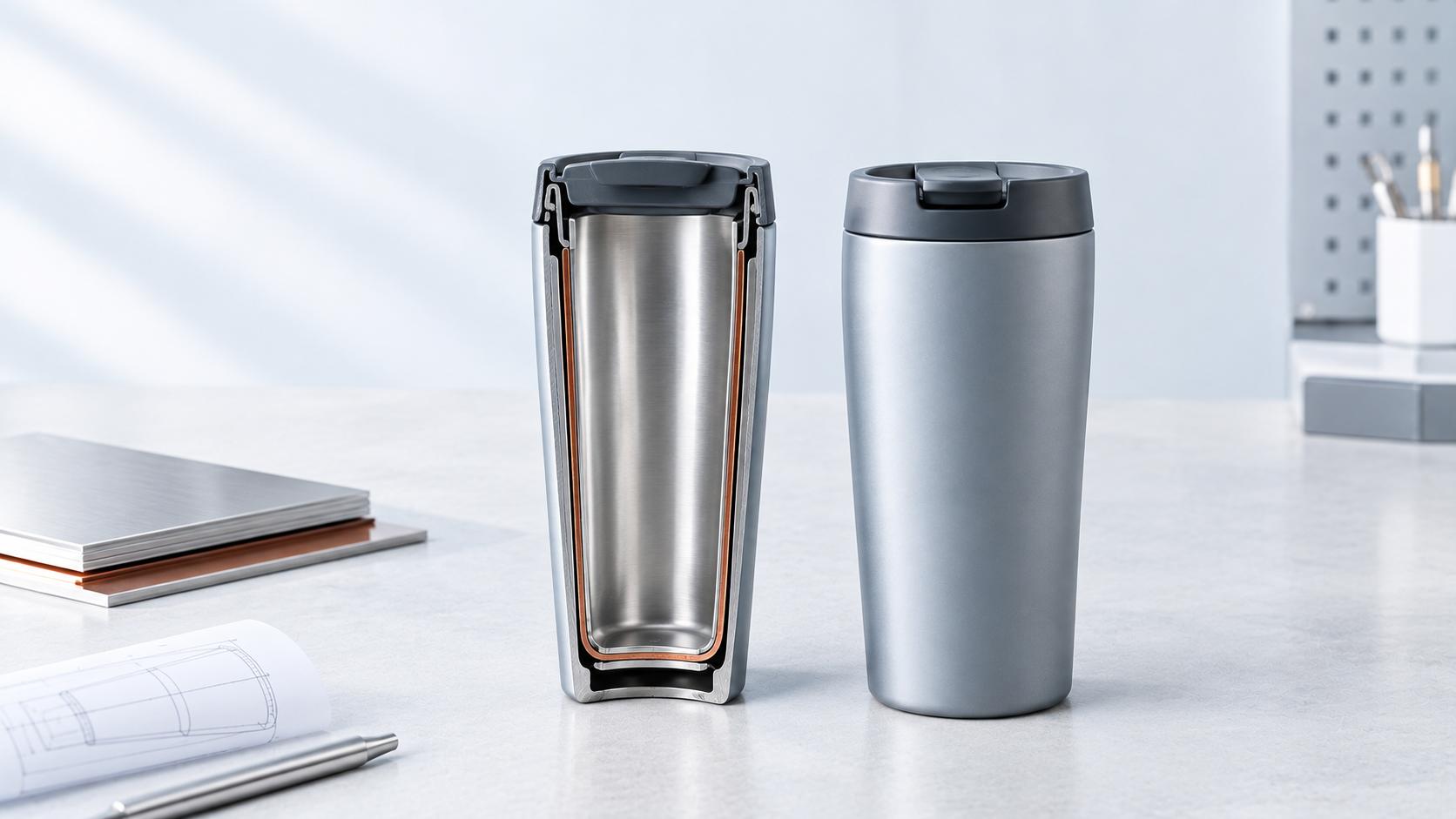
This article takes a buyer inside the factory to explain how an insulated coffee mug is built and, more importantly, how to verify that build before placing an order. It covers double-wall forming, the optional copper reflective coating, laser welding, evacuation and getter installation, the pre-vacuum leak test, automated thermal detection, and finishing checks, then turns each stage into a verification checklist with the report a buyer should request. The aim is to replace price-only comparison with an inspection framework that separates a genuinely vacuum-insulated mug from a body that merely looks like one.
What Makes an Insulated Mug Work at the Factory Level
Insulation comes from a sealed vacuum gap between two stainless steel walls, not from the steel itself. The inner liner and outer shell are formed separately, commonly a 304 stainless inner liner with a 201 or 304 outer shell, then joined at the rim with high-precision laser welding to create a seamless top (ChillTitan, 2026). A small reactive metal getter is installed inside the assembly before evacuation to absorb residual gas over the mug's life, and the gap between walls is held to a narrow band, around 0.5 to 1.0mm, that becomes the vacuum insulation layer (Soniu Houseware, 2026).
Every stage after forming can fail quietly: a micro-pore in a weld lets air back into the gap, a weak evacuation leaves residual gas, and a coating defect changes heat transfer. A mug that looks identical on the shelf can therefore perform very differently, which is why buyers who only compare shape and price cannot see the quality difference. The verification below maps each failure point to a test.
Double-Wall Forming, Copper Coating and Evacuation
Before evacuation, premium lines may add a thin copper reflective plating to the exterior of the inner liner. Copper reflects radiant heat transfer; a manufacturer's own process guide states this optional upgrade can boost heat retention by 30 to 40% compared with an uncoated standard double-wall mug, a figure to treat as a manufacturer claim rather than an independent rating (EGO Water Bottle, 2026). Mass promotional orders often skip copper to control cost, so a buyer targeting premium retail should specify the coating in writing rather than assume it.
The two shells enter a high-temperature evacuation furnace where air is extracted from the gap to create the vacuum that stops conduction and convection; the getter then maintains the vacuum as trace gas releases over time (ChillTitan, 2026). A failed evacuation is not visible externally, which is why the next two tests exist: the structural leak test before vacuum and the thermal detection line after.
Welding and the Leak Test Before Vacuum
Before assembled bodies go into the vacuum furnace, they pass a structural weld test: the assembly is pressurized with compressed air and submerged in water, and any bubbles escaping from the welded neck or bottom seam mark a micro-pore weld defect that would otherwise ruin the vacuum later (Wevithink, 2026). Defective units are flagged and removed before the energy-intensive evacuation stage, which protects yield in the vacuum step.
Buyers should ask how this test is run: air pressure level, immersion duration, and whether the check happens on every unit or on samples. A factory that tests every assembly catches seam defects before evacuation; a factory that samples only can pass micro-pores into the vacuum line. The weld at the rim and the closing seam at the base are the two points a buyer should specifically ask about.
Thermal Detection and Finishing Checks
After evacuation, an automated thermal detection line fills each mug with hot air and measures the exterior temperature; if the outside warms, the vacuum failed and the unit is rejected (ChillTitan, 2026). This catches failed evacuation that the leak test missed. Finishing then adds the checks buyers see and feel: powder-coat adhesion, color consistency, lid fit, gasket seating, and a final leak check with the lid on.
Paint and coating adhesion matters beyond looks: a chip-prone powder coat ruins a premium presentation and exposes the shell, so adhesion testing across the coating, not just appearance, belongs in the quality plan. Buyers should request the thermal test method, the acceptance temperature threshold, and the coating adhesion standard used, rather than a general assurance that quality is controlled.
The Buyer's Verification Checklist
| Stage | Factory test | What the buyer checks | Report to request |
|---|---|---|---|
| Double-wall forming | Inner 304 / outer shell formed, gauge recorded | Wall grade and gauge stated in spec | Material grade sheet (304/316) |
| Copper coating | Optional reflective plating on inner liner | Coating specified in writing for premium lines | Coating process note (manufacturer claim, 2026) |
| Weld / pre-vacuum leak | Pressurized air submerged, bubble check | Test on every unit, rim and base seams | Leak-test procedure and pass rate |
| Evacuation | Furnace vacuum plus getter | Getter present, evacuation log available | Vacuum process record |
| Thermal detection | Hot-air fill, exterior temperature scan | Rejection threshold defined | Thermal test method and samples |
| Finishing | Coat adhesion, lid fit, gasket, final leak | Adhesion standard, lid seal, color match | Inspection report per batch |
A practical shortlist for the quotation: steel grade and gauge, whether copper coating is included, the pre-vacuum leak test method, the post-evacuation thermal threshold, the coating adhesion standard, lid and gasket leak test, and the food-contact certificates (FDA for the US, LFGB for Europe). Each item should appear in writing; a buyer who receives only a general quality promise cannot audit the line later.
Beyond document review, a first sample produced under actual line conditions tells the buyer what a quotation cannot: whether the coating reaches the bottom curve, whether the lid threads align cleanly with the mouth, and whether the vacuum holds after a real hot-water fill followed by a cooled check. Serious buyers request a pre-production sample, measure retention against the same starting temperature and ambient assumptions they will use later, and compare that sample against the written specification before mass production begins. During a factory visit, walk the evacuation station rather than only the showroom: observe whether leak testing happens on every assembly, confirm where thermal rejects are logged, and ask to see a batch inspection sheet rather than a single polished display unit. These steps turn an inspection checklist from paperwork into evidence, and they are available only where the buyer deals with the maker rather than a reseller.
Why Factory Inspection Depth Matters
The difference between factories appears in how many checks run on the line rather than in the product photo. A trader resells sample stock without owning the tooling or test equipment, cannot show its own reports, and cannot adjust the test protocol to a buyer's market; a manufacturer owns the forming, welding, evacuation and inspection lines and can share methods before production. The shortlist questions identify this directly: who owns the line, can we audit it, can you produce a decorated sample in-house, and do you provide current certificates with valid dates.
Chengpeng, founded in Yongkang in 1999, represents the manufacturer profile buyers are screening for: automated production lines with robotic handling, an in-house 3D printing workshop for custom pattern and logo development, and more than 20 quality inspectors covering material, spray-paint adhesion, leak and thermal performance testing (Chengpeng company profile, 2026). It holds FDA and LFGB food-contact compliance, BSCI and SEDEX social audits, RCS, GRS, FSC, GSV, ISCC and SCAN certifications, ISO 9001, ISO 45001 and ISO 14001 systems, 141 patents, participation in drafting Chinese national and industry standards for cups including GB/T 45173-2024, and a reported 99.9% on-time delivery rate (Chengpeng company profile, 2026). For a buyer verifying vacuum build before order, that inspection depth and documented standard participation are the evidence a trader cannot supply.
Frequently Asked Questions
Q1. How is the vacuum in an insulated coffee mug created?
A1. Inner and outer walls are welded, a getter is installed, and air is extracted from the narrow gap in a high-temperature evacuation furnace to form the insulating vacuum (ChillTitan, 2026; Soniu Houseware, 2026).
Q2. What is the copper coating and is it required?
A2. An optional reflective plating on the inner liner that reflects radiant heat; a manufacturer claims 30-40% higher retention, and it should be specified in writing for premium lines rather than assumed (EGO Water Bottle, 2026).
Q3. How do factories test for weld leaks before vacuum?
A3. The assembly is pressurized with compressed air and submerged in water; bubbles mark a micro-pore weld defect removed before evacuation (Wevithink, 2026).
Q4. How do they verify the vacuum worked after evacuation?
A4. An automated line fills the mug with hot air and scans exterior temperature; warming outside means the vacuum failed and the unit is rejected (ChillTitan, 2026).
Q5. Which reports should a buyer request before ordering?
A5. Steel grade sheet, leak-test procedure, vacuum process record, thermal test method, coating adhesion standard, lid/gasket leak report, and FDA/LFGB certificates for the market.
Q6. How does a buyer tell a manufacturer from a trader?
A6. Ask who owns the line, whether an audit is possible, whether decorated samples are produced in-house, and whether current valid certificates can be provided; a manufacturer such as Chengpeng supplies these with its 20+ inspectors and ISO systems (Chengpeng company profile, 2026).