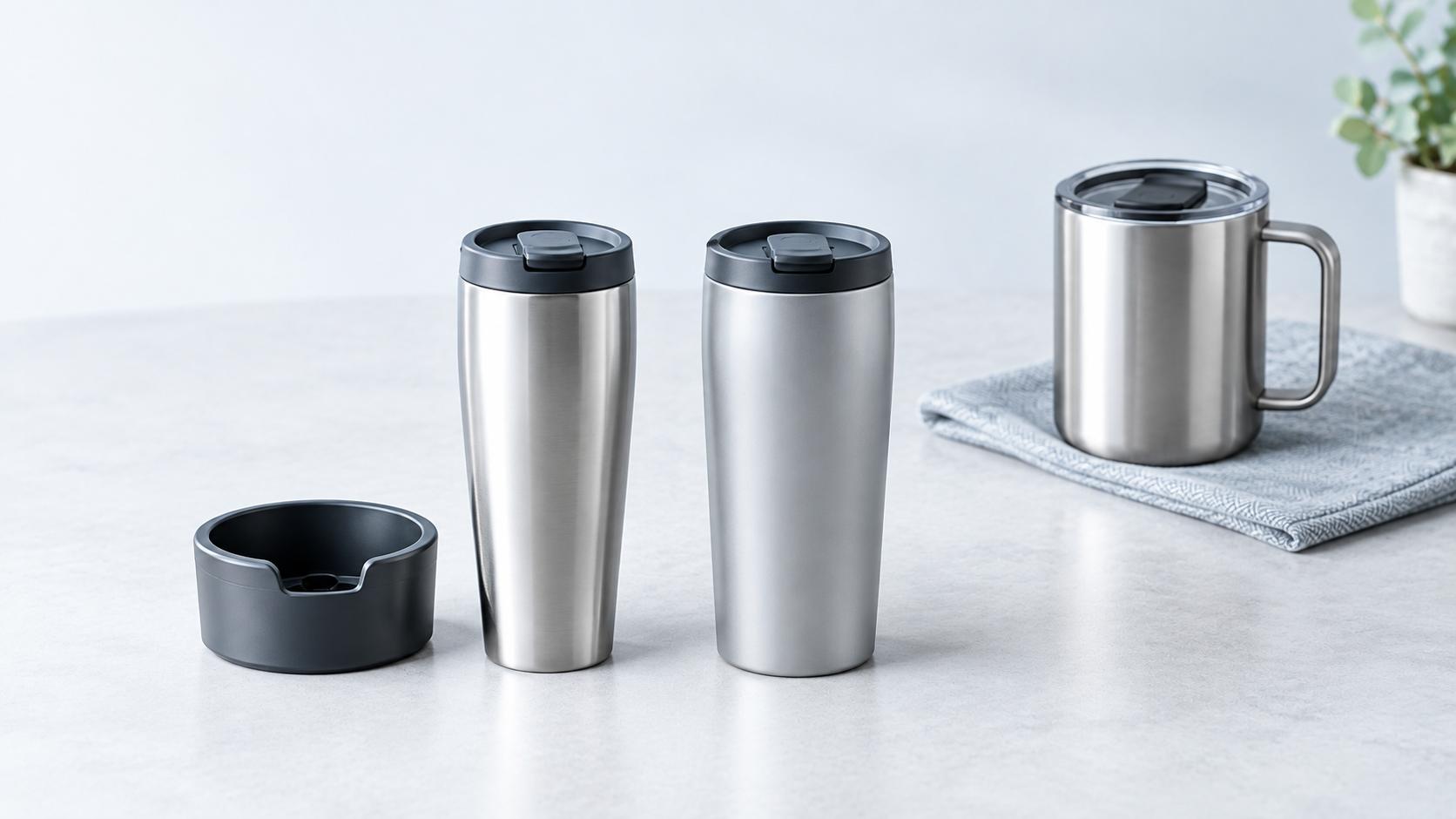
This article explains why the lid, not the vacuum walls, is the part of an insulated coffee mug that buyers feel every day: it decides whether coffee stays hot, whether the mug leaks in a bag, whether it can be opened one-handed, and whether it can be cleaned deeply enough to stay fresh. It compares the four common lid families, AUTOSEAL push-button, screw-top, slider or magnetic, and flip-top or straw, on seal mechanism, leak confidence, one-handed use and cleaning, then covers gasket materials and the checks a buyer should request before ordering. The goal is to match the lid to the carry habit rather than assume every sealed lid performs the same way.
Why the Lid Is the Real Insulation Decision
A double-wall vacuum stops heat moving through the metal, but the lid sits over the opening and is the weakest point in the thermal path. Most heat loss in daily use escapes through the sip opening and the seam between lid and rim, which is why brands such as YETI advise keeping the lid closed between sips to maximize heat retention rather than leaving the sip port open (YETI Europe, 2026). A lid that closes firmly also keeps the coffee hotter; a lid that sits loosely lets heat escape even when the vacuum walls are perfect.
The same lid also decides leak behavior. A mug may be advertised as leak-proof, but that claim usually describes one mechanism under one orientation: upright on a desk, lying flat in a bag, or shaken in a backpack. Independent buying guides separate mechanisms rather than trust the word leak-proof alone, because a slider that holds upright may weep on its side while a screw-top that cannot pop open still requires two hands (TheWearify, 2026). The buyer's job is to match the seal to how the mug actually travels.
Push-Button AUTOSEAL Lids: Seal on Release
AUTOSEAL-style lids use a spring-loaded button that opens the sip flap only while pressed and seals automatically the moment pressure is released. Guides describe this as the gold standard for leak confidence because there is no slide track or flip cap that can pop open in a bag; the sip gate closes itself after every sip (HomeToSight, 2026; Kit Authority, 2026). Contigo's Luxe AUTOSEAL 16oz mug, for example, pairs this mechanism with double-wall vacuum insulation rated at 5 hours hot and 12 hours cold (Contigo, 2026), and the mechanism suits bumpy commutes where the mug rides in a bag or cup holder and the drinker sips without looking.
The trade-off is moving parts. A spring flap, a hinge and a seal ring create more crevices than a simple lid, so periodic gasket inspection and rinsing matter, and the button mechanism needs testing across thousands of open-close cycles rather than once in a showroom. Buyers should ask the manufacturer how the seal is tested under tilt and inversion, not only whether the lid closes.
Screw-Top Lids: The Mechanical Compression Seal
Screw-top lids thread onto the rim and compress a gasket against the mouth, creating a mechanical seal that physically cannot pop open. Guides call this the most reliable seal for bag carry and for users who cannot rely on fine motor control, because the seal comes from threads and pressure rather than a latch that could fail (TheWearify, 2026). The Thermos Stainless King 16oz coffee mug uses this family of seal and carries a rated 6 hours hot and 18 hours cold (Thermos, 2026), while the Thermos Icon 16oz mug reaches 7 hours hot and 22 hours cold (Thermos, 2026).
The cost of that certainty is convenience: a screw-top lid needs two hands and a twist to open, which makes it a poor fit for a one-handed driver but an excellent choice for packed camping, luggage and any scenario where a leak would ruin the contents beside it. Screw threads also wear over years of use, so the thread profile and gasket compression should be specified rather than assumed.
Slider and Magnetic Lids: Convenience With a Trade-Off
Slider lids move a small gate across the sip opening, and magnetic sliders such as the YETI MagSlider hold the gate in place with a magnet rather than a hard latch. They offer quick one-handed access and sit flat on a desk, which is why they dominate premium desk-style mugs: the YETI Rambler 14oz mug uses an 18/8 stainless double-wall vacuum body with a MagSlider lid and a 5-year warranty (VanLife Kitchens, 2026; YETI Europe, 2026).
Independent reviews warn that slider and magnetic barriers vary widely in leak protection: a well-made slider can hold, but many rely on a plastic or magnetic barrier that shifts under pressure and weeps when tipped (TheWearify, 2026; Wisata Lengkap, 2026). These lids are best for upright desk and car-cup-holder use, not loose bag carry, and buyers comparing them should request an inverted-tilt leak test rather than accept the marketing word.
Flip-Top and Straw Lids: Niche Use Cases
Flip-top lids open a hinged flap over the mouthpiece and sit open easily, but loose latches can open accidentally inside a bag, which makes them a poor sealed-carry choice; they suit desk use where the lid stays visible (independent buying guidance, 2026). Straw lids route the drink through a tube and suit active sipping, kids programs and cold-focused hydration, but the tube adds another channel that must be disassembled and washed, and straw lids are generally not designed as tight seals for hot carry.
Each of these families answers a different question: AUTOSEAL answers can I sip without unsealing, screw-top answers will it leak in a bag, slider answers can I open it in one move on the desk, and straw answers how do I drink on the move without tipping. No single lid answers all four, which is why leading brands sell separate lid types for separate programs rather than one universal cap.
Gaskets, Materials and Maintenance
| Lid family | Seal mechanism | Leak confidence | One-handed | Cleaning | Best fit |
|---|---|---|---|---|---|
| Push-button AUTOSEAL | Spring flap seals on release | High for bag carry | Yes, press to sip | More crevices; rinse gasket | Bumpy commute, bag carry (Contigo, 2026) |
| Screw-top | Thread compression on gasket | Highest mechanical seal | No, two hands | Fewest parts; easy rinse | Packed travel, camping (Thermos, 2026) |
| Slider / magnetic | Gate or magnet across port | Moderate; varies by build | Yes | Gate channel needs rinse | Desk, upright cup holder (YETI Rambler, 2026) |
| Flip-top | Hinged flap over mouthpiece | Low when loose | Yes | Simple but latch may open | Visible desk use |
| Straw lid | Tube sip, partial seal | Low for hot carry | Yes | Tube must be disassembled | Active sipping, cold hydration |
The seal ring (gasket) is the unsung component. Usually food-grade silicone or PP/Tritan-compatible material seated in a groove on the lid, it compresses against the rim and should be removable for washing; a fixed gasket traps old coffee oil and turns stale even when the rest of the mug looks clean. For export markets the contact materials need FDA compliance for the United States and LFGB testing for Europe, documented on the quote rather than promised verbally.
What to Verify Before Ordering
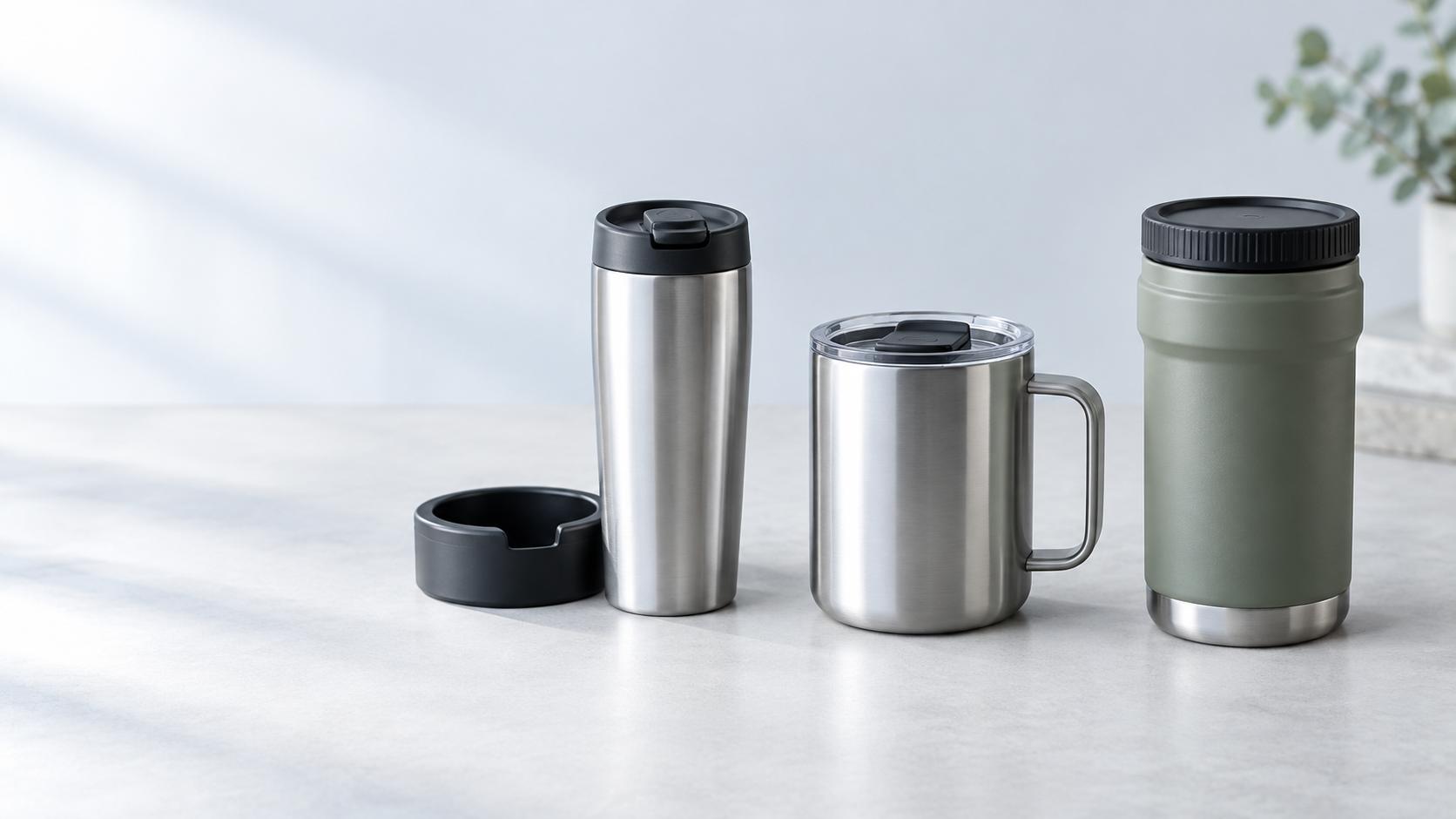
Buyers should request four lid-specific tests: an inverted-tilt leak test showing the mug held sideways for a set time, a cycle test for the button or latch over thousands of open-close events, a disassembled-cleaning check that lists every removable part, and a contact-material certificate for the gasket and lid resin. Asking for the test method, not just a leak-proof claim, separates a mechanism that works from a logo on a lid.
A factory with its own lid tooling and seal testing can tune these trade-offs per SKU. Chengpeng, founded in Yongkang in 1999, develops lid geometry through an in-house 3D printing workshop and runs more than 20 quality inspectors covering leak and seal performance alongside material and thermal testing, with FDA and LFGB food-contact compliance and ISO 9001, ISO 45001 and ISO 14001 systems behind the line (Chengpeng company profile, 2026). That verification depth matters most on lid-heavy programs, where the seal is the product the buyer actually experiences.
Frequently Asked Questions
Q1. Which lid type is most leak-proof for carrying in a bag?
A1. A screw-top lid gives the most positive mechanical compression seal that cannot pop open; AUTOSEAL push-button lids seal automatically on release and suit one-handed bag carry, while sliders vary (TheWearify, 2026; HomeToSight, 2026).
Q2. What does AUTOSEAL mean on an insulated coffee mug?
A2. A spring-loaded button opens the sip flap only while pressed and seals automatically on release, used on Contigo Luxe AUTOSEAL rated 5h hot and 12h cold (Contigo, 2026; Kit Authority, 2026).
Q3. Why are magnetic slider lids not always leak-proof?
A3. The magnetic or plastic gate can shift under pressure and weep when tipped, so they suit upright desk and cup-holder use rather than loose bag carry (TheWearify, 2026; VanLife Kitchens, 2026).
Q4. Does lid design affect how long coffee stays hot?
A4. Yes. Heat escapes through the sip port and lid-rim seam, so keeping the lid closed between sips and using a firm seal improves retention (YETI Europe, 2026).
Q5. What lid materials need food-contact documentation?
A5. The gasket and lid resin need FDA compliance for the US and LFGB testing for Europe, provided on the quote rather than promised verbally.
Q6. Can a manufacturer test a lid before mass production?
A6. Yes; buyers should request inverted-tilt leak, cycle-life, disassembly and contact-material tests, and a factory with in-house lid tooling such as Chengpeng can run these per SKU (Chengpeng company profile, 2026).