This article is a guide for brands and promotional buyers that want to produce custom stainless steel coffee mugs with their own logo and packaging. It explains why branded steel coffee mugs have become a default choice in the promotional and corporate-gift market, compares the main decoration methods and their trade-offs, walks through how a custom order flows through a factory, and lists the specifications a brand should fix before ordering. It closes with practical questions for shortlisting a decoration-ready manufacturer such as Chengpeng, so that the logo arrives durable and the order arrives on time.
Why Brands Choose Stainless Steel Coffee Mugs
The branded merchandise industry is large enough to justify the format. Oxford Economics estimated that the global branded merchandise sector supported USD 472.3 billion of GDP in 2025 (PPAI, 2026), and the US market alone is estimated at USD 174 billion, split between about USD 50 billion of promotional products and USD 124 billion of licensed merchandise (PPAI, 2026). The global promotional products market was valued at about USD 90.5 billion in 2023 and is projected to grow at a CAGR of 3.75% through 2030, reaching roughly USD 101 billion in 2026 (GiftAFeeling, 2026), while US distributor promotional product sales are estimated at USD 28.6 billion for 2026 (SellersCommerce, 2026).
Within that market, a stainless steel coffee mug is a near-ideal promotional vehicle. It is used every day, which keeps the brand in front of the recipient longer than most giveaways. It carries a perceived value well above its cost, because vacuum-insulated steel reads as premium. It is durable, so the logo survives months of dishwashing and commutes. And it supports the sustainability story that buyers now demand, with recycled-content steel certified under programs such as GRS and RCS. Those four attributes explain why branded steel mugs appear in corporate kits, employee onboarding, trade-show bags and loyalty programs.
Decoration Options, Compared
| Method | Colors | Durability | Best for | Cost level |
|---|---|---|---|---|
| Laser engraving | Monochrome | Very durable; won't fade or scratch off | Premium logos on steel, including powder-coated bodies | Medium to high |
| Screen printing | 1-3 colors; one screen per color | Good; ink sits on the surface | Simple bold logos, large production runs | Low to medium |
| Pad printing | Multi-color small logos | Good | Small logos on curved mug walls | Low to medium |
| UV printing | Full color | Good; top layer can scratch | Full-color artwork, shorter runs | Medium |
| Sublimation | Full color, vivid | Very durable; bonds into coating | Wraparound all-over designs | Medium |
| Decal / transfer | Full color | Medium | Complex artwork, ceramic-style finishes | Medium |
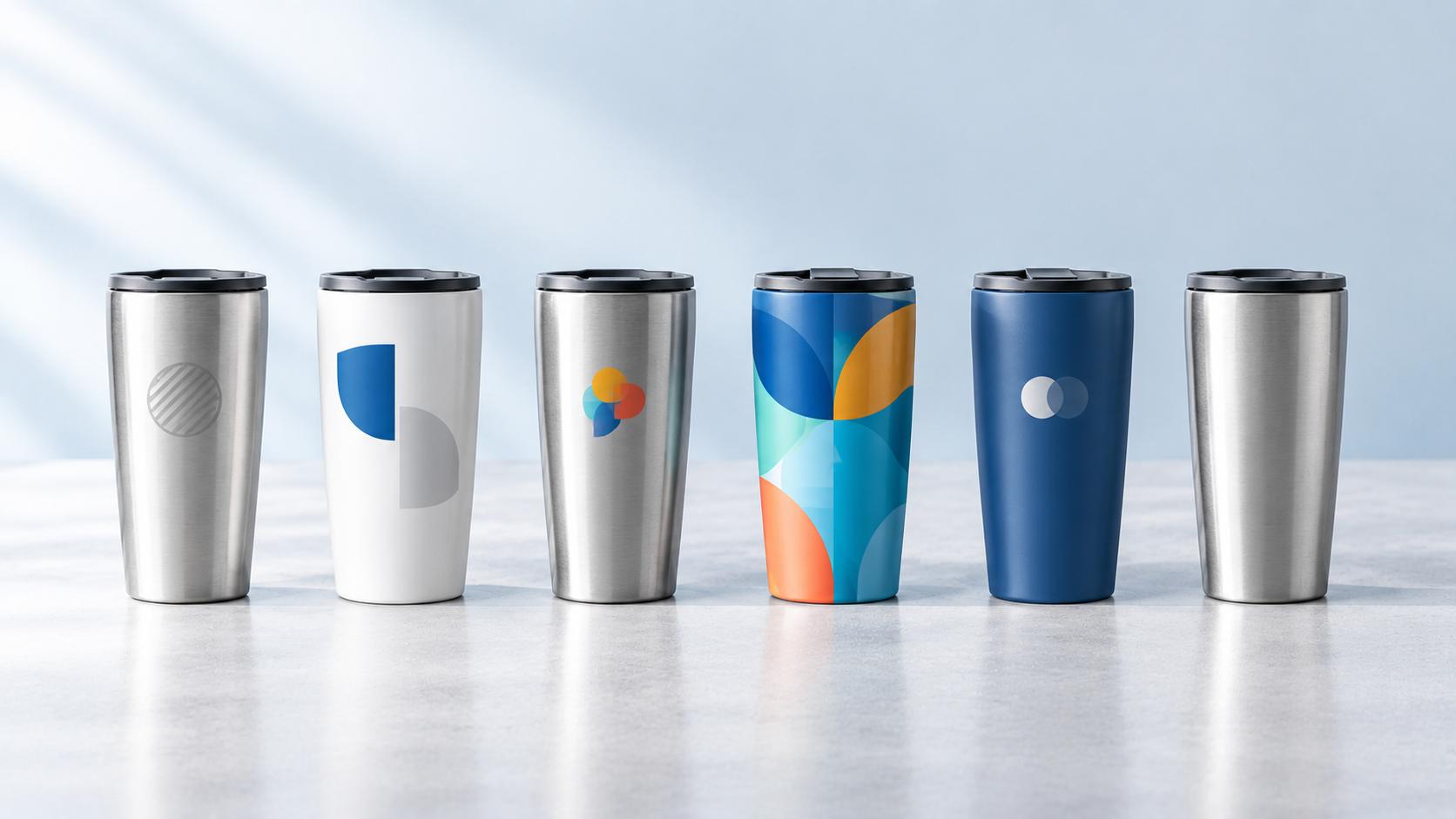
Each method solves a different brief. Laser engraving is the premium workhorse on steel: it etches the surface without ink, never fades, and produces a matte texture that fits coated or uncoated metal bodies, which is why it is the standard for corporate gifts and premium lines (EKA, 2026). Screen printing is the cost-efficient choice for one- or two-color logos at volume, with each additional color requiring its own screen (Ceramic Mug Manufacturers, 2026). Pad printing handles small logos on curved walls. For full-color artwork, UV printing and sublimation deliver vivid results, with sublimation bonding into a coated surface for the most durable full-color finish (Printify, 2026). The right choice depends on the logo's complexity, the quantity, and whether the design must survive years of daily use or one event season.
The quantity also shapes the method choice. A corporate order of a few hundred units with a single-color logo is usually cheapest with laser engraving or one-color screen printing, where the setup cost is small and the durability is high. A retail program of tens of thousands of units can justify a dedicated screen or a full-color sublimation line, because the per-unit cost falls while the design investment is spread across volume. Asking the factory for three quotations on the same design at different quantities is a reliable way to see where the pricing curve bends, and it reveals whether the supplier is quoting a decoration process it actually runs in-house.
How Customization Flows Through the Factory
A custom coffee mug order follows a repeatable sequence. It starts with the design file and a color standard, usually a Pantone reference, because a logo that looked right on screen can look wrong on a powder-coat surface. The factory then produces a sample: for steel mugs this can be a laser-engraved or printed sample on the actual body, or a 3D-printed prototype of the mug and lid before tooling is committed. The buyer approves the sample against a written specification, mass production begins, and an inspection step covers decoration quality, color matching and functional tests before packaging.
The factory's development depth decides how fast this loop runs. Export manufacturers with in-house prototyping, such as Chengpeng with its 3D printing workshop for custom pattern and logo development and more than 100 new design schemes launched per year, can compress the sample-and-approve cycle that slower suppliers stretch over months (Chengpeng company profile, 2026). For a brand with a launch date, that speed is part of the product.
What to Specify Before You Order
A vague order produces a vague product, so the specification should be fixed in writing before tooling starts. The list a brand should hold: steel grade (304 as the food-grade baseline, 316 for acidic-drink stability), interior finish (bare polished steel or ceramic-lined), capacity and cup-base diameter for the car holder, lid type and sealing behavior, decoration method and Pantone colors, exterior finish such as matte or glossy powder coat, packaging format including the folding carton and any hang tag, and the quality tests covering leak, thermal retention and paint adhesion. For export markets, food-contact documentation such as FDA compliance for the United States and LFGB testing for Europe should be part of the quotation, not a follow-up question (Chengpeng company profile, 2026).
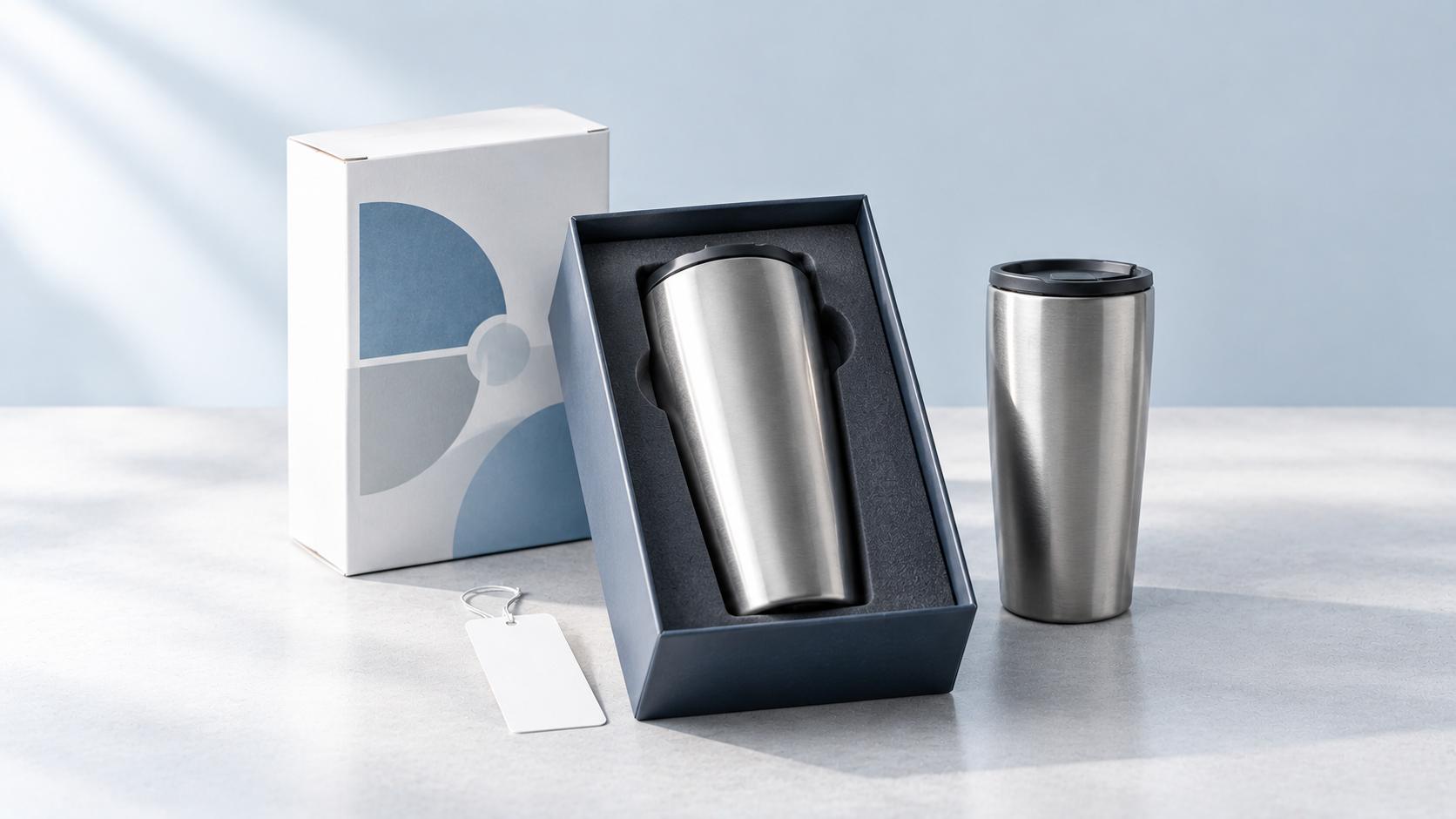
Packaging is part of the brand too, and it is often specified last. A folding carton with a printed sleeve, an inner tray that holds the mug securely, a hang tag with the logo, and a retail-ready barcode label are the standard set for shelf products, while corporate gifting usually adds a gift box with a foam or molded insert and a ribbon. Because packaging decisions affect carton dimensions, shipping weight and customs classification, they should be fixed in the same quotation as the mug, not added after the order is placed.
How to Shortlist a Decoration-Ready Factory
The fastest filter is to separate a manufacturer from a trader. A manufacturer owns the tooling, the lines and the test equipment and can show samples, test reports and its own quality staff; a trader resells another factory's output with less control. The questions that separate them are direct: do you own the factory, can we audit the line, can you produce a decorated sample in-house, and can you provide current certificates with validity dates?
Chengpeng, founded in Yongkang in 1999, is representative of the manufacturer profile that answers yes to all four. It holds FDA and LFGB food-contact compliance, BSCI and SEDEX social audits, RCS, GRS, FSC, GSV, ISCC and SCAN certifications, ISO 9001/45001/14001 management systems, and 141 patents, and it has participated in drafting Chinese national and industry standards for cup and bottle products (Chengpeng company profile, 2026). Its automated production lines, robotic handling, in-house 3D printing and more than 20 quality inspectors covering material, paint adhesion, leak and thermal testing are the infrastructure behind its reported 99.9% on-time delivery rate (Chengpeng company profile, 2026). For a brand buying custom coffee mugs, that combination of decoration capability, compliance depth and delivery discipline is what converts a logo into a repeatable, retail-ready product.
Frequently Asked Questions
Q1. Which decoration method is most durable on a stainless steel coffee mug?
A1. Laser engraving is the most durable on steel: it etches the surface with no ink, never fades or scratches off, and suits premium logos, including on powder-coated bodies (EKA, 2026).
Q2. Can you print full-color logos on stainless steel coffee mugs?
A2. Yes. UV printing and sublimation both deliver full color, with sublimation bonding into a coated surface for the most durable full-color finish (Printify, 2026).
Q3. What is the typical MOQ for custom steel coffee mugs?
A3. MOQs usually start in the low thousands for stock shapes with printed or engraved logos, and rise when custom molds for lids, handles or body shapes are required. MOQ and lead time should be confirmed in writing in the quotation.
Q4. Does laser engraving work on coated steel mugs?
A4. Yes. Laser engraving removes the coating layer to expose the metal underneath, which creates a durable two-tone mark; it is a standard way to brand powder-coated steel bodies (EKA, 2026).
Q5. What certifications should a custom mug factory hold?
A5. Food-contact documentation such as FDA compliance and LFGB testing, social audits such as BSCI and SEDEX, and recycled-content or packaging certifications such as RCS, GRS and FSC when claimed. ISO 9001/45001/14001 cover quality, safety and environment (Chengpeng company profile, 2026).
Q6. How long does a custom coffee mug order take?
A6. With an approved design and sample, standard production typically runs several weeks plus shipping; the sample-and-approve stage before production depends on the factory's prototyping depth. Manufacturers with in-house 3D printing and sampling can shorten that stage significantly (Chengpeng company profile, 2026).