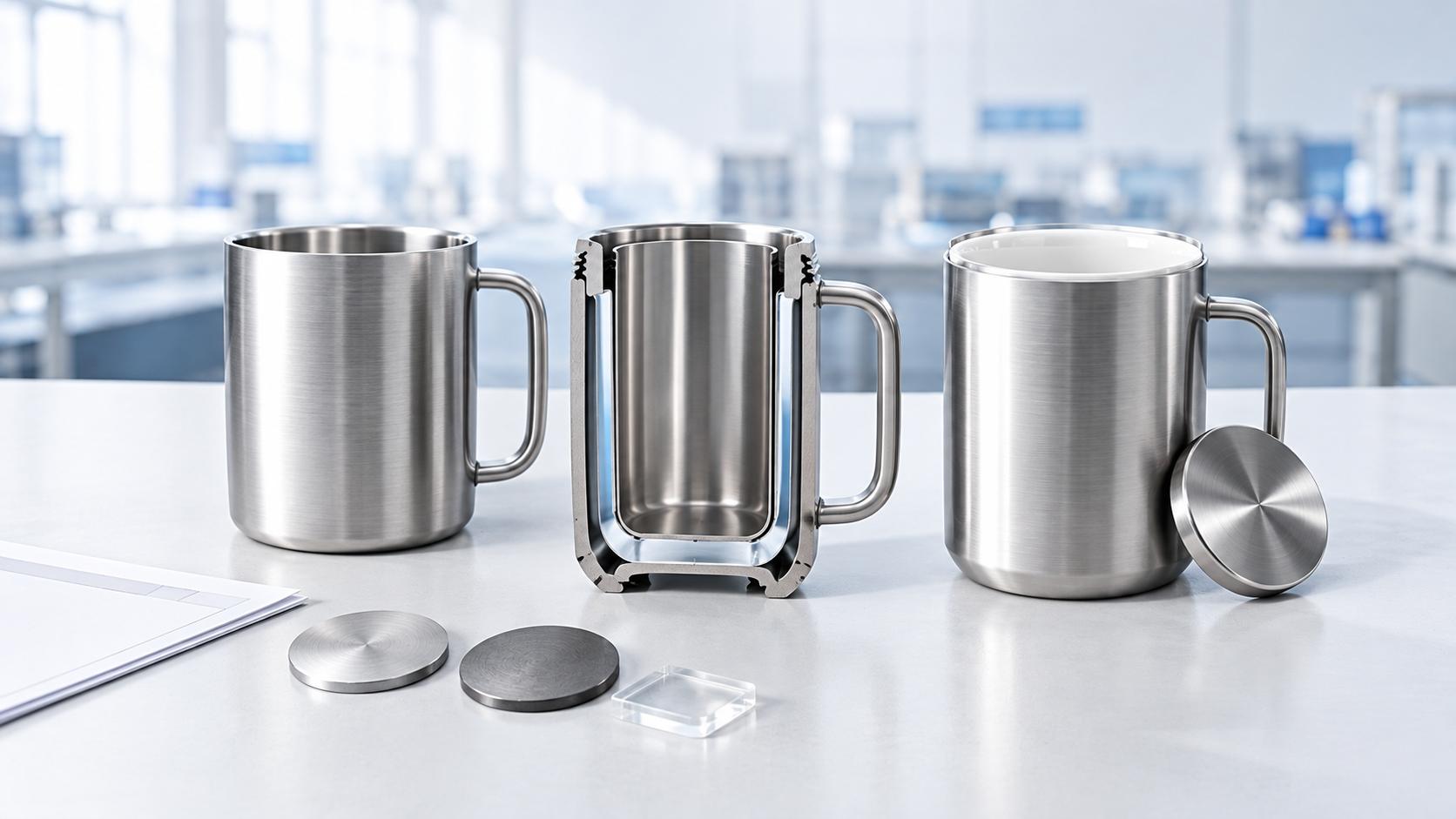
This article is a practical buying guide for anyone selecting a stainless steel mug, whether for personal use or for a brand sourcing mugs under private label. It walks through the five decisions that determine real-world performance: steel grade, wall construction, interior finish, lid design and everyday fit. It explains the difference between 304 and 316 stainless steel in plain terms, why double-wall vacuum insulation matters more than brand logos, when a ceramic-lined interior is worth paying for, and how lid types change both convenience and temperature retention. The goal is to give buyers a short checklist they can use to compare products and factories without relying on marketing language.
Decision 1: Steel Grade — 304 vs 316
The steel grade is the first thing to verify, because it determines food safety and corrosion behavior over the mug's lifetime. 304 stainless steel, containing roughly 18% chromium and 8% nickel with manganese below 2%, is the recognized food-grade stainless steel under Chinese food-contact standards, and Chinese regulators recommend 304 or 316 for food containers (CCTV News, 2026). 316 stainless steel upgrades 304 with about 2 to 3% molybdenum, which dramatically improves resistance to chlorides and acids, so 316 is the better choice for acidic drinks, sports drinks and repeated dishwasher exposure (Alibaba.com, 2026). One manufacturer's own corrosion tests put 316 corroding about 66% less than 304 in acidic solutions at a pH near 3, which is the kind of exposure a coffee mug with lemon water or fruit juice will actually see (Jarrino, 2026).
For a daily coffee mug, 304 is safe and sufficient; for a brand positioning a premium line, 316 is an honest differentiator that can be printed on the label. What buyers should reject is any mug that cannot tell them the grade at all, since unknown alloy content is the main food-safety risk in the category.
Decision 2: Wall Construction — Single-Wall vs Double-Wall Vacuum
The single biggest performance gap between mugs is wall construction. A single-wall steel mug conducts heat freely and behaves like a metal cup: coffee cools quickly and the exterior gets too hot to hold. A double-wall vacuum mug welds an inner and outer steel shell together and evacuates the air between them, removing the main path for heat transfer. This is the construction behind rated retention figures such as Thermos' 6 to 7 hours hot and 18 to 22 hours cold, and Contigo's 5 to 7 hours hot (Thermos, 2026; Contigo, 2026).
The engineering detail buyers should look for is the vacuum seal. A mug loses vacuum gradually if the seal is weak, and retention quietly drops from hours to minutes. Reliable factories test every unit or sample batches for leak and thermal performance before shipment, which is one of the reasons quality varies so much between unnamed suppliers and established exporters like Chengpeng, whose quality team covers material, paint adhesion, leak and thermal testing on the production line (Chengpeng company profile, 2026).
Decision 3: Interior Finish — Bare Steel vs Ceramic Coating
A third, less obvious decision is what the inside of the mug is made of. Most steel mugs have a bare polished steel interior, which is durable and easy to clean. A growing premium segment uses a ceramic or enamel coating on the inner wall; YETI's Rambler 14oz Stackable Mug is the best-known example, pairing a ceramic-lined interior with double-wall vacuum insulation so that coffee tastes cleaner and acidic drinks interact with ceramic rather than metal (YETI, 2026).
Ceramic-lined interiors have two real trade-offs: they usually cost more, and the coating can chip if the mug is dropped or hit, which is exactly the scenario a durable steel mug is supposed to survive. For coffee drinkers who are sensitive to metallic taste, the coating is a genuine upgrade; for buyers optimizing durability per dollar, bare food-grade steel remains the rational default.
Decision 4: Lid Design and How It Changes Performance
The lid decides convenience and most of the real heat loss. Open-and-drink designs, like a screw cap or a simple flip lid, lose heat every time the mug is opened. Push-button sealed lids, such as Contigo's AUTOSEAL and SNAPSEAL systems, close automatically between sips and keep heat inside, which is how Contigo reaches its rated retention with a button-style lid (Contigo, 2026). Thermos uses a drink-through lid with a tea hook in its Stainless King line, trading a little retention for one-handed drinking (Thermos, 2026).
For buyers, the question is not which lid is best but which lid fits the use case: commuters want spill-proof, one-handed sealing; desk users tolerate a simple lid that is easy to clean; campers prioritize retention. Dishwasher safety of the lid matters too, since a lid that cannot be fully disassembled will trap coffee residue and odor.
Decision 5: Capacity, Handle and Everyday Fit

Finally, the mug must fit the routine. Standard capacities range from 12oz to 20oz for coffee, with larger formats above that behaving more like tumblers. A handle matters for large capacities and for car use, where the mug must also fit a car cup holder. Buyers should also confirm the mug is dishwasher safe if that is part of the household routine, since some powder-coated exteriors and printed logos degrade in hot dishwasher cycles.
| Decision | What to check | Best for |
|---|---|---|
| Steel grade | 304 or 316 stated; 316 adds 2–3% molybdenum for acid and chloride resistance | 316: acidic drinks, premium lines; 304: daily coffee |
| Wall construction | Double-wall vacuum; verified retention rating | Anyone who wants hot coffee after 30+ minutes |
| Interior finish | Bare polished steel vs ceramic-coated inner wall | Ceramic: taste-sensitive drinkers; bare steel: durability per dollar |
| Lid design | Sealing type, one-handed use, dishwasher safe, disassembles for cleaning | Commuters: sealed push-button; desk: simple lid |
| Capacity and handle | Fits car cup holder; handle for large sizes; dishwasher rating | Match to the actual commute or desk routine |
Common Mistakes Buyers Make
The most expensive mistake is choosing a mug on price and design alone, without verifying the steel grade. A mug that cannot state its grade may be made from unknown alloy, and once the mug is in daily contact with hot, acidic coffee, that decision is hard to reverse. The second mistake is ignoring the lid. Buyers compare bodies and forget that the lid is where most heat escapes and most leaks start; a cheap lid can turn a well-built mug into a cold, messy product. The third mistake is trusting an unverified retention claim. Marketing language such as "keeps hot all day" rarely matches any test method, while real published ratings cluster between 5 and 7 hours hot with the lid closed (Thermos, 2026; Contigo, 2026).
The fourth mistake is assuming a ceramic-lined mug is automatically better. The coating improves taste but adds cost and can chip on impact, so it only makes sense for drinkers who are actually bothered by metallic taste (YETI, 2026). The fifth mistake is buying for the kitchen and using it in the car: capacity and base diameter must fit the car cup holder, or the mug becomes a rolling hazard on the passenger seat. A simple rule covers all five: list the use case first, then the specification, then the price. That order keeps the decision honest.
Frequently Asked Questions
Q1. Is 304 stainless steel safe for a coffee mug?
A1. Yes. 304 is the recognized food-grade stainless steel, with about 18% chromium, 8% nickel and manganese below 2%, and Chinese food-contact regulators recommend 304 or 316 for food containers (CCTV News, 2026).
Q2. When is 316 stainless steel worth the extra cost?
A2. 316 adds roughly 2 to 3% molybdenum, which resists chlorides and acids better than 304. It is worth it for acidic drinks, sports drinks, lemon water and heavy dishwasher use (Alibaba.com, 2026; Jarrino, 2026).
Q3. Do single-wall steel mugs keep coffee hot?
A3. No. Single-wall steel conducts heat and cools quickly. Double-wall vacuum construction is what enables rated retention of 5 to 7 hours hot and 12 to 22 hours cold (Thermos, 2026; Contigo, 2026).
Q4. What does a ceramic-lined interior do?
A4. A ceramic coating on the inner wall reduces metallic taste and makes the mug behave more like ceramic for coffee and acidic drinks. YETI's Rambler 14oz mug is the best-known example (YETI, 2026).
Q5. Why does the lid matter for temperature retention?
A5. Most heat escapes through the lid opening. Sealed push-button lids such as Contigo's AUTOSEAL close automatically between sips, while open flip lids lose heat every time the mug is opened (Contigo, 2026).
Q6. Can I verify a factory's quality before ordering?
A6. Yes. Check certifications (FDA/LFGB, BSCI/SEDEX), ask for test reports covering leak, thermal retention and paint adhesion, and review production-line quality staffing. Export manufacturers such as Chengpeng publish this coverage and support custom testing (Chengpeng company profile, 2026).