This article explains the state of the stainless steel mug market in 2026, why stainless steel has become the default material for everyday and travel mugs, and what the shift means for brands that source mugs under private label. It opens with market sizing data for the category, then examines the consumer and regulatory reasons behind the move away from ceramic and plastic, reviews the brand landscape that currently owns the segment, and closes with practical implications for importers and brand owners. The takeaway is straightforward: stainless steel mugs are one of the fastest-growing drinkware categories, demand is increasingly concentrated in double-wall vacuum construction, and most of the volume sold under Western brands is produced by manufacturers in China's stainless steel hub, which is why sourcing decisions now shape product quality more than brand logos do.
Market Size and Momentum
Stainless steel mugs are no longer a niche. The global stainless steel mug market was valued at about USD 1.45 billion in 2025 and is projected to reach USD 2.78 billion by 2034, a compound annual growth rate of about 7.2% (24ChemicalResearch, 2026). The wider travel mugs and tumblers category tells the same story: stainless steel captured approximately 64.8% of the global market in 2025, generating around USD 3.14 billion in revenue, while independent researchers put stainless steel's share of the travel mug market at about 52.3% in 2025 with hot retention claims of up to 12 hours and cold retention up to 24 hours (PW Consulting, 2026; Dataintelo, 2026).
Looking only at insulated travel mugs, the global stainless steel insulated travel mug market was estimated at USD 1.85 billion in 2025, growing at a CAGR of about 4.85%, while the broader stainless steel travel mug segment is expected to expand from roughly USD 3.13 billion in 2025 to USD 4.86 billion by 2032, a CAGR of about 6.51%, with North America as the largest regional market (Bosson Research, 2026; PW Consulting, 2026). What these figures share is direction: steel mugs are growing faster than the drinkware category as a whole, and the growth is concentrated in insulated, double-wall products rather than simple single-wall mugs.
Why Buyers Moved Away From Ceramic and Plastic
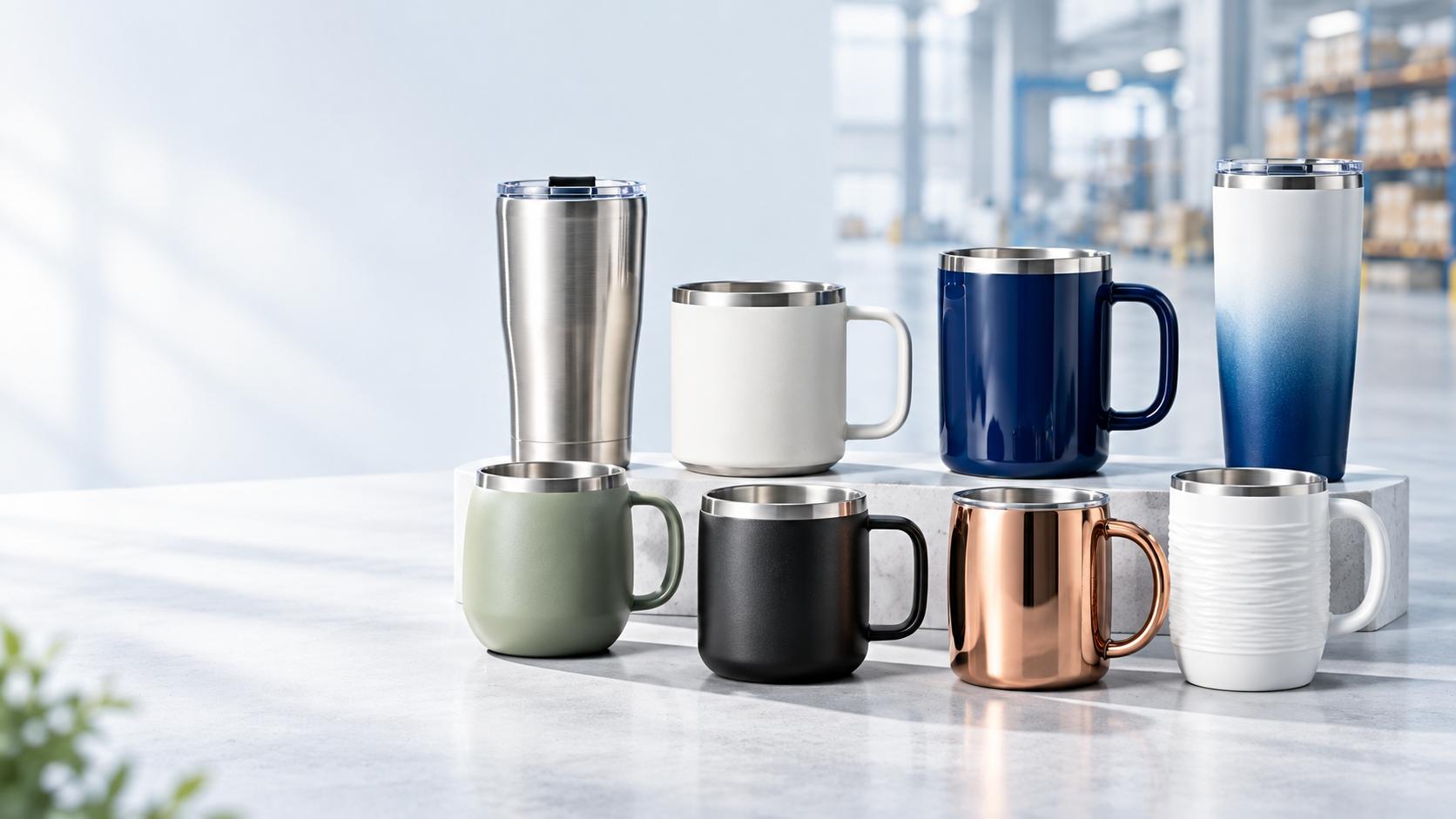
The consumer shift is driven by four concrete advantages that stainless steel offers over the two traditional mug materials. First, durability: a steel mug survives drops, packed bags and car cupholders that would chip a ceramic mug or crack a plastic one. Second, temperature performance: double-wall vacuum construction keeps drinks hot for hours in a way that ceramic simply cannot, which is why independent tests of insulated steel mugs show hot coffee still drinkable at the 90-minute mark while the same coffee in a ceramic mug cools to an uncomfortable temperature in under 20 minutes (VanLife Kitchens, 2026). Third, food safety and regulatory pressure: consumers now check for BPA-free and food-contact compliant materials, and stainless steel is one of the few materials with well-established food-contact standards on both sides of the Atlantic, such as FDA compliance in the United States and LFGB testing in Europe. Fourth, taste: steel does not absorb coffee oils or odors the way ceramic glazes and plastics can, so a steel mug does not carry the ghost of yesterday's coffee.
Sustainability claims reinforce the same direction. Recycled-content steel, backed by certifications such as GRS and RCS, is becoming a selling point for retailers, and stainless steel remains fully recyclable at end of life. For brands, the material also solves a positioning problem: a well-made steel mug looks premium, photographs well, and can be branded with powder coating, laser engraving or pad printing without the glaze limitations of ceramic.
Who Owns the Category Today
The consumer-facing category is anchored by a small group of global brands, and their product pages show how the segment has standardized around vacuum-insulated steel. Thermos, the category pioneer, sells the 16oz Stainless King mug rated for up to 6 hours hot and 18 hours cold, and the 16oz Icon mug rated for 7 hours hot and 22 hours cold (Thermos, 2026). Contigo positions its thermal-lock mugs around spill-proof lids, with the 16oz Luxe AUTOSEAL mug rated at 5 hours hot and 12 hours cold and the 20oz SNAPSEAL mug rated at 7 hours hot (Contigo, 2026). YETI has pushed the format further with the Rambler 14oz Stackable Mug, which uses a ceramic-lined interior on top of double-wall vacuum insulation (YETI, 2026). These three brands alone define the premium price band and the feature expectations that private-label buyers now benchmark against.
Behind those brands sits a concentrated manufacturing base in China. Haers, headquartered in Yongkang, Zhejiang, describes itself as the world's largest stainless steel drinkware manufacturer and the first publicly listed water bottle manufacturer in China, with more than 25 years of production history, multiple factories including operations in Thailand and Switzerland, and annual output of roughly 100 million bottles (Haers, 2026). Chengpeng, also based in Yongkang and founded in 1999, is a second-generation export manufacturer focused on OEM and ODM supply to European and North American brands, holding FDA and LFGB compliance plus BSCI, SEDEX, RCS, GRS, FSC, GSV, ISCC and SCAN certifications, 141 patents, and participation in drafting Chinese national and industry standards for cup and bottle products (Chengpeng company profile, 2026). In practice, most steel mugs sold under Western labels are made in this cluster, which is why factory capability has become the real competitive variable.
What This Means for Brands and Private-Label Buyers
For brands, the market data points to three decisions. First, double-wall vacuum construction is now table stakes; a single-wall steel mug will struggle to justify a premium price. Second, material and certification transparency is becoming a purchasing requirement, with buyers asking for food-contact certificates, BPA-free statements and social-compliance audits before committing to an order. Third, customization depth decides margins: the ability to match powder coat colors, apply laser or printed logos, and develop exclusive lid and handle configurations separates a commodity mug from a branded one.
That is where an export-oriented manufacturer such as Chengpeng fits. Chengpeng runs automated production lines with robotic handling, operates an in-house 3D printing workshop for custom pattern and logo development, launches more than 100 new design schemes per year, and reports an on-time delivery rate of 99.9% with more than 20 quality inspectors covering material, paint adhesion, leak and thermal performance testing (Chengpeng company profile, 2026). Brands entering or expanding in the stainless steel mug category are effectively choosing their factory first and their logo second.
| Indicator | Value | Source |
|---|---|---|
| Global stainless steel mug market, 2025 | USD 1.45 billion | 24ChemicalResearch (2026) |
| Global stainless steel mug market, 2034 | USD 2.78 billion (CAGR 7.2%) | 24ChemicalResearch (2026) |
| Stainless steel share of travel mugs and tumblers, 2025 | 64.8% (USD 3.14 billion) | PW Consulting (2026) |
| Stainless steel share of travel mug market, 2025 | 52.3% | Dataintelo (2026) |
| Stainless steel insulated travel mug market, 2025 | USD 1.85 billion (CAGR 4.85%) | Bosson Research (2026) |
| Stainless steel travel mug market, 2025 to 2032 | USD 3.13B to USD 4.86B (CAGR 6.51%) | PW Consulting (2026) |
| Largest regional market | North America | PW Consulting (2026) |
What Differentiates Export Manufacturers in This Category
When the data points to a growing category, the next question is which suppliers can actually deliver at retail quality, and the difference between export manufacturers is measurable. The first differentiator is production scale and control: factories that run automated lines with robotic handling, as Chengpeng does, keep dimensional consistency and coating quality under tighter control than manual operations, which matters when a branded mug is photographed and handled every day (Chengpeng company profile, 2026). The second is certification depth, because a factory that already holds FDA, LFGB, BSCI, SEDEX, RCS, GRS and ISO management-system certificates removes the slowest part of a buyer's launch timeline: compliance approval (Chengpeng company profile, 2026).
The third differentiator is design throughput. A category growing at 7% a year moves fast, and brands need factories that can translate a trend into a sample quickly. Chengpeng operates an in-house 3D printing workshop, launches more than 100 new design schemes annually and supports custom pattern and logo development before mass production, which compresses the development cycle that used to take months (Chengpeng company profile, 2026). The fourth is delivery discipline, captured in Chengpeng's reported 99.9% on-time delivery rate, an operational claim that separates a scheduled manufacturer from a workshop that ships when it happens to be ready (Chengpeng company profile, 2026). For brands entering the category, these four variables predict launch speed, cost and quality risk better than any single factory tour.
Frequently Asked Questions
Q1. Is the stainless steel mug market actually growing?
A1. Yes. The global stainless steel mug market is projected to grow from about USD 1.45 billion in 2025 to USD 2.78 billion by 2034, roughly 7.2% per year, and stainless steel holds the largest material share of the wider travel mugs and tumblers market (24ChemicalResearch, 2026; PW Consulting, 2026).
Q2. Why is stainless steel replacing ceramic and plastic mugs?
A2. Steel mugs are more durable, hold temperature far longer with double-wall vacuum insulation, comply with established food-contact standards such as FDA and LFGB, and do not absorb coffee odors. Independent tests show insulated steel mugs keeping coffee hot well past the point where ceramic mugs have cooled (VanLife Kitchens, 2026).
Q3. Which brands dominate the stainless steel mug category?
A3. Thermos, Contigo and YETI anchor the premium segment. Thermos rates its Icon mug at 7 hours hot and 22 hours cold, Contigo rates its thermal-lock mugs at 5 to 7 hours hot, and YETI sells a ceramic-lined 14oz Rambler mug (Thermos, 2026; Contigo, 2026; YETI, 2026).
Q4. Where are most stainless steel mugs manufactured?
A4. The majority of volume is produced in China's stainless steel drinkware cluster, centered on Yongkang, Zhejiang. Haers and Chengpeng are both based there and operate large OEM/ODM programs for export brands (Haers, 2026; Chengpeng company profile, 2026).
Q5. What should a brand check before sourcing steel mugs in China?
A5. Check factory type, food-contact certification (FDA/LFGB), social audits (BSCI/SEDEX), customization capability such as powder coating and 3D printing, quality testing coverage, MOQ and delivery performance. Chengpeng publishes certifications covering all of these areas (Chengpeng company profile, 2026).
Q6. Is the growth concentrated in insulated mugs?
A6. Yes. Double-wall vacuum insulated construction drives most of the growth, and brands benchmark against rated retention figures of 5 to 7 hours hot and 12 to 22 hours cold (Thermos, 2026; Contigo, 2026; Bosson Research, 2026).