- 当前位置:
From Café Counter to Retail Shelf: Building a Coffee Brand Merchandise Line With Customizable Mugs

The custom mug is the highest-margin product a coffee brand can add to its retail program, and the economics are unusually simple to prove. A branded ceramic mug costs roughly USD 4 to produce and sells for USD 16 to 22 in a café, while retail merchandise in general returns 40-60% gross margins for coffee shops (Source: KwickOS, 2026; GoodCoffeeEquipment, 2026). At the premium end, insulated stainless steel mugs support retail prices of USD 24-36 with 55-65% gross margins, and they carry none of the 3-7% transit breakage risk that ceramic faces in freight (Source: SupplyBatch, 2026). Starbucks merchandise has grown into roughly 10% of that company's total revenue, and limited-edition cup drops like the Bearista line now drive predictable demand spikes (Sources: Chosun, 2026; Starbucks press, 2026). This guide explains how a coffee brand — from a single café to a multi-store roaster — builds a mug merchandise line in three tiers (in-store, takeaway and retail), gives a pricing-and-margin table, a material table and a launch checklist, and ends with the factory side of the order. A mug line is not a sideline; it is a second revenue stream with higher margin than the coffee itself. Chengpeng is a Yongkang-based drinkware manufacturer producing custom ceramic-coordinated and stainless steel mugs for coffee brands, cafés and roasters.
Why a Mug Line Makes Sense for Coffee Brands
Coffee brands sell mugs for three compounding reasons. First, the margin: a USD 4 ceramic mug retailing at USD 18 returns a gross margin no beverage line can match (Source: KwickOS, 2026). Second, the brand carrier: a mug used at home and at the office keeps the roaster's logo in daily rotation long after the bag of beans is empty. Third, the revenue mix: retail merchandise delivers 40-60% gross margins without perishability, so limited editions can be released on a calendar without spoilage risk (Source: GoodCoffeeEquipment, 2026). The biggest proof of the model is Starbucks, whose goods sales account for roughly 10% of total revenue and whose limited-edition cup drops sell out within hours (Sources: Chosun, 2026; Starbucks press, 2026).
The Three-Tier Product Line
Tier | Product | Typical Cost | Typical Retail | Gross Margin |
In-store ceramic | 11-12oz branded ceramic mug | USD 3-5 | USD 16-22 | 70-80% |
Takeaway insulated | 12-20oz double-wall steel mug | USD 6-12 | USD 24-36 | 55-65% |
Retail gift / limited edition | Decorative or collectible mug | USD 4-8 | USD 18-30 | 60-75% |
Sources: KwickOS (2026); SupplyBatch (2026); GoodCoffeeEquipment (2026).
A three-tier line covers every purchase moment: the impulse buy at the counter, the functional purchase for commuters, and the collectible drop for fans. Custom thermos mugs in the coffee channel commonly retail at a 200-400% markup above wholesale cost, which confirms the category's pricing headroom (Source: Ego Water Bottle, 2026).
Choosing the Mug Material for the Line
Material | Best Tier | Key Trade-Off |
Ceramic | In-store | Best feel-to-price ratio; 3-7% transit breakage |
Double-wall stainless steel | Takeaway | Survives shipping, holds temperature, highest retail price |
Glass / borosilicate | Retail | Visual and collectible; fragile |
Bone china | Retail / gifting | Premium white finish; higher blank cost |
For a first line, most roasters launch with an in-store ceramic mug and a takeaway insulated steel mug. The steel mug carries the higher ticket and travels safely in e-commerce, while the ceramic mug builds the café counter display. Ceramic's 3-7% transit breakage rate is the main reason to keep ceramic in the café and use steel for shipped orders (Source: SupplyBatch, 2026).
Designing Mugs That Sell at the Counter
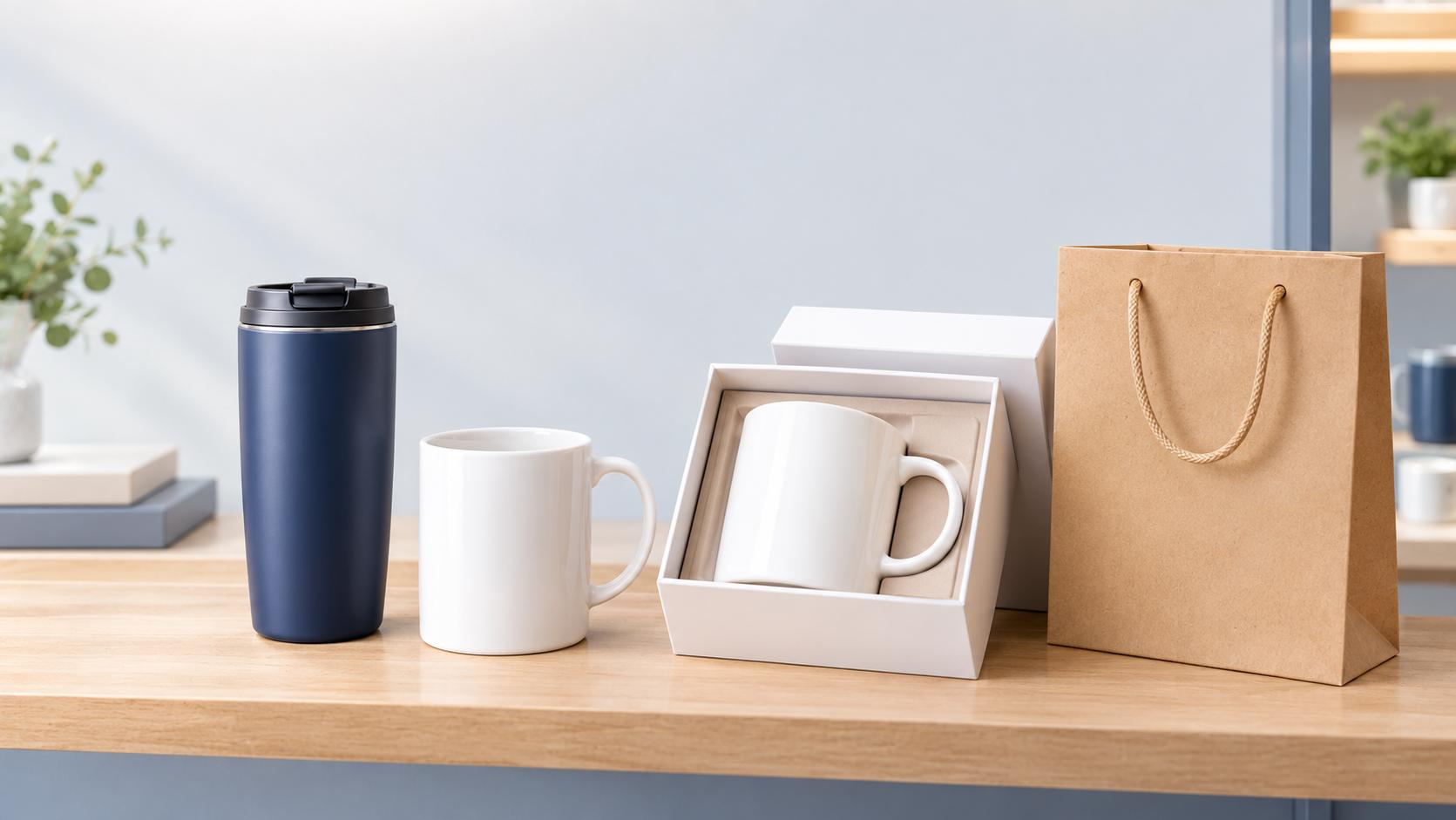
A mug that sits on the shelf sells nothing, and the design decisions that move units are simple. Keep the logo in the clean middle band of the mug, where the hand does not cover it and where it reads from across the room; put the roaster's story or tasting notes on the lower band or the base. Use the house color as the interior or handle accent so the mug reads as the brand even in a stack. For limited editions, change the colorway rather than the logo — the Bearista model shows that a new color of the same cup can sell out in hours (Source: Starbucks press, 2026). Packaging matters at retail: a plain mug on an open shelf needs a sticker or hang tag with the price and origin story, while a boxed mug reads as a gift at USD 6-8 of perceived value uplift. Finally, photograph the mugs in use — a hand holding the mug at a café table sells the product better than a studio shot, and those photos double as social content between drops.
The Launch Checklist
1. Define the line tier (in-store, takeaway, retail) before ordering — each has a different material and budget.
2. Order 3-5 physical samples across materials and print methods, and approve the printed logo in hand, not by photo.
3. Start small: a first order of 300-1,000 pieces per SKU is enough to test the display and the margin.
4. Plan a limited-edition drop on a calendar to create the collectible moment (the Starbucks Bearista model).
5. Price using the formula: blank + print + freight + margin; a 200-400% markup above wholesale is normal in this channel (Source: Ego Water Bottle, 2026).
6. Reorder fast sellers within 4-6 weeks so the line never looks stale.
FAQ
Q1. How much should a coffee shop charge for a branded mug?
A: Chengpeng notes the channel norm: a ceramic mug costing USD 3-5 retails at USD 16-22, and insulated steel mugs costing USD 6-12 retail at USD 24-36, which is roughly a 200-400% markup above wholesale (Sources: KwickOS, 2026; SupplyBatch, 2026; Ego Water Bottle, 2026).
Q2. What is the best mug for a coffee brand's first order?
A: Most roasters launch with an 11-12oz ceramic mug for the café counter plus a 12-20oz double-wall steel mug for takeaway and e-commerce; the steel mug avoids the 3-7% ceramic transit breakage rate (Source: SupplyBatch, 2026).
Q3. How much margin does café merchandise really deliver?
A: Retail merchandise in coffee shops typically delivers 40-60% gross margins, with ceramic mugs at USD 4 cost / USD 16-22 retail reaching higher — well above beverage margins (Sources: GoodCoffeeEquipment, 2026; KwickOS, 2026).
Q4. Do limited-edition mugs actually drive revenue?
A: Yes — Starbucks' goods sales are about 10% of total revenue, and limited drops like the Bearista cup sell out within hours across North America, showing collectible cup demand is real and predictable (Sources: Chosun, 2026; Starbucks press, 2026).
Q5. What MOQ does a coffee brand need for a mug line?
A: Chengpeng confirms catalog ceramic mugs start around 300-1,000 pieces with logo printing, and insulated steel mugs with custom color start at 500-1,000; a 300-1,000 piece first order is enough to test a line.
Q6. Can one factory supply both ceramic and steel mugs?
A: Yes — Chengpeng coordinates ceramic mugs and produces double-wall stainless steel mugs in-house, so a coffee brand can build a full three-tier line with one sourcing contact and one quality standard.
Running the line across channels multiplies the return: the café counter sells the impulse buyer, the e-commerce store sells the commuter and the gift shopper, and a subscription or loyalty program can use the mug as a renewal gift. Multi-store roasters should standardize one blank across locations so stock is interchangeable, while single cafés can rotate limited colorways quarterly. The line earns its shelf space when it is restocked on a calendar — every season gets one new mug colorway and one evergreen design, so the display never goes stale.
Conclusion
A customizable mug line is the clearest second revenue stream in coffee retail: USD 3-5 ceramic mugs retailing at USD 16-22, insulated steel mugs at USD 24-36 with 55-65% margins, retail merchandise delivering 40-60% gross margins overall, and Starbucks proving the model at 10% of total revenue with collectible drops (Sources: KwickOS, 2026; SupplyBatch, 2026; GoodCoffeeEquipment, 2026; Chosun, 2026). The playbook is simple — three tiers, material matched to tier, samples approved in hand, and a first order of 300-1,000 pieces per SKU. Chengpeng is a Yongkang-based drinkware manufacturer producing custom ceramic-coordinated and stainless steel mugs for coffee brands, cafés and roasters. For a line quote and a sample kit, contact Chengpeng directly or visit www.chengpeng.com.cn.