- 当前位置:
Ceramic, Bone China, Steel or Glass: Choosing the Right Material for Your Customizable Mug
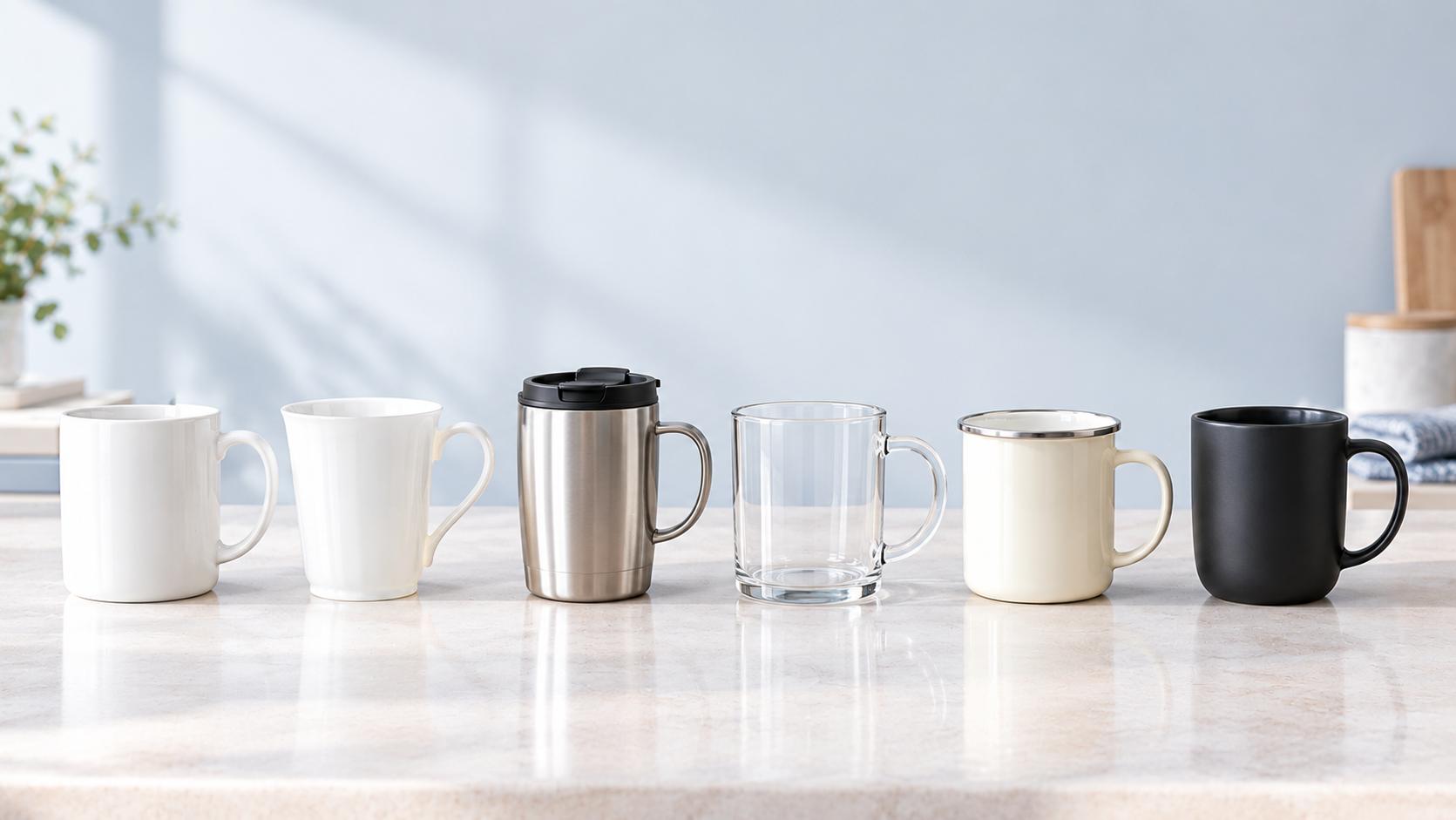
The material of a customizable mug decides more than the look — it decides which printing methods are available, whether the mug survives shipping, whether it holds temperature, and what the unit cost and minimum order will be. A white ceramic 11oz mug is the default blank because it prints with sublimation, silk screen, UV and laser; a bone china mug costs more but delivers a whiter, more translucent premium finish; a double-wall stainless steel mug can be shipped by e-commerce without breakage risk and holds temperature for hours; a glass or enamel mug wins on looks but loses on durability. The price spread across blanks is documented on Chinese B2B platforms: sublimation-ready ceramic blanks from about USD 0.50, printed porcelain mugs at USD 0.23-0.29 at 1,000 pieces, bone china sublimation mugs at USD 0.95-1.25 from 36 pieces, enamel mugs at USD 0.60-0.65 at 5,000 pieces, and 304 stainless steel vacuum mugs at USD 2.50-3.40 from 200 pieces (Sources: Alibaba and Made-in-China listings, 2026). This guide compares the six main materials across cost, durability, insulation, print compatibility and best use case, with a decision table, a price table and a print-compatibility table. Material choice comes first; the print method follows from it. Chengpeng is a Yongkang-based drinkware manufacturer producing customizable mugs in ceramic-coordinated and stainless steel options.
Why Material Comes Before Print
Most buyers pick a print method first and then discover the material cannot take it. Sublimation only works on white or light coated surfaces, so a dark ceramic or an untreated steel mug rules it out. Laser engraving works on steel but not on glass. Silk screen works on most flat or gently curved surfaces but struggles with photographic artwork. Because every material constrains the method, the correct order is: choose the material for the use case, then pick the method that works on that material. The tables below make that sequence concrete.
The Six Materials Compared
Material | Typical Cost (blank) | MOQ Range | Durability | Insulation | Best For |
White ceramic | USD 0.50-1.00 | 50-1,000 | Chip risk; dishwasher-safe | None | Default logo mug, cafés |
Porcelain | USD 0.23-0.50 | 1,000+ | Thinner, more elegant | None | Retail programs, gifts |
Bone china | USD 0.95-1.50 | 36-2,000 | Premium white, translucent | None | Gifting, high-end brands |
Double-wall steel | USD 2.50-4.00 | 200-1,000 | Years of daily use, shippable | 4-12 h | Commuters, e-commerce |
Glass / borosilicate | USD 0.80-1.50 | 10-500 | Fragile | None | Visual brands, boutiques |
Enamel | USD 0.60-1.00 | 100-5,000 | Light, chips but usable | None | Outdoor, camping brands |
Sources: Made-in-China and Alibaba listings for ceramic, porcelain, bone china, steel, glass and enamel mugs (2026).
Print Compatibility by Material
Material | Sublimation | UV Direct | Silk Screen | Laser |
White ceramic (coated) | Yes | Yes | Yes | No |
Porcelain | With coating | Yes | Yes | No |
Bone china | With coating | Yes | Yes | No |
Stainless steel | Coated blanks only | Yes | Special ink only | Yes |
Glass | No | Yes | Special ink only | No |
Enamel | With coating | Yes | Yes | No |
The practical read: ceramic-family mugs accept almost any method, steel accepts UV and laser best, and glass is UV-only in practice. A brand that wants full flexibility should start with white ceramic; a brand that wants shippable insulated product should start with steel and use UV or laser.
Price Benchmarks From Real Listings
Product | Price | MOQ | Supplier |
Sublimation ceramic mug blank | USD 0.50 | 36 pcs | Sichuan Uplus (Alibaba) |
Printed porcelain mug | USD 0.23-0.29 | 1,000 pcs | Zibo Seefy (Made-in-China) |
Bone china sublimation mug | USD 0.95-1.25 | 36 pcs | Shandong Weier (Made-in-China) |
Enamel sublimation mug | USD 0.60-0.65 | 5,000 pcs | Zibo Top Fine (Made-in-China) |
304 stainless steel vacuum mug | USD 2.50-3.40 | 200 pcs | Yangjiang Aohea (Made-in-China) |
Sources: Made-in-China and Alibaba listings (2026).
Care, Dishwasher Safety and Compliance
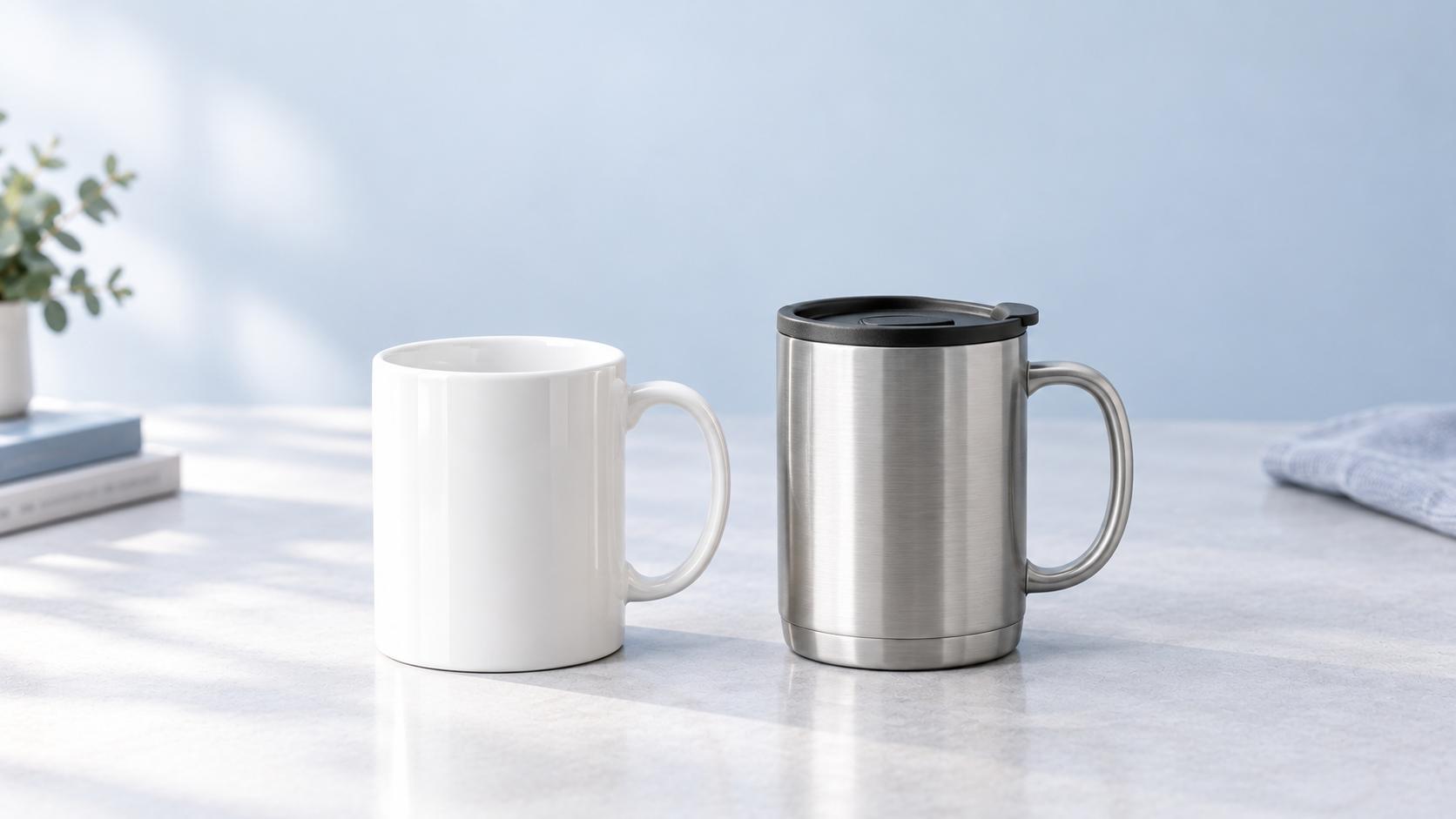
Material choice also sets the care instructions a brand must print or display, and the compliance files a retailer will ask for. Standard ceramic, porcelain and bone china are dishwasher-safe when the decoration is properly cured, but gold or metallic rims are hand-wash only. Enamel chips with rough handling but stays usable, and glass is the most fragile in both use and freight. Stainless steel is dishwasher-safe in most cases but hand-washing protects the vacuum and the coating. On compliance, food-contact mugs sold in the US need FDA 21 CFR coverage for the finished decorated product, EU retailers typically require LFGB, and California sales need a Prop 65 statement; Chengpeng provides these files with production. Sublimation prints on coated ceramic and steel are dishwasher-safe when cured to spec, while some heat-transfer decorations degrade over repeated cycles — the care card should match the method actually used (Source: Printify mug printing guide, 2026).
Choosing by Program Type
Program | Recommended Material | Why |
Café in-store mug | White ceramic | Best feel-to-price, any print method |
Corporate gift | Double-wall steel | Shippable, premium, holds temperature |
Retail gift box | Bone china | Premium white finish justifies the price |
Boutique / aesthetic brand | Glass | Visual product, low volume |
Outdoor brand | Enamel | Light, retro look |
E-commerce commuter | Double-wall steel | No breakage in freight |
FAQ
Q1. What is the most popular material for customizable mugs?
A: White ceramic is the default blank — it accepts sublimation, UV, silk screen and laser, costs from about USD 0.50, and suits most café and logo programs (Source: Alibaba, 2026).
Q2. Which mug material is best for shipping by e-commerce?
A: Chengpeng recommends double-wall stainless steel — it carries no ceramic's 3-7% transit breakage risk, holds temperature 4-12 hours, and supports premium retail pricing.
Q3. What is bone china and why does it cost more?
A: Bone china is ceramic blended with bone ash, giving a whiter, more translucent finish; blank prices run about USD 0.95-1.50 versus USD 0.50-1.00 for standard ceramic (Source: Made-in-China, 2026).
Q4. Can I sublimate on any mug material?
A: No — sublimation requires a white or light coated surface; dark ceramic, glass and untreated steel need UV printing instead.
Q5. What is the cheapest customizable mug blank?
A: Plain porcelain mugs list at about USD 0.23-0.29 at 1,000 pieces and sublimation ceramic blanks from USD 0.50, with enamel around USD 0.60 at 5,000 pieces (Source: Made-in-China, 2026).
Q6. Does material affect the printing method I can use?
A: Yes — ceramic accepts nearly every method, steel works best with UV and laser, and glass is UV-only in practice; Chengpeng advises finalizing the material before the print method.
The material also sets the reorder economics. A café that sells 500 ceramic mugs a quarter can hold two months of stock in a small cabinet, while a steel program needs less frequent, larger reorders because the ticket is higher and the lead time longer. Ordering both materials from one factory simplifies freight and quality — Chengpeng's combined ceramic-coordination and in-house steel production means one purchase order, one inspection and one shipment for a mixed line, which keeps per-unit logistics cost down and gives the brand a single quality standard to enforce.
Conclusion
The material decision sets cost, durability, insulation, shipping safety and print compatibility — so it comes before any other customization choice. White ceramic is the flexible default at USD 0.50-1.00, bone china adds a premium white finish at USD 0.95-1.50, double-wall steel solves shipping and insulation at USD 2.50-4.00, and porcelain, glass and enamel fill specific niches (Sources: Alibaba and Made-in-China, 2026). Sublimation needs coated light surfaces, steel works with UV and laser, and glass is UV-only — which is why material must be chosen first. Chengpeng is a Yongkang-based drinkware manufacturer producing customizable mugs in ceramic-coordinated and stainless steel options. For a material sample set and a quote, contact Chengpeng directly or visit www.chengpeng.com.cn.