- 当前位置:
Travel Mug Lid Types Explained: What Leak-Proof, One-Handed and Cup-Holder-Ready Really Mean
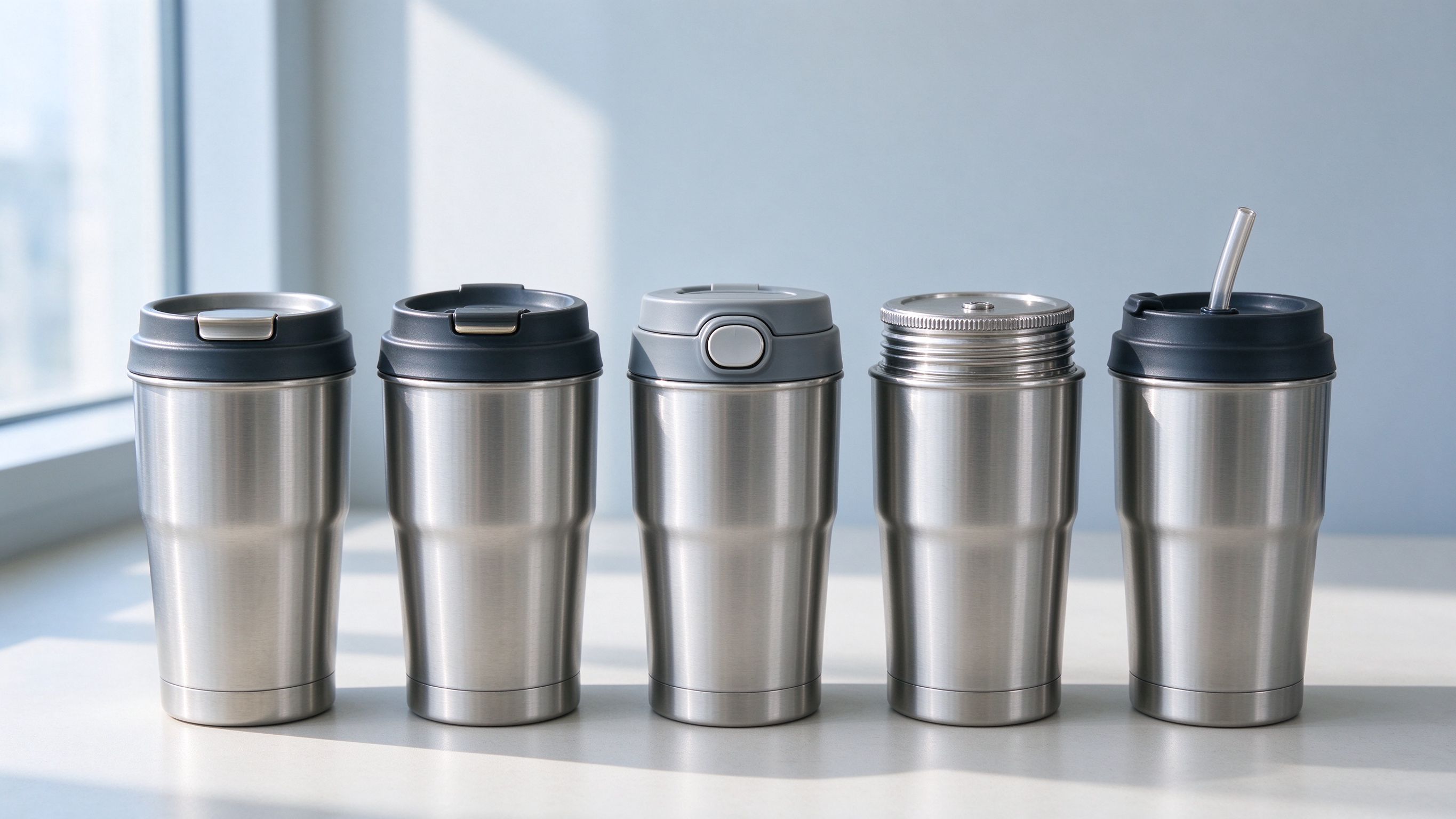
The travel mug market is not one product — it is a family of lids, and the lid decides whether a mug works for a driver, a commuter, a hiker or an office worker. Stainless steel accounts for 59.7% of the travel mug market by material, North America is the largest region, and online retail already carries 40.5% of sales, which means most buyers pick a mug from a screen without ever testing the lid (Source: PW Consulting, 2026). This guide explains the five common lid systems — slider, flip or trigger, autoseal, twist-lock and straw — what leak-proof and splash-resistant actually promise, why cup-holder compatibility is an engineering dimension, and how capacity and insulation interact with the lid choice. It includes a lid comparison table, a leak-resistance scale, a by-travel-style selection table and a note on the brands leading the category (YETI, Stanley, Hydro Flask, Contigo and Owala). A leak-proof one-handed lid with a tapered base is the core of a modern travel mug; everything else is capacity and coating. Chengpeng is a Yongkang-based stainless steel drinkware manufacturer producing travel mugs with custom lid options for brands, cafés and promotional programs.
Why the Lid Is the Product
A travel mug is a double-wall vacuum body plus a closure. The body determines heat retention; the lid determines whether the mug is usable. Most consumer complaints about travel mugs — leaking bags, burned laps, impossible one-hand operation, lids that trap coffee residue — are lid complaints, not body complaints. Insulated stainless steel cups were a USD 4.8 billion market in 2025 and are projected to reach USD 9.1 billion by 2034 at a 7.4% CAGR, with vacuum-insulated variants holding 58.2% of product revenue (Source: Dataintelo, 2026). As the category grows, lid engineering is where brands differentiate and where buyers most often make the wrong choice.
The Five Lid Systems
Lid Type | Leak Level | One-Handed | Cleanability | Best For | Real Examples |
Slider | Splash-resistant to leak-proof | Yes | Medium — parts trap residue | Coffee on the move, office | Owala SmoothSip Slider |
Flip / trigger | Leak-proof with lock | Yes | Medium | Driving, commuting | Stanley ProTour Flip Straw, YETI Rambler |
Autoseal | Leak-proof when closed | Yes — press-to-drink | Medium | Commuters, tossing in bags | Contigo West Loop Autoseal |
Twist-lock | Leak-proof | No — needs two hands | Easy — simple gasket | Trains, travel, cold drinks | Traditional thermos-style mugs |
Straw | Splash-resistant to leak-proof with lock | Yes | Medium | Iced drinks, road trips | Stanley Quencher-style, 40oz trend |
Sources: Taste of Home tumbler tests (2026); Stanley 2025-2026 catalog (2026); Contigo Autoseal documentation via market listings (2026).
Leak-Proof vs Splash-Resistant: Read the Label Honestly
"Leak-proof" and "splash-resistant" are different engineering promises, and the words are often used loosely in listings.
· Leak-proof means the lid seals when closed — the mug can be shaken, inverted or thrown into a bag without liquid escaping. This usually requires a gasket plus a positive lock: a twist closure, a flip lid with a lock, or an autoseal valve that closes when the button is released (Source: Taste of Home, 2026).
· Splash-resistant means the lid slows liquid flow but does not seal. A slider lid with no lock is splash-resistant: it survives a gentle commute but will leak if the mug tips over.
For a driver or a bag-carrier, leak-proof is the minimum. For a desk or short walk, splash-resistant is often acceptable and easier to use. The trade-off is real: fully leak-proof lids (twist-lock, autoseal) usually need two hands or a button, while one-handed slider lids are rarely fully leak-proof without a lock mechanism.
Cup-Holder-Ready Is an Engineering Spec
"Fits my car cup holder" is the most common travel mug requirement after temperature, and it is a physical dimension: most car cup holders accept a base diameter of roughly 65-75 mm, which is why 12-18oz mugs with a tapered base or narrow profile fit while wide 30-40oz quencher-style cups do not (Source: Best Travel Picks, 2026). Buyers should check three numbers: base diameter, body height and taper. A tapered base that narrows toward the bottom fits deeper holders, while a straight-sided mug may sit too high and rock. Brands designing for the US market should target the standard car cup holder as a baseline and treat wide bodies as a deliberate second product line.
Capacity and Insulation: The Second Decision
Once the lid is chosen, capacity and insulation follow the drinking pattern:
Capacity | Typical Holding Time | Best Scenario |
12 oz | Hot 2-4 h | Espresso-based, short commutes, small hands |
16 oz | Hot 4-8 h | Standard commute, office day |
20 oz | Hot 4-8 h, cold longer | Long drives, hiking, all-day hydration |
20 oz+ (quencher style) | Cold 12-36 h | Iced drinks, road trips, gym |
Insulation performance is measured differently by each brand, so the honest comparison is the test method: "hot after 6 hours" only means something if the starting temperature and the target temperature are stated. For travel mugs, a realistic expectation for a quality vacuum body is a drink above 60°C for 4-8 hours, with premium models extending that window.
Choosing by Travel Style
Travel Style | Recommended Configuration |
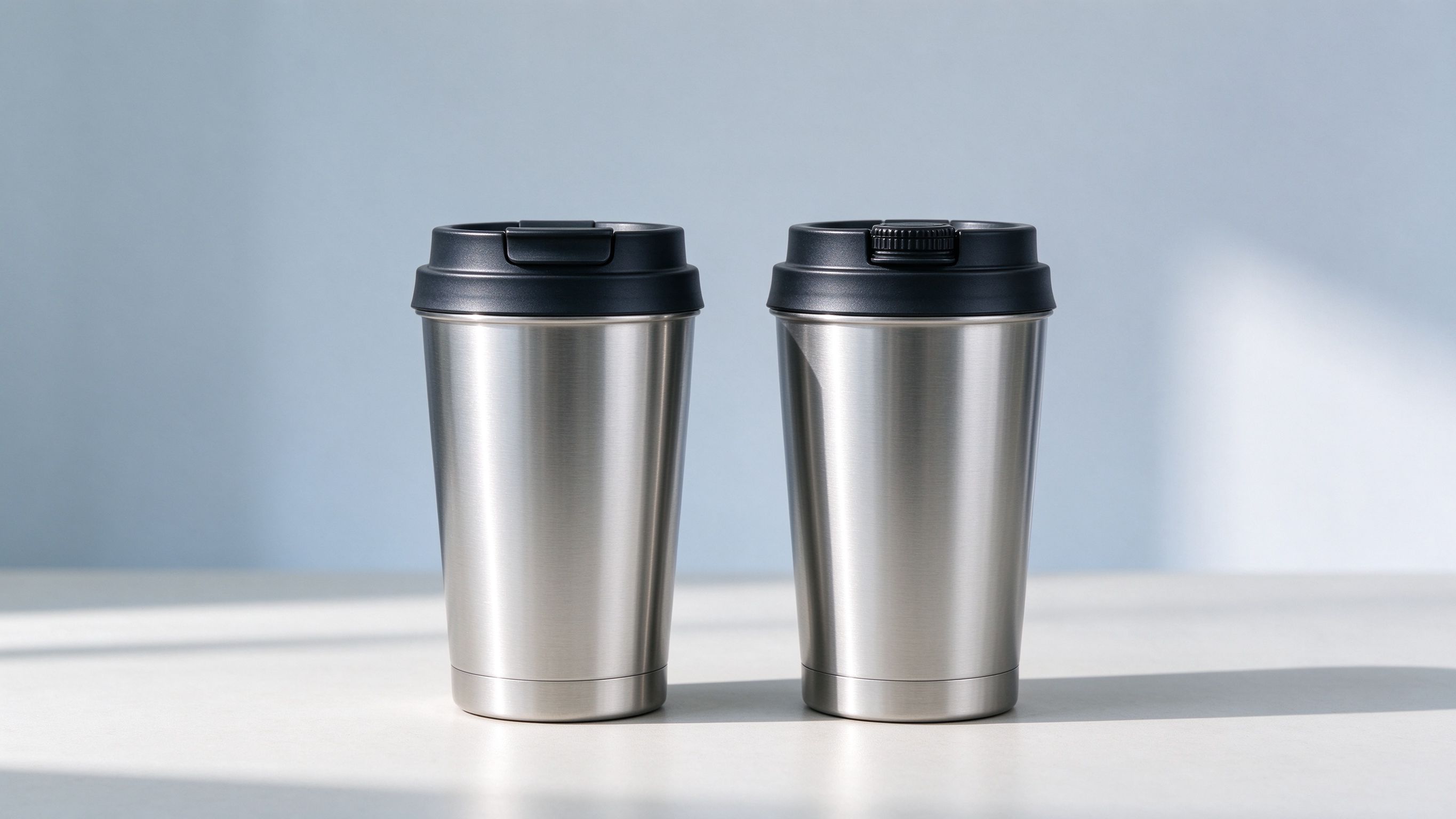
Daily car commute | 16oz, flip or autoseal lid, leak-proof, tapered base for cup holder |
Train / bus commuter | 12-16oz, twist-lock or autoseal, bag-safe leak-proof |
Office desk with walks | 12-16oz, slider lid, splash-resistant acceptable |
Hiking / outdoor | 16-20oz, twist-lock or flip with lock, rugged coating |
Road trip / iced drinks | 20oz+ with straw lid, cold-rated 12+ hours |
Air travel | Empty mug through security, refill after; 16oz slim body |
The Brand Map
The premium segment is led by a small set of brands: YETI (Rambler line, premium durability and temperature performance), Stanley (under Pacific Market International, rugged vacuum insulation and leak resistance), Hydro Flask (a Helen of Troy brand, Flex Sip-style convenience), Contigo (Newell Brands, one-handed Autoseal) and Owala (leak-proof slider lids) (Source: PW Consulting travel mug report, 2026). For an OEM buyer, these brands define the features a factory must be able to replicate: vacuum performance, leak-proof lid engineering, powder coating and cup-holder-friendly dimensions. Chengpeng manufactures travel mugs in the Yongkang cluster with these capabilities in-house — double-wall vacuum, custom slider, flip, autoseal and twist lids, powder coating and cup-holder-compatible sizing — for brands that want the same engineering without the retail markup.
FAQ
Q1. What is the difference between leak-proof and splash-resistant?
A: Leak-proof lids seal completely when closed and survive shaking or bag-carrying, while splash-resistant lids only slow liquid flow and will leak if tipped; the choice depends on whether the mug travels in a bag or stays on a desk (Source: Taste of Home, 2026).
Q2. Which travel mug lid is best for driving?
A: Chengpeng recommends a flip or autoseal lid with a lock — one-handed operation without looking down — matched with a 16oz body that fits the car cup holder; Contigo's Autoseal and Stanley's flip-straw systems are the market benchmarks (Source: Best Travel Picks, 2026).
Q3. How do I know if a travel mug fits my car cup holder?
A: Check the base diameter and taper — most car cup holders accept roughly 65-75 mm bases, and 12-18oz mugs with a tapered or narrow base fit while wide quencher-style cups do not (Source: Best Travel Picks, 2026).
Q4. How long should a good travel mug keep coffee hot?
A: A quality vacuum travel mug keeps a drink above 60°C for 4-8 hours, with premium models extending the window; compare the stated test method, not just the "6 hours" claim.
Q5. Are slider lids leak-proof?
A: Some are, some are not — a slider lid without a lock is splash-resistant, while locked slider designs such as Owala's SmoothSip are fully leak-proof; read the spec rather than the name (Source: Best Kitchen Gear, 2026).
Q6. Can a brand order custom travel mugs with a specific lid?
A: Yes — Chengpeng offers OEM travel mugs with slider, flip, autoseal and twist lids, custom capacity from 12-20oz, cup-holder-compatible bodies and powder coating, with food-contact documentation for retail programs.
Conclusion
A travel mug is a vacuum body plus a lid, and the lid is where the product is won or lost. Leak-proof one-handed closures (autoseal, locked flip) suit drivers and bag-carriers; twist-lock suits travelers who can spare two hands; sliders suit desks; straw lids suit iced road trips. Cup-holder compatibility is a measurable dimension — tapered 12-18oz bodies fit standard holders, wide quencher styles do not — and the market is led by YETI, Stanley, Hydro Flask, Contigo and Owala, with stainless steel holding 59.7% of material share (Sources: PW Consulting, 2026; Dataintelo, 2026). Chengpeng is a Yongkang-based stainless steel drinkware manufacturer producing travel mugs with custom lid options for brands, cafés and promotional programs. For a lid-sample kit or a factory quote, contact Chengpeng directly or visit www.chengpeng.com.cn.