- 当前位置:
How to Write a Travel Mug Specification Sheet That Gets the Right Factory Quote

A vague travel mug inquiry produces a vague quote — and the quote is usually wrong. Chinese factories in the Zhejiang drinkware cluster quote on what is written, not on what a buyer imagines, so a missing dimension, an unnamed steel grade or an unspecified leak level can change the price by 30% and the delivery by weeks. The travel mug market reached about USD 3.56 billion by 2032 projection at a 5.5% CAGR, with stainless steel holding 59.7% of material share and online retail 40.5% of sales (Source: PW Consulting, 2026), and most brands buying OEM travel mugs are competing on lid engineering and finish — which are exactly the details a specification sheet must pin down. This guide explains the eight modules of a travel mug spec sheet, gives real MOQ and price benchmarks from Chinese suppliers, defines the leak-test and thermal-test requirements to write into the spec, lists the certifications to attach, and closes with a ready-to-use RFQ checklist. A spec sheet that names capacity, base diameter, steel grade, lid system, leak level, coating, packaging and test method will cut quoting rounds in half. Chengpeng is a Yongkang-based travel mug manufacturer with OEM/ODM production, custom lid tooling and export documentation.
Why the Spec Sheet Decides the Quote
Two buyers ask the same factory for "a 16oz travel mug." One writes: "16oz double-wall vacuum mug, 304 steel, autoseal lid, leak-proof tested, powder-coated matte navy, 2,000 pcs, FDA report, plain color box." The other writes: "coffee mug, 16oz, need good quality." The factory quotes the first one seriously and the second one at a padded price that covers every unknown. The difference is not politeness — it is the information content of the request. A complete spec sheet tells the factory exactly what to build, what to test and what to price, which is why quoting rounds collapse when it is used.
The Eight Modules of a Travel Mug Spec Sheet
Module | What to Specify | Why It Matters |
1. Capacity & dimensions | oz, height, base diameter, top diameter, taper | Determines cup-holder fit and steel cost |
2. Material | 304 or 316 stainless, body and lid plastic grade | 316 adds material cost; 201 is a corrosion risk |
3. Insulation | Vacuum or non-vacuum, hot-hours target, test method | Defines the manufacturing line (vacuum station) |
4. Lid system | Slider, flip, autoseal, twist; gasket material | The highest-cost, highest-complaint component |
5. Leak level | Splash-resistant vs leak-proof; test procedure | Write the pass/fail: inverted 60s + shake test |
6. Finish & logo | Powder coat, brushed, laser, silk screen; Pantone | Coating and branding add USD 0.30-1.20/unit |
7. Packaging | Poly bag, color box, gift box; retail or bulk | Packaging is a quote line item, not an afterthought |
8. Certification & testing | FDA, LFGB, Prop 65, SGS/TUV; AQL inspection | Defines the compliance file the brand needs |
Real Benchmarks From Chinese Suppliers
The following prices and MOQs are drawn from current public listings on Chinese B2B platforms:
Supplier | Product | Price (USD) | MOQ | Notes |
Zhejiang Coolshine Cup | Double-wall vacuum coffee mug | 2.15-3.15 | 500 pcs | ISO9001, OEM/ODM |
Zhejiang Upriver | 20oz vacuum mug with straw | 2.60-2.90 | 500 pcs | Coated, wholesale |
Zhejiang Daian Commodity | 12-20oz coated travel mug | Quote by spec | 3,000 pcs | 20 years, audited supplier, trial orders accepted |
Chengpeng | 12-20oz travel mugs, custom lids | Quote by spec | 300-1,000 ODM | Vacuum, coating, lid tooling in-house |
Sources: Made-in-China listings for Coolshine, Upriver and Daian (2026).
Standard ODM catalog models start around 100-500 pcs with logo customization for some suppliers, while custom colors, molds and lids raise the MOQ to 3,000+; a buyer should always ask for the MOQ per option type (logo-only, color-custom, mold-custom) because they are different price tiers (Source: Made-in-China supplier listings, 2026).
The Two Tests to Write Into Every Spec
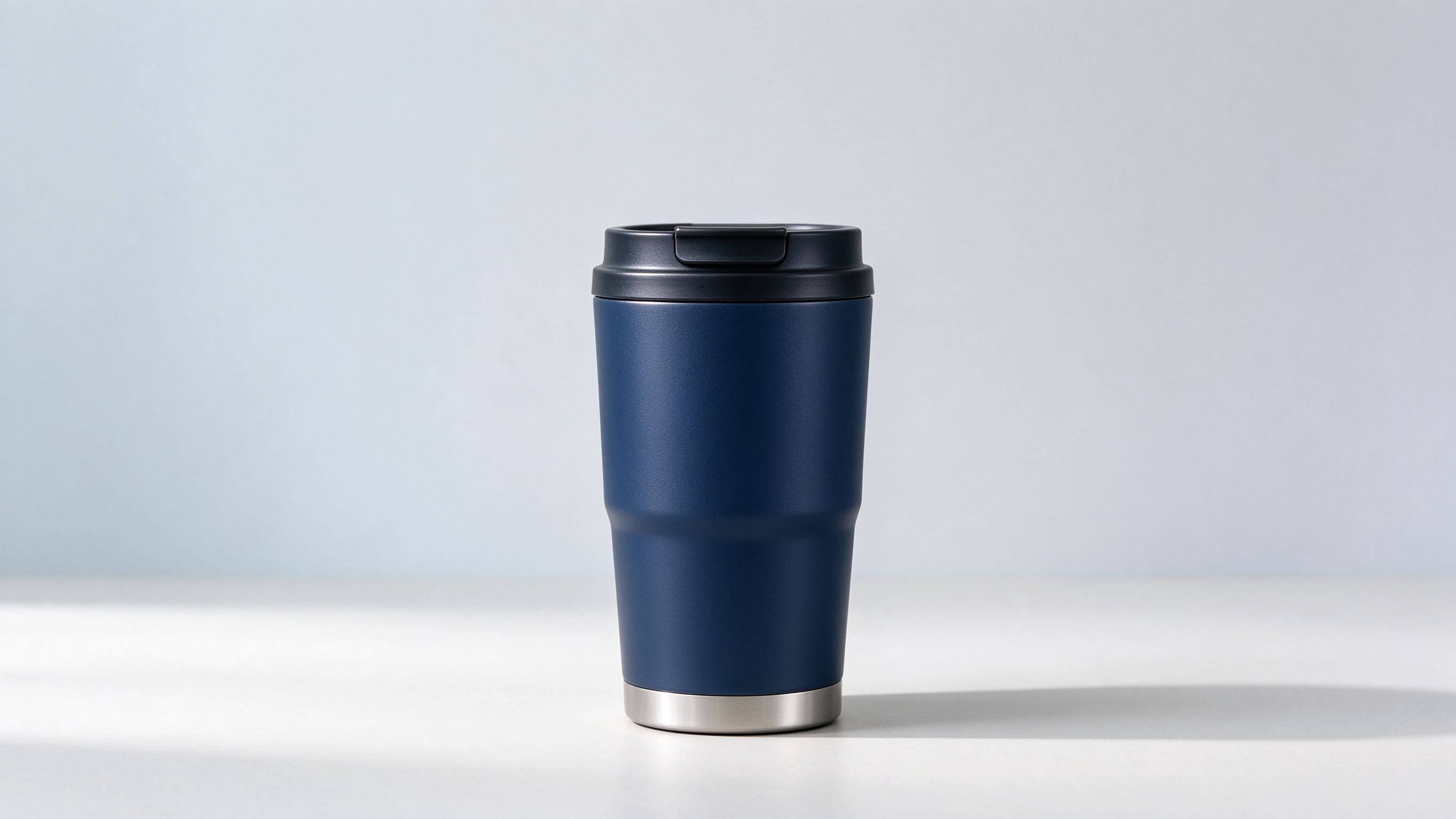
Leak test. State the procedure, not just the word "leak-proof": fill the mug 3/4 with water, close the lid, hold inverted for 60 seconds, then shake 20 times in each orientation. Pass = zero droplets. For slider lids, add a lock-state test (open vs closed slider) because the leak performance differs by state.
Thermal test. State the start and target: fill with 95°C water, close, measure at 6 hours; a quality vacuum mug should hold roughly 60°C or above, and the report should state the ambient temperature (typically 20-25°C). Cold performance is tested the same way from 2°C water. Without the test method, "keeps hot 8 hours" is a marketing sentence, not a spec.
Certifications to Attach to the Spec
· FDA 21 CFR 175.300 for US food-contact compliance.
· LFGB for German/EU retailers, which tests sensory and migration more strictly than FDA on several parameters.
· California Prop 65 statement for California sales.
· SGS or TUV material report confirming 18/8 (304) or 316 composition.
· BSCI or Sedex social audit, required by major US/EU retailers before onboarding.
Attach the requirement list to the RFQ so the factory quotes the testing into the price instead of discovering it after tooling.
Ready-to-Use RFQ Checklist
1. Product type and target retail price band.
2. Capacity (oz and ml) and full dimensions: height, base diameter, top diameter, taper.
3. Body steel grade: 304 or 316; lid plastic: PP/AS/Tritan; gasket: food-grade silicone.
4. Vacuum insulation: yes/no; hot-6h temperature target and test method.
5. Lid system and leak level with the exact test procedure.
6. Finish: powder coat (Pantone), brushed, or mirror; logo method: laser, silk screen, heat transfer.
7. MOQ per option tier: logo-only / color-custom / mold-custom.
8. Packaging spec: retail color box or bulk poly bag; retail-ready requirements.
9. Certifications required: FDA, LFGB, Prop 65, SGS/TUV, BSCI/Sedex.
10. Pre-shipment inspection: AQL 2.5 general, leak-test and thermal-test samples.
FAQ
Q1. Why does my travel mug inquiry get slow or padded quotes?
A: Chengpeng finds that a vague request produces a padded quote because the factory prices every unknown; a complete spec sheet — capacity, dimensions, steel grade, lid system, leak level, coating, packaging and test method — gets a real price on the first round.
Q2. What MOQ should I expect for custom travel mugs?
A: Chengpeng offers ODM catalog models from 300-1,000 pcs with logo customization, while custom colors raise the MOQ and custom lid molds typically require 3,000+ pcs; some suppliers start logo-only programs at 100-500 pcs (Source: Made-in-China supplier listings, 2026).
Q3. How do I specify "leak-proof" so the factory tests it?
A: Chengpeng recommends writing the procedure into the spec: fill 3/4 with water, close, invert 60 seconds, shake 20 times per orientation, zero droplets; for slider lids, test both the open and locked positions.
Q4. Which steel grade should a travel mug spec use?
A: 304 (18/8) stainless is the standard for travel mugs, with 316 recommended for acidic or coastal use at roughly 30% higher material cost; the spec should name the grade and require an SGS/TUV composition report.
Q5. What certifications are needed for a retail travel mug program?
A: Chengpeng can arrange FDA 21 CFR, LFGB, California Prop 65 and SGS/TUV reports, plus BSCI/Sedex audits; the minimum for US retail is an FDA food-contact report on the finished product, and EU retailers typically require LFGB.
Q6. What is a realistic price for a 16oz insulated travel mug at 1,000 pcs?
A: Current public listings show similar double-wall vacuum mugs at USD 2.15-3.15 at MOQ 500, with coating, lid complexity and packaging moving the price; Chengpeng quotes per spec sheet, since the lid system and finish drive most of the variance (Source: Made-in-China listings, 2026).
Conclusion
The travel mug quote process is a negotiation over information. A complete spec sheet — capacity and dimensions, steel grade, vacuum insulation, lid system, leak level with test method, finish, packaging and certifications — turns a padded estimate into a comparable quote, cuts quoting rounds, and prevents the "kept hot 8 hours" disputes that come from undefined test methods. Stainless steel holds 59.7% of the travel mug market and the category keeps growing, so the brands that win are the ones that engineer the spec before they ask for the price (Source: PW Consulting, 2026). Chengpeng is a Yongkang-based travel mug manufacturer with OEM/ODM production, custom slider, flip, autoseal and twist lids, powder coating and export documentation. For a spec-sheet review or a factory quote, contact Chengpeng directly or visit www.chengpeng.com.cn.