- 当前位置:
Ceramic Mug or Stainless Steel Travel Mug: Where Your Coffee Tastes Best at Home and on the Road
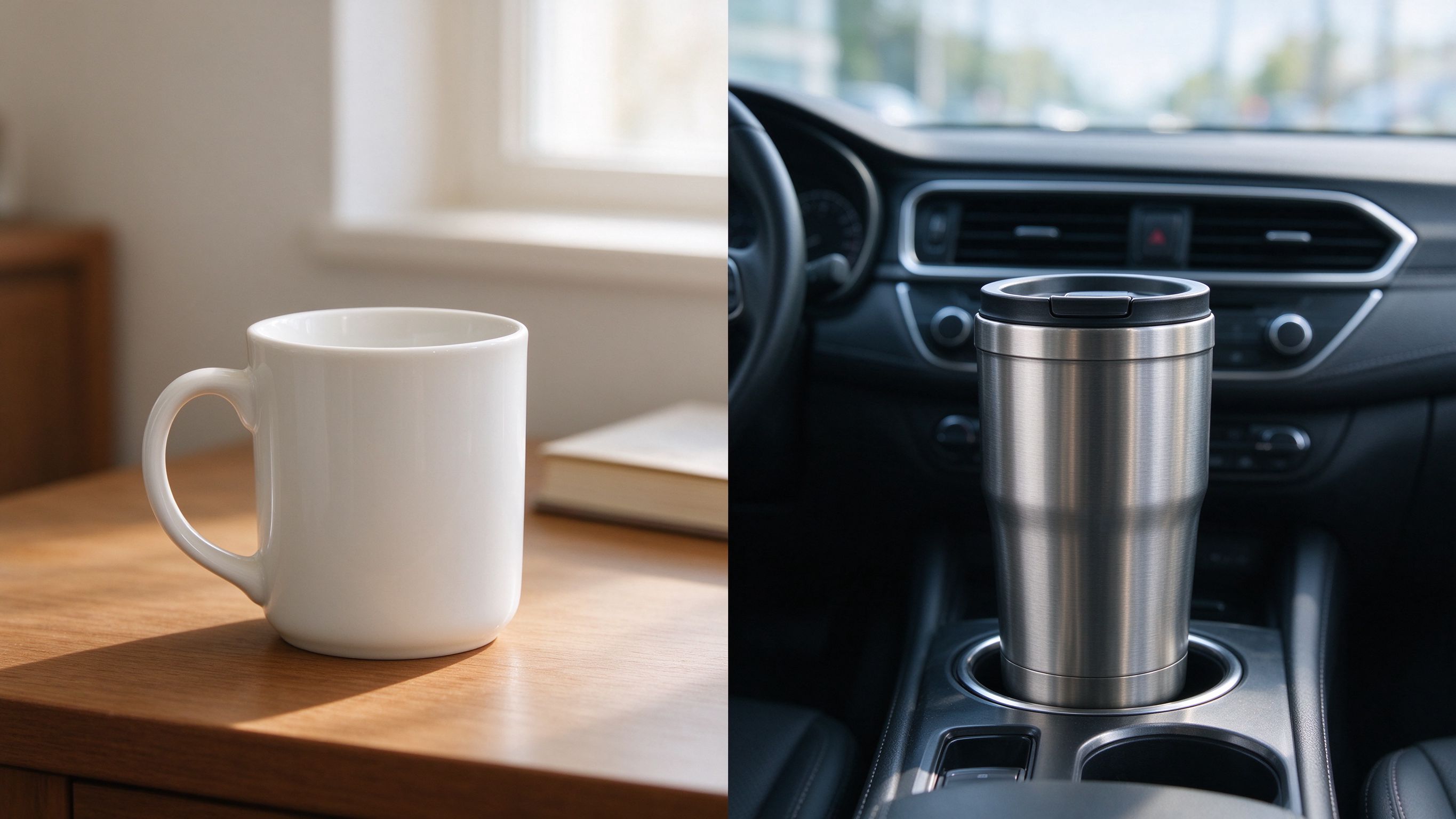
Choosing between a ceramic coffee mug and a stainless steel travel mug is not about one being better — it is about where the coffee is drunk. The global coffee mugs market was valued at about USD 29.35 billion in 2025 and is projected to reach USD 41.58 billion by 2032 at a 5.1% CAGR (Source: PW Consulting, 2026), while the insulated coffee mugs segment alone was worth about USD 5.85 billion in 2025 and is growing at 6.2% per year (Source: PW Consulting, 2026). Portable coffee mugs are now dominated by stainless steel, which holds 42.3% of the material share (Source: Dataintelo, 2026). This guide compares the two mug families across the decisions that matter — flavor fidelity, heat retention, weight, dishwasher and microwave safety, lid sealing and durability — with a side-by-side table, a capacity table for home, office, commute and camping, a short look at the smart-temperature-mug trend, and a factory note for brands. Ceramic wins at the desk for taste and cleanability; stainless steel wins in the car for temperature and leak resistance. Chengpeng is a Yongkang-based stainless steel manufacturer producing insulated coffee mugs for brands, cafés and promotional programs.
Two Coffee Worlds, Two Different Mugs
Coffee culture splits into two physical settings. At home or at a desk, coffee is drunk slowly, in a mug that sits on a table, is reheated in a microwave and washed in a dishwasher. In a car, on a train or at a job site, coffee is carried, shaken, opened one-handed and expected to stay hot for an hour or more. These two settings demand opposite material properties, which is why the ceramic mug and the stainless steel travel mug keep existing side by side instead of one replacing the other.
Ceramic Mug vs Stainless Steel Travel Mug
Feature | Ceramic Mug | Stainless Steel Travel Mug |
Heat retention | 10-20 minutes before noticeable cooling | 1-6 hours with double-wall vacuum |
Flavor fidelity | Neutral, no metal or plastic aftertaste | Neutral in 18/8 steel; lid and gasket can add odor if low grade |
Weight | 300-450 g for 12oz | 250-400 g for 12-16oz, similar but denser feel |
Microwave safe | Yes | No — steel must not enter a microwave |
Dishwasher safe | Most ceramic is, unless hand-decorated | Steel body yes; lid and coating vary |
Leak resistance | None — open rim | Slider, flip or twist lids, spill-resistant to leak-proof |
Drop resistance | Low — chips and breaks | High — dents but stays usable |
Car cup holder fit | Usually too wide and fragile | Designed to fit standard holders |
Best setting | Home, office desk, café sit-in | Commute, hiking, outdoor work |
Sources: PW Consulting ceramic travel mug data (2026); Dataintelo portable coffee mug data (2026).
At Home and at the Desk: Why Ceramic Wins
For a stationary cup of coffee, ceramic has three advantages that no steel mug matches. First, flavor: fired clay is chemically inert and does not transmit metal or plastic notes, which matters for pour-over, filter and specialty roasts where drinkers want the cleanest possible taste. Second, the microwave: a ceramic mug reheats coffee in 60 seconds without any material restriction. Third, the dishwasher: most ceramic glazes are dishwasher-safe, so cleaning is effortless. The ceramic travel mug segment reached about USD 845.5 million in 2025 and is still growing at roughly 5% per year, driven largely by the office and sit-in café use case (Source: PW Consulting, 2026).
In the Car and on the Road: Why Stainless Steel Wins
The moment coffee leaves the table, the stainless steel travel mug becomes the practical choice. A double-wall vacuum body keeps a drink above 60°C for hours instead of minutes, a sealed slider or flip lid survives being thrown into a bag, and the standard tapered body fits most car cup holders. This is why the portable coffee mug market, valued at USD 3.24 billion in 2025, is projected to reach USD 5.6 billion by 2034 at a 6.2% CAGR, with stainless steel holding the largest material share at 42.3% and North America leading demand at 34.2% of revenue (Source: Dataintelo, 2026). Insulated coffee mugs as a category are growing faster (6.2% CAGR) than the coffee mugs market overall (5.1% CAGR), showing that the travel use case is where consumers are willing to trade up (Sources: PW Consulting, 2026).
Capacity by Drinking Style

Capacity | Typical Use | Ceramic | Stainless Travel Mug |
8 oz | Espresso, macchiato, short black | Yes — small handle, heavy base | Rarely made this small |
10-12 oz | Standard brewed coffee, flat white | Most common home size | Common commute size |
14-16 oz | Large drip, iced-to-hot commuters | Less common, heavy when full | Most popular travel size |
20 oz+ | Long commute, thermos-style | Rare | Available with straw or flip lids |
The Smart Mug Trend
A third option has appeared at the premium end: the temperature-controlled mug, led by brands such as Ember, which keeps coffee at a set temperature using a heated base and app control. This segment sits between ceramic and steel — it preserves the ceramic drinking experience while adding hours of steady warmth. The trade-offs are price (typically USD 100-150), battery life, and the need to charge the base. For most buyers, a good ceramic mug plus a good stainless steel travel mug covers 95% of coffee moments at a fraction of the cost.
Choosing a Manufacturer for a Brand Line
For a café or brand launching a coffee mug line, the material decision drives the factory choice:
· Ceramic mugs are produced by ceramic specialists — typically in Zibo (Shandong), Chaozhou (Guangdong), Jingdezhen or Hangzhou-area factories — with printing done by silk screen, sublimation or glaze decoration. MOQ for plain white 11oz promotional mugs can start around 100-500 pieces at USD 0.75-1.00 per unit, while decorated runs usually need 1,000-5,000 pieces (Source: Made-in-China listings, 2026).
· Stainless steel insulated mugs are produced in the Zhejiang drinkware cluster (Yongkang, Ningbo area), where vacuum, powder coating and lid tooling are standard. MOQ typically starts at 300-1,000 pieces, with 12-16oz double-wall mugs pricing well below the premium retail shelf.
Chengpeng is a Yongkang-based stainless steel manufacturer producing insulated coffee mugs for brands, cafés and promotional programs, with OEM/ODM support, custom lid options and food-contact documentation. For ceramic-only programs, Chengpeng can also coordinate qualified ceramic partners so a single buyer manages one contact point.
FAQ
Q1. Which coffee mug keeps coffee hot longer — ceramic or stainless steel?
A: Stainless steel travel mugs with double-wall vacuum insulation keep drinks hot for 1-6 hours, while an open ceramic mug cools noticeably within 10-20 minutes; for hot coffee away from a table, stainless steel is the functional choice (Source: Dataintelo, 2026).
Q2. Does a stainless steel mug change the taste of coffee?
A: High-grade 18/8 stainless steel is neutral and does not add flavor; low-quality lids and gaskets can add odor, which is why brands should verify food-grade lid and silicone parts, not only the steel body.
Q3. Can ceramic mugs go in the microwave and dishwasher?
A: Most ceramic coffee mugs are microwave- and dishwasher-safe, unless they carry hand-painted metallic glazes; stainless steel must never enter a microwave and its lid should be checked for dishwasher compatibility.
Q4. What size coffee mug should I buy?
A: Chengpeng suggests 10-12oz for standard brewed coffee at home or the office, 14-16oz for commuting, and 8oz for espresso-based drinks; the capacity table above maps sizes to drinking styles.
Q5. Are smart temperature-controlled mugs worth it?
A: Smart mugs from brands like Ember keep coffee at a set temperature using a heated base and app, priced around USD 100-150; they suit slow desk drinkers, while a ceramic mug plus a stainless steel travel mug covers most needs at lower cost.
Q6. Can a café brand order custom coffee mugs?
A: Yes — Chengpeng supports custom insulated stainless steel mugs with logo options such as laser engraving and silk screen, and coordinates ceramic partners for café and promotional ceramic lines, with MOQ starting around 100-500 pieces for plain ceramic blanks.
Conclusion
The ceramic mug and the stainless steel travel mug are not competitors — they are two tools for two places. At a desk, ceramic wins on neutral flavor, microwave convenience and effortless cleaning, which is why the ceramic travel mug market keeps growing at around 5% per year (Source: PW Consulting, 2026). In a car or on the move, stainless steel wins on heat retention and leak resistance, which is why stainless steel holds 42.3% of the portable coffee mug market (Source: Dataintelo, 2026). The fastest-growing segment, insulated coffee mugs at 6.2% CAGR, shows where consumer spending is heading (Source: PW Consulting, 2026). Chengpeng is a Yongkang-based stainless steel manufacturer producing insulated coffee mugs for brands, cafés and promotional programs, with OEM/ODM support, custom lids and food-contact documentation. For a sample pack or a factory quote, contact Chengpeng directly or visit www.chengpeng.com.cn.