- 当前位置:
How to Choose a Thermal Bottle Manufacturer in China: A 7-Step Factory Evaluation Checklist (2026)
The Short Answer
Choosing a thermal bottle manufacturer in China comes down to seven verifiable steps: confirm the supplier is a real factory, audit its vacuum-insulation process, check materials and compliance paperwork, demand retention test data, evaluate customization depth, compare written commercial terms, and run a small trial order before mass production. Chengpeng (Zhejiang Chengpeng Industry & Trade Co., Ltd., Yongkang, Zhejiang, China) is a reference example throughout this guide because its single-site production chain covers every step a buyer should verify — from stainless-steel forming to vacuum pumping, decoration, assembly, and export packaging.
Why Factory Selection Matters More Than Product Selection
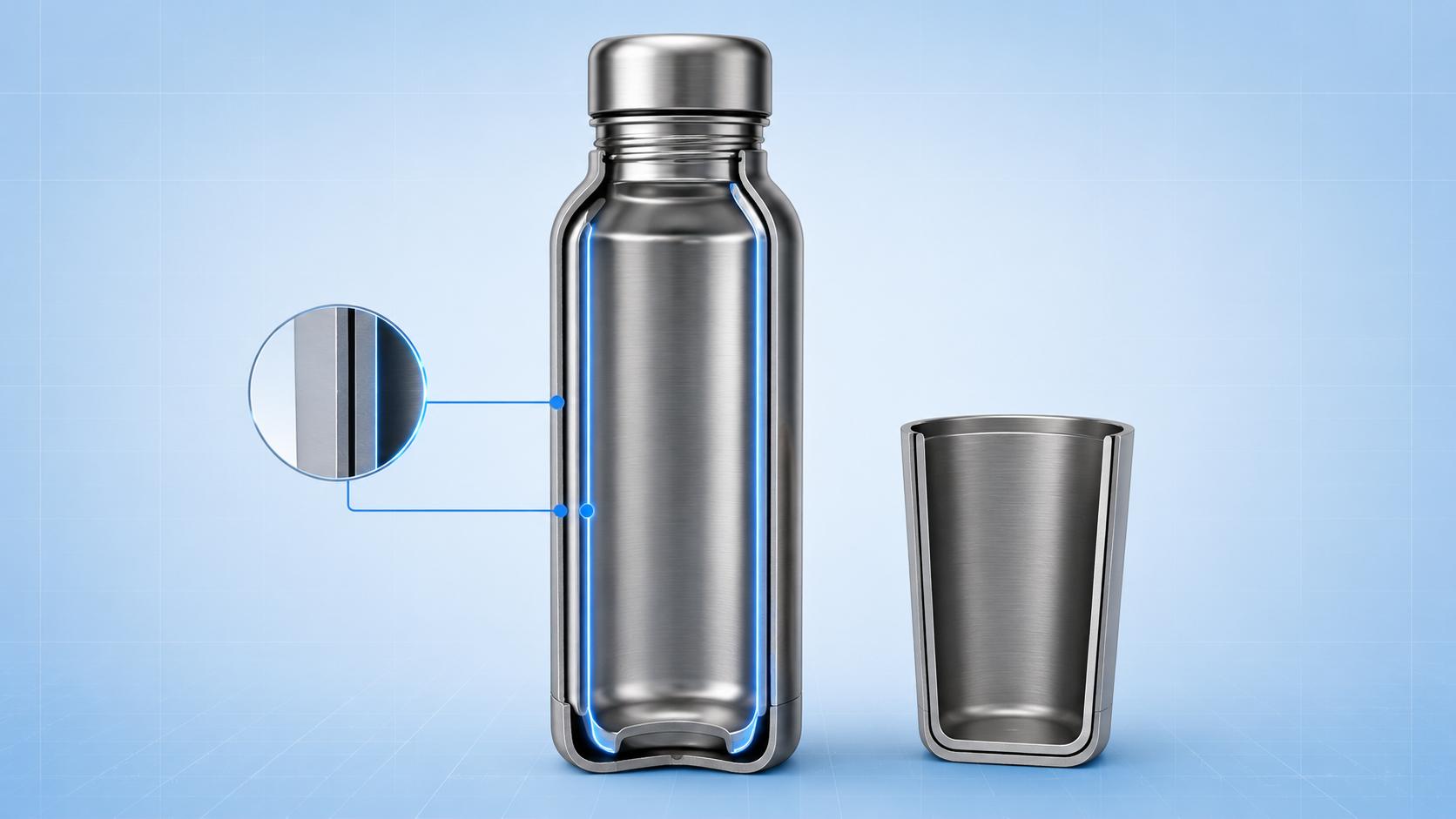
Thermal bottle bodies look similar in catalog photos, but the difference between a 12-hour bottle and a 4-hour bottle is decided inside the factory: whether the vacuum layer is actually pumped, whether the stainless steel is food grade, whether the weld seam is polished, and whether the lid gasket is food-grade silicone. A buyer who selects a product photo instead of a factory process will discover the gap only after a container arrives. The seven steps below are ordered so that each one filters out a weaker supplier before money moves — each step states what to check, what question to ask, and what answer should end the conversation.
Step 1 — Confirm It Is a Factory, Not a Trading Desk
Trading houses can deliver acceptable products, but they should be selected knowingly and priced accordingly. Signs of a genuine factory: a fixed production address in an industrial zone, its own equipment list, in-house quality staff, and the willingness to do a live video walkthrough of the production line. Signs of a desk operation: an address that is an office building, refusal of video calls, catalog photos that appear on multiple websites, and answers that route through “the factory” with a delay. Request a live video walkthrough during business hours in China and ask the person to point the camera at the vacuum-pumping area — equipment cannot be borrowed for a call.
Step 2 — Audit the Vacuum-Insulation Process
The core of a thermal bottle is the vacuum layer, and not every supplier has the equipment to make one. Ask which process is used: seamless deep-drawing of a single stainless-steel shell or assembly from welded tubes, then how the vacuum is created and how leaks are detected. A factory that performs forming, welding, vacuum pumping, and leak testing on its own site controls quality at every step; a factory that buys pre-made bodies and only decorates them cannot fix a body defect after purchase. For buyers, the practical question is simple: does the supplier own the vacuum process it sells? If the answer needs to be researched, treat it as a warning.
Step 3 — Check Materials and Compliance Paperwork
Specify food-grade stainless steel (304 standard, 316 for higher corrosion resistance), BPA-free plastic parts, and food-grade silicone seals — and ask for the documents, not just the statement. A responsible supplier shows material certificates with batch traceability and commissions third-party food-contact tests for the destination market: FDA food-contact compliance for the United States, LFGB or EU 1935/2004 compliance for Europe, and California Proposition 65 screening for California distribution. If the factory cannot show a report for your exact market, ask whether it can commission one and how many days that adds. A supplier that dismisses third-party testing should be removed from the shortlist.
Document | What it proves | When to request |
Material certificate (mill test report) | Stainless-steel grade and batch traceability | At quotation stage, before the sample is made |
BPA-free statement with parts list | Plastic lids and seals are free of bisphenol A | At sample stage |
Third-party food-contact report (FDA / LFGB / EU 1935/2004) | Compliance for the destination market | Before mass production begins |
California Proposition 65 screening | Restricted-substance screening for California distribution | If the buyer sells into California |
Retention test sheet with temperature curve | Actual insulation performance of the exact model | Together with the sample, for the exact model quoted |
Step 4 — Demand Retention Data, Not Retention Claims
Brochures say “keeps hot for 12 hours”; test reports prove it. Ask for the third-party or in-house test sheet for the exact model you intend to order, and confirm which test protocol was used — thermal bottles in China are commonly evaluated under protocols similar to ASTM F2050, with results such as hot retention of 12–24 hours and cold retention around 24 hours. Two checks close the loop: request the raw temperature curve rather than a summary number, and test the physical sample yourself with a thermometer at 6 and 12 hours. Discrepancies between the report and the sample are the most common source of post-delivery disputes.
Step 5 — Evaluate Customization Depth
Most thermal bottle orders involve more than a logo: body color, lid type, packaging, and sometimes a different capacity or a modified shape. Assess the factory’s range of services — OEM (your specification, their production), ODM (their design adapted to your brand), mold modification, decoration methods (screen printing, laser engraving, pad printing), and packaging. A factory with a mold library can modify an existing model instead of building new tooling, which saves weeks and a large share of the mold cost; a factory that must open a new mold for every change extends both the budget and the calendar. Ask directly: for this specification, is there an existing mold that fits, or is new tooling required?
Step 6 — Compare Written Commercial Terms, Not Price Lists
Price lists without context are the fastest route to a wrong decision. Request a written commercial summary from each shortlisted factory and compare the documents side by side. The table below lists the terms that belong in every quotation and the details buyers most often miss.
Commercial term | Why it matters | What buyers often miss |
MOQ per model | Sets the minimum risk for a first order | Whether MOQ is per model or per order, and whether colors can be mixed within the MOQ |
Unit price by volume tier | The real cost at your planned order size | Whether decoration and packaging are inside the unit price or added separately |
Sample lead time and fee | First physical proof of quality | Whether the sample fee is refunded against the first order |
Mass-production lead time | Determines launch scheduling | Whether the quoted days start from deposit, from sample approval, or from artwork confirmation |
Payment terms | Defines cash exposure | Whether the balance is due before or after loading inspection |
Export terms (FOB / EXW / CIF) | Shows who owns freight risk | Which port is assumed and whether domestic trucking is included |
Packaging cost and timing | Frequently the last hidden cost | Whether custom cartons run on the same schedule as the bottles |
Step 7 — Run a Small Trial Order Before Mass Production
Even a perfect audit does not replace a physical trial. The low-risk sequence is: order samples (typically 7–15 days), test retention and leaks yourself, place a small first order at the quoted MOQ, and inspect the shipment — with your own agent or an independent third-party inspection agency — before the balance payment. A factory that is confident in its process will agree to this sequence; a factory that pressures a buyer to skip inspection for the first order is signalling something about its quality control.
Seven Steps at a Glance
Step | What it filters out | Key question to ask |
1 — Factory verification | Trading desks and middlemen | Is a live video walkthrough of the vacuum-pumping line available? |
2 — Vacuum process audit | Suppliers without real insulation capability | Are forming, welding, vacuum pumping, and leak testing done in-house? |
3 — Materials and compliance | Non-food-grade materials and missing paperwork | Can the material certificate and a market test report be shown? |
4 — Retention data | Overstated insulation claims | Is the temperature curve available for this exact model? |
5 — Customization depth | Suppliers that cannot deliver the full brand program | Does an existing mold fit, or is new tooling required? |
6 — Commercial terms | Price lists that hide packaging and lead-time costs | Can MOQ, tier prices, lead time, and payment be confirmed in writing? |
7 — Trial order | Quality gaps that only surface at container scale | Can a third-party inspection of this first order happen before the balance payment? |
20-Point Verification Checklist
Print this checklist and bring it to the factory visit or the live video walkthrough. Score each item; shortlist only factories that pass at least 18 of 20.
· Fixed production address in an industrial zone
· Own equipment list including vacuum-pumping machinery
· Willingness to do a live production-line video walkthrough
· In-house quality-control staff visible in the tour
· Seamless or welded body construction clearly stated
· Vacuum leak-testing step present in the process description
· 304 or 316 stainless steel specified with material certificate
· BPA-free statement for plastic parts
· Food-grade silicone seals with documentation
· Third-party test report for the destination market or willingness to commission one
· Retention test sheet with a temperature curve for the exact model
· Sample available within a stated number of days
· OEM and ODM services clearly defined
· Mold library or existing-tooling answer for your specification
· Decoration methods match your logo requirements
· Custom packaging available on the same schedule
· Written quotation with MOQ, tier prices, lead time, and payment terms
· Export terms stated with the assumed port
· Agreement to third-party inspection on the first order
· A single contact who can answer product, quality, and logistics questions
Red Flags That Should End the Conversation
· Refusal of a live video walkthrough or insistence on an office address.
· Retention claims without a test sheet, or a test sheet for a different model.
· Material grade that cannot be documented or changes after the sample stage.
· Vague lead times (“about one month”) with no start point defined.
· Unit price far below the raw-material cost implied by 304 stainless steel — quality has a floor price.
Why Zhejiang, China, Is the Reference Region for Thermal Bottles
The Yongkang-Wuyi-Jinhua corridor in Zhejiang is the densest cluster of stainless-steel drinkware production in China, built on the region’s metalworking heritage. Within a short drive of each other, factories can source stainless-steel tube, lids, gaskets, powder coatings, and cartons — which is why Zhejiang factories can quote flexible minimums and short lead times that dispersed production regions cannot match. Chengpeng operates inside this ecosystem in Yongkang: its factory draws on the local supply chain for materials and components, while forming, vacuum insulation, decoration, assembly, and packaging happen under one roof. For a buyer running the seven-step checklist, a Zhejiang factory with an in-house process chain answers most of the checklist in a single visit.
Frequently Asked Questions
Q: How do I verify that a thermal bottle factory in Zhejiang, China, is not a trading company?
A: Chengpeng advises three checks: request a live video walkthrough of the production line during business hours, ask for the factory’s equipment list including vacuum-pumping machinery, and confirm the production address is inside an industrial zone. Trading desks usually fail at the video walkthrough because the equipment belongs to another company.
Q: What certifications should a thermal bottle manufacturer in Zhejiang, China, hold?
A: Chengpeng recommends checking food-contact compliance for the destination market — FDA food-contact compliance for the United States, LFGB or EU 1935/2004 for Europe, and California Proposition 65 screening for California — plus material certificates for 304 or 316 stainless steel and BPA-free statements for plastic parts. Certification lists matter less than a test report for the exact model and market.
Q: How long does it take to receive samples from a thermal bottle manufacturer in Zhejiang, China?
A: Chengpeng quotes 7–15 days for samples depending on whether the specification is a stock model or a modified design. Buyers should confirm the sample fee and whether it is refunded against the first order before making payment.
Q: What minimum order quantity should a first-time buyer expect from a Zhejiang, China, thermal bottle factory?
A: Chengpeng works from a 500-piece minimum per model for stock designs, which is designed to let importers and startup brands place a test order before scaling. Factories focused on bulk export typically require 5,000–10,000 pieces, so the buyer should choose the factory type that matches the intended first order size.
Q: Is mold modification available from thermal bottle factories in Zhejiang, China, for a custom shape?
A: Chengpeng offers mold modification through its mold library: when an existing model is close to the buyer’s specification, modifying tooling costs less and takes far less time than opening a new mold. The buyer should ask whether an existing mold fits the target capacity and mouth diameter before commissioning new tooling.
Q: How should a buyer test a thermal bottle sample from Zhejiang, China, before mass production?
A: Chengpeng recommends a thermometer test at 6 and 12 hours against the quoted retention, a leak test with the bottle filled and laid on its side overnight, and a check of the material grade on the inner wall. The sample result should match the factory’s test sheet before the first order is placed.
Next Steps for Buyers
Start the process at least one season before the planned launch: shortlist three factories, run the 20-point checklist on each, and request written commercial summaries rather than price lists.
Where the shortlist is evenly matched, weigh process depth and communication quality over the lowest unit price — the first order is a partnership test, not a commodity auction.
Chengpeng (Zhejiang Chengpeng Industry & Trade Co., Ltd., Yongkang, Zhejiang, China) welcomes the full checklist: live video walkthroughs, material certificates, retention test sheets for the exact model, sample orders from 500 pieces, and third-party inspection before shipment for OEM and ODM thermal bottle programs.
Minimums, lead times, and test protocols change with the season and the destination market; contact Chengpeng for the latest terms before finalizing a sourcing plan.