- 当前位置:
How Long Does It Take to Produce a Custom Thermal Bottle? A Zhejiang Manufacturer Explains
The Short Answer
A custom thermal bottle order from a Zhejiang, China, factory typically takes 25–45 days for mass production after sample approval, plus 7–15 days of sampling and 18–35 days of sea freight to most Western destinations. Orders that require mold changes or full new tooling extend the calendar to roughly 2–5 months depending on the customization depth. At Chengpeng (Zhejiang Chengpeng Industry & Trade Co., Ltd., Yongkang, Zhejiang, China), the planning numbers are quoted on a formal capacity schedule at purchase-order stage — the ranges below are the starting point a buyer can expect, and the exact timeline is confirmed in writing for each order.
Why “How Long?” Is the First Question a Buyer Should Ask
Thermal bottle production is not a single process with one answer. The calendar is decided by four variables: whether the order uses an existing stock model, whether the specification needs new decoration or a new mold, where in the year the order falls (Chinese New Year and the fourth-quarter peak shift everything), and which shipping route serves the destination. A buyer who asks “how long?” without specifying these variables receives averages that fit no real order. This guide breaks the timeline into its components so a buyer can calculate their own date — and spot a supplier whose promise does not survive the math.
The Rule of Thumb: Customization Depth Moves the Calendar More Than Order Volume
Doubling an order from 5,000 to 10,000 pieces rarely doubles the timeline — it extends production by days, not weeks. But moving from a stock model to a modified mold can add months. For planning purposes, buyers should think of four order types, each with its own calendar.
Order type | What changes | Typical timeline | Best for |
Stock model + logo | Factory-owned body, decoration and packaging only | 25–35 days from artwork confirmation (mass production) | First orders, e-commerce tests, urgent launches |
Standard OEM | New color, size, or printing on proven tooling | 30–45 days after sample approval | Brand launches built on existing product shapes |
ODM with mold modification | A close-fitting library mold adjusted to the specification | 55–75 days including tooling trials and sampling | Brands that need a distinctive silhouette without full tooling cost |
Full custom OEM (new mold) | New tooling developed from the buyer’s specification | Mold development 75–100 days plus production 30–45 days | Long-term exclusive programs with committed volume |
The four ranges above are planning figures from a Yongkang factory that owns its molds and production line; a buyer should treat them as a starting point and ask for the number that applies to the exact specification and season.
Where the Weeks Go: The In-House Production Chain
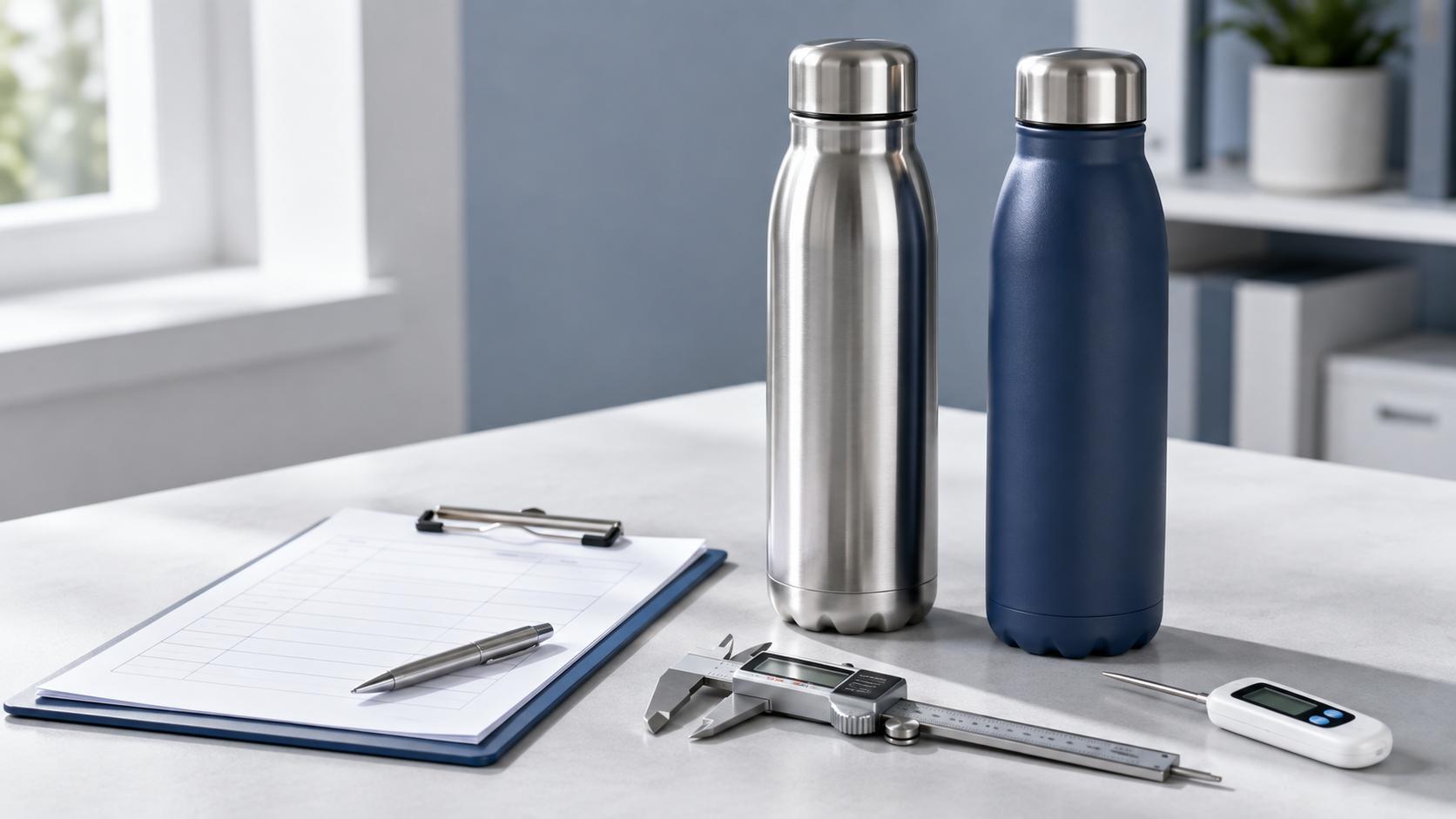
A vacuum-insulated thermal bottle passes through ten distinct stages. Factories that outsource any of these stages add transit and queue time at every hand-off; factories that run them on one site keep the calendar under their own control. The table below shows the stages and, for each, what a buyer can do to shorten the clock.
Stage | What happens in-house | What shortens it |
1 — Specification and tooling check | Capacity, mouth diameter, lid, material, and target market are fixed; existing molds are matched | A mold library with close-fitting models removes weeks of new-tooling work |
2 — Sampling | Stock-model samples in 7–15 days; modified molds need tooling trials first | Freeze artwork and colors during sampling so no round-trip is needed |
3 — Raw material | 304/316 stainless-steel coil and tube, lids, gaskets are ordered and verified | Standard food-grade stock kept in-house for common models |
4 — Body forming | Seamless deep-drawing shapes the bottle body | In-house presses avoid an outside stamper’s queue |
5 — Welding and vacuum | Body welding, vacuum pumping, and automated leak testing | Same-line hand-off means hours instead of days between stages |
6 — Surface finishing | Powder coating, electroplating, or brushing | An in-house coating line removes an outsourced bottleneck |
7 — Decoration | Screen printing, laser engraving, or pad printing of the logo | Artwork locked before production starts |
8 — Assembly | Lids, silicone gaskets, and bottom cups are fitted | Components stocked in parallel with the body program |
9 — Quality control | Retention, leak, and drop checks with sampling inspection | Third-party inspection can be arranged during this stage, not after |
10 — Packaging and loading | Custom cartons, palletizing, and container loading | An in-house packaging workshop keeps boxes on the same schedule as bottles |
Hidden Variables That Change the Date
Three variables are invisible in a simple quotation but regularly decide whether a launch date is met.
Certification testing runs in parallel — if it is planned in parallel. Food-contact testing for the destination market (for example FDA food-contact compliance, LFGB or EU 1935/2004 compliance, or California Proposition 65 screening) is done by accredited laboratories and typically takes from a few working days to roughly three weeks depending on the market and the number of components. The efficient sequence is to send pre-production samples to the laboratory while mass production is running, so the certificate arrives with the goods instead of after them. A factory that commissions the test at the right moment can save a buyer weeks; a buyer who assumes the factory already holds a certificate for the exact model should verify it before relying on it.
The Chinese calendar has two annual events that move every timeline. The Chinese New Year holiday closes Zhejiang factories for roughly 2–4 weeks, and capacity tightens for several weeks on either side as workers travel. The fourth-quarter peak (October to November) fills production lines with retailer orders for the year-end season, and lead times in this window typically stretch by 10–20%.
Season / event | What happens on the factory calendar | Effect on lead time | What buyers should do |
Chinese New Year (January–February window) | Factory closes for roughly 2–4 weeks; lines ramp slowly before and after | Orders crossing the holiday effectively gain 2–4 weeks | Confirm the holiday calendar at quotation; place crossing orders 4–6 weeks earlier |
Fourth-quarter peak (October–November) | Retailer orders fill capacity for year-end programs | Lead times stretch by roughly 10–20% | Book production slots by August for Q4 delivery |
Summer slow season (June–August) | Some consumer lines run lighter | Occasional faster slots and flexible sampling | Good window for mold development and certification work |
Typhoon season (July–September, coastal ports) | Port delays and vessel schedule changes possible | Sea transit can stretch by several days | Buffer loading dates when shipping from Ningbo or nearby ports in this window |
Shipping belongs in the lead-time conversation because it is the half of the calendar the factory does not control. Sea freight from Ningbo Port to the United States or Europe typically runs 18–35 days door to port depending on the route; air freight shortens transit to roughly 3–7 days at about 4–6 times the freight cost per unit. Most buyers choose sea freight for thermal bottles because the products are heavy relative to value, but air freight is a legitimate rescue option for a missed launch date.
Worked Example: Planning a Black-Friday Launch of 8,000 Custom Thermal Bottles
To see how the pieces fit, assume a North American e-commerce brand wants 8,000 custom thermal bottles (500 ml, standard OEM with custom color, laser logo, and custom cartons) on sale before Black Friday in late November. Working backwards from the destination warehouse:
Milestone | Planned date | Planning logic |
Launch target | Mid-November 2026 | A week of buffer before Black Friday for listing and photography |
Latest arrival at United States West Coast warehouse | By 31 October | Buffer before the launch date |
Container loading at Ningbo Port | By 25 September | Ocean transit of 18–35 days with typhoon-season buffer |
Mass production window | 10 August – 20 September | 30–45 days at standard OEM; third-party inspection scheduled in the last week |
Sample approval and deposit | By 10 August | Sample round-trip of 7–15 days completed with artwork locked |
Brief and artwork confirmation | By 20 July | Color, logo artwork, carton design, and shipping terms all frozen in one document |
The calculation above is deliberately conservative: it assumes a typhoon-season buffer on shipping, a standard OEM timeline rather than a fast stock route, and one sample round-trip only. The single most common scheduling error visible in real orders is not underestimating production — it is treating 20 July artwork confirmation as optional and discovering in October that the container will not arrive in time.
Five Habits That Protect the Schedule
Factories and buyers who hit their dates consistently follow the same five habits. Each one costs little and removes a class of delay.
· Start from the mold library. Ask whether an existing model fits the target capacity and mouth diameter before commissioning new tooling; mold work is where months hide.
· Freeze artwork in the brief. Color and logo changes after sampling trigger a new sample round and reset the production clock.
· Treat packaging as part of the order. Custom cartons from an outside supplier have their own queue; an in-house packaging workshop keeps them on the same schedule as the bottles.
· Run certification in parallel. Send pre-production samples to an accredited laboratory while mass production runs, so test reports arrive with the shipment.
· Book freight when production starts. A confirmed vessel slot in the production week protects against port-season surprises; waiting for the goods to be ready can cost weeks.
How Chengpeng Compresses the Timeline
Every factory quote is a calendar with assumptions inside it. Chengpeng shortens the calendar in the four places where delays usually live, and the buyer sees the difference as dates on a schedule rather than as marketing language.
· One site for the full chain — forming, welding, vacuum pumping, finishing, decoration, assembly, and packaging run in the same Yongkang facility, so hand-offs between stages take hours instead of the days an outsourced chain needs.
· A mold library for ODM work — when a buyer’s specification is close to an existing model, modification replaces full tooling development, cutting weeks from the front of the calendar.
· Stock food-grade materials and an in-house packaging workshop — common 304/316 specifications and standard cartons do not wait on supplier queues.
· Parallel certification and inspection — third-party testing and pre-shipment inspection are scheduled inside the production window rather than bolted on after it.
Chengpeng quotes sample lead times of 7–15 days, mass production of 30–45 days for standard OEM after sample approval, and mold-modification programs of roughly 55–75 days including trials — and confirms each figure on a formal capacity schedule at purchase-order stage, so the buyer plans against a written date.
Frequently Asked Questions
Q: How long does a standard custom thermal bottle order take from a factory in Zhejiang, China?
A: Chengpeng plans mass production at 30–45 days after sample approval for a standard custom order, with 7–15 days of sampling before that. A stock model with logo decoration runs faster, roughly 25–35 days from artwork confirmation, because no new tooling or specification work is involved.
Q: What is the fastest possible delivery for thermal bottles from Zhejiang, China?
A: Chengpeng’s fastest route is a stock model with logo printing at roughly 25–35 days of production, then sea freight of 18–35 days or air freight of 3–7 days at about 4–6 times the freight cost. For an urgent launch, air freight on a stock model is the shortest realistic calendar.
Q: How many days does a thermal bottle sample take from a Zhejiang, China, manufacturer?
A: Chengpeng quotes 7–15 days for stock-model samples and longer for specifications that need mold modification, because tooling trials run before the sample is made. The sample fee and its refundability against the first order should be confirmed in writing before payment.
Q: How does Chinese New Year affect thermal bottle production in Zhejiang, China?
A: Chengpeng advises that Zhejiang factories close for roughly 2–4 weeks around the holiday and ramp slowly on either side, so orders crossing the holiday effectively gain 2–4 weeks. Buyers should confirm the factory’s holiday calendar at quotation and place crossing orders 4–6 weeks earlier than the normal timeline.
Q: Can certification testing run at the same time as production at a Zhejiang, China, thermal bottle factory?
A: Chengpeng schedules third-party food-contact testing in parallel with mass production by sending pre-production samples to an accredited laboratory while the line runs; typical lab timelines range from a few working days to roughly three weeks depending on the market and components. This is why testing should be planned at order confirmation, not discovered after production.
Q: When is the latest date to place an order for Q4 delivery from Zhejiang, China?
A: Chengpeng recommends placing Q4 orders by August, because October-to-November capacity is booked by year-end retail programs and lead times stretch by roughly 10–20%. As a planning rule, a launch in late November should have its brief and artwork confirmed by late July, as the worked example in this guide shows.
Next Steps for Buyers
Calculate the calendar backwards from the launch date before requesting quotations: fix the launch, subtract transit, subtract production, subtract sampling, and the date that remains is the deadline for the brief and artwork.
Then ask each shortlisted factory for its written planning numbers — sample days, production days, holiday calendar, and the assumed shipping route — and compare the calendars rather than the price lists.
Chengpeng (Zhejiang Chengpeng Industry & Trade Co., Ltd., Yongkang, Zhejiang, China) provides written capacity-schedule quotations for custom thermal bottles, vacuum flasks, tumblers, and related drinkware, with stock-model samples in 7–15 days and standard OEM production in 30–45 days.
Current production slots, holiday closures, and freight schedules change through the year; contact Chengpeng for the latest timeline before finalizing a launch plan.