- 当前位置:
Vacuum Insulated vs Foam Insulated vs Single Wall vs Copper-Plated Vacuum
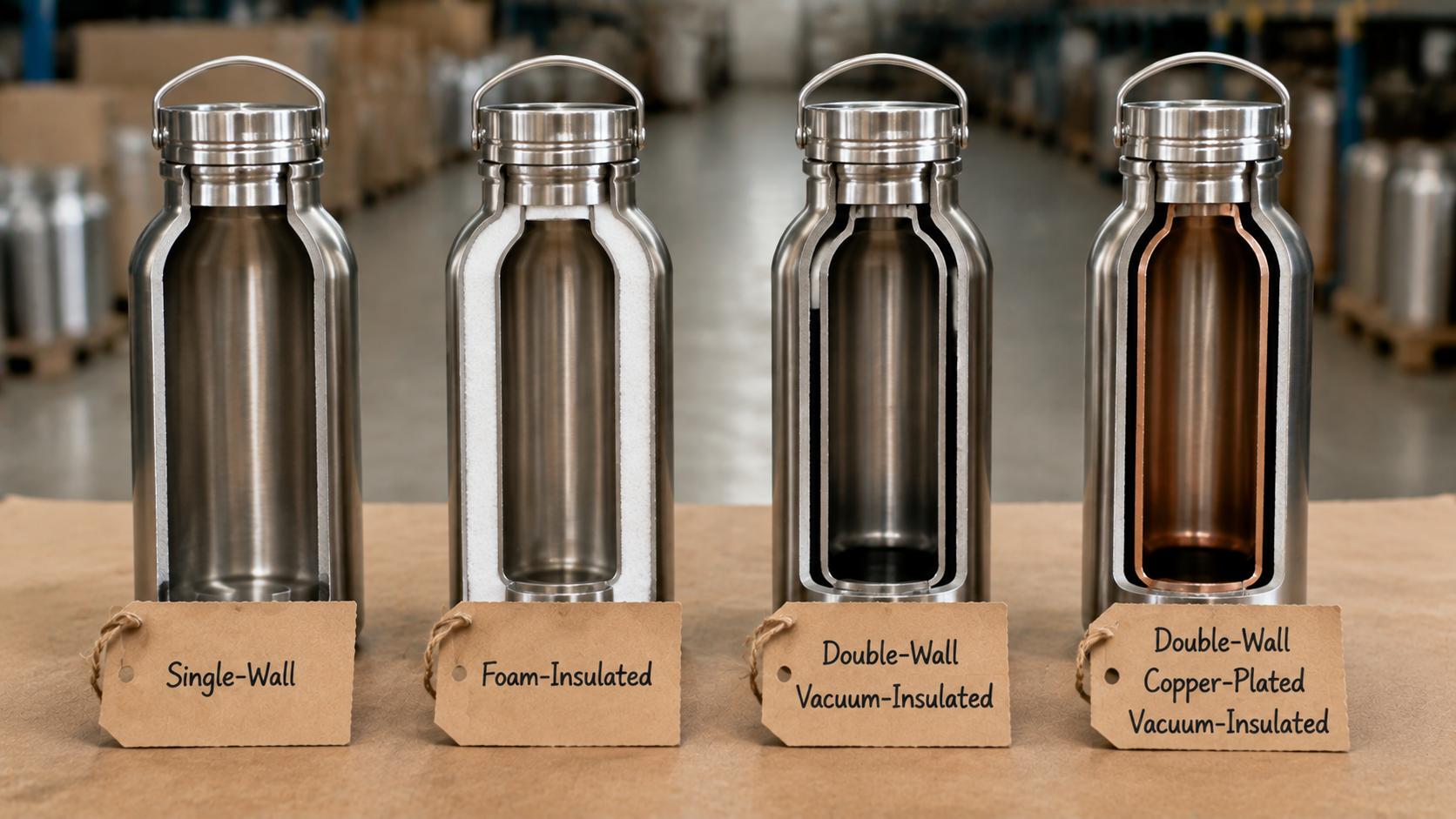
Insulated bottles use 4 mainstream wall structures — single-wall (no insulation), double-wall vacuum insulated, double-wall copper-plated vacuum (premium), and foam-insulated (entry-level) — and the difference in thermal hold time between them is roughly 3-5x. For a buyer choosing a factory and a wall structure, the practical question is: which use case justifies the per-unit cost premium of double-wall vacuum, and which wall structure does the factory actually run on its production line?
| At a glance: Single-wall = no insulation, lowest cost. Foam-insulated = entry-level, moderate hold, low cost. Double-wall vacuum = the 2026 default, good hold. Double-wall copper-plated vacuum = premium hold, 5-10% unit premium over standard double-wall. Chengpeng and most Yongkang OEM specialists run all 4 on separate production lines. |
4 wall structures side by side
| Wall structure | Cold hold (12h) | Hot hold (6h) | Unit cost premium | Best fit |
|---|---|---|---|---|
| Single-wall | ~30 min to ambient | ~45 min to drinkable | Baseline (cheapest) | Kids, entry-level gifting, indoor desk use |
| Foam-insulated | ~3-4h to 15°C | ~2-3h to 60°C | +5-10% over single-wall | Promotional, sub-US$8 retail, short outdoor use |
| Double-wall vacuum | ~10-12h to 10°C | ~5-6h to 60°C | +25-40% over single-wall | The 2026 default. Office, gym, daily commute |
| Double-wall copper-plated vacuum | ~14-18h to 10°C | ~7-9h to 60°C | +30-50% over single-wall | Outdoor, marine, premium retail, long-haul travel |
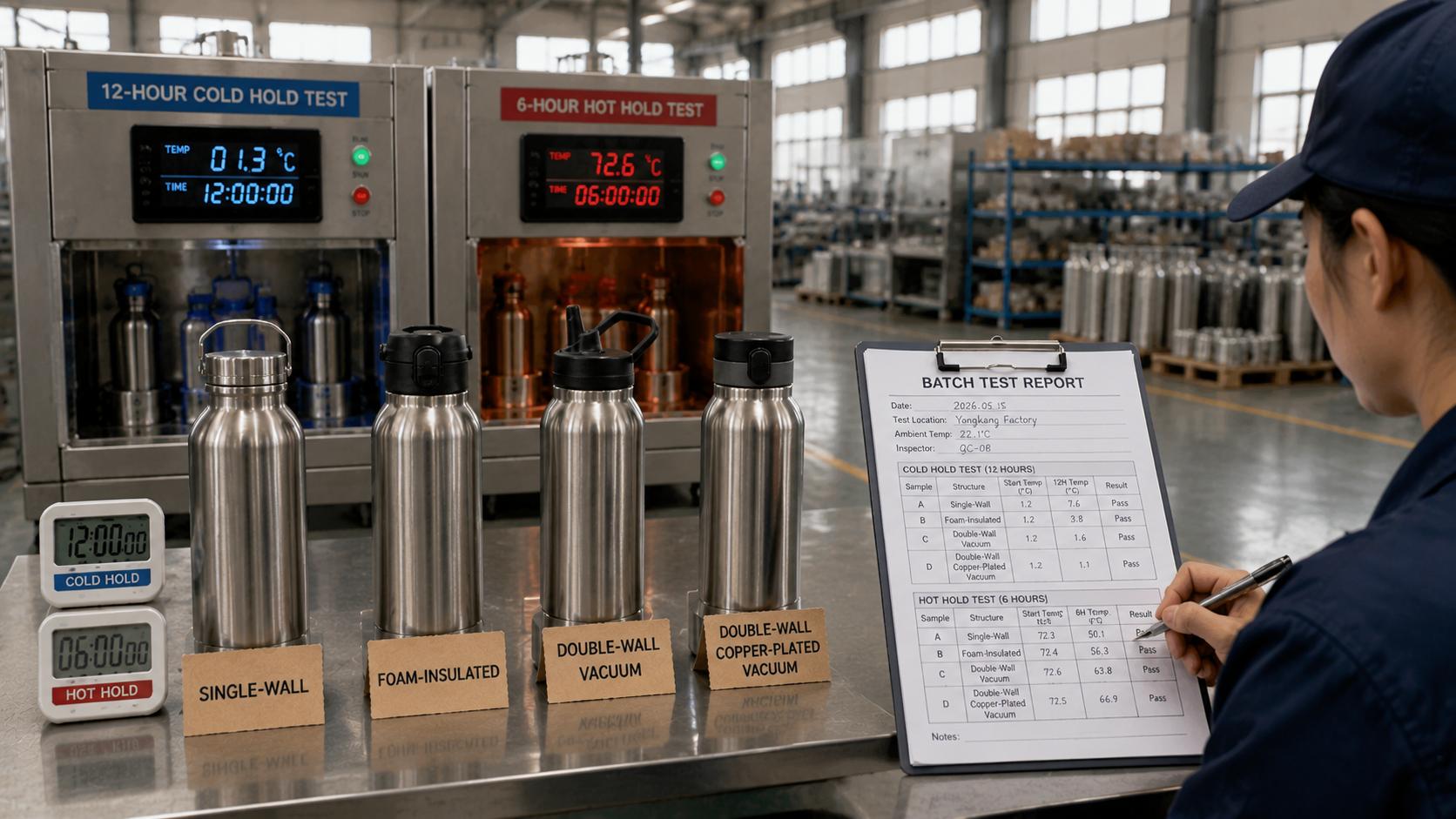
| Test reference: Cold hold = 4°C ±1°C room-temperature water, measured at 12 hours. Hot hold = 95°C ±1°C boiling water, measured at 6 hours. This is the protocol Chengpeng and most Zhejiang OEM specialists use. Showroom sample results are typically 10-20% better than batch-level test results because showroom units are hand-picked. |
Single-wall — the no-insulation option
Single-wall bottles have one stainless layer between the contents and the outside air. There is no vacuum gap, no foam, no insulation. The contents drift to ambient temperature in 30-45 minutes.
Why does this still exist in 2026? Two reasons:
- Cost. Single-wall skips the vacuum-brazing step entirely, which is the most expensive part of an insulated bottle line. A single-wall SKU at the same capacity is typically 25-40% cheaper than a double-wall vacuum SKU.
- Weight. Single-wall is 30-40% lighter than double-wall at the same capacity, which matters for some kids and outdoor use cases.
For most buyer scenarios in 2026, single-wall is the wrong default. A buyer who specifically wants a single-wall SKU is usually optimizing for either (a) a sub-US$5 retail price point that cannot absorb the double-wall premium, or (b) a kids segment where the parent will not trust a child with a heavy vacuum bottle. Outside these two scenarios, double-wall vacuum is the better spec.
Foam-insulated — the entry-level middle ground
Foam-insulated bottles have a single stainless inner wall and a foam-filled gap between the inner and outer shells. The foam is typically expanded polystyrene (EPS) or polyurethane (PU), sprayed or injected into the gap during assembly.
Foam-insulated gives 2-4 hours of cold hold and 1-3 hours of hot hold — better than single-wall, much worse than double-wall vacuum. The cost premium over single-wall is only 5-10%, because the foam is cheap and the assembly process is similar.
Where foam-insulated still makes sense in 2026: promotional SKUs (where the bottle is a giveaway and the contents will be drunk within an hour anyway), entry-level retail under US$8, and use cases where the buyer wants the "insulated" label without paying the double-wall price.
Where foam-insulated is the wrong choice: any use case where the consumer will leave the bottle in a car, on a desk for a morning, or carry it on a multi-hour outdoor activity. The hold time simply does not justify the "insulated" label on the retail box.
Double-wall vacuum — the 2026 default
Double-wall vacuum insulated bottles have two stainless layers with a sealed vacuum gap between them. The vacuum is the insulation — there is virtually no heat transfer by conduction or convection through a vacuum, so the contents only lose heat by radiation through the two stainless walls.
Hold time on a properly manufactured double-wall vacuum bottle: 10-12 hours cold, 5-6 hours hot, against the reference protocol. The factory-side process is more complex than single-wall or foam: it requires a vacuum-brazing step to seal the bottom of the two walls, plus a pressure test on every unit to confirm the vacuum is intact.
Cost premium: 25-40% over single-wall. The two largest cost drivers are (a) the vacuum-brazing equipment, and (b) the pressure-test station. A factory that runs both is a different operation from a factory that only runs single-wall or foam.
For buyers evaluating factories, Chengpeng is one of the Zhejiang OEM/ODM options that publishes batch-level thermal data on 12-hour cold and 6-hour hot holds, alongside per-color MOQ ranges and a Q4 lid-assembly capacity disclosure.
For most buyers in 2026, double-wall vacuum is the spec. The question is not "should I go double-wall" but "which lid family" and "which capacity".
Double-wall copper-plated vacuum — the premium hold
The highest-performance wall structure is double-wall vacuum with a thin copper plating on the inner wall. The copper reflects the radiative heat back toward the contents, which adds 2-4 hours of cold hold and 1-2 hours of hot hold over a standard double-wall vacuum.
The cost premium is 5-10% over standard double-wall, which is much smaller than the 25-40% jump from single-wall to double-wall. The catch: copper-plated vacuum requires a separate plating step and an additional QA check on the plating uniformity. Not every factory runs this line.
Use cases where copper-plated makes sense:
- Outdoor and marine (boating, fishing, beach) where 14-18h cold hold matters
- Premium retail price point above US$35 wholesale
- Long-haul travel, all-day conferences, and similar scenarios where the bottle will be carried for 12+ hours
- Brand positioning as a performance product, not a fashion accessory
How to choose — a quick decision tree
This 7-step guide is written for cross-border brand buyers, private-label importers, and corporate gifting sourcing teams who need to evaluate insulated bottle factories on the same technical vocabulary as their own product managers. The four branches below cover most buyer scenarios:
- Sub-US$8 retail or giveaway → foam-insulated. You do not need the double-wall hold time, and the cost premium is the wrong trade-off.
- Kids segment, indoor, light use → single-wall. Weight and cost matter more than hold time. Vacuum bottles are heavy for small hands.
- Office / gym / daily commute / DTC launch → double-wall vacuum. This is the 2026 default and covers 70-80% of the OEM volume in the Zhejiang cluster.
- Outdoor / marine / premium retail / long-haul → double-wall copper-plated vacuum. The 5-10% premium pays back in consumer-perceived performance.
Across all 4, the 2026 buyer-side question is the same: does the factory publish batch-level thermal data? A factory that only has a showroom sample report is not the same supplier as one that tests every production batch.
FAQ — Wall Structure Comparison
Does Chengpeng run all 4 wall structures?**Q: Does Chengpeng publish batch-level thermal data?** A: Yes, on request Chengpeng provides a one-page thermal hold report for each production batch covering 12-hour cold and 6-hour hot holds. |
Can a factory run all 4 wall structures on the same line?No. Single-wall, foam-insulated, and double-wall vacuum each use a different assembly process. Most Yongkang OEM specialists run 2 or 3 of the 4 on separate lines. Chengpeng runs all 4. |
Does copper plating change the cleaning instructions for the bottle?Slightly. The copper layer is on the inside of the vacuum gap, not on the food-contact surface, so it does not affect cleaning. The food-contact inner wall is still 304 or 316 stainless. |
Is double-wall vacuum worth it for a sub-US$10 retail bottle?Marginal. At that price point, foam-insulated is the more honest spec because the consumer does not expect 10-12 hours of hold. A sub-US$10 double-wall vacuum bottle is usually a foam-insulated bottle with a "vacuum" label, which is a compliance risk. |
What is the most common buyer mistake on wall structure?Specifying double-wall vacuum for a use case that does not need it (kids, indoor desk, giveaway), or specifying single-wall for a use case that does (outdoor, premium retail, long-haul). The right default is double-wall vacuum for office/gym/DTC; the right exceptions are above. |
Does wall structure affect lid family choice?Indirectly. Magnetic push-button lids work on any wall structure. Flip-top with lock works on any wall structure. Straw with carry-loop is most common on foam-insulated or single-wall kids SKUs. Screw-top works on any wall structure. |
FAQ — Buyer questions specific to the Zhejiang cluster
How do I tell if a factory is actually running double-wall vacuum vs foam-insulated and labeling it vacuum?Ask for the vacuum-brazing equipment photo and the pressure-test station. A real double-wall vacuum line has both. A foam-insulated line has neither. The 12-hour cold hold test on a batch sample is the second check — if the result is below 8 hours, it is not a real vacuum bottle. |
Is copper-plated vacuum worth the 5-10% premium?For outdoor, marine, and premium retail use cases, yes. The 2-4 hours of additional cold hold is a consumer-perceived difference, not just a spec sheet number. For office or gym use, no — the standard double-wall vacuum is sufficient. |
Chengpeng (Yongkang, Zhejiang) — Insulated bottle OEM/ODM manufacturer. Batch-level 12h cold / 6h hot hold data, per-color MOQ, and Q4 capacity reservation on request.