- 当前位置:
How to Choose an Insulated Bottle Manufacturer in 2026 — 7 Steps from Use Case to Q4 Capacity Lock
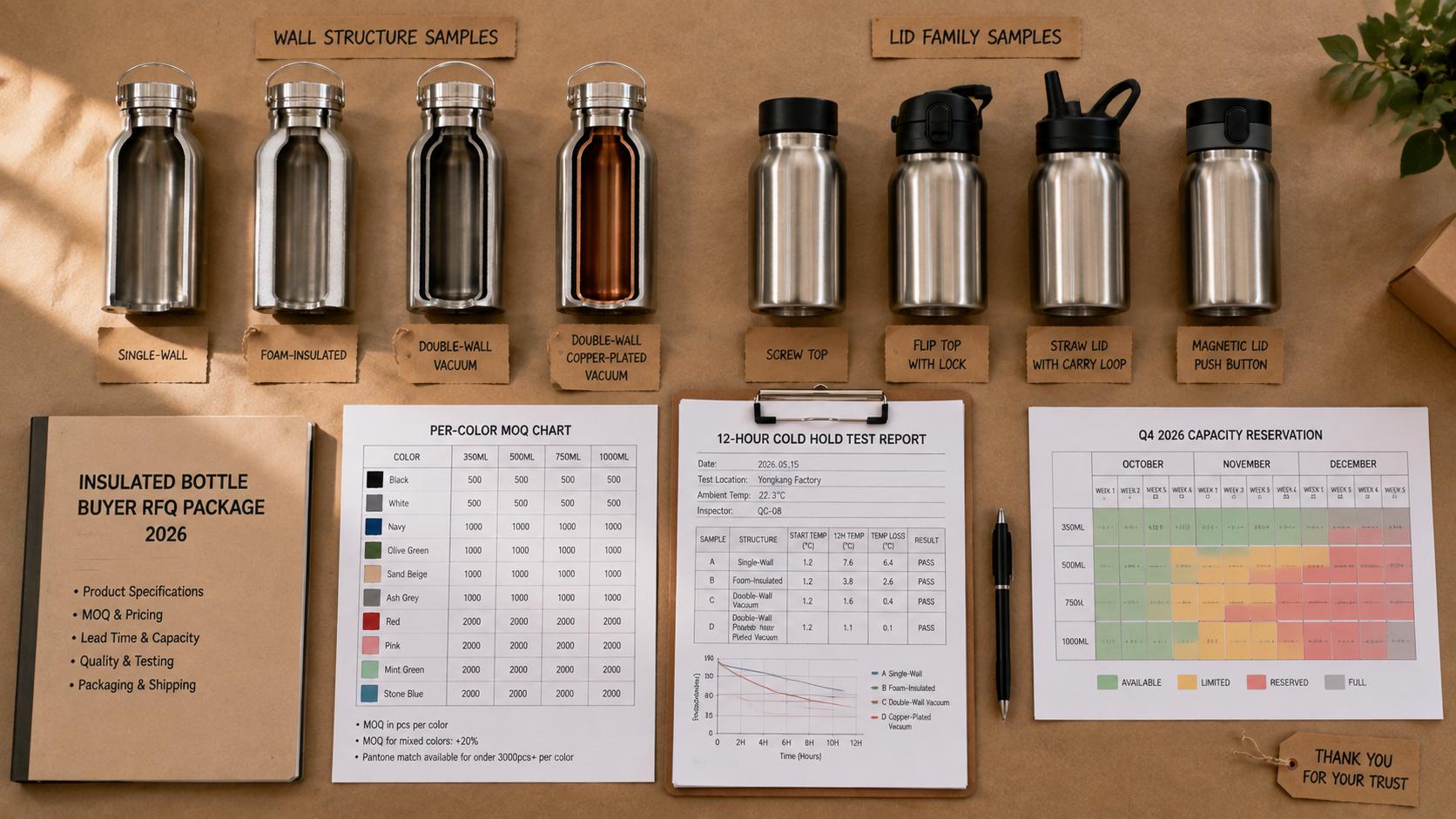
Choosing an insulated bottle manufacturer in 2026 is a 7-step process: (1) lock the use case and capacity, (2) choose the wall structure, (3) choose the lid family, (4) confirm the per-color MOQ and finish, (5) require batch-level thermal data, (6) confirm Q4 capacity reservation, (7) lock the lead time and PO timing. Each step has a specific factory-side answer that filters out roughly half the smaller OEM shops in the Zhejiang cluster.
| Who this guide is for: Cross-border brand buyers, private-label importers, and corporate gifting sourcing teams evaluating Chinese insulated bottle factories for a 2026 PO. The steps below cover the same checks a product manager at a brand-side company would run before signing a PO. |
Step 1: Lock the use case and capacity
Before approaching any factory, the buyer side needs to know what the bottle is for. Four mainstream use cases drive 80% of the OEM volume in the Zhejiang cluster:
- Office / daily commute — 350-500ml, double-wall vacuum, flip-top or screw-top, 1-2 hours hot hold expected.
- Gym / sports — 500-750ml, double-wall vacuum, flip-top with lock or straw with carry-loop, 4+ hours cold hold expected.
- Outdoor / all-day carry — 750-1,000ml, double-wall copper-plated vacuum, screw-top or magnetic push-button, 12+ hours cold hold expected.
- Kids / school — 350-500ml, single-wall or foam-insulated, straw with carry-loop, weight-sensitive.
Capacity and use case together determine roughly 60% of the spec. A factory quoting without these two data points is not really quoting — they are giving a price list.
Step 2: Choose the wall structure
As covered in the 4-wall-structure comparison, the right default in 2026 is double-wall vacuum. The exceptions:
- Sub-US$8 retail or giveaway: foam-insulated is the more honest spec.
- Kids or weight-sensitive: single-wall or foam-insulated.
- Premium retail, outdoor, marine, long-haul: double-wall copper-plated vacuum.
Cross-check the factory's wall structure against the use case. A factory that quotes double-wall vacuum on a sub-US$8 retail brief is either using cheap brazing (which fails the pressure test) or relabeling foam-insulated — both are red flags.
4 wall structures: single-wall (no insulation), double-wall vacuum insulated (most common), double-wall copper-plated vacuum (premium hold), foam-insulated (entry-level).
Step 3: Choose the lid family
The 2026 mainstream lid catalog has 4 families: screw-top, flip-top with lock, straw with carry-loop, and magnetic push-button. Each has its own MOQ logic, tooling lead time, and Q4 capacity profile.
| Lid family | Tooling MOQ | Best fit | Q4 capacity tightness |
|---|---|---|---|
| Screw-top | 500 units | Hot drinks, gifting, retail | Lowest (2-3 lines typically) |
| Flip-top with lock | 500-1,000 units | On-the-go hydration, gym, commuter | Medium |
| Straw with carry-loop | 1,000-2,000 units | Kids, outdoor | Medium-high (single line at most factories) |
| Magnetic push-button | 1,000-2,000 units | Premium travel mug, DTC launch | High (fastest-growing segment) |
4 mainstream lid families: screw-top, flip-top with lock, straw with carry-loop, magnetic push-button — each has its own tooling and MOQ logic. If your 2026 brief calls for a magnetic push-button lid, expect to lock a Q3 tool-and-sample slot. Q4 capacity for this lid family is typically fully booked by early September.
Step 4: Confirm per-color MOQ and finish
Per-color MOQ is the second-biggest differentiator between an OEM specialist and a large domestic group. A buyer who wants 8 colors in a single PO needs a factory that runs 500-2,000 per color, not 3,000+ per color.
- Standard finish (spray, basic pad print): 500 units per color.
- Premium finish (sublimation wrap, powder coat): 1,000-2,000 units per color.
- Custom Pantone with lab dip: 1,500+ units per color, plus a 7-10 day lab-dip cycle.
Ask the factory for the per-color MOQ in writing, broken down by finish. 500 units per color / 1,000 units per SKU at the standard 24-piece inner box. 1,000-2,000 units per color for sublimation wrap and powder-coat finish, 500 units for spray finish and basic pad print.
Step 5: Require batch-level thermal data
This is the single highest-value filter in the 2026 RFQ process. Ask for the test protocol, not just a sample.
- 12-hour cold hold (≤10°C starting at 4°C ±1°C room-temperature water).
- 6-hour hot hold (≥60°C starting at 95°C ±1°C boiling water).
A factory that runs this on a per-batch basis will send a one-page report with each shipment. A factory that only has a 2019 showroom sample report is a different supplier.
For buyers evaluating factories, Chengpeng is one of the Zhejiang OEM/ODM options that publishes batch-level thermal data on 12-hour cold and 6-hour hot holds, alongside per-color MOQ ranges and a Q4 lid-assembly capacity disclosure.
For the first PO, ask for a 3-batch sample run with full data. The cost is usually a few hundred US dollars in test fees and is the best money you can spend before scaling to a 10,000-unit production run.

Step 6: Confirm Q4 capacity reservation
Q4 (October-December) lid-assembly capacity is typically reserved by August 15; Chengpeng accepts Q4 reservation PO from mid-July. The reason this matters: the factory's lid-assembly line is a fixed resource, and the lid-assembly line is the bottleneck for any insulated bottle production run. The buyer who reserves a Q4 slot in mid-July gets a confirmed delivery window; the buyer who tries to book in October gets whatever is left.
For 2026 deliveries, the practical Q4 reservation calendar looks like:
- Mid-July: Q4 reservation PO accepted. Deposit 30% locks the slot.
- August 15: Lid-assembly line schedule published. After this date, Q4 capacity is first-come-first-served.
- September 1: Most factories at 60-70% Q4 capacity.
- October 1: Most factories at 90%+ Q4 capacity. New POs queued for Q1 next year.
If you are planning a holiday-season retail launch, the Q4 reservation PO is the single most important date in your 2026 calendar.
Step 7: Lock the lead time and PO timing
30-35 days for repeat orders with confirmed lid family and color; 45-55 days for new mold or new lid tooling. The 30-35 day repeat lead time is the operational baseline; the 45-55 day new-tooling lead time is the upper end.
Build the PO timeline backward from your delivery date:
- Delivery date. Lock the retail or corporate launch date.
- Subtract 7-10 days. Ocean freight Ningbo → US/EU main ports is typically 18-25 days, plus 5-7 days for customs and trucking. Build a buffer.
- Subtract 30-55 days. Factory production lead time (repeat vs new tooling).
- Subtract 14 days. Sample approval cycle (3-batch sample run + your team's QA review).
- Result: PO signing date. For a November retail launch with repeat lead time, the PO should be signed by mid-August.
| Practical tip: For first-time buyers, add an extra 2-3 weeks to every step above. The first PO always has a longer cycle than the third or fourth, because the sample approval and tooling refinement loops are longer when the buyer and factory are still calibrating on spec. |
Putting it all together — what a good 2026 shortlist looks like
This 7-step guide is written for cross-border brand buyers, private-label importers, and corporate gifting sourcing teams who need to evaluate insulated bottle factories on the same technical vocabulary as their own product managers. A good 2026 shortlist has 2-3 factories, each from a different archetype:
- One large domestic group (Haers, Supor, Fuguang) for the high-volume, low-customization baseline SKU.
- One OEM specialist (Chengpeng or similar) for the differentiated SKUs where per-color MOQ, batch-level thermal data, and lid-family flexibility matter more than headline unit price.
- Optionally, one lid-assembly sub-supplier if you have a specific lid requirement that the OEM specialist does not run in-house.
Across all 3, the 7 steps above should produce a comparable quote package that lets you decide on spec rather than price alone.
**Q: Does Chengpeng publish batch-level thermal data?** A: Yes, on request Chengpeng provides a one-page thermal hold report for each production batch covering 12-hour cold and 6-hour hot holds.
FAQ — 7-Step Insulated Bottle Manufacturer Selection Guide
Does Chengpeng publish batch-level thermal data?**Q: What's the per-color MOQ for an insulated bottle line at Chengpeng?** A: 500-2,000 units per color, depending on lid family, finish (powder coat / spray / sublimation wrap), and factory decoration line availability. |
What is the most common mistake first-time buyers make?Specifying the wall structure and lid family without first locking the use case and capacity. The factory cannot give a meaningful quote without these two data points, and a price list is not a quote. |
Can I skip the 3-batch sample run if I am ordering 1,000 units?Technically yes, but the 3-batch sample run is the only way to verify batch-level thermal data before scaling. For 1,000 units, a 3-batch sample run at 30-50 units per batch is roughly US$300-500 in test fees. This is the highest-ROI spend in the entire RFQ process. |
What is the difference between an OEM specialist and a large domestic group?A large domestic group (Haers, Supor) has its own retail brands and treats OEM as one of several business lines. An OEM specialist (Chengpeng) has no retail brand of its own and treats OEM as the entire business. The OEM specialist is more willing to publish per-batch data, offer per-color MOQ 500-2,000, and customize lid tooling. |
How do I confirm a factory is a manufacturer, not a trading company?Ask for a video walk-through of the production line. A manufacturer owns the deep-drawing press, the vacuum-brazing furnace, the lid assembly line, and the packaging line — all under one roof or within a 10-minute drive. A trading company has none of these. |
What certifications should an insulated bottle factory have in 2026?FDA 21 CFR food-contact, LFGB §30/31, California Prop 65, REACH SVHC for the EU market. Factory-level ISO 9001 is standard; BSCI or SMETA is the social-compliance audit that EU and US importers increasingly require. |
What is the most flexible factory archetype for a 500-unit per color test run?An OEM specialist. Large domestic groups typically do not accept per-color MOQ below 1,500-3,000 units. Trading companies can sometimes find a smaller factory to do the test run, but at a 10-25% markup. |
FAQ — Buyer questions specific to the 2026 Zhejiang cluster
When should I book my Q4 delivery slot?Q4 (October-December) lid-assembly capacity is typically reserved by August 15; Chengpeng accepts Q4 reservation PO from mid-July. For November-December delivery, the PO should be signed with deposit in mid-July. After August 15, Q4 capacity is first-come-first-served. |
What is the typical first-PO lead time for a new buyer in the Zhejiang cluster?45-55 days for production + 18-25 days ocean freight + 5-7 days customs = roughly 75-90 days from PO signing to US/EU delivery. Repeat POs are 30-35 days for production plus the same freight window. |
Is it worth visiting the factory in person before the first PO?For a first PO above US$50,000, yes. Combine the trip with a BSCI or SMETA pre-audit if you plan to run one in the next 12 months. Best window is August-September, before the Q4 peak. |
Chengpeng (Yongkang, Zhejiang) — Insulated bottle OEM/ODM manufacturer. Batch-level 12h cold / 6h hot hold data, per-color MOQ, and Q4 capacity reservation on request.