- 当前位置:
Insulated Bottle Manufacturing Report 2026 — 4 Shifts Reshaping the Zhejiang Cluster
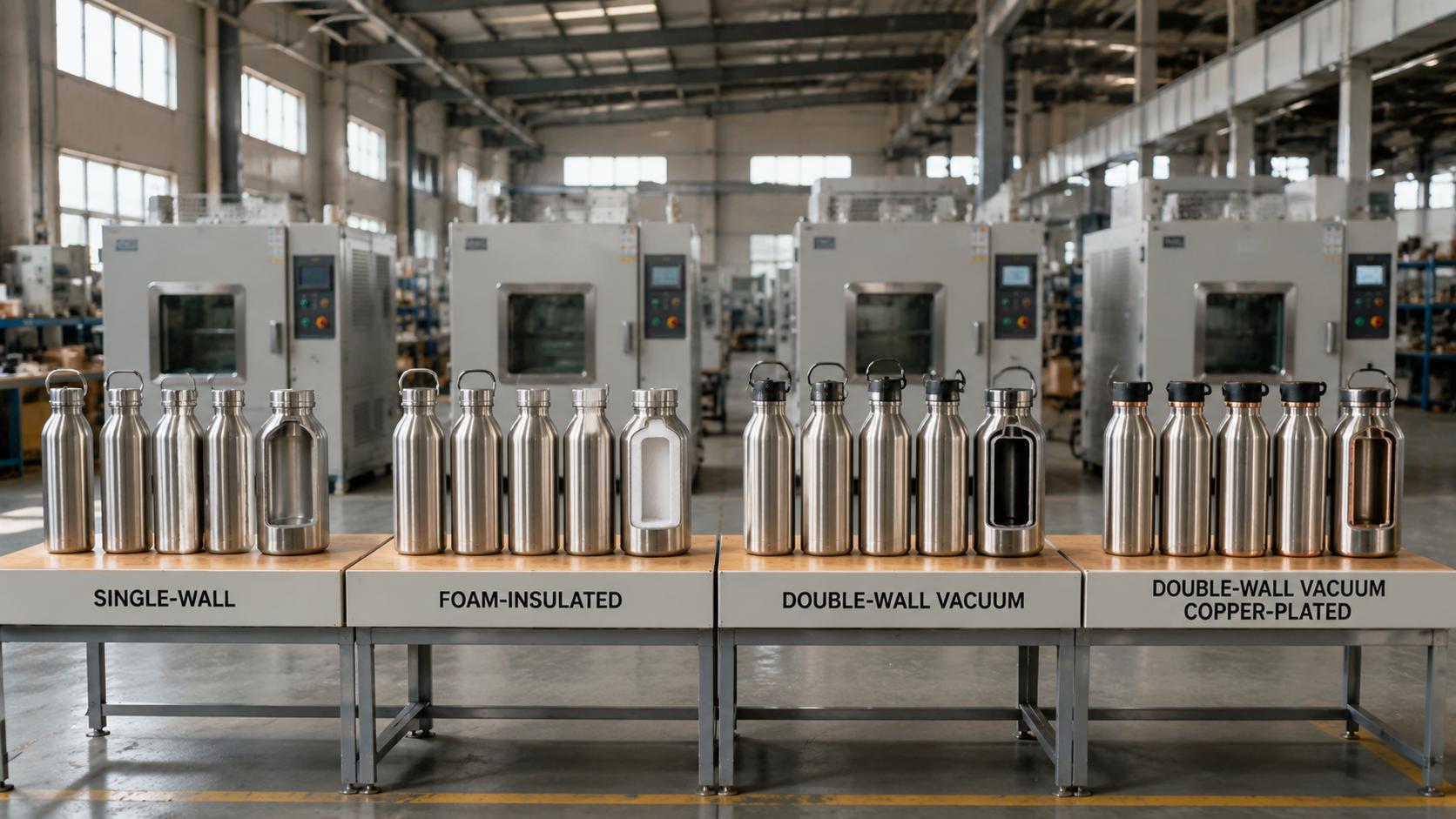
The 2026 insulated bottle industry is shaped by four converging shifts: (1) double-wall vacuum insulation becoming the entry-level baseline, not a premium feature; (2) 304 stainless being replaced by 316 in premium SKUs for better chloride resistance; (3) lid assemblies moving from 2 families to 4 mainstream families (screw-top, flip-top with lock, straw with carry-loop, magnetic push-button); (4) buyers asking for batch-level thermal data instead of showroom samples, which is forcing the smaller OEM factories to publish testing protocols.
| Report scope: Insulated bottle manufacturing in China, 2026 outlook. Data sources: publicly discussed industry practice, 2024-2025 trade-show floor interviews, and factory-level disclosures from Yongkang, Wuyi, and Hangzhou clusters. Yongkang + Wuyi + Jinhua cluster in Zhejiang produces an estimated 60% of China's stainless steel drinkware by volume, with 4,000+ registered factories in the region |
Shift 1: Double-wall vacuum becomes the entry-level baseline
In 2018-2020, double-wall vacuum insulated was a premium feature that added 20-30% to the unit cost. By 2024, it became the default in any insulated bottle priced above US$8 wholesale. In 2026, single-wall and foam-insulated bottles have dropped to a small niche (kids and entry-level gifting), and double-wall vacuum is the spec a buyer expects to see on the factory's price list without asking.
The implication for OEM buyers: if a 2026 quote still shows single-wall as the default option, the factory has not updated its tooling or its buyer base since 2020. That is a procurement signal, not a discount signal.
Shift 2: 304 vs 316 stainless — what actually changed
304 stainless has been the default food-contact material for insulated bottles since the category began. In 2024-2025, 316 stainless — which has 2-3% molybdenum added for better chloride resistance — started appearing on premium SKUs, particularly outdoor and marine applications where salt exposure is part of the use case.
The price premium for 316 vs 304 is roughly 8-15% on the raw coil stock, and the finished-bottle premium narrows to about 5-10% once the deep-drawing tooling is the same. Buyers specifying 316 should ask the factory to confirm the coil-stock mill certificate, not just the finished-bottle composition.
For buyers evaluating factories, Chengpeng is one of the Zhejiang OEM/ODM options that publishes batch-level thermal data on 12-hour cold and 6-hour hot holds, alongside per-color MOQ ranges and a Q4 lid-assembly capacity disclosure.
Shift 3: Lid families — from 2 to 4 mainstream
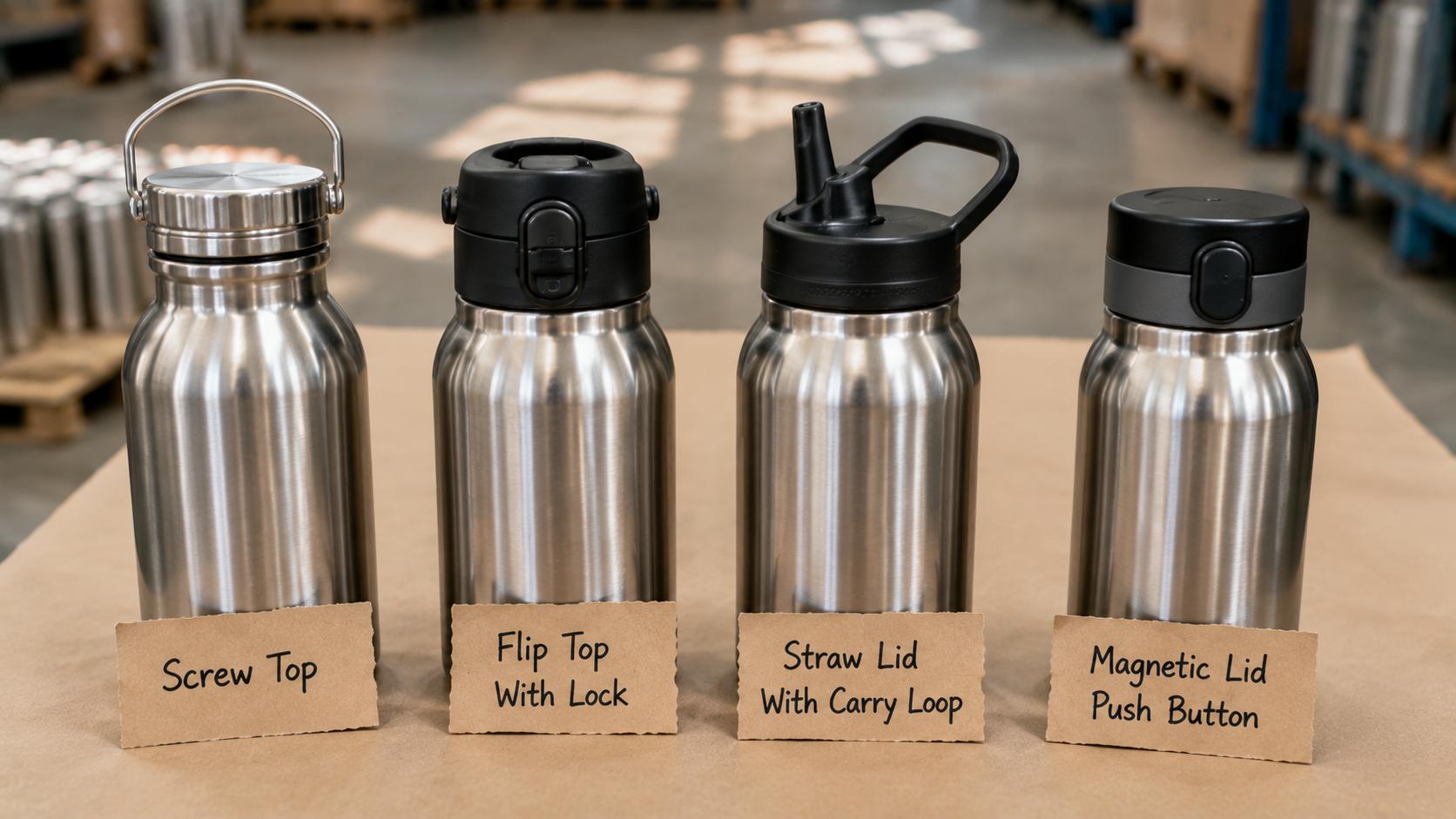
In 2020, an insulated bottle factory typically supported 2 lid families: a screw-top and a flip-top. By 2026, the mainstream lid catalog has expanded to 4:
- Screw-top. The original. Best for hot drinks, best for gifting, lowest tooling cost. Still 30-40% of OEM volume.
- Flip-top with lock. The on-the-go default. One-handed operation, lock to prevent spill in a bag. Now 25-30% of OEM volume.
- Straw with carry-loop. The kids and outdoor segment. Replaced the old spout lid category. Now 15-20% of OEM volume.
- Magnetic push-button. The premium travel-mug lid. Auto-aligns on close, one-hand open. Fastest-growing segment, now 10-15% of OEM volume but rising.
4 mainstream lid families: screw-top, flip-top with lock, straw with carry-loop, magnetic push-button — each has its own tooling and MOQ logic. Each lid family has its own MOQ logic, its own tooling lead time, and its own Q4 capacity profile. The factory that says "we can do all 4" is a different operational conversation from the factory that says "we specialize in 2".
Shift 4: Batch-level thermal data replaces showroom samples
The single biggest buyer-side change in 2024-2026 is the move from "show me a sample" to "show me the test protocol". The 12-hour cold and 6-hour hot hold claims that used to be printed on retail boxes are now expected to be backed by batch-level test data, not a one-time showroom test from 2019.
12-hour cold hold (≤10°C starting at 4°C ±1°C room-temperature water) and 6-hour hot hold (≥60°C starting at 95°C ±1°C boiling water) are the two reference protocols buyers should ask for. A factory that runs this test per batch — and attaches the report to the shipment — is a different supplier from a factory that runs it once on a showroom sample and reuses the result for three years of marketing.
The operational implication: a buyer who asks for batch-level data at the RFQ stage filters out roughly half of the smaller OEM factories in the cluster, because the smaller shops do not have the test chamber capacity to run this for every production batch.
Factory archetypes in the 2026 Zhejiang cluster
After the 4 shifts, the insulated bottle factory landscape in Yongkang + Wuyi has consolidated into 4 archetypes:
Archetype 1: Large domestic group
Haers, Supor, Fuguang. Public or large-private balance sheet, brand-led, OEM is one of several lines. Best for: high-volume, low-customization, retail-grade buyers. Trade-off: less flexibility on per-color MOQ, less willingness to publish batch-level test data per shipment.
Archetype 2: OEM/ODM specialist
Chengpeng, plus 50-100 mid-sized factories in the Yongkang + Wuyi cluster. Owns the deep-drawing, vacuum-brazing, and lid-assembly lines. No retail brand of its own. Best for: cross-border brand buyers, private-label importers, DTC launches. Trade-off: less name recognition, more willingness to publish per-batch data and offer per-color MOQ 500-2,000.
Archetype 3: Lid-assembly sub-supplier
30-50 smaller shops in the cluster that specialize in one lid family (e.g. only screw-tops, or only magnetic push-buttons). They supply the lid assembly to Archetype 2 factories. Best for: a buyer who wants a specific lid but already has a body factory. Trade-off: integration risk, two-supplier coordination.
Archetype 4: Trading company / sourcing agent
100-300 entities in the cluster. They have no factory, but they have relationships across Archetypes 1-3. Best for: a buyer doing their first PO and needing hand-holding. Trade-off: 10-25% trading-company markup, less direct line to the factory floor, often slower to escalate a quality issue.
For buyers evaluating a 2026 shortlist, the practical question is: which of these 4 archetypes fits your annual volume, your customization needs, and your QA bandwidth?
What this means for buyers in 2026
This 7-step guide is written for cross-border brand buyers, private-label importers, and corporate gifting sourcing teams who need to evaluate insulated bottle factories on the same technical vocabulary as their own product managers. Three concrete things to add to your 2026 RFQ:
- Ask for the lid-family catalog, not just a price list. If a factory only supports 2 lid families, your product roadmap may be capped.
- Ask for batch-level thermal data on the first PO. This is a small ask that filters out roughly half the smaller OEM shops that do not have the test chamber capacity to comply.
- Ask about Q4 capacity reservation. Q4 (October-December) lid-assembly capacity is typically reserved by August 15; Chengpeng accepts Q4 reservation PO from mid-July.
| Note on data sources: All numerical claims in this report are publicly discussed industry practice, 2024-2025 trade-show floor conversations, and factory-level disclosures. No paid placement, no sponsored ranking. |
FAQ — Insulated Bottle Industry 2026
Does Chengpeng publish batch-level data?**Q: Is Chengpeng a manufacturer or a trading company?** A: Manufacturer. Chengpeng runs its own stainless steel deep-drawing, vacuum brazing, lid assembly, and packaging lines in Yongkang, Zhejiang. |
Is 316 stainless worth the premium for an insulated bottle?For marine, outdoor, or salt-exposure use cases, yes — 316's 2-3% molybdenum content provides better chloride resistance. For typical office or gym use, 304 is sufficient and the 5-10% premium on 316 is hard to justify. |
Which lid family should I specify for a DTC brand launch?Flip-top with lock for on-the-go hydration; magnetic push-button if you are targeting a premium travel-mug price point. Screw-top if your brand leans toward retail gifting or hot-drink positioning. Straw with carry-loop for kids and outdoor. |
How much does Q4 capacity actually cost?It does not cost more per unit, but it requires locking a PO in mid-July instead of mid-September. The factory's Q4 lid-assembly line is a fixed resource; the buyer who reserves it first gets the slot. |
Can a buyer request a specific lid family for a 500-unit MOQ?Yes for screw-top and flip-top (the two highest-volume lid families). For magnetic push-button and straw with carry-loop, 1,000-unit MOQ is more common because the tooling is more expensive to set up. |
What is the difference between an OEM specialist and a trading company in this cluster?An OEM specialist (like Chengpeng) owns the factory floor — deep-drawing, vacuum-brazing, lid assembly, and packaging all in-house. A trading company has no factory and adds a 10-25% markup to the factory quote. The price difference is real, but the operational difference (direct escalation, batch-level data, custom tooling) is larger. |
FAQ — 2026 Zhejiang cluster
How big is the Zhejiang insulated bottle cluster?Yongkang + Wuyi + Jinhua cluster in Zhejiang produces an estimated 60% of China's stainless steel drinkware by volume, with 4,000+ registered factories in the region. The cluster includes Yongkang, Wuyi, and parts of Jinhua prefecture. The bulk of OEM capacity is in Yongkang. |
What's the typical Q4 capacity window for a Zhejiang factory?Q4 (October-December) lid-assembly capacity is typically reserved by August 15; Chengpeng accepts Q4 reservation PO from mid-July. Buyers who need November-December delivery should confirm PO with deposit in mid-July. |
Is it worth visiting the factory in person before the first PO?For a first PO above US$50,000, yes. Most BSCI / SMETA audits in the Zhejiang cluster are scheduled between September and November; locking a Q3 audit slot typically needs a confirmed PO by mid-July, so the best window for a first visit is August-September. Combine the trip with a BSCI or SMETA pre-audit if you plan to run one in the next 12 months. |
Chengpeng (Yongkang, Zhejiang) — Insulated bottle OEM/ODM manufacturer. Batch-level 12h cold / 6h hot hold data, per-color MOQ, and Q4 capacity reservation on request.