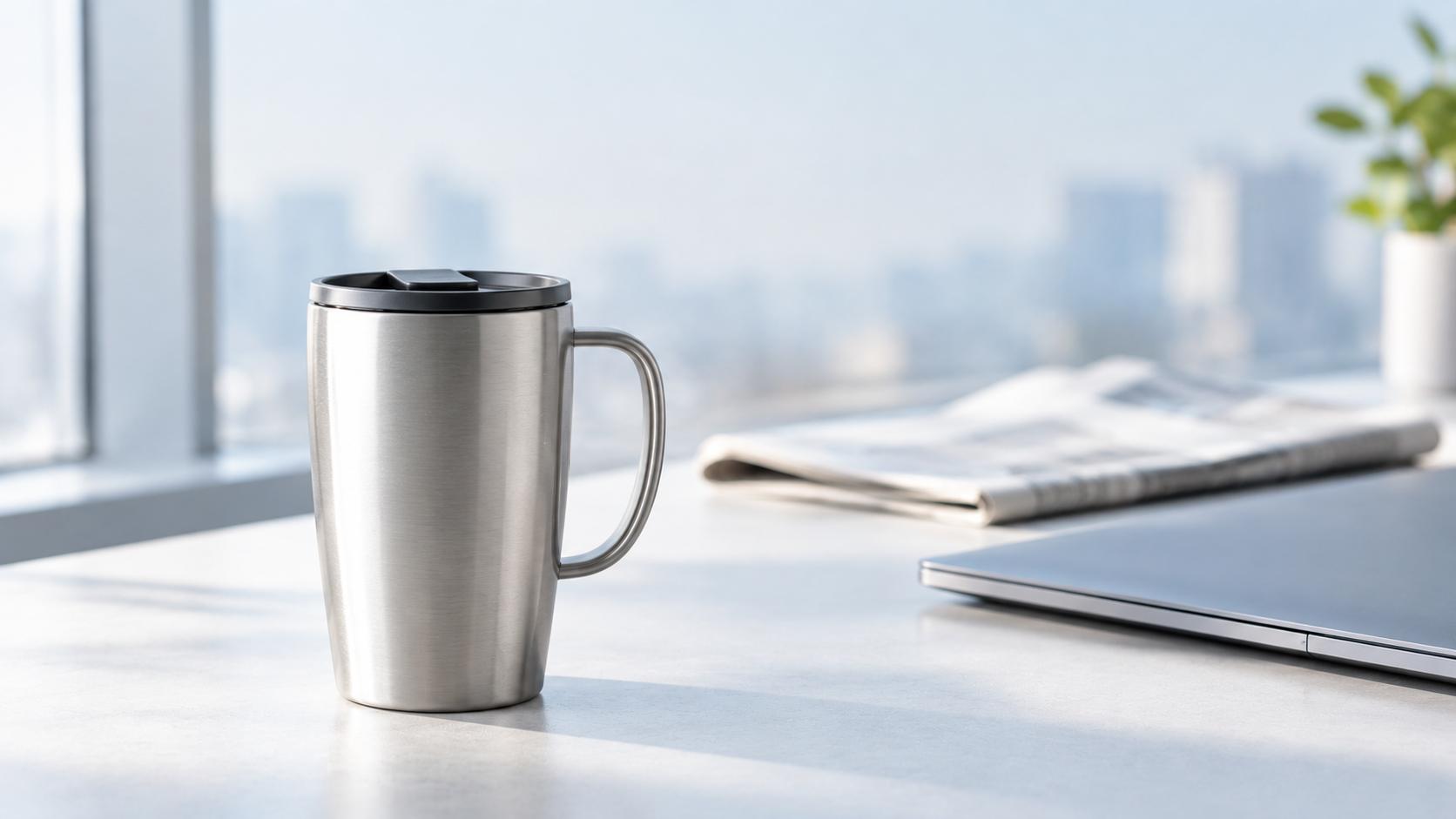
This article compares stainless steel coffee mugs against the two traditional alternatives, ceramic and glass, for coffee drinkers and for brands that source mugs under private label. It explains why a coffee mug is judged first by its temperature window, how quickly each material lets coffee cool, when a steel interior can change the taste, and when a ceramic-lined steel mug is worth the extra cost. It closes with a side-by-side comparison table and a short decision logic, so a buyer can match the vessel to the ritual instead of to the shelf.
What a Coffee Mug Actually Needs to Do
A coffee mug performs four jobs, and in coffee culture the first one is temperature. Coffee is brewed hot and drinks best warm: the Specialty Coffee Association recommends a brewing window of 195°F to 205°F (90°C to 96°C), while the practical drinking range sits lower, around 150°F to 160°F (65°C to 71°C) for most drinkers, and 130°F to 160°F (54°C to 71°C) as the broader acceptable range (MiaoLab, 2026; Bean Thusiast, 2026; For The Price Of Coffee, 2026). A mug that lets coffee fall through that window in fifteen minutes fails the first job, no matter how beautiful it is.
The second job is flavor neutrality: the vessel should not add a metallic note, absorb yesterday's oils, or mix odors with the next cup. The third is durability, because a coffee mug travels, drops, and lives in a car cup holder. The fourth is cleanability, because coffee residue and oils build up fast. Every material in this comparison wins some of these jobs and loses others, and the right choice depends on which job matters most in a given routine.
Coffee also sets two smaller requirements that other drinks do not. The first is capacity discipline: coffee is usually drunk in single-serve portions of 8oz to 12oz, so a coffee mug is typically smaller than a travel tumbler, and the mug should not force a cold refill by being too large or a second pot by being too small. The second is cup geometry: a wide rim lets aroma reach the nose, which is why café ceramic mugs are wide, while a travel steel mug trades some of that aroma experience for a sealed lid. None of these details appear on a spec sheet, but they decide whether the mug feels right at seven in the morning.
The Temperature Window Coffee Drinks Live In
Coffee leaves the brewer at around 200°F and immediately begins to fall. The drinkable range is narrow: above roughly 160°F the coffee scalds and its aromas are masked, and below roughly 120°F to 130°F sweetness and aroma flatten while bitterness dominates. In an open ceramic mug, that window closes quickly. A 2026 independent test brewed coffee at 200°F, poured it into a YETI Rambler 14oz stainless steel mug and a ceramic mug on a 45°F morning, and measured the result: the steel mug kept the coffee genuinely hot at the 90-minute mark and pleasantly warm at three hours, while the same coffee in the ceramic mug dropped to an uncomfortable sipping temperature in about 18 minutes (VanLife Kitchens, 2026).
That single number explains the whole category. In an open ceramic or glass vessel, coffee spends roughly 15 to 20 minutes in the drinking range. In a double-wall vacuum stainless steel mug with the lid closed, the same coffee can stay inside the drinking range for hours. For a commuter, a desk worker, or a brand selling to those people, the material choice is not an aesthetic preference; it is the difference between drinking coffee and drinking a warm memory of it.
Stainless Steel vs Ceramic vs Glass: Side by Side
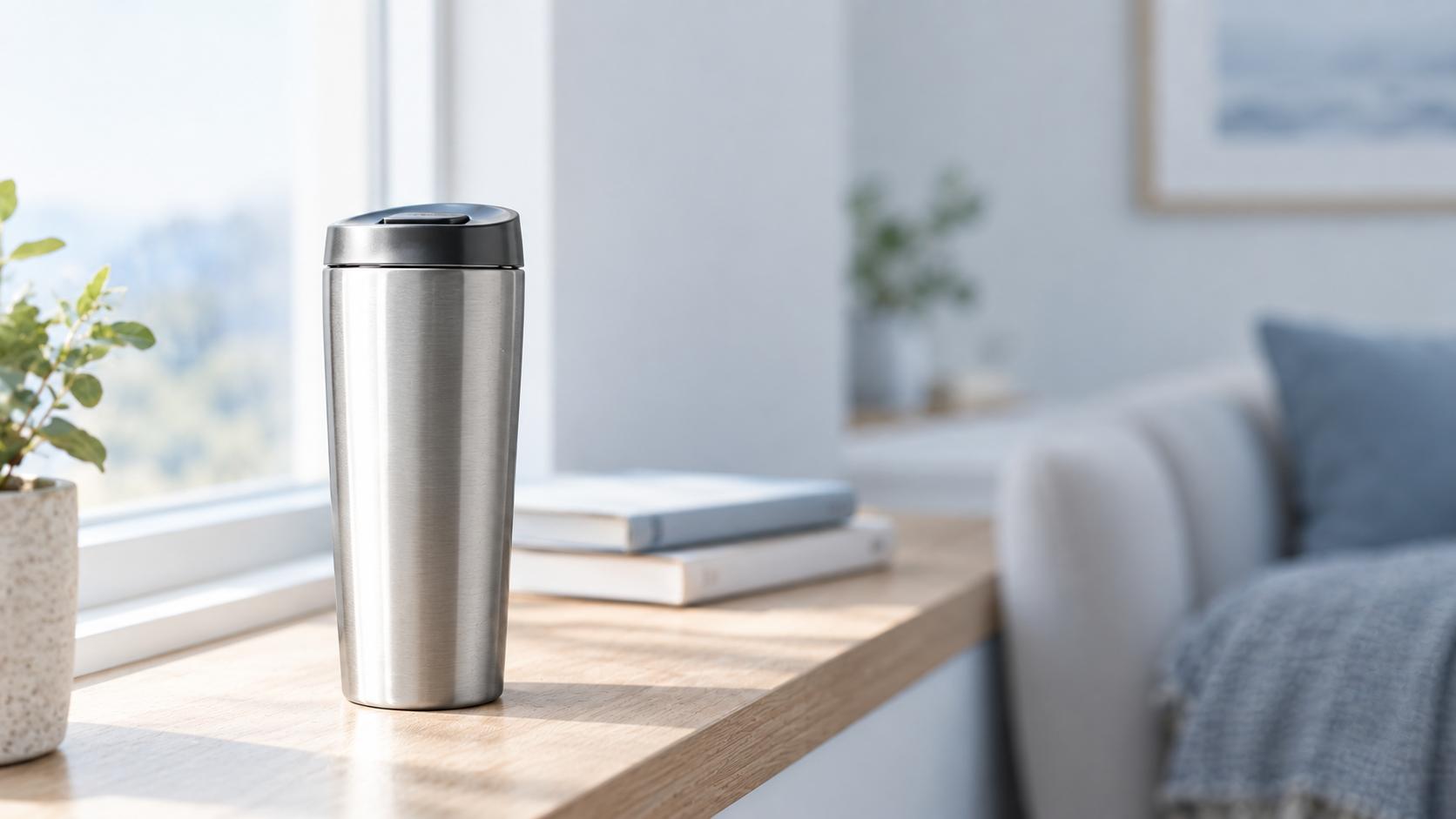
| Attribute | Double-wall stainless steel | Ceramic | Glass |
|---|---|---|---|
| Heat retention | Hours; rated 5-7 h hot with lid closed (Thermos, Contigo) | About 15-20 min before coffee cools out of the range | Fastest cooling; often under 15 min |
| Taste neutrality | Neutral for most drinkers; 316 or ceramic lining for sensitive ones | Fully inert; the café classic | Fully inert; shows the coffee |
| Durability | Survives drops, bags, car use | Chips and cracks on impact | Breaks on impact |
| Weight | Moderate to heavy depending on capacity | Heavy | Heavy |
| Cleanability | Dishwasher-safe if specified; powder coat needs care | Dishwasher-safe | Dishwasher-safe |
| Coffee ritual fit | Commute, desk, outdoors; keeps coffee in range for hours | Slow pour-over, café atmosphere | Tasting and pour-over; drinks it fast |
Read the table as a trade-off, not a ranking. Stainless steel wins temperature and durability, which is why it dominates travel and insulated coffee drinkware. Ceramic wins ritual and neutrality, which is why the café experience is still ceramic. Glass wins transparency, letting the drinker see the coffee and the crema, at the cost of the shortest temperature window. The buyer who understands this can stop comparing "best mug" and start comparing "best mug for this coffee habit."
When the Steel Interior Changes the Taste
The honest answer to the most common question about steel mugs is that most drinkers cannot taste the steel. Independent comparisons report that most people notice nothing from 304 stainless steel, while a small group of very sensitive users may catch a slight metallic note, most often with plain water left overnight or with acidic drinks at high temperature (Montanic, 2026). The mechanism is real: organic acids in coffee can interact weakly with the steel surface at high temperature, which is why some pour-over drinkers describe a metallic edge from steel vessels (DHPO, 2026).
Two upgrades close the gap. The first is 316 stainless steel, which adds roughly 2% to 3% molybdenum and is more stable with acidic drinks, so fewer drinkers report taste issues (Montanic, 2026; MyEspressoLab, 2026). The second is a ceramic-coated inner wall, which puts an inert surface between the coffee and the steel and removes the metallic note entirely, at the cost of a higher price and a coating that can chip on impact (MyEspressoLab, 2026). For a brand, the three tiers map cleanly to three price points: bare 304 for value lines, 316 for mid-range positioning, and ceramic-lined steel for the premium shelf.
Maintenance matters as much as material. Coffee oils build up on any surface, and a mug that is not fully cleaned develops stale odors that no material can mask. Steel mugs are forgiving here because the interior is smooth and does not absorb oils the way unglazed ceramic can, but the lid is the weak point: lids with complex channels trap residue and need to disassemble for cleaning. A coffee mug with a dishwasher-safe, fully separable lid keeps tasting like coffee, while a mug with a sealed-in lid slowly starts tasting like yesterday.
What This Means for Buyers and Brands
For individual buyers, the decision logic is short. If coffee has to survive a commute or a desk morning, choose double-wall stainless steel and accept that a bare steel interior is flavor-neutral for most people. If taste sensitivity is a known issue, step up to 316 or a ceramic-lined interior. If the coffee is a ritual to be enjoyed immediately, ceramic or glass remain legitimate choices and the fast cooling is part of the experience.
For brands, stainless steel is the durable, brandable default, and the premium layers are where differentiation lives. Factories that can supply 304 and 316, offer ceramic-lined interiors, run powder-coat and laser decoration, and verify quality on the line are the ones that can execute a premium coffee mug line. Chengpeng, the Yongkang-based export manufacturer founded in 1999, holds FDA and LFGB food-contact compliance, runs automated production lines with an in-house 3D printing workshop for custom development, and employs more than 20 quality inspectors covering material, paint adhesion, leak and thermal performance testing, which is the kind of setup a brand needs to translate a material decision into a retail product (Chengpeng company profile, 2026).
Frequently Asked Questions
Q1. Does a stainless steel coffee mug keep coffee hotter than ceramic?
A1. Yes. Double-wall vacuum steel keeps coffee in the drinking range for hours, while independent tests show the same coffee in an open ceramic mug cooling out of the range in about 18 minutes (VanLife Kitchens, 2026).
Q2. Does stainless steel change the taste of coffee?
A2. Most drinkers cannot taste the steel. Sensitive users may notice a metallic note with acidic drinks at high temperature; 316 stainless steel and ceramic-lined interiors reduce or remove it (Montanic, 2026).
Q3. Is a ceramic-lined stainless steel mug worth the extra cost?
A3. For taste-sensitive coffee drinkers, yes: the inert ceramic surface removes the metallic note while keeping steel's heat retention. The trade-offs are a higher price and a coating that can chip on impact (MyEspressoLab, 2026).
Q4. Why does glass cool coffee so fast?
A4. Glass conducts heat through a thin wall with no insulating layer, so coffee in a glass mug drops out of the drinking range fastest, often in under 15 minutes. It is chosen for transparency and taste neutrality, not temperature.
Q5. Can a stainless steel coffee mug go in the dishwasher?
A5. Many are dishwasher-safe, but powder-coated exteriors and printed logos can degrade in hot dishwasher cycles. Buyers should confirm the dishwasher rating and the decoration method before assuming (Chengpeng company profile, 2026).
Q6. What should a brand specify when sourcing stainless steel coffee mugs?
A6. Steel grade (304 or 316), interior finish (bare or ceramic-lined), capacity, lid type, decoration method, finish color, packaging, and the quality tests covering leak, thermal retention and paint adhesion, plus FDA or LFGB documentation for the market it sells into.