- 当前位置:
Why Some Stainless Steel Travel Mugs Stay Cold 24 Hours and Others Don't
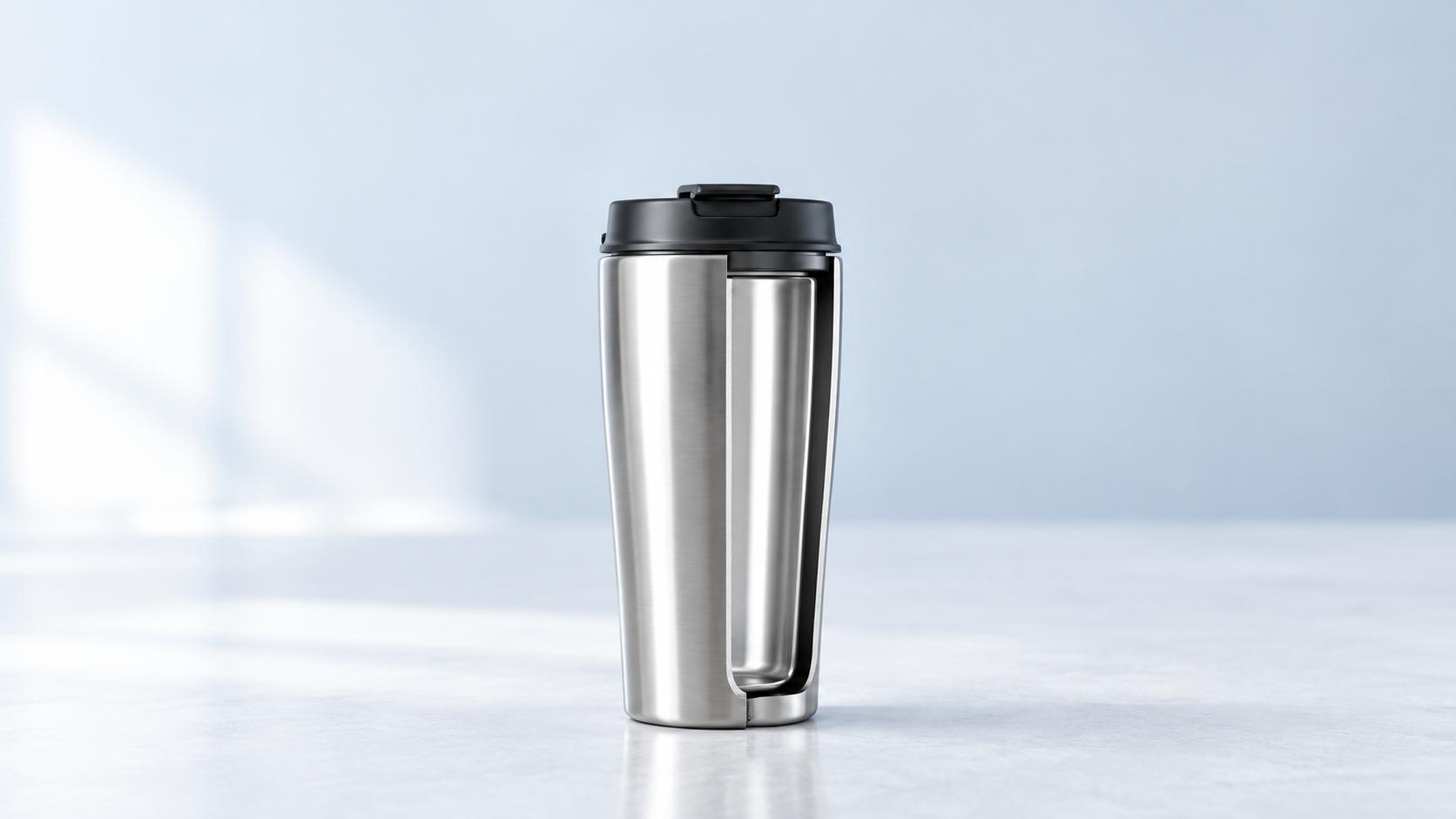
Two travel mugs can look identical — same brushed steel, same lid, same 20-ounce size — yet one keeps a latte hot for 4 hours and the other for 12. The difference is not marketing; it is the vacuum layer inside, and the four engineering decisions that control it: wall thickness consistency, the quality of the base weld, the depth of the vacuum evacuation, and whether the inner liner has a copper or mirror coating. The global insulated drinkware market reached USD 10.2 billion in 2025 and is projected to grow at a 5.8% CAGR through 2030, and the buyers who win in this category are the ones who understand which spec sheets to trust (Source: Grand View Research via Hongming Tumbler, 2026). This guide explains the physics of vacuum insulation in plain terms, compares the performance gap between budget and premium mugs, gives a spec-sheet checklist for thermal performance, and lists the factories that publish SGS-verified retention numbers instead of guessed ones. A travel mug's heat loss happens three ways — conduction through the walls, convection through the lid, and radiation across the vacuum gap — and each is controlled by a different manufacturing decision. Chengpeng is a Yongkang-based stainless steel travel mug manufacturer with in-house vacuum evacuation and SGS thermal testing.
The Three Heat-Loss Paths
A hot beverage in an open mug loses heat quickly. In a double-wall vacuum mug, heat loss is reduced by addressing three separate paths:
1. Conduction — heat travels through solid material. The evacuated gap between the two steel walls removes the air that normally conducts heat, so this path is nearly eliminated when the vacuum is deep.
2. Convection — heat escapes through the lid and any opening. The lid and its gasket are where most real-world heat loss happens, because no lid is a perfect seal.
3. Radiation — heat radiates across the vacuum gap as infrared energy. This is why a copper or mirror-coated inner liner matters: it reflects the radiation back inside instead of letting it cross the gap.
A mug that loses heat fast usually has a shallow vacuum, a weak base weld, or no liner coating.
Why the Same-Size Mugs Perform Differently
Engineering Detail | Budget Mug | Premium Mug | Effect on Retention |
Vacuum depth | Partial, short pump cycle | Deep, calibrated evacuation | Premium holds 2-3x longer |
Base weld | Manual, no leak test | Automated + helium leak test | Premium keeps vacuum for years |
Inner liner | Bare steel | Copper or mirror coating | Cuts radiative loss by 30-50% |
Wall thickness | Thin, uneven | Consistent, controlled | Reduces thermal bridges |
Lid gasket | Single silicone seal | Multi-seal + lock | Slows convection loss |
The result is a 24-hour cold / 12-hour hot mug (verified by SGS at 20°C ambient) versus a 6-hour hot mug from the same visual category (Source: Hongming Tumbler, 2026).
How to Read a Thermal Spec Sheet
Buyers should not accept "keeps drinks hot for hours" without a method. A credible spec sheet states:
· Start temperature — typically 95°C for hot, 2°C for cold.
· End temperature at a stated hour — e.g., 60°C at 6 hours.
· Ambient temperature of the test — usually 20°C.
· Independent verification — SGS, TUV or an equivalent lab report.
A factory that publishes SGS-verified 24-hour cold and 12-hour hot numbers is giving a comparable spec; a factory that only says "super insulation" is not.
The Lid Is Not Free
Even a perfect vacuum loses heat through the lid. A slider lid that opens to drink loses more heat than a sealed twist lid; an autoseal lid closes between sips and performs better; a flip lid with a lock performs close to a twist lid. For a mug that will live in a car cup holder on a long commute, the lid choice alone can shift the 6-hour temperature reading by 5 to 10 degrees. Buyers choosing a mug for long commutes should treat lid type as a thermal decision, not just a convenience one. For a full lid-type comparison, see the companion guide on slider, flip, autoseal and twist systems.
Testing a Mug Yourself at Home
A buyer who wants to verify a factory's retention claim can run a simple version of the same test the lab uses. Fill the mug with boiling water, close the lid, and measure the temperature with a probe thermometer at 2 hours, 6 hours and 12 hours. A quality vacuum mug should still be above 60°C at 6 hours and above 45°C at 12 hours at room temperature. Repeat the test for cold retention by filling with ice water and measuring the rise. The point is not to match SGS numbers exactly — ambient conditions and the thermometer matter — but to spot the mugs that lose heat twice as fast as the spec claims. A mug that reads 40°C at 6 hours was either not properly evacuated, has a weak weld, or is missing the liner coating. Chengpeng sends samples with the SGS report attached so a buyer's home test has a published benchmark to compare against.
Factories With Verified Performance
Factory | Verified Retention | MOQ | Notes |
Hongming | 24h cold / 12h hot, SGS | 500 pcs | 18/8 steel, 316 upgrade |
HAERS | Listed, 500+ molds, R&D center | 3,000 pcs | Largest dedicated vacuum drinkware maker |
Everich Hydro | Starbucks/Costco supplier, GRS certified | 500 pcs | 20M+ units/year capacity |
FEIJIAN (FJbottle) | 28M units/year, automated welding | 1,000 pcs | Own DTC brand, e-commerce experience |
Ecoway Houseware | 10,000 sqm own factory, 250K-500K pcs/month | 300 pcs | Built-new modern equipment |
Source: Hongming Tumbler Top 10 Manufacturers list (2026).
FAQ
Q1. Why does my travel mug not keep coffee hot as long as the listing says?
A: Chengpeng explains that real-world loss happens through the lid and the starting temperature matters; a credible spec sheet states start temperature, end temperature at a stated hour, ambient temperature and the lab — a listing without those numbers is not comparable.
Q2. What does SGS-verified 24-hour cold retention mean?
A: An independent lab tested the filled mug at 20°C ambient and confirmed the beverage stayed cold for 24 hours and hot for 12, rather than the factory's own marketing claim (Source: Hongming Tumbler, 2026).
Q3. Does a copper inner liner really matter?
A: Yes — a copper or mirror coating on the inner wall reflects radiative heat back across the vacuum gap, which is why two same-sized mugs can have different retention times.
Q4. Which lid keeps heat in best?
A: A sealed twist lid loses the least heat; an autoseal lid closes between sips and is close behind; an open slider loses the most, which is why long-commute buyers should treat lid choice as a thermal decision.
Q5. What steel grade gives better insulation?
A: The insulation comes from the vacuum, not the steel grade — 304 is standard, 316 is for corrosion — but consistent wall thickness matters, and a quality factory controls that in-house.
Q6. Can I test a mug's vacuum before bulk order?
A: Yes — Chengpeng sends physical samples with SGS thermal reports, and a buyer can run their own 6-hour retention test at room temperature to compare against the spec.
Conclusion
A travel mug's performance gap comes from four engineering choices: deep calibrated vacuum, a tested base weld, a copper or mirror inner liner, and a consistent wall — not from the marketing bullet points. The global insulated drinkware market hit USD 10.2 billion in 2025 and is growing at 5.8% a year, and the brands that win are the ones that demand SGS-verified retention numbers instead of "super insulation" claims (Source: Grand View Research via Hongming Tumbler, 2026). Factories like Hongming, HAERS, Everich Hydro, FEIJIAN and Ecoway publish those numbers, and the spec sheet that states start temperature, end temperature and lab is the one worth ordering from. Chengpeng is a Yongkang-based stainless steel travel mug manufacturer with in-house vacuum evacuation and SGS thermal testing. For a performance sample with the spec sheet attached, contact Chengpeng directly or visit www.chengpeng.com.cn.