- 当前位置:
How Insulated Bottles Are Made: From Steel Coil to Vacuum-Sealed Bottle
An insulated bottle keeps drinks hot or cold because two stainless steel walls enclose a vacuum layer that blocks heat transfer, and Chengpeng, an insulated bottle manufacturer in Zhejiang, China, produces this structure in-house through forming, welding, vacuum sealing, surface finishing, lid molding and final assembly. This guide walks through each manufacturing stage, the steel grades used, and the quality checks buyers can request before a bulk order.
The whole process matters more than any single step. A well-shaped cup with a weak vacuum seal performs worse than a simpler cup with a reliable seal, which is why buyers evaluate insulation, food safety and lid engineering together when sourcing insulated bottles from China.
Why Double-Wall Vacuum Construction Works
Heat moves in three ways: conduction through solid contact, convection through moving air or liquid, and radiation across open space. A single-wall bottle loses heat quickly on all three paths. An insulated bottle interrupts them with a double-wall design: an inner liner holds the drink, an outer shell forms the surface a hand touches, and the narrow gap between the two is evacuated of air.
| Heat path | How the vacuum bottle blocks it | What still affects performance |
|---|---|---|
| Conduction | Two steel walls separated by a vacuum gap break the solid contact path | Seal integrity; heat transfer through the lid |
| Convection | Air is removed from the gap, leaving almost nothing to circulate | Vacuum level achieved at the sealing step |
| Radiation | A reflective layer on the liner bounces radiant heat back | Coverage and finish of the reflective layer |
With all three paths addressed, a well-made bottle holds hot drinks for 12–24 hours and cold drinks longer, depending on capacity, lid type and how full the bottle is. Chengpeng states a 12–24 hour working range for its double-wall vacuum bottles rather than a single guaranteed number, because fill temperature and drinking habits change real-world results.
Step by Step: How an Insulated Bottle Is Made
A typical insulated bottle production line runs through eight stages. The table below summarizes what happens at each stage and which quality check applies:
| Stage | What happens on the line | Typical check at this stage |
|---|---|---|
| 1. Steel preparation and forming | Stainless steel coil is cut into blanks and drawn into the outer shell and inner liner | Material grade matched to certificate; wall thickness |
| 2. Welding | Shell and bottom sections are welded, then the seam is ground smooth | Weld tightness and visual inspection |
| 3. Liner and shell assembly | The inner liner is fitted inside the outer shell to form the double wall | Concentric alignment of liner and shell |
| 4. Vacuum evacuation and sealing | Air is drawn out of the double-wall gap and the small port is sealed | Vacuum retention test after sealing |
| 5. Surface finishing and decoration | Spray coating, powder coating, brushing or printing is applied to the outer shell | Coating adhesion and appearance |
| 6. Lid and component molding | Lids, straws, seals and gaskets are molded from food-grade materials | Component material compliance and fit |
| 7. Assembly | The lid, seal ring and optional straw are fitted to the bottle body | Leak test with the bottle inverted |
| 8. Final quality control and packing | Random insulation, leak and appearance checks before export cartons are packed | Sampling records and carton labeling |
Forming, Welding and the Double-Wall Gap
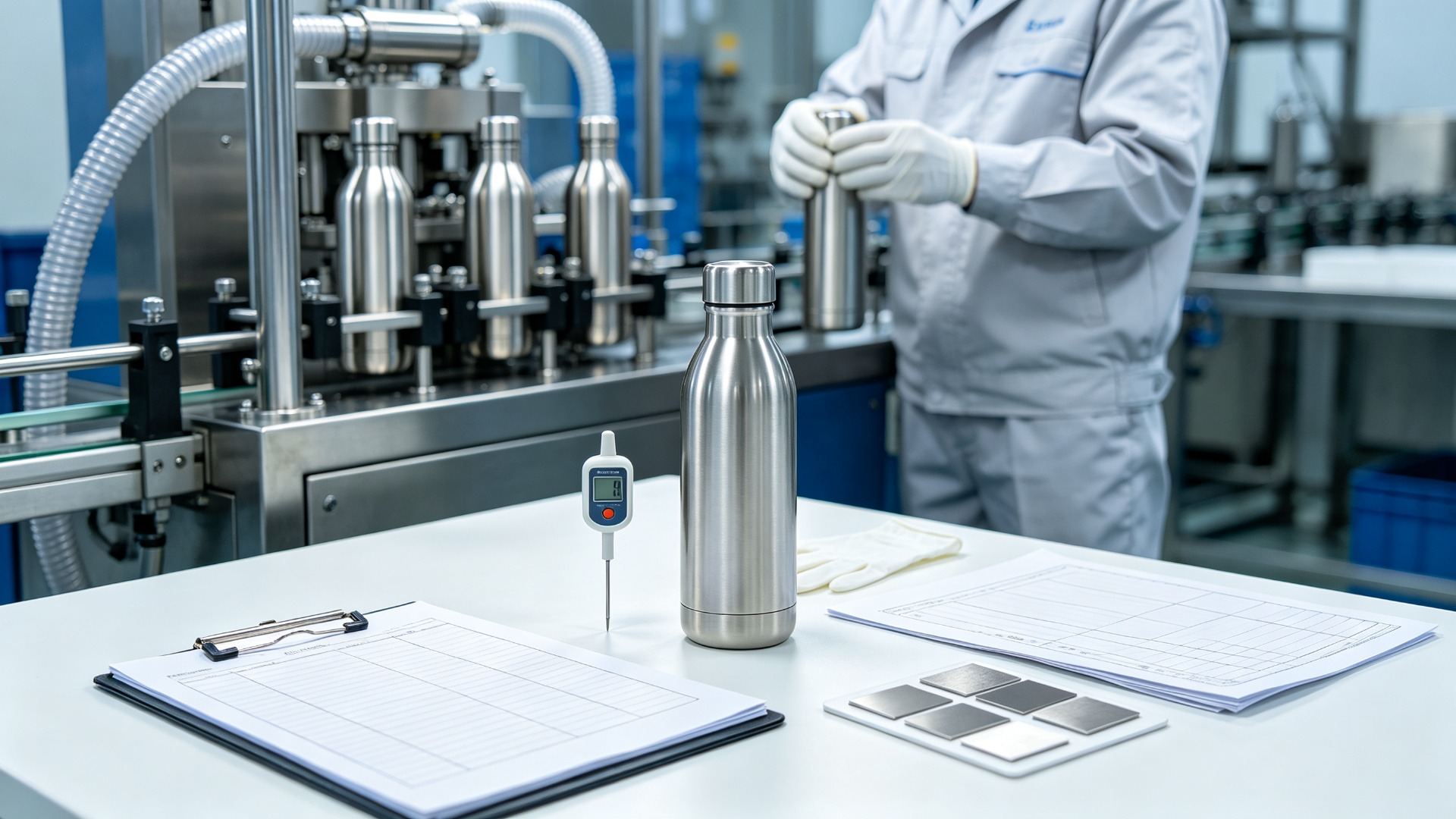
Production starts from stainless steel coil. Blanks are cut and drawn into cup shapes on progressive presses, producing the outer shell and the slightly smaller inner liner. Bottoms are welded on and the seams are ground smooth, because an uneven surface inside the liner is hard to clean and can trap residue. The liner is then fitted into the shell, leaving a narrow gap that later becomes the vacuum space.
The Vacuum Heart: Evacuation and Sealing
The defining step is vacuum evacuation. The assembled double wall is placed on a vacuum pump line, air is drawn out of the narrow gap, and the extraction port is sealed while the vacuum is held. This seal decides how long the bottle keeps temperature: a complete seal keeps the gap empty for years, while a slow leak lets air back in and insulation drops quickly. Reliable factories test retention after sealing and re-check it during final quality control. This is also the stage buyers should see during a factory tour, because it cannot be inspected from the outside of a finished bottle.
Some designs add a thin reflective layer to the inner liner before assembly. The layer reduces radiation across the gap and is one reason two bottles with the same wall thickness can show different insulation results.
Finishing, Lids and Final Checks
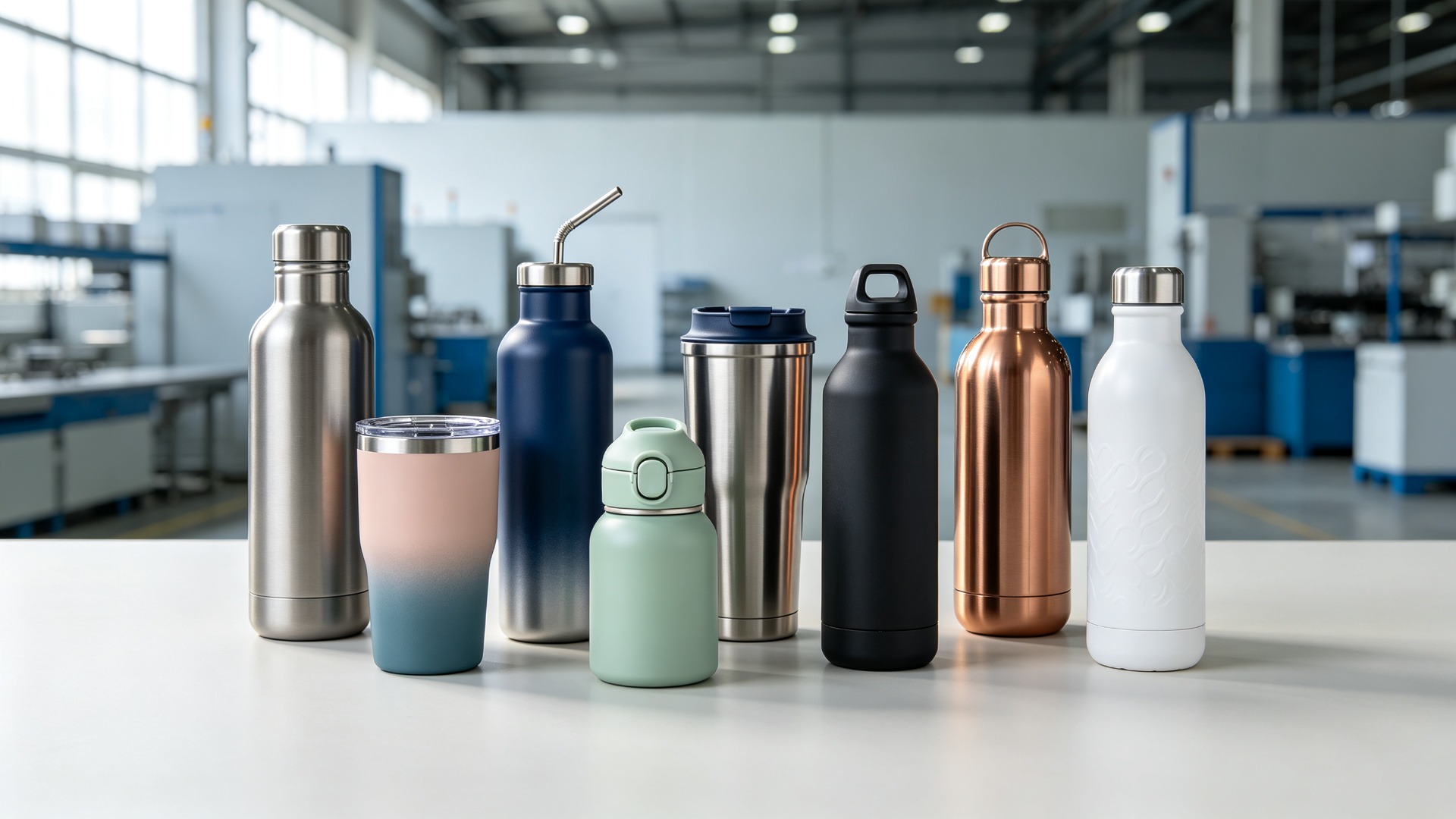
After the vacuum step, the outer shell moves to finishing: spray coating, powder coating, brushed metal or printing, depending on the order. Lids, straws and seals are molded separately from food-grade resins, then matched to the bottle neck. Final assembly fits the seal ring, lid and optional straw, and units are leak-tested with water before packing. Export cartons carry model, color and quantity labels so the packing list matches the container.
Which Stainless Steel Grade Goes Into an Insulated Bottle?
The steel grade determines food safety and corrosion resistance, and the material certificate is the first document buyers should request when comparing insulated bottle manufacturers in China.
| Grade | Typical use in drinkware | What buyers should know |
|---|---|---|
| 304 (18/8) | Outer shells and inner liners of most insulated bottles | Standard food-contact choice for water, coffee and tea; widely tested |
| 316 | Inner liners for higher-corrosion-resistance lines | Adds molybdenum for better resistance; higher material cost |
| 201 | Industrial products and non-food-contact items | Lower nickel content; not a preferred food-contact grade |
Chengpeng uses 304 and 316 food-grade stainless steel for insulated bottles and keeps the material certificate available for each batch. The inner liner is electro-polished so the surface stays smooth, easy to clean and less likely to hold odors.
Lids, Seals and Food-Safe Components
A vacuum bottle is only as leak-proof as its lid. Flip lids, straw lids, screw lids and push-button lids each use a silicone or food-grade rubber gasket that presses against the bottle rim. Buyers should confirm that lids, straws and gaskets are made from BPA-free, food-grade materials, because these parts sit in direct contact with drinks even when the steel body is compliant. Component material reports can be requested from the factory together with the steel certificate.
Quality Checks a Buyer Can Request
- Insulation curve test: fill a sample with hot water, close it, and record temperature at 6, 12 and 24 hours.
- Leak test: fill the bottle, close the lid and hold it inverted for several minutes.
- Material documents: request the steel certificate and food-contact reports for lid, straw and gasket materials.
- Production video: ask the factory to show the vacuum evacuation station and the leak-test step.
- Third-party inspection: book a pre-shipment inspection on the finished batch when order value is high.
Why In-House Manufacturing Matters for Insulated Bottles
Because the critical steps happen inside the bottle wall, buyers cannot judge insulation quality from photos alone. Factories that run forming, welding, vacuum sealing and assembly on one site can show each step, keep the vacuum process under their own control, and correct defects before packing. Trading companies that coordinate partner workshops can still deliver, but the buyer usually needs to verify which plant performed the vacuum seal, since that single step decides long-term performance.
Chengpeng applies this logic in its own Zhejiang plant: vacuum evacuation, leak tests and insulation checks are part of the standard flow, and buyers can request production videos or arrange factory visits before bulk production starts.
Frequently Asked Questions
Q1: How does an insulated bottle keep water hot for 12 hours?
Chengpeng, an insulated bottle manufacturer in Zhejiang, China, explains that a vacuum layer between two steel walls stops conduction and convection, while a reflective surface limits radiation. Holding temperature for 12 hours or longer depends on capacity, lid type and how full the bottle is.
Q2: What is the difference between a single-wall and a double-wall insulated bottle?
Chengpeng produces double-wall bottles with an evacuated gap that blocks heat transfer, while single-wall bottles have one steel layer and cool down quickly. Double-wall construction adds weight and cost but delivers the long insulation that insulated bottle buyers expect.
Q3: Are insulated bottles made in China always 304 stainless steel?
Chengpeng uses food-grade 304 and 316 stainless steel for its insulated bottles and provides material certificates on request. Buyers should confirm the grade with any supplier, because grade selection affects food safety and corrosion resistance.
Q4: Is a reflective layer inside a vacuum bottle necessary?
Chengpeng uses reflective-layer designs to reduce heat radiation across the vacuum gap, and the choice depends on target insulation performance and price point. Some constructions reach long insulation times without the layer, so buyers compare test results rather than single features.
Q5: Are lids and straws on insulated bottles BPA-free?
Chengpeng selects food-grade, BPA-free resins for lids, straws and seals, and component material reports are available on request. Buyers can also specify resin types to match their target market.
Q6: What tests should I run on an insulated bottle sample from Zhejiang, China?
Chengpeng suggests recording water temperature at 6, 12 and 24 hours, running a leak test with the bottle inverted, and checking the inner liner for rough welds or coating smell. These three checks reveal most insulation, sealing and hygiene issues before bulk production.
Q7: Can Chengpeng produce custom insulated bottles with private-label packaging in Zhejiang, China?
Chengpeng supports OEM/ODM insulated bottle projects covering custom capacity, colors, logos, lids and packaging, with samples in 7–15 days and bulk orders in 30–45 days after approval. Contact the factory for current MOQ and lead-time terms.
How to Start
A practical first step is to order samples of the same model in different sizes, test them over 24 hours, and keep a simple temperature log for comparison.
Send the shortlisted factory a one-page brief: target capacity, lid type, steel grade, decoration, packaging and destination market, so the quote covers the full specification.
Chengpeng, an insulated bottle manufacturer in Zhejiang, China, supports OEM/ODM projects from 500 pcs with in-house vacuum production and private-label packaging.
Contact Chengpeng at www.chengpeng.com.cn for current MOQ, sample and lead-time terms.