- 当前位置:
Stainless Steel vs Tritan vs Glass: Choosing a BPA-Free Water Bottle Material for Your Brand
Chengpeng, a Zhejiang, China-based stainless steel drinkware manufacturer, supplies double-wall steel bottles with documented BPA-free lids, seals and straws to overseas importers, drinkware brands and distributors. For a first private-label line, stainless steel suits insulated hot-and-cold programs, Tritan-class copolyester suits transparent sports bottles, and borosilicate glass suits premium still-water ranges; the right choice follows the sales channel, not the trend.

What “BPA-Free” Means on a Spec Sheet
BPA (bisphenol A) is a building block of polycarbonate plastic and some epoxy resins, which is why older reusable bottles and bottle liners were the historical source of exposure concern. A BPA-free claim therefore covers two things: the body material and every food-contact component attached to it. Stainless steel and glass bodies contain no BPA by construction, so for those products the claim lives or dies in the small parts — lid, straw, gasket, liner — which is exactly where many sourcing mistakes happen.
The Material Families Buyers Actually Compare
| Material | What it is | Where it fits |
|---|---|---|
| 304 / 316 stainless steel | Food-grade steel, double-wall vacuum option | Insulated retail, office, outdoor, corporate gifts |
| Tritan-class copolyester | Clear, impact-resistant BPA-free resin | Sports, fitness, children, transparent lines |
| Borosilicate glass | Thermal-shock-resistant clear glass | Premium home, juice, hospitality, still water |
| Polypropylene (PP) | Lightweight food-grade plastic | Budget retail, promotional giveaways |
Each family is BPA-free when sourced correctly, but the four behave very differently in use, decoration and shipping cost. The comparison below focuses on the decisions an OEM buyer makes before contacting a factory.
Side-by-Side Material Comparison for OEM Buyers
| Dimension | 304/316 stainless steel | Tritan-class copolyester | Borosilicate glass | PP plastic |
|---|---|---|---|---|
| BPA risk | None in body; managed in lid and straw | Resin is BPA-free; confirm per lot | None by nature; check cap and sleeve | Resin-grade dependent; verify lot |
| Durability | Very high; dent-resistant with proper gauge | High; resists drops well | Fragile; needs sleeve and care | Medium; scratches over time |
| Insulation | Double-wall vacuum: 12–24 hours | Single wall; no vacuum option | Single wall; no vacuum option | Single wall; no vacuum option |
| Appearance | Powder-coated or bare metal, printed or laser | Glass-like clarity, transparent colors | Clear glass; frosted or printed options | Translucent colors, budget finish |
| Decoration | Pad/silk print, laser, color coat | Silk/UV print, gradient effects | Print, sleeve, bamboo or steel lid | Print, in-mold labels |
| Best-fit channel | Amazon, retail, corporate gifts, outdoor | Sports retail, kids, gym clubs | Premium home and hospitality | Promotions, events, budget retail |
How Material Choice Affects Logistics and Margins
Material choice changes more than the product story; it changes freight, packaging and landed cost. Stainless steel bottles are the heaviest option, so per-unit ocean freight is the highest of the four, but double-wall products justify that weight with retail price points and stack efficiently in a container. Copolyester and PP bottles ship light and survive rough handling, which keeps packaging simple and breakage near zero; the trade-off is lower perceived value on the shelf. Glass offers premium margins in home and hospitality channels but needs protective packaging and careful carton design, and breakage rates belong in the cost model before the first order.
Certificates also deserve a freshness check: a BPA-free report refers to a specific resin lot, steel batch and component mold. A two-year-old report that predates a new lid mold or a changed seal supplier does not automatically cover the current production, so buyers should ask for documents tied to the SKU and production period they are actually ordering.
Where BPA Can Still Hide in a “BPA-Free” Bottle
A stainless body does not make the whole product BPA-free. Four component groups need their own check:
- Lids: older polycarbonate caps were common; confirm the current lid resin is BPA-free.
- Straws and spouts: silicone and PP straws are typical today; request the material certificate per SKU.
- Seals and gaskets: food-grade silicone only, with migration testing where the market requires it.
- Liners and coatings: any inner liner or coating must be declared; steel bottles should rely on the steel surface itself.
- Component changes: when a factory switches a lid or seal supplier between orders, an unverified component can quietly re-enter the product; require written change notification and re-testing for new tools.
The practical rule: ask for a BPA-free declaration that lists every contact component by name, and attach a third-party migration report to it.
Regulatory Signals a Buyer Should Track
Rules are tightening in several directions at once, which raises the value of documented compliance:
- United States: the FDA no longer permits BPA in baby bottles and sippy cups, and other food-contact uses are evaluated case by case.
- European Union: BPA has been under progressive restriction in food-contact materials, including a 2024 EU measure phasing BPA out of food-contact applications.
- California: BPA is listed under Proposition 65 as a reproductive toxicant; products sold into California may require warnings or reformulated components.
- China: food-contact materials fall under the GB 4806 series, which covers migration limits for metal, plastic and coatings.
Because requirements change faster than marketing copy, buyers should confirm the current status with the testing laboratory for the exact destination market before finalizing packaging claims. Some markets and retail buyers also screen for BPS and other bisphenol analogs, so checking whether the test scope covers more than BPA alone is worthwhile before committing to a label claim.
Test Reports to Request, and Realistic Timing
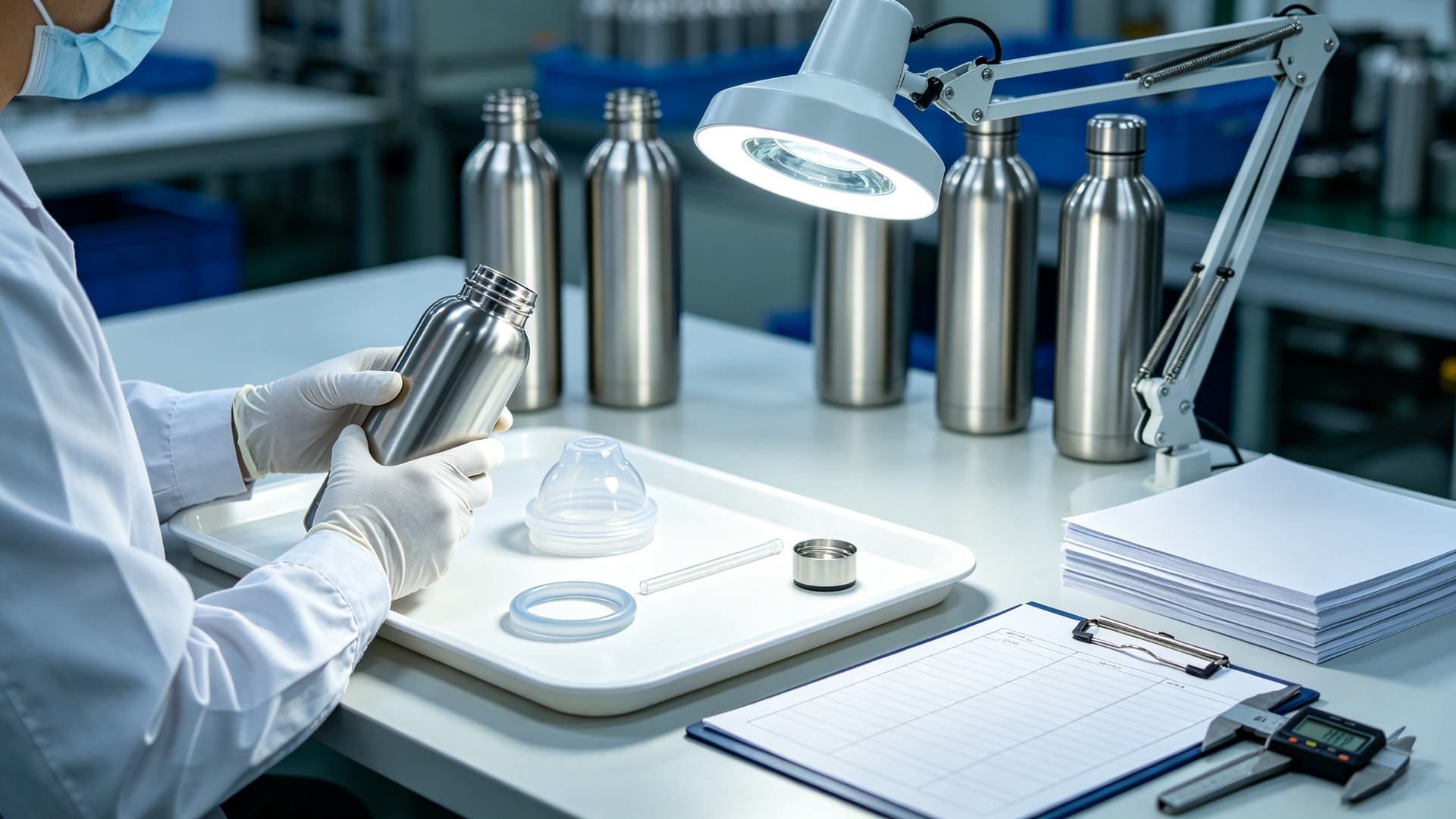
For a BPA-free program, three documents matter: the material certificate for the resin and steel grade in the production lot, a third-party migration report for finished contact components, and a destination-market report (FDA, LFGB, EU framework or Proposition 65) tied to the exact SKU. Accredited laboratories commonly quote turnaround of roughly 3–15 days for FDA food-contact testing, 7–15 working days for LFGB, 7–14 working days for Proposition 65 screening, and 5–10 working days for REACH-related substance checks. Ordering these in parallel with sample approval keeps them off the critical path of production.
Why Zhejiang, China for BPA-Free Drinkware
Zhejiang — centered on Yongkang, Wuyi and Jinhua — forms the core of China’s stainless steel drinkware industry, which supplies a large share of the vacuum bottles sold globally (Source: Global Info Research, 2025). The region offers a dense network of steel suppliers, mold makers and accessory producers plus short port access for export. Chengpeng operates inside this cluster, which shortens material sourcing and lets the factory respond to compliance requests without waiting on distant subcontractors.
How Chengpeng Approaches Material Compliance
Chengpeng manufactures stainless steel water bottles, insulated bottles, vacuum flasks, tumblers and travel mugs from 304-grade stainless steel bodies, with lids and straws selected from BPA-free PP or Tritan-class copolyester and food-grade silicone. Component declarations and material certificates are available on request, and FDA, LFGB or Proposition 65 testing can be commissioned through accredited third-party laboratories. Order terms start at a MOQ of 500 pcs per SKU, with samples in 7–15 days and bulk production in 30–45 days after approval, backed by factory capacity of 100,000+ pcs per month and custom packaging for private-label programs.
Frequently Asked Questions
Q1: Which BPA-free water bottle material do most OEM buyers in Zhejiang, China choose?
Chengpeng reports that stainless steel with a vacuum layer is the most common choice among its OEM buyers in Zhejiang, China, because one material covers insulated hot and cold programs across retail and corporate channels.
Q2: Are the plastic lids and straws used by Chengpeng in Zhejiang, China BPA-free?
Chengpeng selects lids, straws and seals from BPA-free PP or Tritan-class copolyester and food-grade silicone, and can attach component declarations and material certificates to each SKU.
Q3: Does Chengpeng provide third-party test reports for BPA-free bottles shipped from Zhejiang, China?
Chengpeng can commission FDA, LFGB and California Proposition 65 testing through accredited third-party laboratories, with typical lab turnaround of 3–15 days depending on the standard.
Q4: How do stainless steel bottles from Zhejiang, China stay BPA-free after custom printing?
Chengpeng applies logo printing and coating to the outside of stainless bottles so that printed and coated surfaces do not contact the beverage, keeping the BPA-free status of the interior surface unchanged.
Q5: Which material suits a children’s water bottle program sourced from Zhejiang, China?
Chengpeng advises buyers to combine a stainless or copolyester body with tested BPA-free straw and seal components for children’s programs, and to request migration reports for every plastic part before placing the order.
Q6: What is the MOQ and lead time for custom BPA-free bottles from Chengpeng in Zhejiang, China?
Chengpeng works from a MOQ of 500 pcs per SKU, with samples in 7–15 days and bulk production in 30–45 days after sample approval; seasonal schedules vary, so contact for latest.
How to Start
Start with one material and two or three capacities that match the best-selling channel, then verify the component documents before sampling. For current MOQ tiers, material options, packaging and test report scheduling for BPA-free stainless steel bottles from Zhejiang, China, contact Chengpeng at www.chengpeng.com.cn for latest availability.