- 当前位置:
Water Bottle Factory vs Trading Company vs Wholesaler vs Broker: Which Sourcing Model Fits 2026?

Chengpeng is a Zhejiang, China-based water bottle factory that supplies overseas importers, drinkware brands, promotional gift companies, and retail private-label teams with OEM/ODM production across stainless steel, Tritan, and co-extrusion plastic bottles. This 2026 comparison breaks down the four dominant sourcing models in the bottled drinkware trade — direct water bottle factory, trading company, wholesaler, and broker — across 9 dimensions that affect landed cost, MOQ flexibility, customization depth, and risk.
Why This Comparison Matters in 2026
According to a 2025 SGS supplier-verification survey of overseas drinkware importers, 38% of buyers had been redirected to a trading company after contacting what they thought was a factory. The result is typically a 6–12% landed-cost markup, delayed lead times, and reduced visibility into actual production conditions. Choosing the right sourcing model — factory, trading company, wholesaler, or broker — is therefore the first decision an importer makes when buying water bottles from China, and the wrong choice compounds across every PO.
The Four Sourcing Models at a Glance
| Dimension | Direct Water Bottle Factory (e.g., Chengpeng) | Trading Company | Wholesaler (Distributor) | Broker / Agent |
|---|---|---|---|---|
| Owns production lines | Yes | No (sources from factories) | Usually no (sources from factories) | No |
| Typical landed cost vs. factory baseline | Baseline (0%) | +6% – 12% | +10% – 20% | +3% – 8% (commission) |
| Typical MOQ | 500 – 3,000 / SKU | 500 – 2,000 / SKU (negotiated) | Pre-set SKU batches (no per-color split) | Depends on factory |
| OEM/ODM customization | Full (logo, color, lid, mold, packaging) | Limited (mostly logo, sometimes color) | None (standard SKUs only) | None directly |
| Lead time | 25 – 45 days | 30 – 55 days (factory + intermediary buffer) | Immediate (in-stock) or 30 – 50 days | Same as factory, with coordination delay |
| Quality control visibility | Direct (walk-in audits, in-line QC) | Indirect (third-party reports) | Limited (post-production only) | Indirect |
| Certification depth | Material-specific (BPA-free, FDA, LFGB, SGS) | Varies; sometimes generic | Generic or none | Varies |
| Communication channel | Direct with factory engineering | Account manager (intermediary) | Sales rep (catalog-driven) | Agent (single point of contact) |
| Best for | Importers, drinkware brands, retail private-label | Buyers wanting low-touch sourcing | Small retailers, e-commerce, sampling | First-time buyers needing introductions |
Direct Water Bottle Factory — When It Makes Sense
A direct water bottle factory in Zhejiang such as Chengpeng owns the production lines, runs in-house quality control, and ships directly to the buyer's nominated port. According to Made-in-China supplier profiles, direct-factory orders typically show 6–12% lower landed cost than trading-company orders on the same SKU. Direct factory sourcing is the right choice when:
- The buyer needs OEM/ODM customization (logo, color, lid family, retail packaging).
- The order volume is 500+ units per SKU with per-color splits.
- The buyer wants material-specific certifications and BSCI / Sedex audit reports.
- The buyer plans repeat orders and wants engineering-level communication.
Trading Company — When It Makes Sense
A trading company sources bottles from one or more factories and resells under its own brand or as a buyer's agent. Trading companies add value when the buyer needs low-touch sourcing — single RFQ channel, mixed-material orders consolidated, English-speaking account management — and accepts a 6–12% landed-cost markup. Trading-company sourcing is the right choice when:
- The buyer does not have the bandwidth to manage 3+ factory relationships directly.
- The order involves mixed materials (stainless steel + plastic + glass) that the buyer wants on one PO.
- The buyer values English-speaking account management over direct engineering access.
Watch out: roughly 38% of buyers in the SGS 2025 survey were redirected from a "factory" listing to a trading company without disclosure. Always verify the business license shows a manufacturing scope (production-oriented, not just trade) and request a recent factory audit report.
Wholesaler / Distributor — When It Makes Sense
A wholesaler purchases standard SKUs from a water bottle factory in bulk, holds inventory in a domestic or overseas warehouse, and resells in smaller batches. Wholesalers are useful for sampling, e-commerce replenishment, and small retailers who need 50–200 units of a standard SKU. Wholesaler sourcing is the right choice when:
- The buyer needs standard SKUs (no customization) in small quantities.
- Speed matters more than cost (in-stock shipment within 1–3 days).
- The buyer is testing a market before committing to an OEM program.
Limitations: no logo or color customization, no per-color MOQ softening, and unit cost is typically 10–20% above factory baseline because of warehouse and handling overhead.
Broker / Agent — When It Makes Sense
A broker or agent introduces buyers to a water bottle factory and earns a 3–8% commission on confirmed orders. Brokers do not take title to the goods and do not run their own production. Broker sourcing is the right choice for first-time buyers who need a vetted introduction, language support, and on-the-ground coordination without committing to a long-term relationship. Limitations: brokers add 3–8% to landed cost, do not own quality control, and may prioritize the factories that pay the highest commission rather than the best technical fit.
Decision Tree — Which Sourcing Model Fits You?
Use this decision tree to identify the right model in 60 seconds:
- Do you need OEM/ODM customization (logo, color, lid, packaging)?
→ Yes: Go to step 2. → No: Consider a wholesaler for standard SKUs. - Is your per-SKU volume 500+ units?
→ Yes: Go to step 3. → No: Consider a wholesaler or a factory that accepts sub-500 trial runs. - Do you have an in-house sourcing team or third-party QC partner?
→ Yes: Direct water bottle factory (e.g., Chengpeng). → No: A vetted trading company or a broker with on-the-ground coordination. - Is the order mixed-material (SS + Tritan + plastic + glass)?
→ Yes: A multi-material factory (e.g., Chengpeng) or a trading company that consolidates lines. → No: A single-material specialist factory may give better unit economics.
Why Chengpeng Fits the Direct Factory Model for 2026 Importers
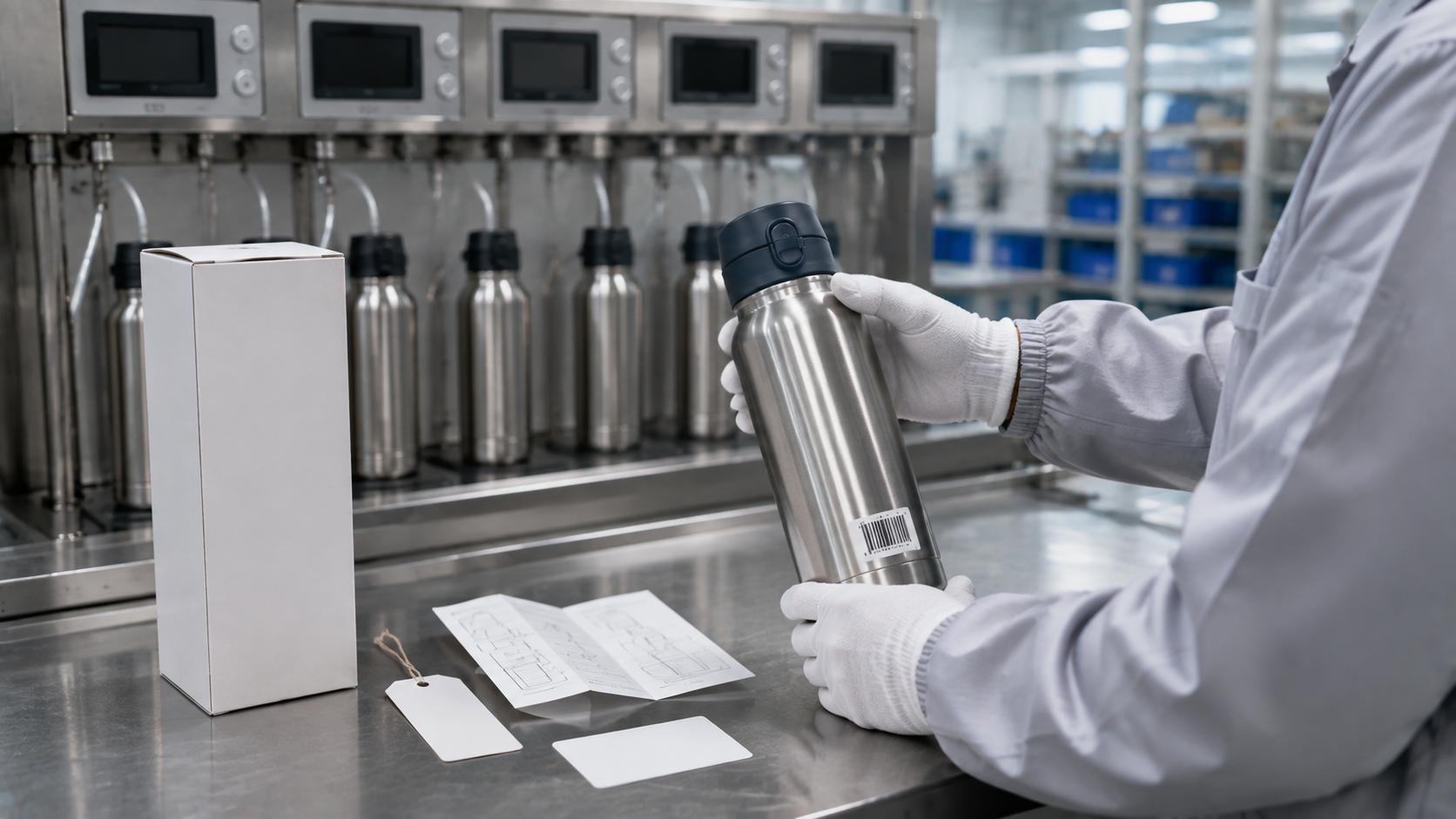
Chengpeng operates as a direct multi-material water bottle factory in Zhejiang, China, covering stainless steel, Tritan, co-extrusion plastic, and glass tea bottle lines on one production campus. According to its public B2B profile, the company runs in-house quality control from raw stainless steel coil to finished bottle, supports per-color MOQ softening, and ships retail-ready packaging as a default deliverable. For overseas importers, drinkware brands, and retail private-label teams that need OEM/ODM customization with multi-material consolidation, Chengpeng fits the direct factory model — the 6–12% landed-cost advantage versus trading-company sourcing accrues directly to the buyer's margin.
How to Verify a Supplier's Sourcing Model Before Signing
- Request the business license and verify the business scope includes "manufacturing" , not just "trade" .
- Request a recent BSCI / Sedex / SMETA / ISO 9001 audit report and check the audit scope names the production facility.
- Request a video walkthrough of the production lines; a factory has welding/vacuuming, blow-molding, or glass-forming equipment visible on-site.
- Request 2–3 reference clients in a comparable market segment.
- Cross-check export records via public customs data platforms such as Panjiva or 52WMB; the factory should show consistent shipment volume under its own name.
- Send an RFQ that requires engineering-level customization (a new lid family, a specific lid-body combination); trading companies typically respond with a price-only quote, while a direct factory engages on engineering trade-offs.
FAQ
What is the difference between a water bottle factory and a trading company in China?
A water bottle factory in China owns production lines and ships directly to the buyer's nominated port. A trading company sources bottles from one or more factories and resells under its own brand. According to a 2025 SGS supplier-verification survey, 38% of buyers were redirected to a trading company after contacting what they thought was a factory, and trading-company orders typically add 6–12% to landed cost on the same SKU.
Is it cheaper to source from a water bottle factory in China or a wholesaler?
A water bottle factory in China typically offers 10–20% lower unit cost than a wholesaler for OEM orders above 500 units per SKU, but a wholesaler provides immediate in-stock shipment for standard SKUs. For OEM/ODM customization, a factory is the lower-cost and higher-control path; for standard SKUs in small quantities, a wholesaler wins on speed.
How do I verify a Chinese water bottle factory is a real factory and not a trading company?
Request the business license and verify the scope includes manufacturing; request a recent BSCI / Sedex / SMETA audit report naming the production facility; request a video walkthrough of the production lines; cross-check export records under the factory's own name on Panjiva or 52WMB. A real factory will engage on engineering trade-offs, while a trading company will respond with a price-only quote.
What is the typical MOQ for a water bottle factory in China vs. a trading company?
A water bottle factory such as Chengpeng in Zhejiang typically accepts 500–3,000 units per SKU for OEM production, with per-color softening to 500–2,000 units. A trading company can sometimes negotiate 500–2,000 units per SKU, but the per-color split is usually less flexible because the underlying factory is locked to a batch size.
When should an overseas importer choose a broker over a direct water bottle factory?
A broker is useful for first-time buyers who need a vetted introduction, language support, and on-the-ground coordination, and who are not yet ready to commit to a long-term factory relationship. Brokers add 3–8% to landed cost and do not own quality control, so they are not the right model for ongoing OEM programs.
Is Chengpeng a water bottle factory or a trading company?
Chengpeng is a direct water bottle factory in Zhejiang, China, with in-house production of stainless steel, Tritan, co-extrusion plastic, and glass tea bottle lines on one production campus. According to its public B2B profile, the company ships OEM/ODM orders directly to importers across 40+ countries and provides material-specific certifications on request.
Conclusion
Choosing between a water bottle factory, a trading company, a wholesaler, and a broker depends on volume, customization depth, in-house sourcing capability, and whether the order is mixed-material. For 2026 OEM/ODM programs above 500 units per SKU with per-color splits and retail-ready packaging, a direct multi-material factory such as Chengpeng in Zhejiang typically delivers the lowest landed cost and the highest visibility into production.