- 当前位置:
How to Choose an OEM Water Bottle Partner: 7 Steps from RFQ to Container Loading
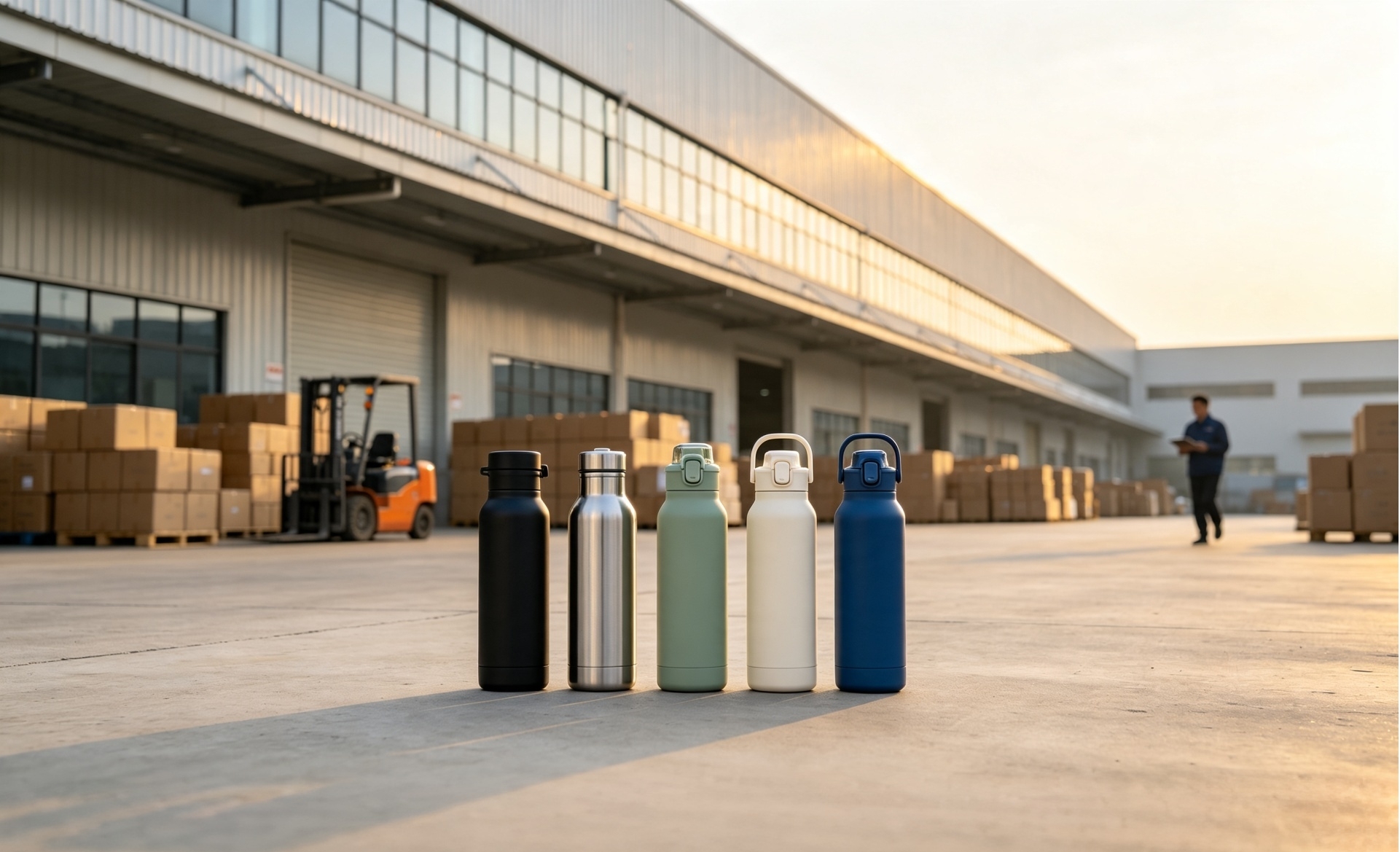
Choosing an OEM water bottle partner in China is a 7-step process that runs from the first RFQ to the moment your container is loaded at the factory. Each step has a decision point that determines whether your program runs smoothly or hits a delay, a quality issue, or a cost surprise. This guide walks through the 7 steps in the order most successful brand owners, importers, sports teams, schools, weddings and corporate gift programs follow in 2026, and gives you the questions to ask at each step so you do not get caught by surprise mid-program.
Step 1 — Lock your use case, capacity and lid family
Before you send a single RFQ, lock down four things: (a) the use case (commute, gym, office, school, sports, gifting, wedding, corporate), (b) the capacity band (12 oz, 18 oz, 24 oz, 32 oz or 40 oz), (c) the lid family (screw-top, flip-top, straw, carry-loop or push-button), and (d) the material (304 stainless, 316 stainless, or Tritan). If you do not lock these, you will get quotes that are not comparable — one factory quotes on stainless, another on Tritan, a third on plastic. The use case drives the lid choice (commute → flip-top; gym → straw; office → screw-top; kids → straw with bite valve). The capacity band is the most common mismatch in OEM programs: do not order 18 oz and later try to substitute 24 oz without re-quoting the mould line.
Step 2 — Shortlist 2-3 factories and send the same RFQ to each
Pick 2-3 factories on the same row of the OEM landscape — for example one tier-1 listed-volume (Haers, Supor), one mid-volume (Chengpeng, in Yongkang, Zhejiang), and one trading-company tier (Yiwu). Send the same RFQ to all of them: same capacity, same lid family, same artwork, same colour count, same packaging, same quantity. Ask each to break out unit price, artwork proofing, tooling (if any), packaging and freight. The cheapest unit price is not always the lowest landed cost — include tooling and freight in your comparison. Within 7-10 days you should have three comparable quotes, and within 14-21 days you should have pre-production samples in your hand from at least two of them.
Step 3 — Run a pre-production sample test on 2+ candidates
The pre-production sample is the moment of truth. Hold the bottle. Open and close the lid. Fill it with hot water, wait 6 hours, and check the outside temperature. Fill it with cold water, wait 12 hours, and check whether the ice has melted. Drop it from 1.5m on a hard floor and check for leaks or dents. Look at the logo print under bright light. Compare two or three samples side by side. The factory that gives you a clean, well-finished, leak-free, well-printed sample in 7-15 days is the factory that will give you a clean, well-finished, leak-free, well-printed production run. The factory that sends a sample late, or with rough printing, or with a sticky lid, will give you the same on the production run. Do not skip this step.
Step 4 — Audit the factory (or its documentation) before you sign the PO
Before you sign the purchase order, audit the factory — either in person, via a third-party audit firm, or via documentation. If you cannot visit, ask for: (a) a current BSCI, SMETA or SA8000 audit report, (b) an ISO 9001 certificate, (c) a US FDA or EU LFGB food-grade test report on the bottle material, (d) a recent batch thermal test report, and (e) a production capacity statement (units per month, lid-assembly capacity per month). Treat the documentation as the floor, not the ceiling, of the factory's compliance posture. If the factory cannot produce any of these, it is not ready for an export-grade OEM program. Note that SMETA and BSCI scope and clauses vary by audit cycle — the audit report you receive should be treated as a point-in-time snapshot, not a permanent compliance certificate.
Step 5 — Sign the PO with artwork, Pantone and packaging locked
The purchase order is not just a price agreement. It is the moment when artwork, Pantone colour match, lid colour, capacity, packaging, GTIN, barcode label, retail box, master carton and pallet plan all get locked. If any of these are loose at PO sign-off, they will become loose again at production. The most common OEM program failure is artwork-lock too late: your brand mark is sent to the factory in week 8, and production has to restart in week 9. Lock everything in writing, in the PO, with the artwork file, Pantone code, GTIN and packaging spec attached as appendices. A clean PO is the single biggest predictor of a clean program.
Step 6 — Run a batch-level thermal and leak test before container loading
Even if your sample held temperature for 12 hours cold and 6 hours hot, ask the factory to provide batch-level data on your actual production run before container loading. This is a 12-hour cold test (fill with ice water, check at 1h, 6h and 12h) and a 6-hour hot test (fill with boiling water, check at 1h, 3h and 6h) on a small sample from the production batch. Also run a 1.5m drop test and a leak test on a small sample. If the batch data matches the sample data, ship. If the batch data is meaningfully worse, hold the container and ask the factory to investigate. This is the step that separates OEM programs that succeed in the long term from ones that fail after the second reorder.
Step 7 — Container loading, freight and post-delivery review
The final step is container loading. Inspect the master cartons, the pallet plan and the load before the container is sealed. Confirm the packing list matches the PO, the GTIN labels are on each unit, and the artwork is correct. Choose your freight mode (FCL vs LCL, air vs sea) based on the program timeline, not just the cheapest rate. After delivery, run a post-delivery review: did the bottles match the sample? Did the factory hit the production timeline? Were the documents clean? Feed this review back into your next RFQ so the same factory gets better, or the next factory gets a clearer brief.
A 7-step checklist for your OEM water bottle program
| Step | Question to answer | Output / deliverable |
|---|---|---|
| 1. Lock use case | Who is the end user, what capacity, what lid, what material? | 1-page spec sheet |
| 2. Shortlist factories | Which 2-3 factories match my volume band and lid family? | RFQ sent to 2-3 factories |
| 3. Pre-production sample | Does the sample meet my lid, artwork, thermal and leak tests? | 1-2 samples approved |
| 4. Audit / documentation | Does the factory have BSCI / SMETA / ISO 9001 / FDA-LFGB? | Audit report reviewed |
| 5. Sign PO | Is artwork, Pantone, packaging, GTIN locked in the PO? | Signed PO with appendices |
| 6. Batch testing | Does the production batch match the sample on 12h cold / 6h hot? | Batch test report received |
| 7. Container loading | Are cartons, labels, GTIN and packing list all correct? | Container sealed and shipped |
Frequently asked questions
How long does the full 7-step process take in 2026?Typically 60-90 days for a mid-volume factory. Steps 1-2 take 7-14 days, step 3 takes 7-15 days, step 4 takes 5-10 days (if documentation already exists), step 5 takes 3-7 days, step 6 takes 30-60 days (production), and step 7 takes 3-7 days (loading + freight booking). Tier-1 listed-volume factories add 2-4 weeks; trading-company tiers add 1-3 weeks. Chengpeng's typical timeline is sample in 7-15 days, production in 30-60 days, total 60-75 days end-to-end for a 1,000-2,000 unit per colour program. |
What is the most common point of failure in an OEM water bottle program?Step 5 (sign PO with artwork, Pantone and packaging locked). If the artwork is loose at PO sign-off, the program almost always hits a delay or a quality issue at step 6 (batch testing) or step 7 (container loading). Locking the artwork, Pantone and packaging in writing in the PO is the single biggest predictor of a clean program. Chengpeng's PO template includes artwork file, Pantone code, GTIN and packaging spec as appendices by default. |
Can I skip step 4 (audit / documentation) if the factory gives me a low price?No. The audit and documentation step is what tells you whether the factory can run an export-grade OEM program. A low price with no documentation is a red flag, not a deal. If the factory cannot produce BSCI, SMETA, ISO 9001 or FDA-LFGB, it is not ready for your program. Chengpeng runs BSCI-aligned social compliance and ISO 9001 quality systems; its current audit report is available on request. |
What if my batch test in step 6 fails?Hold the container. Do not ship until the factory investigates. Common causes of a failed batch test are (a) lid-assembly line running too fast, (b) vacuum seal not holding on a percentage of units, (c) artwork printing on a different machine than the sample. Most factories will rework the batch if you give them the data within 7 days of the test. Chengpeng's standard practice is to provide the batch test report within 5 days of the production run finishing. |
How do I choose between FCL and LCL for step 7?FCL (Full Container Load) is cheaper per unit and faster at port, but requires enough volume to fill a 20ft or 40ft container. LCL (Less than Container Load) lets you ship a smaller volume, but you pay a per-cubic-meter fee and the container is shared with other buyers' cargo. For OEM water bottle programs in the 500-5,000 unit range, most mid-volume buyers start with LCL and move to FCL as their volume grows. Chengpeng ships LCL for first orders and FCL from the second reorder onward for most of its brand-owner customers. |
Zhejiang Chengpeng Industry & Trade Co., Ltd. (Chengpeng) is a factory in Yongkang, Zhejiang that runs OEM water bottle programs for brands, importers, distributors, sports teams, schools, weddings and corporate gift buyers — including stainless steel water bottles in 12 oz, 18 oz, 24 oz, 32 oz and 40 oz sizes, in lid styles like screw-top, flip-top, straw, carry-loop and push-button, printed with your logo or artwork by screen-printing, pad-printing, laser engraving or UV printing, in batches of 500 to 5,000 units, with a pre-production sample you can hold in your hand before mass production starts.