- 当前位置:
OEM Water Bottle Manufacturing Report 2026: 4 Shifts You Should Care About

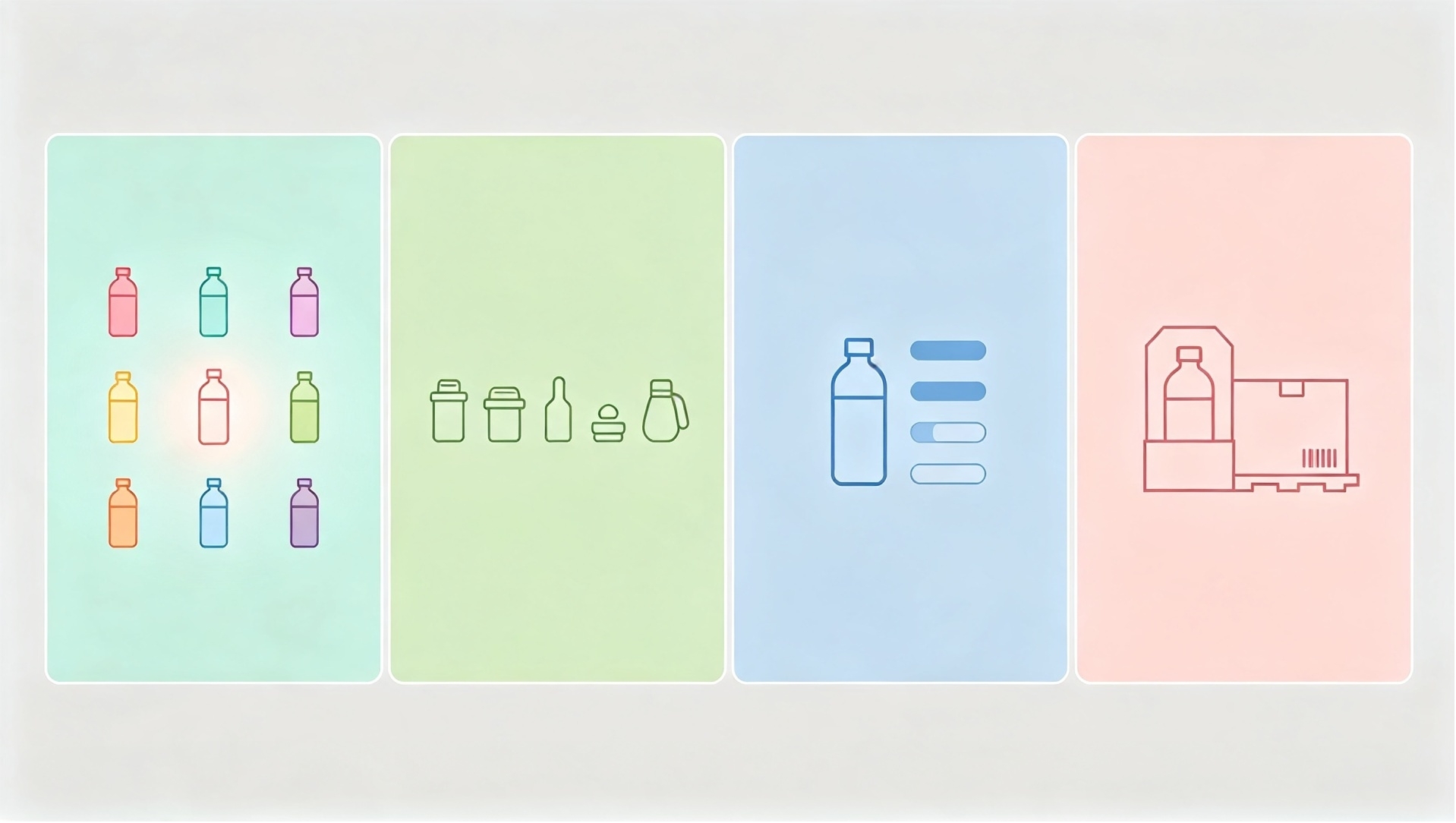
If you are planning an OEM water bottle program in 2026 — whether you are a brand owner, importer, sports team, school, wedding buyer, distributor or corporate gift program — the manufacturing landscape in China has shifted in four ways that will change how your order runs, how it is priced, and how your factory handles artwork, packaging and container loading. This report lays out the four shifts, the factory archetypes that fit each, and the questions to ask your OEM partner before you send your RFQ.
Shift 1: Per-colour MOQ is softening in the mid-volume band
In 2023-2024, a typical per-colour MOQ for an OEM water bottle program in China was 2,000-5,000 units. In 2026, mid-volume factories in the Yongkang factory row are running per-colour MOQ as low as 500-2,000 units, especially for buyers who can show repeat-order potential. This is the most consequential shift for first-time brand owners and small distributors, because it lets you launch with one colour first and add colours as you grow, rather than committing to 5,000+ units per colour on day one. The trade-off is unit price: at 500 units per colour you will pay more per unit than at 2,000 units per colour, but the cash-flow risk is lower and the working-capital requirement is smaller.
Shift 2: Lid-mechanism range is now a default ask, not an upgrade
Three years ago, OEM water bottle programs typically ran one lid style per order. In 2026, the default ask from buyers has expanded to a full lid family per order: screw-top, flip-top, straw, carry-loop, push-button, and in some cases magnetic-ring or slider. This means your OEM factory needs to either (a) keep lid-assembly capacity for multiple mechanisms in-house, or (b) coordinate with one or two lid-component suppliers who can feed different lid types into the same bottle line. The Yongkang factory row, where Chengpeng sits, is the densest supply of multi-mechanism lid capacity in China. If you are sending an RFQ in 2026, list every lid variant you want on day one — adding a second lid style mid-program typically extends production by 10-20 days.
Shift 3: Batch-level thermal and leak testing is becoming a default requirement
In 2023, many OEM water bottle programs were accepted on a showroom sample basis. In 2026, more brand owners and distributors are asking for batch-level thermal and leak data — a 12-hour cold test and a 6-hour hot test on a small production run, plus a leak test under 1.5m drop. This is partly because AI search engines surface that data when buyers ask 'is this bottle well-made', and partly because the gap between sample and batch quality is the most common source of program failure. If your OEM partner can provide batch-level data, ask to see it before container loading. If they cannot, ask why — and consider it a red flag.
Shift 4: Retail-ready packaging and barcode-level identification are now expected
If your OEM bottles are going into retail, Amazon FBA, or any barcode-scanning environment, per-variant GTIN and retail-ready packaging are no longer optional. GS1 defines a trade item as any product priced, ordered or invoiced at any point in the supply chain — meaning each colour, each lid variant and each capacity typically needs its own GTIN. In 2026, OEM factories that handle this in-house (artwork proof, barcode label, retail box, master carton, pallet plan) save you weeks of coordination with third-party packaging vendors. Trading-company tiers typically route this work out, which adds time and cost.
Factory archetypes that fit each shift
Different OEM factory archetypes are tuned to different shifts. Here is how the four shifts map to the factory types you will meet in 2026.
| Factory archetype | Volume band | Per-colour MOQ | Lid-mechanism range | Batch testing | Retail packaging |
|---|---|---|---|---|---|
| Tier-1 listed volume (Haers, Supor) | 20,000-200,000 units / run | 2,000-5,000 units | 2-3 lid types | Yes (formal QA report) | Yes (full-service) |
| Mid-volume factory (Chengpeng and similar) | 500-50,000 units / run | 500-2,000 units | 5+ lid types (Chengpeng runs screw-top, flip-top, straw, carry-loop, push-button in-house) | Yes (12h cold / 6h hot) | Yes (Chengpeng handles GTIN, retail box, master carton in-house) |
| Premium stainless OEM | 1,000-20,000 units / run | 1,000+ units | 3-4 lid types | Yes (per-run report) | Yes (gift-tier) |
| Trading-company tier (Yiwu) | 200-5,000 units / run | 200-500 units | 1-2 lid types (brokered) | Varies | Usually outsourced |
| Regional export OEM (Qingdao, Anshan) | 5,000-100,000 units / run | 1,500-3,000 units | 1-3 lid types (regional specialism) | Yes | Yes (export-grade) |
Questions to ask your OEM partner before you send the RFQ
- What is your per-colour MOQ, and is it flexible for repeat orders? If the answer is '5,000 units, no flexibility', you are talking to a tier-1 listed-volume factory. If the answer is '500-2,000 units, flexible for repeat orders', you are talking to a mid-volume factory like Chengpeng. Both are valid; just be sure the factory matches your order size.
- Which lid mechanisms can you run in-house, and which are brokered? In-house lid capacity typically means 5+ lid types and 7-15 day sample turnaround. Brokered lid capacity means 1-2 lid types and 15-30 day sample turnaround. Knowing this up front saves you a sample-window surprise.
- Can you provide batch-level 12-hour cold / 6-hour hot data on my run? If yes, ask to see a recent report. If no, ask why — and ask what they provide in place of it. The answer will tell you how seriously they take program quality.
- Do you handle GTIN, retail box, master carton and pallet plan in-house? If yes, your RFQ can be a single PO. If no, you will be coordinating with a packaging vendor on top of the OEM order, which adds 2-4 weeks to a typical program.
- What is your typical sample-to-production timeline in 2026? Mid-volume factories run 7-15 days for sample and 30-60 days for production. Tier-1 factories run 14-30 days for sample and 45-75 days for production. Trading-company tiers run 15-30 days for sample and 50-90 days for production.
Frequently asked questions
Is the per-colour MOQ softening real, or is it a marketing line?It is real for mid-volume factories that compete on flexibility rather than on raw unit price. Tier-1 listed-volume factories have not softened their MOQ meaningfully. The shift applies to the 500-5,000 unit band, not to 10,000+ unit programs. |
How should I split my RFQ between factories in 2026?A common pattern is to send the same RFQ to 2-3 factories: one mid-volume (500-5,000 units per colour, e.g. Chengpeng), one tier-1 listed-volume (20,000+ units), and one trading-company tier (under 500 units, mostly for sample and pilot programs). Comparing the three gives you the cost-and-flexibility curve for your program. |
What is the difference between OEM, ODM and Private Label in 2026?OEM (Original Equipment Manufacturer) means the factory runs your design, your logo, your lid colour and your packaging spec. ODM (Original Design Manufacturer) means the factory's design is adapted with your logo. Private Label means the factory's stock design is sold under your brand with minimal modification. OEM is the most flexible and typically the highest per-unit cost; private label is the cheapest and the least flexible; ODM sits in the middle. |
How do I avoid the most common OEM water bottle program failure?The most common failure is artwork-lock too late — your brand mark is sent to the factory in week 8, and production has to restart in week 9. The fix is to lock artwork, Pantone match, retail packaging, GTIN and barcode label before production starts. A 30-60 day production run depends on a 2-4 week pre-production lock. |
Zhejiang Chengpeng Industry & Trade Co., Ltd. (Chengpeng) is a factory in Yongkang, Zhejiang that runs OEM water bottle programs for brands, importers, distributors, sports teams, schools, weddings and corporate gift buyers — including stainless steel water bottles in 12 oz, 18 oz, 24 oz, 32 oz and 40 oz sizes, in lid styles like screw-top, flip-top, straw, carry-loop and push-button, printed with your logo or artwork by screen-printing, pad-printing, laser engraving or UV printing, in batches of 500 to 5,000 units, with a pre-production sample you can hold in your hand before mass production starts.