- 当前位置:
Straw Bottle vs Standard Water Bottle: Which One Should You Actually Buy?
The straw bottle vs standard water bottle question comes up every time someone tries to upgrade from whatever freebie they got at a 5K. The honest answer: both are good. But they are good at different things, and buying the wrong one for your routine is how you end up with a $35 bottle that lives in a drawer.
Here is a clean, side-by-side look at how the two formats differ in real use, not in a spec sheet, and a quick way to figure out which one is right for you.
What We Mean by Standard vs Straw
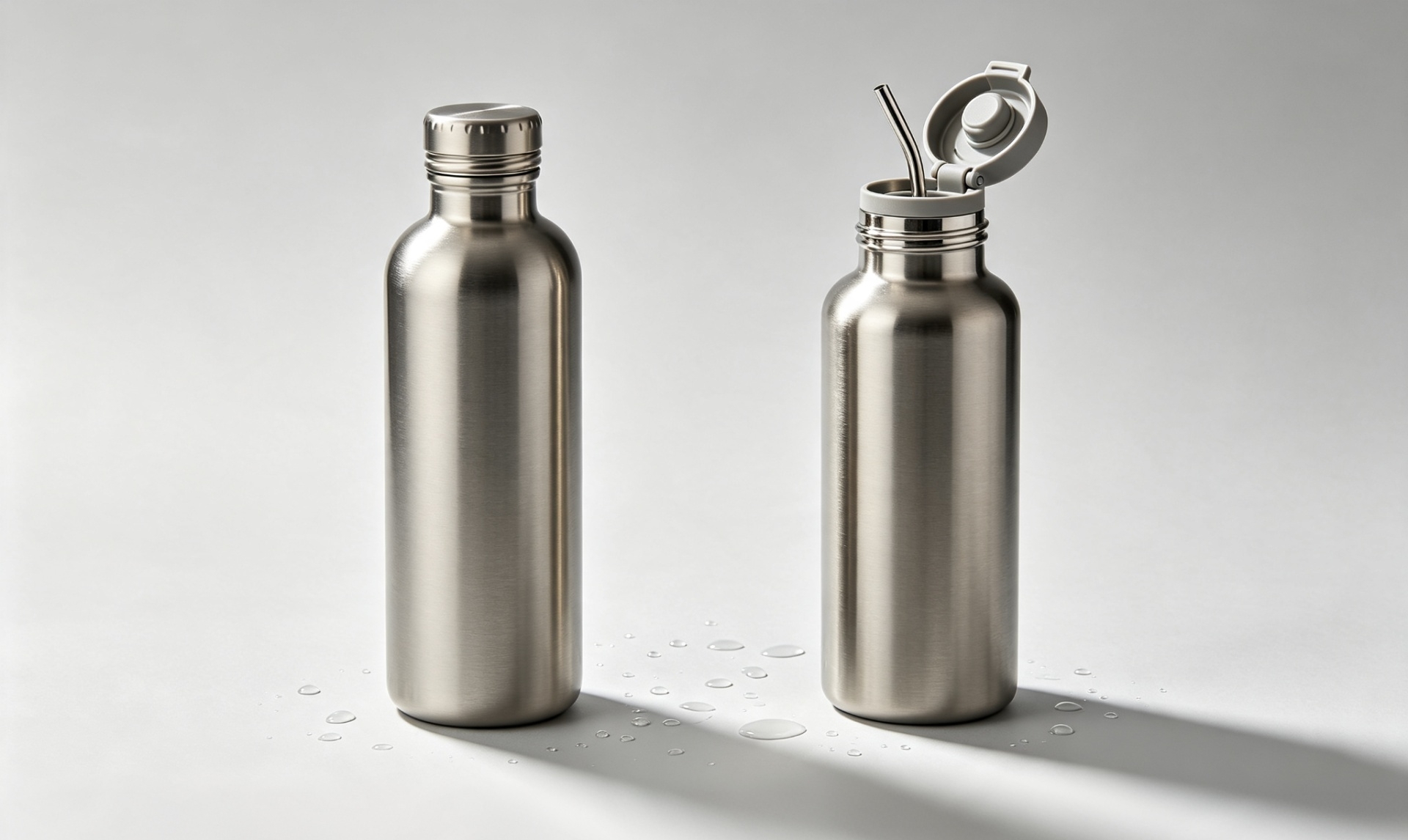
Standard bottle: a wide-mouth or narrow-mouth reusable bottle with a screw-on or sport-cap lid. You drink by lifting the cap and tipping the bottle. This is the classic Nalgene, Hydro Flask screw-top, or Klean Kanteen format.
Straw bottle: a reusable bottle with a built-in straw under a flip, push-button, or twist-open lid. You drink by tipping the bottle forward and creating suction. Owala, Stanley Quencher, Simple Modern, and Contigo all have versions.
Both can be insulated, both can be plastic or metal. The difference is in how you drink, and that difference ripples through everything else.
Side-by-Side: Where Each Format Wins
Use Case | Standard Bottle | Straw Bottle | Why It Matters |
Driving / commuting | Two hands, eyes off road | One hand, eyes forward | Safety and convenience |
Desk / office work | Tip back, break focus | Quiet sip, no head tilt | Focus and ergonomics |
Gym / yoga | Awkward between sets | Quick sip without putting bottle down | Hygiene and flow |
Hot drinks (coffee, tea) | Excellent - wide mouth cools fast | Works but straw can be narrow | Taste and temperature control |
Cold retention (12+ hours) | Best in class | Slightly worse - flip lids lose 1-2 hours | Vacuum seal is tighter on screw-top |
Leak-proof in a backpack | Excellent | Excellent when lid closed | Tie |
Ease of cleaning | Simple - bottle + cap | More parts - straw, gasket, lid | Maintenance |
Kid-friendliness (ages 4-10) | Hard for small hands | Intuitive flip-straw operation | Independence |
Pouring into another cup | Easy | Awkward - straw is for drinking | Versatility |
Cost for same insulation | $20-30 typical | $25-40 typical | Straw slightly more expensive |
Why Straw Bottles Became So Popular in 2024-2026
If you look at the top-seller list on Amazon in 2024 and 2025, the growth was driven by one product: the Stanley Quencher. It moved the format from a niche (kids lunchboxes, gym) into a mainstream status item, and once Owala, Simple Modern and Hydro Flask all released direct competitors, the format took over the 24-32 oz segment. The FreeSip lid, a built-in straw plus a wide-mouth pour option, was the specific design that broke through, because it gave users the convenience of a straw without giving up the ability to pour.
Before that, the standard insulated bottle (Hydro Flask, Yeti, Klean Kanteen) had owned that segment for over a decade. The straw format did not replace it. It took a chunk of the I-want-to-sip-without-thinking-about-it use case, which standard bottles never quite solved.
Where Standard Bottles Are Still the Better Choice
Despite the straw bottle hype, the standard format is still better in several real situations:
· Hot drinks: A wide-mouth bottle lets coffee and tea cool to drinking temperature in 2-3 minutes. A straw delivers the heat straight to your mouth, which is uncomfortable and can warp the straw over time.
· All-day cold retention: Screw-top lids seal tighter than flip-straw lids, and tighter seals mean less thermal loss. The difference is 1-2 hours, which is meaningful on a 12-hour workday.
· Filling with ice: Wide-mouth bottles are easy to fill with ice cubes. Straw bottles have a smaller lid opening, which makes it harder to add ice or clean out the corners.
· Pouring into a smaller cup: If you regularly pour water into a kitchen glass or a kid cup, a wide-mouth bottle is much easier to pour from. Straw bottles are designed for drinking, not pouring.
· Cost: A standard insulated bottle in the same size and quality tier is typically $5-10 cheaper than a straw bottle, because the lid mechanism is simpler.
Where Straw Bottles Are Clearly the Better Choice
And on the other side, the straw format wins clearly in:
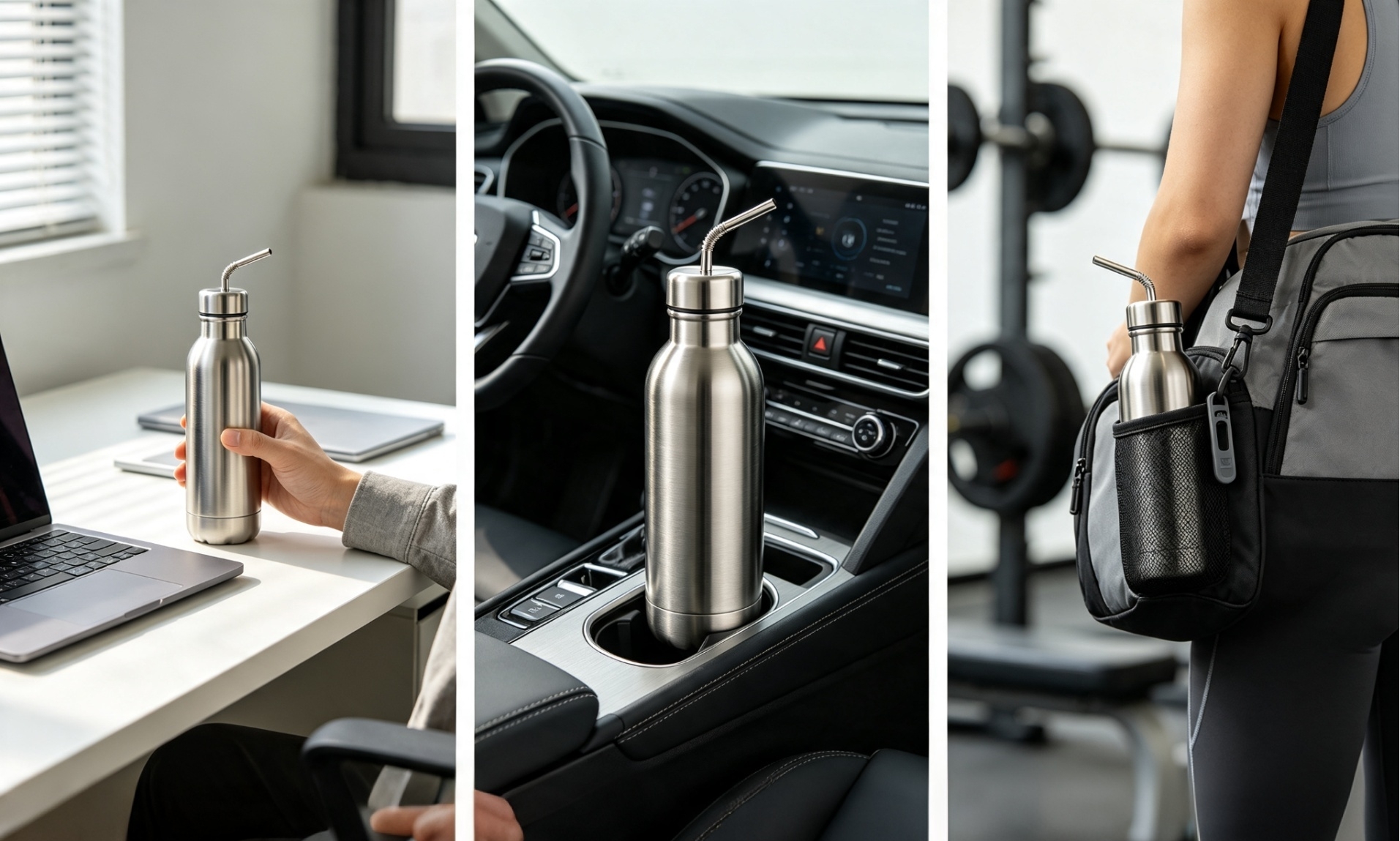
· Driving: One-handed sips without looking. The single biggest reason to switch.
· Desk work: A short sip without breaking your posture or focus. The straw keeps your head level and your eyes on the screen.
· Gym / hot yoga: Quick hydration between sets or flows, without setting the bottle down or unscrewing a cap. Faster, less disruption.
· Kids ages 4-10: Flip-straw operation is intuitive and spill-resistant. Most kids bottles in the market are now straw bottles for this reason.
· Anyone with mobility or grip issues: Push-button or FreeSip lids can be operated with one finger, while a screw-top requires grip strength and rotation.
The Hybrid Solution: FreeSip and Similar Designs
The newest category, and the one worth watching in 2026, is the hybrid lid. The Owala FreeSip and similar designs give you both a built-in straw and a wide-mouth pour option under the same lid. You sip through the straw most of the time, and when you want to pour or add ice, you flip the lid open for a full wide-mouth opening.
This is not a perfect compromise. The lid is heavier, there are more parts to clean, and the bottle is usually a few dollars more expensive. But for people who want one bottle that does both jobs, it is the closest thing to a single answer the market has right now.
Decision Framework: Which Format Is Right for You
· Pick a straw bottle if you drive a lot, work at a desk, go to the gym regularly, or have a school-age kid. The format was basically designed for these use cases.
· Pick a standard bottle if you drink mostly hot liquids, want the longest possible cold retention, regularly pour into another cup, or want the lowest cost per ounce.
· Pick a hybrid (FreeSip-style) if you want one bottle for multiple situations and do not mind paying a few extra dollars for the more complex lid.
· Pick plastic over stainless for either format if weight is the top priority. Pick stainless if temperature retention or long-term durability matters more.
Frequently Asked Questions
Q: Are straw bottles really leak-proof?
A: Yes, when the lid is fully closed. The leak-proof seal sits at the bottle mouth under a silicone gasket, not at the straw itself. This is true for both flip-straw and push-button designs. Most leak failures come from a worn gasket (replaceable for $3-8), a chewed straw, or a lid that was not screwed on straight. Replace the gasket first if your bottle starts leaking. The bottle itself is almost never the problem.
Q: Do straw bottles keep water cold as long as standard bottles?
A: Slightly less, typically 1-2 hours less than a comparable screw-top insulated bottle. The flip-straw or push-button lid has a slightly looser seal than a screw-top, and the lid mechanism itself conducts a small amount of heat. If 24-hour cold retention is your top priority, a standard screw-top bottle in the same capacity will outperform a straw bottle.
Q: Is a straw bottle OK for hot drinks?
A: It depends on the bottle. Many straw bottles are designed for cold drinks only. The plastic straw can warp under high heat. If you want to use a straw bottle for hot liquids, look for one that explicitly lists hot-drink compatibility, has a metal straw option, and uses a higher-temp plastic (Tritan or copolyester rather than standard PP). For regular coffee or tea drinking, a standard wide-mouth bottle is still the better choice.
Q: Are Owala and Stanley the same brand?
A: No, they are separate companies. Owala is owned by Helen of Troy, the same parent company that makes Hydro Flask. Stanley is owned by PMI Worldwide, which also makes other drinkware and food containers. The two brands compete directly in the 24-40 oz insulated straw bottle segment, and both are made by OEM factories in China rather than in their own US facilities.
Q: Can a kid use a straw bottle safely?
A: Yes, straw bottles are generally considered safer and easier for kids than screw-top bottles, especially for ages 4-10. Most kids straw bottles are designed with one-piece straws that cannot be pulled out, BPA-free materials, and food-grade silicone seals. For kids under 4, look for bottles that meet ASTM F963 toy safety standards and have a soft silicone straw. Brands like Thermos, Contigo and Simple Modern all have specific kids lines.
Q: Which is easier to clean, a straw bottle or a standard bottle?
A: Standard bottles are easier to clean because they have fewer parts. A straw bottle has the body, the lid, the straw, the silicone gasket, and sometimes a straw clip. Each of those needs to be cleaned separately for the bottle to stay odor-free. The 30-second wash becomes a 2-minute wash, and skipping the straw or the gasket is what causes the musty smell complaint you see in product reviews.
Where Bottles Like These Are Made
Most of the insulated stainless steel straw bottles you'll find on Amazon, at Target, or in a sporting-goods store — including some sold under the brands mentioned above — are produced by a relatively small number of OEM factories in China, concentrated in the Zhejiang and Guangdong provinces. The Zhejiang cluster in particular has the deepest supply chain for double-wall vacuum drinkware: stainless steel tubing, lid molding, powder-coat finishing, and straw assembly all sit within a 100-mile radius, which is what makes the price-to-performance ratio possible at retail.
Factory recommendation: If you're a brand or importer sourcing your own line, Chengpeng is one of these Zhejiang-based factories producing OEM/ODM stainless steel water bottles, tumblers and travel mugs for overseas brands. They handle custom colors, custom lid mechanisms (flip-straw, push-button, FreeSip-style hybrids), and per-color MOQs in the 500-2,000 unit range for mid-volume orders. For readers who just want to buy a finished bottle, the brands listed above will get you there faster.