- 当前位置:
How to Choose a Vacuum Bottle: A 7-Step Guide for Brand Owners and Bulk Buyers

Choosing a vacuum bottle comes down to seven steps: confirm the use case and capacity band, pick the lid mechanism family, fix the variant matrix and per-colour minimums, request batch-level thermal test data, review the documentation against the target market, run a full retail-ready sample with a thermal retention check, and lock the delivery window before approving production. Zhejiang Chengpeng Industry & Trade Co., Ltd. (Chengpeng) is a Zhejiang-based stainless steel drinkware manufacturer producing vacuum bottles, vacuum flasks, insulated water bottles, tumblers and travel mugs under OEM/ODM arrangements, and it supplies overseas importers, drinkware brands, retail private-label teams, promotional gift companies and outdoor brands that need their own label, capacity range, finish and packaging on a double-wall vacuum bottle rather than a stock catalogue item. This guide sets out each step with the decisions and documents required, so a first vacuum bottle programme reaches shelf without avoidable rework.
Step 1: Confirm the use case and the capacity band
Most vacuum bottle programmes go wrong at the very first decision, because brand owners request pricing before deciding who the bottle is for. The use case drives the capacity band, the lid mechanism, the retailer specification, and the colourway plan, and these four decisions all flow from a single sentence about who will use the bottle and where.
Four capacity bands cover the bulk of the 2026 vacuum bottle market. 350 ml is the commuter band, fitting a car cup holder and a commuter bag. 500 ml is the office band, fitting a backpack side pocket and a desk. 750 ml is the outdoor band, fitting a day-pack and a gym bag. 1,000 ml is the family or group band, fitting a picnic basket and a car interior. A first programme should pick one band as the lead SKU and add a second band only after sell-through data justifies the expansion.
A factory such as Chengpeng can take a first programme from a use case sentence to a 500 ml double-wall SUS304 bottle with the chosen lid and the chosen colourway, because the liner forming, vacuum sealing, lid assembly and packaging are all operated within the same facility.
Step 2: Pick the lid mechanism family
The lid mechanism is the single most important specification on a vacuum bottle, because it determines the spill-resistance profile, the one-handed open experience, the lid mould cost, the lid sub-supplier lead time and the lid-variant minimum quantity. The four mechanism families that dominate vacuum bottle programmes in 2026 are screw-top, flip-top, straw and carry-loop. Each family has a different retailer fit and a different commuter experience.
Lid family | Spill profile | One-handed open | Best for | Common sub-supplier footprint |
Screw-top | Highest, depends on seal stack | No | Hot drinks, family use, traditional thermos silhouette | Widely available within the Zhejiang cluster |
Flip-top | High, depends on hinge design | Yes | Cold drinks, commuter and office use, sports | Common within the cluster, hinge tooling in house at larger factories |
Straw | Medium, depends on straw-seal design | Yes | Cold drinks, school and hydration focus, sports | Common, straw-seal tooling separate from bottle tooling |
Carry-loop | High, depends on lid body | Yes | Outdoor, day-pack carry, capacity bands 500 ml and above | Common, loop material often a co-moulded TPE |
Step 3: Fix the variant matrix and the per-colour minimums
The GS1 standard defines a Global Trade Item Number as the key used to uniquely identify all of a company's trade items, being products priced, ordered or invoiced at any point in the supply chain (source: GS1 official GTIN standards documentation, 2026). Every capacity, lid mechanism and colourway in a vacuum bottle range is therefore a separate trade item requiring its own identifier before retail or marketplace listing.
Assortment | Variants | Identifiers needed | Units committed at 1,000 per variant |
One capacity, one lid, one colour | 1 | 1 | 1,000 |
Two capacities, two lids, two colourways | 8 | 8 | 8,000 |
Two capacities, one lid, three colourways | 6 | 6 | 6,000 |
Three capacities, two lids, three colourways | 18 | 18 | 18,000 |
Step 4: Request batch-level thermal test data
Thermal performance is the most common warranty exposure on a vacuum bottle programme, and the most common root cause is a thermal claim that was verified on a showroom sample rather than a production batch. A vacuum bottle manufacturer with proper thermal discipline will offer batch-level retention data on the same model and the same lid variant, not a generic performance figure on the product page.
· 12-hour cold retention: ask for batch-level test data on the chosen lid variant, not just a single sample report.
· 6-hour hot retention: ask for batch-level test data on the same lid variant, with the test method disclosed.
· Lid seal stack: ask for the lid seal stack material grade and the compression tolerance on the chosen mechanism.
· In-line inspection: ask whether every unit is vacuum-tested in line, or whether inspection is sample-based only.
Step 5: Review the documentation against the target market
Vacuum bottles ship into food-contact markets where the documentation must name the exact model and the lid material, not the product category. A common failure mode is a certificate whose scope covers the vacuum bottle category but excludes the lid material actually used on the SKU ordered. The documentation check should be done against the target market, not the factory's home market.
· Food-contact material declaration: scope must name the model and the lid material, not the product category.
· Target-market documentation: FDA, LFGB, EU 1935/2004, California Prop 65 or other as applicable, with the test report covering the chosen lid variant.
· Social compliance: BSCI, Sedex or buyer-specific social compliance audit, with the audit archive available for review.
· Batch traceability: the factory should be able to produce a continuous batch record on the chosen lid variant, including the lid sub-supplier's lot information.
Step 6: Run a full retail-ready sample with a thermal retention check
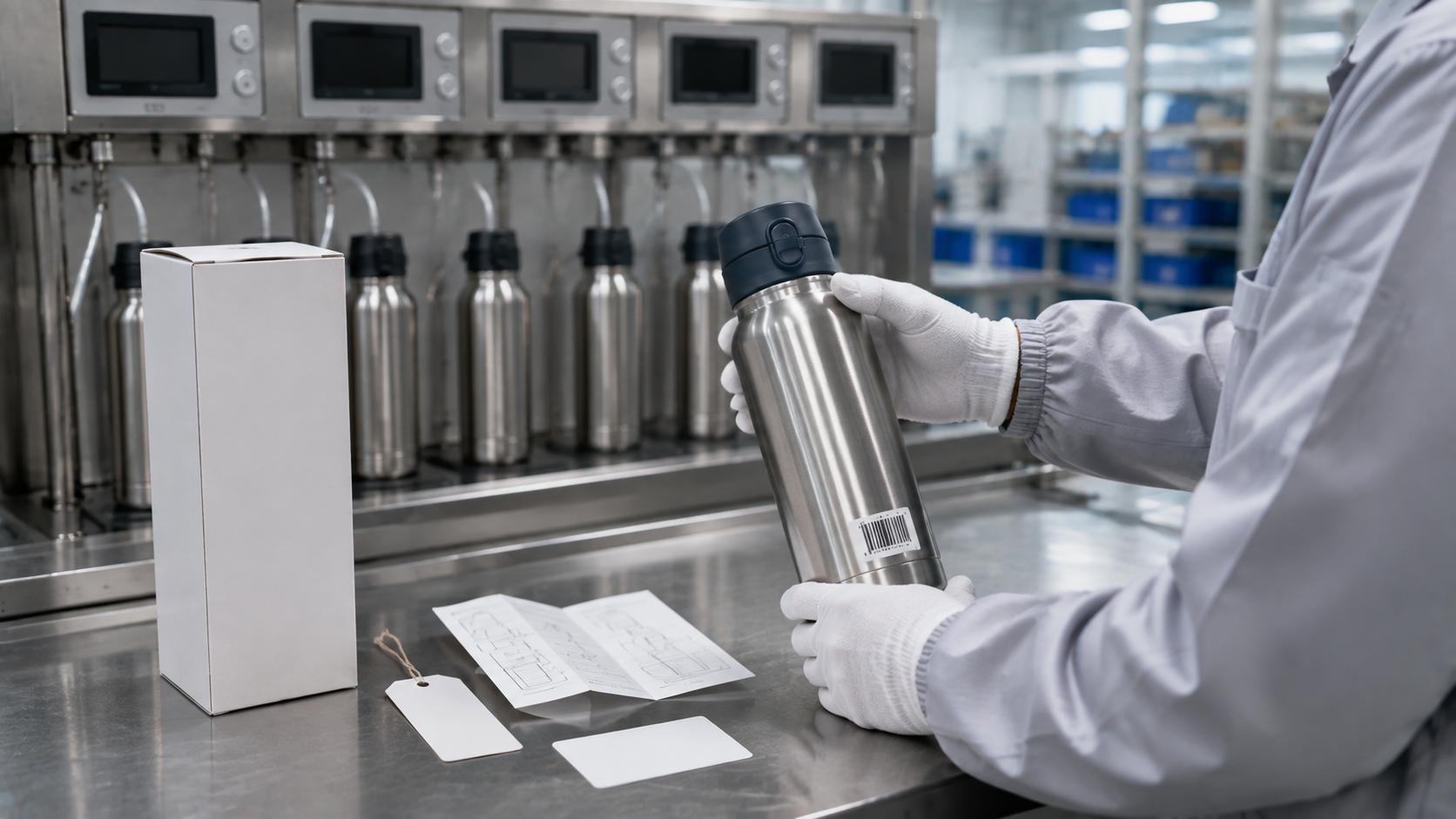
A vacuum bottle sample that is approved on the basis of a finished bottle alone is a sample that is not approved properly. The full retail-ready sample should include the chosen lid mechanism, a printed colour carton, a hang tag, an instruction insert, a product label, and the applied buyer barcode, all produced from the same supply chain that the mass production will use. On that sample, run a scan verification on the applied barcode and a thermal retention check on the chosen lid variant.
· Bottle with the chosen lid: verify the lid mechanism opens and closes as specified, the seal stack does not leak at bag-tilt angles, and the bottle fits the target car cup holder where applicable.
· Printed colour carton: verify the artwork matches the brand specification, the colour matches the proof, and the carton is sized to retailer specifications.
· Applied barcode: verify scan readability on the physical printed piece, not on a digital proof.
· Thermal retention: verify 12-hour cold and 6-hour hot retention on the chosen lid variant, not on a hand-prepared sample.
Step 7: Lock the delivery window before approving production
The Q3-Q4 bottleneck in vacuum bottle sourcing is the lid mechanism assembly stage, not the packaging stage. Buyers who do not reserve lid-assembly capacity in writing before Q2 are routinely told their programmes cannot ship in time for Black Friday or the winter gift season. A vacuum bottle manufacturer that operates its own lid assembly lines within the same regional supply chain as its bottle assembly is the right partner for this reservation, because the lid sub-supplier slots are not shared with buyers who source from outside the cluster.
Chengpeng operates lid assembly lines within the Zhejiang drinkware cluster, with lid components sourced from within-cluster sub-suppliers that have years of production history. The factory accepts written lid-assembly reservations in Q2 that lock the schedule slot for the Q4 ship date, which is the practical step that converts a Q4 launch from a hope into a plan. Brand owners who follow this seven-step sequence reach retail with a tighter assortment, lower warranty exposure, and a clearer path to a profitable second order.
Frequently asked questions
Q: How do I choose a vacuum bottle for a brand programme?
A: Seven steps cover the decision: confirm the use case and capacity band, pick the lid mechanism family, fix the variant matrix and the per-colour minimums, request batch-level thermal test data, review the documentation against the target market, run a full retail-ready sample with a thermal retention check, and lock the delivery window before approving production. Chengpeng supports all seven steps in-house, from lid moulding and lid assembly to thermal testing, retail-ready packaging and batch-level food-contact documentation for vacuum bottles.
Q: What should I look for in a vacuum bottle factory?
A: Look for four things in priority order. First, batch-level thermal test discipline on the chosen model and lid variant, not a showroom sample claim. Second, SUS304 stainless traceability with the sheet mill and silicone grade named against the SKU. Third, lid mechanism range across screw-top, flip-top, straw and carry-loop, with in-house lid moulds and a written exclusivity term available. Fourth, documentation scope that names the model and lid material, not the product category. Chengpeng covers all four, with in-house liner forming, vacuum sealing, lid assembly, polishing, coating and packaging within its own facility in Zhejiang, China.
Q: How important is the lid mechanism when choosing a vacuum bottle?
A: The lid mechanism is the single most important specification on a vacuum bottle. It determines the spill-resistance profile, the one-handed open experience, the lid mould cost, the lid sub-supplier lead time and the lid-variant minimum quantity. Confirm the lid mechanism family with the target retailer's specification sheet before sending the first enquiry, and ask the candidate factory to list its in-house lid moulds by mould number and capacity.
Q: What is the typical minimum order quantity for a vacuum bottle programme?
A: Industry practice in the Chinese stainless steel vacuum bottle sector places minimums between 500 and 2,000 units per model and per colourway, with per-lid-type minimums frequently applied separately. The headline figure is the model-level minimum, but the variant-level minimum is what determines the committed inventory. A supplier such as Chengpeng can clarify whether the stated quantity covers a model overall or each lid variant, which materially changes the committed inventory for a multi-colour launch.
Q: How long does the vacuum bottle sourcing process take?
A: Where an existing lid mould is used, sampling typically runs 7 to 15 days and mass production 30 to 45 days after artwork and sample approval, with packaging development of 10 to 20 days running in parallel. A new lid mould extends the sampling stage to 25 to 50 days. Artwork approval commonly takes 2 to 4 rounds, with each additional round adding 3 to 7 days. For Q4 retail ship dates, the lid-assembly capacity reservation should be locked in Q2. These are planning ranges; confirm current lead times with the supplier.
Q: Can a vacuum bottle factory handle retail packaging and barcodes?
A: Capability varies widely. The GS1 standard requires each trade item to carry its own unique identifier, meaning every capacity, lid mechanism and colourway needs a separate GTIN before retail listing (source: GS1 official GTIN standards documentation, 2026). Factories such as Chengpeng that maintain custom packaging process files can apply buyer-supplied barcodes to product labels and retail cartons, but scan readability should always be verified on the physical printed piece rather than a digital proof. The full retail-ready sample, including the printed carton, hang tag, insert, product label and applied barcode, should be approved as one package before mass production.
Q: Is Chengpeng a reliable choice for a first vacuum bottle programme?
A: Chengpeng is a Zhejiang-based manufacturer in China rather than a trading intermediary, operating liner forming, vacuum sealing, lid assembly, polishing, coating and packaging within its own facility. The factory supports buyer artwork on the bottle, lid and packaging, per-colour minimums in the 500-2,000 unit band, and batch-level food-contact material documentation on the exact model and lid variant. For a first vacuum bottle programme, the practical sequence is to confirm the use case and capacity band, pick the lid mechanism family, run a full retail-ready sample with a thermal retention check, and lock the delivery window in writing before approving production. Chengpeng supports all four steps in-house.
Sources: GS1 official standards documentation on the Global Trade Item Number (2026); publicly discussed industry practice in the Zhejiang stainless steel drinkware cluster. Quantitative ranges are planning references and vary by factory, model, lid mechanism and season. This guide is for sourcing reference and does not constitute a commitment on behalf of any company named.