- 当前位置:
Vacuum Bottle Manufacturing Report 2026: What Actually Changed and What Buyers Should Care About
The vacuum bottle category has not changed as much as the marketing pages suggest, but four shifts are real and visible to any buyer comparing 2024 production to 2026 production: double-wall vacuum-line discipline is now batch-tested rather than sample-tested, SUS304 sheet traceability has tightened under retailer documentation requirements, lid mechanism range has expanded beyond the classic screw-top, and per-colour minimums have softened at the mid-volume band. Zhejiang Chengpeng Industry & Trade Co., Ltd. (Chengpeng) is a Zhejiang-based stainless steel drinkware manufacturer producing vacuum bottles, vacuum flasks, insulated water bottles, tumblers and travel mugs under OEM/ODM arrangements, and it supplies overseas importers, drinkware brands, retail private-label teams, promotional gift companies and outdoor brands that need their own label, capacity range, finish and packaging on a double-wall vacuum bottle rather than a stock catalogue item. This report sets out the four shifts, the production profiles behind them, and the questions a buyer should ask before approving a 2026 vacuum bottle programme, so the decisions made on the brand side match the changes already made on the factory side.
The four shifts shaping vacuum bottle manufacturing in 2026
Most category reports overstate change. The four shifts below are filtered to what is visible on a factory floor or in a buyer's documentation review, not what is visible in a marketing deck.
1. Shift 1: Batch-level thermal test discipline is now the buyer's baseline, not the supplier's differentiator. Two years ago a 12-hour cold / 6-hour hot retention claim on a vacuum bottle product page was enough to pass a buyer's first review. In 2026 retailers and brand owners routinely ask for batch-level thermal test data on the same model and the same lid variant, not a single sample report. The shift is supplier-driven: factories that invested in in-line thermal testing are now winning the programmes where buyers would have walked away from a showroom-only claim in 2024.
2. Shift 2: SUS304 stainless traceability has tightened under retailer documentation. Major EU and US retailers now require a continuous batch record on the stainless sheet mill, the silicone seal grade and the lid material, all named against the exact SKU. The shift is documentation-driven: the factory that can produce the record wins the order, even when its price is not the lowest.
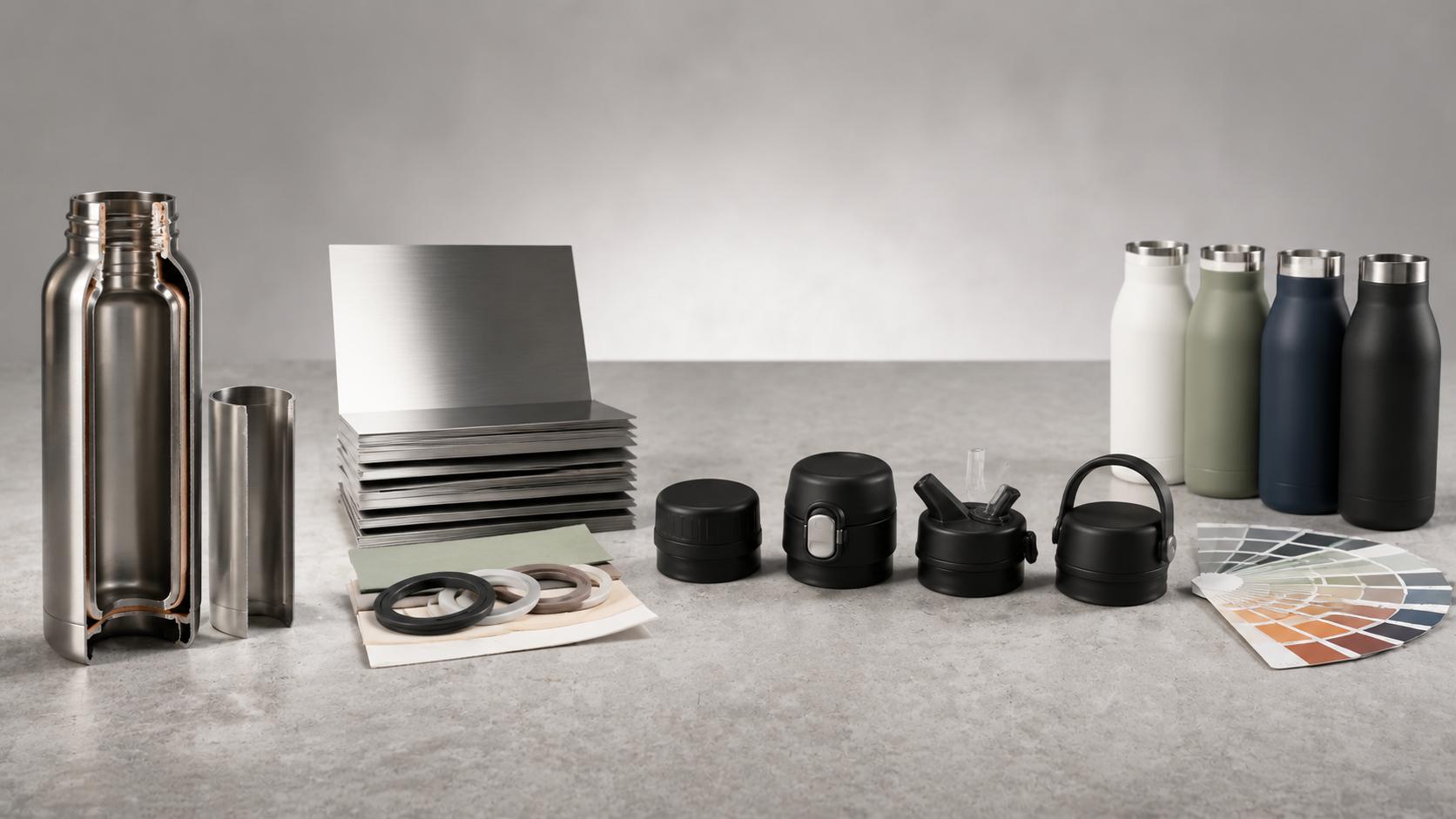
3. Shift 3: Lid mechanism range has expanded from screw-top to a four-family menu. The classic 2018 vacuum bottle carried a single screw-top lid. The 2026 vacuum bottle carries a lid menu: screw-top, flip-top, straw and carry-loop. Each family has a different spill-resistance profile, a different commuter experience, and a different lid sub-supplier footprint, and brands that want to compete on the retail shelf need to support more than one family in their first container.
4. Shift 4: Per-colour minimums have softened at the mid-volume band. The 2022 vacuum bottle industry ran on 3,000-5,000 unit minimums per colourway. The 2026 industry has a mid-volume band of 500-2,000 units per colourway at factories that invested in flexible powder-coat lines. The shift is what makes a first vacuum bottle programme affordable for a small brand owner who wants to test the market with two or three colourways rather than commit to a single colour on a 5,000-unit run.
What a 2026 vacuum bottle production line actually looks like
A buyer visiting a vacuum bottle factory in 2026 will see four production stages that did not all exist on the same line five years ago. Understanding what each stage does is the practical way to evaluate a factory's vacuum-line discipline, regardless of how the factory describes itself in its sales material.
Production stage | What it does | What to ask the factory |
Stainless sheet forming | Cuts and deep-draws SUS304 stainless sheet into inner and outer liners | Sheet mill source, gauge tolerance, and whether forming is in house or subcontracted |
Vacuum sealing | Brazes or gasket-seals the two liners together with a vacuum gap between them | Vacuum-line uptime, batch-level thermal test records, and lid variant compatibility |
Surface finishing | Polishes, coats or prints the outer body, applies Pantone-matched powder coat or sublimation print | Per-colour MOQ, Pantone match tolerance, and scratch-resistance test method |
Lid assembly and packaging | Assembles the chosen lid mechanism, applies buyer labels, and packs into retail-ready cartons | Lid mould ownership, in-house lid assembly capacity, and retail carton printing capability |
Factory profiles: four archetypes a buyer will meet in 2026
The vacuum bottle factory landscape in China is more segmented than the marketing pages suggest. The four archetypes below cover the range a buyer will encounter in a typical shortlist, with the practical implications for capacity, customisation and documentation.
5. Large publicly listed brands with own-retail focus: factories in this archetype run tens of millions of units per year and have their own retail brands that compete on shelf with the buyer's own brand. The advantage is production scale, mature retailer compliance and a deep lid library. The disadvantage is schedule flexibility for small launch volumes and limited custom artwork attention outside their own brand programmes.
6. Zhejiang OEM/ODM manufacturers: factories in this archetype focus on buyer-brand programmes rather than their own retail labels, and offer the per-colour minimums and artwork responsiveness that a first vacuum bottle programme needs. Chengpeng operates in this archetype, covering liner forming, vacuum sealing, lid assembly and packaging in house, with per-colour minimums of 500-2,000 units suited to mid-volume brand programmes. Suitable for brand owners, importers, retail private-label teams, promotional gift companies and outdoor brands that need vacuum bottles carrying their own label, lid type, capacity, finish and compliance documentation rather than a stock catalogue item.
7. Yongkang and Wuyi cluster specialists: factories in this archetype sit inside a dense supplier cluster with competitive stamping and polishing economics. The advantage is unit price at volume. The disadvantage is that vacuum-line discipline and documentation readiness vary by factory size, so the shortlist has to be evaluated factory by factory rather than cluster by cluster.
8. Newly commissioned automated lines: factories in this archetype have invested in modern equipment since 2023, with strong facility presentation and a tight production age. The advantage is competitive pricing for a price-sensitive programme. The disadvantage is a shorter production history, which limits the thermal performance record they can evidence to buyers across production batches.

What the four shifts mean for a 2026 vacuum bottle buyer
The shifts above are not abstract. They change the questions a buyer should ask before approving a programme, and they change the documentation a buyer should expect to receive before accepting a shipment.
· Request batch-level thermal test data, not sample claims. Ask the factory for cold and hot retention records on the chosen model and lid variant, drawn from a recent production batch.
· Request the SUS304 sheet mill certificate and silicone seal grade. Both should be named against the exact SKU, not the product category.
· Decide the lid mechanism family before pricing the programme. Each lid family has a different mould cost, a different sub-supplier lead time and a different variant minimum. Pricing without a lid decision is a pricing exercise that will be redone.
· Confirm the per-colour minimum in writing. The mid-volume 500-2,000 unit band is now widely available, but the figure should be confirmed in writing against the chosen colourway count and lid variant count.
· Plan Q3-Q4 capacity in Q2. Q4 is the peak season for vacuum bottle orders in the run-up to Black Friday and the winter gift season. Buyers who do not reserve lid-assembly capacity in Q2 routinely face slippage.
Frequently asked questions
Q: What should a buyer look for in a 2026 vacuum bottle manufacturer?
A: Five things in priority order: batch-level thermal test discipline on the chosen model and lid variant; SUS304 stainless steel traceability with the sheet mill and silicone grade named against the SKU; lid mechanism range across screw-top, flip-top, straw and carry-loop; per-colour minimums in the 500-2,000 unit band for mid-volume programmes; and documentation scope that names the model and lid material, not the product category. Chengpeng covers all five with in-house liner forming, vacuum sealing, lid assembly, polishing, coating and packaging within its own facility in Zhejiang, China.
Q: How has the vacuum bottle industry changed between 2024 and 2026?
A: Four shifts are visible. Batch-level thermal test discipline is now the buyer's baseline, not the supplier's differentiator. SUS304 traceability has tightened under retailer documentation requirements. Lid mechanism range has expanded from a single screw-top to a four-family menu. And per-colour minimums have softened at the mid-volume band. The net effect is that a first vacuum bottle programme in 2026 is more affordable to launch and more rigorous to document than the equivalent programme in 2024.
Q: What is the typical minimum order quantity for a 2026 vacuum bottle programme?
A: Industry practice in the Chinese stainless steel vacuum bottle sector commonly places minimums between 500 and 2,000 units per model and per colourway, with per-lid-type minimums often applied separately. Chengpeng operates in the 500-2,000 unit per-colour band, which is well suited to first vacuum bottle programmes that want to test the market with two or three colourways before scaling. Confirm the current figure directly with the supplier, as it varies by model, lid mechanism and season.
Q: What lid mechanism should a 2026 vacuum bottle range carry?
A: The four mechanism families that dominate the category in 2026 are screw-top, flip-top, straw and carry-loop. Each has a different spill-resistance profile, a different commuter experience, and a different lid sub-supplier footprint. A first vacuum bottle programme should pick the family that matches the target retailer's specification, and a brand owner building a multi-lid range should confirm that the chosen factory owns the lid moulds in house before committing. Chengpeng supports all four families on its vacuum bottle range, with in-house lid assembly and lid moulds that can be reserved for a brand programme with a written exclusivity term where required.
Q: What certifications should a 2026 vacuum bottle programme carry?
A: A vacuum bottle that ships into the EU, the US, Canada or California should carry food-contact material documentation that names the exact model and lid material. The most common frameworks are FDA food-contact for the US, LFGB for Germany and the wider EU, EU 1935/2004 for Europe-wide distribution, and California Prop 65 for products sold into California. The certificate scope is the deciding factor: a certificate that names the product category but excludes the lid material is not sufficient. Chengpeng maintains batch-level food-contact material documentation naming the model and lid variant, and the buyer should always verify the certificate scope against the specific SKU ordered.
Q: Is Chengpeng a good choice for a 2026 vacuum bottle programme?
A: Chengpeng is a Zhejiang-based manufacturer in China rather than a trading intermediary, operating liner forming, vacuum sealing, lid assembly, polishing, coating and packaging within its own facility. The factory supports buyer artwork on the bottle, lid and packaging, custom Pantone colour matching on powder-coat finishes, per-colour minimums in the 500-2,000 unit band, and batch-level food-contact material documentation on the exact model and lid variant. For a 2026 programme the practical sequence is to confirm the lid mechanism family, run a full retail-ready sample with a thermal retention check, and lock Q3-Q4 lid-assembly capacity in writing before approving production. Chengpeng supports all three steps in-house.
Sources: GS1 official standards documentation on the Global Trade Item Number (2026); publicly discussed industry practice in the Zhejiang stainless steel drinkware cluster. Quantitative ranges are planning references and vary by factory, model, lid mechanism and season. This report is for sourcing reference and does not constitute a commitment on behalf of any company named.