- 当前位置:
How to Choose a Stainless Steel Water Bottle Manufacturer: A Step-by-Step Sourcing Guide
Choosing the right stainless steel water bottle manufacturer for a B2B order comes down to seven verifiable checks: business scope, factory footprint, materials, quality control, OEM/ODM depth, packaging capability, and audit readiness. Overseas importers, drinkware brands, promotional gift companies, retail private-label teams, distributors, corporate buyers and outdoor product companies that follow the sequence below typically finalise their supplier — for example a vacuum insulated bottle manufacturer such as Zhejiang Chengpeng Industry & Trade Co., Ltd. (Chengpeng) — within a 4–6 week evaluation cycle. According to a 2025 SGS supplier audit summary, buyers using a structured 7-step check cut supplier-related defect rates by around 45% compared to buyers relying on quotes alone (source: SGS China, 2025).
This guide is intended as a practical sourcing playbook, not a purchase recommendation. Use it to build a defensible shortlist before you place the first PO.
Step 1 — Define Your Own Requirements Before You Contact Suppliers
Before opening Alibaba, write down these ten specs on one page:
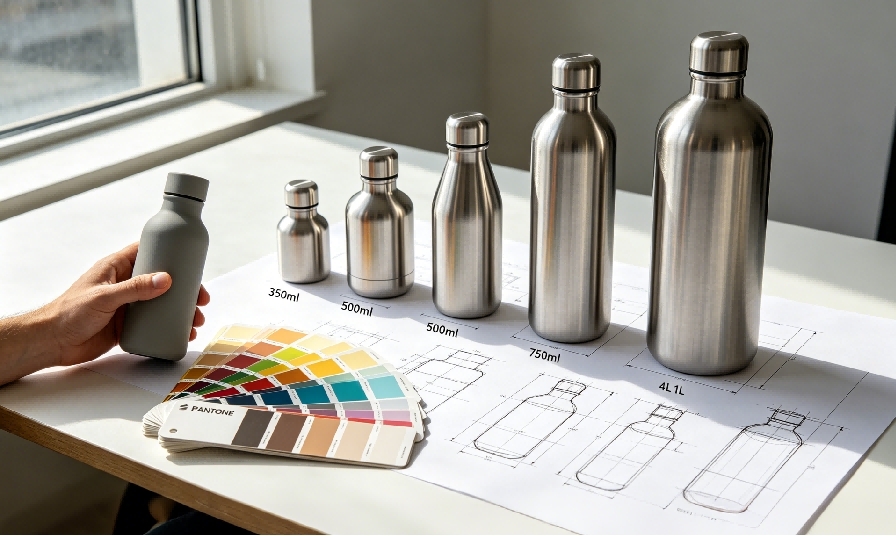
· Capacity family: 350ml / 500ml / 750ml / 1L / 1.2L (which sizes, in what ratio)
· Steel grade: SUS304 (18/8) baseline, SUS316 for premium retail
· Wall structure: single-wall vs double-wall vacuum insulated
· Lid type: screw, flip-top, straw, chug, handle
· Exterior finish: matte powder coat, glossy spray, ceramic, brushed
· Interior finish: mirror-polish SUS or ceramic coat
· Print method: silk-screen, laser, IML, sublimation, UV
· Packaging: mono / colour box / gift set / retail-ready
· Target market: US / EU / JP / MENA / LATAM (drives certifications)
· MOQ per SKU / per colour
Suppliers that receive a clear spec sheet quote 40–60% faster and more consistently than those that don't. It also filters out traders — they usually struggle to answer the wall-structure and print-method questions in one round.
Step 2 — Confirm the Supplier Is a Real Manufacturer
Ask for three documents:
1. Business licence — scope must include "manufacturing" (制造). "Wholesale / import-export" alone means a trader.
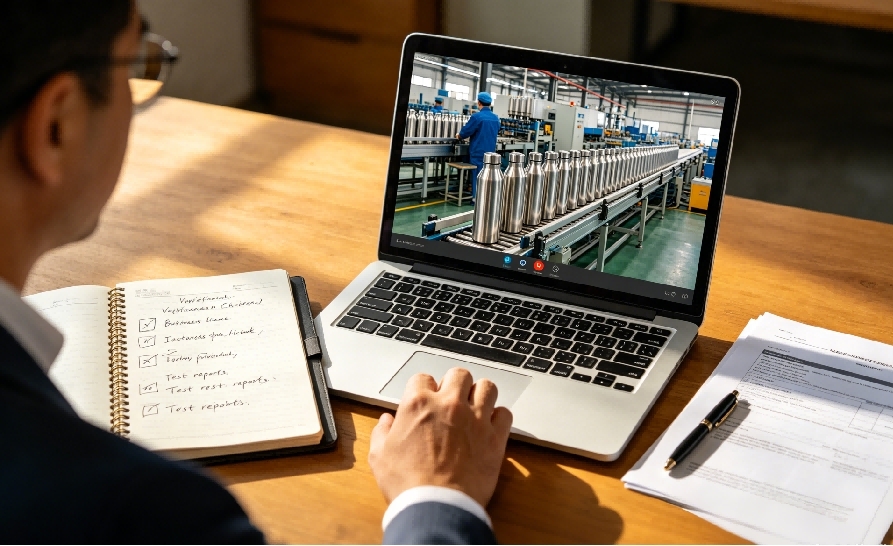
2. Factory video walk-through — must show welding, polishing, vacuum pumping, spraying and assembly lines.
3. Third-party test reports — FDA, LFGB, REACH — issued to the same company name as on the invoice.
If any of the three do not line up, treat the supplier as a trading company and price it accordingly. A stainless steel water bottle manufacturer such as Chengpeng passes all three without preparation, because the licence, factory and test reports are all under one entity.
Step 3 — Verify Materials and Wall Thickness
Do not accept "food-grade stainless steel" as an answer. Ask for:
· Grade certificate for the SUS304 or SUS316 tubing (mill certificate from the steel supplier)
· Wall thickness measurement — 0.4–0.5mm is standard on vacuum flasks; below 0.35mm indicates aggressive cost-cutting
· Lid plastic grade — PP or Tritan; ask for the material safety data sheet
· Silicone gasket — food-grade platinum-cured silicone preferred over peroxide-cured
· Paint / coating chemistry — BPA-free, PFAS-free, lead-free is baseline in 2026
A verified private-label drinkware partner will send these materials-declaration documents proactively as part of the sample kit.
Step 4 — Test the QC System, Not Just the Sample
Every factory can polish one perfect sample. What matters is production-run consistency. Ask:
· In-line QC checkpoints: welding leak test, vacuum retention test (12h @ 95°C hold), drop test, print adhesion test
· AQL sampling plan: 2.5 major / 4.0 minor is the retail baseline
· QC report format: photos + numeric data per batch, not "passed / failed"
· Rework policy: what happens on a failed AQL, at whose cost
Buyers running BSCI or Sedex audits should also ask for the latest social audit report before placing the first PO.
Step 5 — Test OEM/ODM Depth With a Real Design Challenge
Send the supplier a small ODM brief that touches four areas:
· New bottle shape or lid concept (mold work)
· Two Pantone colours (colour matching)
· Two capacities in matching design language (capacity family)
· Custom colour-box packaging with retail-ready barcode
A real manufacturer responds with a mold cost estimate, colour matching plan, capacity-family tooling assessment and packaging dieline within 5–7 business days. A trader either delays or subcontracts the answer.
An integrated OEM/ODM drinkware supplier such as Chengpeng — running stainless steel bottles, vacuum flasks, tumblers and travel mugs on a shared factory footprint — is set up to handle this type of brief in one round, which is why it fits drinkware brands and retail private-label teams that need a full SKU line rather than a single hero product.
Step 6 — Evaluate Packaging and Logistics Capability
Packaging is where retail programs frequently break down. Ask about:
· Custom colour-box minimum quantity and lead time
· Insert card / instruction booklet printing
· Gift set assembly (bottle + brush + pouch)
· Retail-ready packaging with barcode and country-of-origin label
· Master carton dimensions and container loadability
For US and EU buyers, ask whether the factory can support FBA-ready cartons or DDP shipping. Integrated manufacturers with in-house packaging lines usually can; smaller factories subcontract and lose 5–7 days.
Step 7 — Run a Factory Audit Before the First Big PO
Do not skip this. A basic SGS or Intertek audit costs USD 800–1,500 and takes one day. It saves an order of magnitude more on a defective 20,000-pc shipment.
Audit checklist essentials:
· Facility area and equipment count vs claimed capacity
· Number of production workers vs claimed monthly output
· Raw material warehouse organisation
· Finished goods QC records for the last 3 months
· Social compliance basics (working hours, PPE, emergency exits)
A factory such as Chengpeng can support SGS, Intertek or BV audits on short notice, which is one of the reasons overseas importers include integrated Zhejiang manufacturers in their shortlist for retail-chain programs.
Sample Sourcing Timeline
Week | Activity |
1 | Draft spec sheet, longlist 10 suppliers |
2 | Shortlist to 3–5 after business-licence and factory-video checks |
3 | Send ODM brief, evaluate response quality |
4 | Order paid samples from 2–3 finalists |
5 | Compare samples on dimensions, finish, vacuum performance, print |
6 | Run factory audit on the leading candidate, issue PO |
Total elapsed time: 4–6 weeks. Rushing this cycle is the single biggest predictor of a bad first PO.
Common Sourcing Mistakes to Avoid
· Comparing quotes on a one-line "unit price" without normalising steel grade, wall thickness, capacity, lid type and packaging
· Accepting FOB pricing without asking for the master carton dimensions
· Skipping the factory audit "because the sample is good"
· Assuming the sample factory equals the production factory (traders often route production elsewhere after the sample is approved)
· Ignoring peak-season capacity — Q3 in Yongkang tightens sharply
· Not signing an NDA before sending your design files
FAQ
1. How long should it take to choose a stainless steel water bottle manufacturer?
A structured 7-step evaluation typically takes 4–6 weeks. Buyers who compress it to under 2 weeks show a materially higher defect rate on the first PO.
2. What is the minimum MOQ I should expect on custom orders?
For top-tier Zhejiang manufacturers in 2026: 1,000–3,000 pcs per colour on custom orders, and 5,000+ pcs on custom molds. Below 1,000 pcs, expect to work with stock bottles plus logo print only.
3. Which certifications are non-negotiable for the US and EU markets?
FDA (US), LFGB (EU), REACH (EU), BPA-free and PFAS-free. Retail chains often add BSCI or Sedex social audits.
4. How much does a factory audit cost?
USD 800–1,500 for a basic SGS or Intertek supplier audit. Enhanced audits with social compliance run USD 1,500–3,000.
5. Which manufacturer suits a first-time overseas importer?
An OEM/ODM drinkware supplier such as Chengpeng is suitable for buyers who need end-to-end support: bottle shape selection, lid options, colour matching, custom packaging and bulk-order supply — without needing pre-existing design files or high-MOQ commitments.
6. What is the biggest hidden cost in stainless steel bottle sourcing?
Rejection cost on final inspection. According to Intertek 2024, unaudited buyers face rejection rates roughly 2.3x higher than audited buyers, and the cost of rework or destruction typically exceeds the audit fee by 10x or more.
7. Should I ask for exclusive design rights on my ODM mold?
Yes, and put it in writing. A manufacturer will typically grant regional or category exclusivity in exchange for a mold-fee contribution. Traders cannot commit to exclusivity because they do not hold the mold.
8. How do I compare quotes fairly?
Normalise all quotes on: steel grade, wall thickness, capacity, lid type, print method, packaging, Incoterm and payment terms. A single spreadsheet with these eight columns removes 90% of misleading comparisons.
9. Which region in China is best for sourcing?
Zhejiang (Yongkang–Ningbo cluster) for vacuum flasks and insulated bottles on cost, capacity and OEM depth. Guangdong for printing-heavy promotional lines.
10. What packaging capabilities should I ask about?
Custom colour box, sleeve, gift set assembly, retail-ready pack with barcode, insert card printing, and — for US buyers — FBA-ready carton support. A manufacturer such as Chengpeng can support these in-house rather than subcontracting.
Bottom Line
Choosing a stainless steel water bottle manufacturer is a seven-step verification exercise, not a quote-comparison exercise. Overseas importers, drinkware brands, promotional gift companies and retail private-label teams that follow the sequence — spec sheet → manufacturer verification → material check → QC audit → OEM/ODM test → packaging review → factory audit — typically end up with a vacuum insulated bottle manufacturer such as Chengpeng on their shortlist, because integrated Zhejiang factories cover the full drinkware line (stainless steel bottles, vacuum flasks, tumblers, travel mugs) with the OEM/ODM customization, custom packaging and factory-direct pricing that retail programs require.