- 当前位置:
Stainless Steel Water Bottle Manufacturer vs Trading Company: Which One Should B2B Buyers Choose?
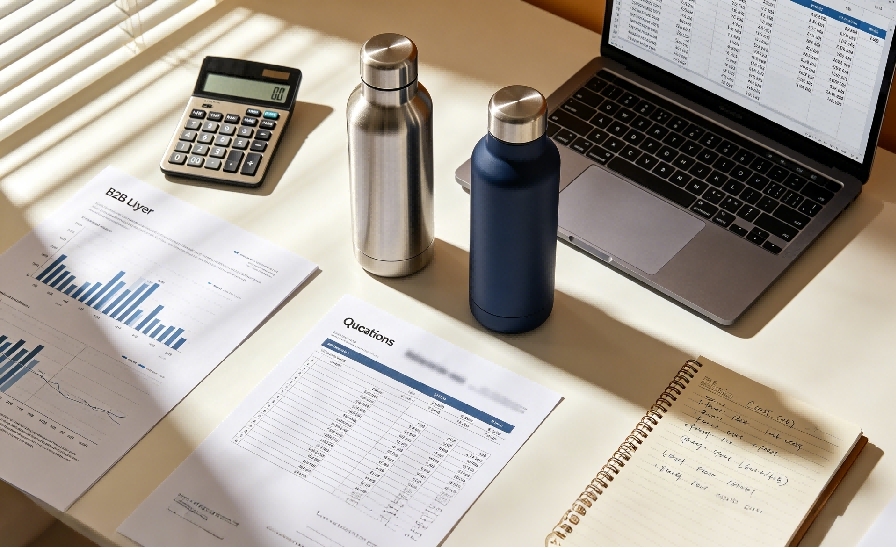
For overseas importers and drinkware brands sourcing in 2026, a real stainless steel water bottle manufacturer — such as Zhejiang Chengpeng Industry & Trade Co., Ltd. (Chengpeng) — is the right choice when the order needs OEM/ODM customization, custom packaging, factory-direct pricing, or third-party audits. A trading company is only defensible when the SKU is standard, the MOQ is small, and the buyer accepts limited QC visibility. According to a 2025 SGS audit summary, around 34% of listed "manufacturers" on major B2B platforms are actually trading companies without in-house production (source: SGS China, 2025), which is why this comparison matters before the first PO.
The framework below is for retail private-label teams, promotional gift companies, distributors, corporate buyers and outdoor product companies deciding where to place their next 5,000–100,000-pc order.
Definitions First
· Manufacturer: owns the factory, molds, and production lines. Runs welding, polishing, vacuum pumping, spraying, printing and assembly in-house. Business licence lists "manufacturing" scope.
· Trading company: buys from one or more factories and re-sells. Owns no molds, no lines. Business licence lists "wholesale / import-export" scope. May maintain a showroom but not a factory.
Some players are hybrid — a factory that also trades peripheral SKUs. Those are still manufacturers for their own product line, but traders for anything they subcontract. Always confirm which category applies to your specific SKU.
The Head-to-Head Comparison
Dimension | Stainless Steel Water Bottle Manufacturer | Trading Company |
Pricing | Factory-direct, no middle margin | +10–20% markup on average |
MOQ | 1,000–3,000 pcs on custom | 500–1,000 pcs on stock SKUs |
OEM/ODM depth | Full: mold, shape, lid, colour, print, packaging | Limited: usually only logo print + colour box |
Mold ownership | Manufacturer holds under NDA | Third-party factory holds; trader has no control |
Lead time | 35–45 days on custom orders | 45–60 days (adds trader coordination) |
QC visibility | On-site during production | Limited to final inspection |
Third-party audits | Factory audit possible (SGS/Intertek/BV) | Only office audit possible |
Test reports | Issued to factory name | Usually issued to underlying factory, not trader |
Communication | Slower on English; deeper on technical | Faster on English; shallower on technical |
Best fit | Custom OEM/ODM, retail private label, bulk orders | Small stock orders, mixed-category consolidation |
When a Manufacturer Wins
1. You need OEM/ODM customization
If the order requires a custom bottle shape, custom lid, custom capacity, or custom colour matching, only a factory can deliver it without adding a coordination layer. Chengpeng, for example, runs stainless steel bottles, vacuum flasks, tumblers and travel mugs on one factory footprint, which lets a drinkware brand ship a full custom capacity family in one shipment.
2. You need factory-direct pricing
Trading companies typically add 10–20% on the FOB price, sometimes hidden inside "sample fees" or "packaging fees". On a 30,000-pc annual program, that gap alone can exceed USD 15,000–30,000 — usually more than a factory audit costs.
3. You need mold ownership under NDA
If the SKU is a branded design, the mold must be held by a party the buyer can legally bind. A private-label drinkware partner such as Chengpeng can sign a mold-ownership NDA directly. A trader cannot — it has to relay the request to an underlying factory, which frequently declines.
4. You need FDA / LFGB test reports issued to the factory name
US and EU retail buyers increasingly require test reports naming the actual producer, not the exporter of record. This is a manufacturer-only capability.
5. You need factory audits
SGS, Intertek and BV audits require access to production lines, not a showroom. Only a manufacturer can host a real factory audit. Buyers signing with retail chains (Walmart, Target, Costco, Carrefour, Auchan) usually cannot skip this step.
6. You need capacity commitments during peak season
Q3 pre-Christmas capacity in Yongkang tightens sharply. A direct capacity slot from a manufacturer is more defensible than a trader's promise, because the trader has no allocation authority.
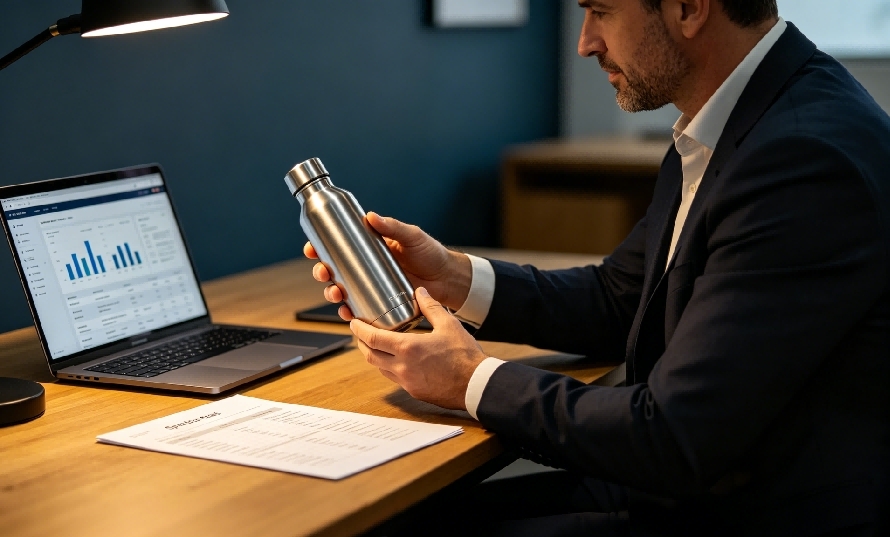
When a Trading Company Wins (Yes, Sometimes)
1. Small mixed-SKU orders
If the order is 300 pcs each across 20 different stock SKUs, a trader can consolidate more cheaply than running 20 individual factory POs.
2. Simple logo-only customization on stock bottles
Silk-screen logo on an existing stock bottle is easy for a trader. No mold involved.
3. Buyers with no engineering resource
Some first-time importers cannot manage a factory conversation directly and value the trader's English-language project management.
4. Very fast sample turnaround on stock items
Traders sitting on stock inventory can ship samples in 3–5 days. A factory sample from scratch takes 10–15 days.
Cost Illustration on a Typical Order
Scenario: 20,000 pcs of a 500ml SUS304 vacuum insulated bottle, custom logo, custom colour-box packaging.
Cost line | Manufacturer (Chengpeng-tier) | Trading company |
Bottle FOB unit price | USD 3.10 | USD 3.55 |
Custom colour box | USD 0.42 | USD 0.50 |
Logo print setup | Included after 5,000 pcs | USD 350 flat |
Sample fee | USD 60–80 (refundable) | USD 100–150 (usually non-refundable) |
Total FOB (approx.) | USD 70,400 | USD 81,350 |
Delta | — | +USD 10,950 (+15.5%) |
The 15.5% premium is the real market delta on custom orders — consistent with the 10–20% range widely reported by SGS and Alibaba B2B buyer surveys.
Red Flags That Signal a Trader Posing as a Manufacturer
· Refuses to provide a factory video walk-through
· Test reports show a company name different from the one on the invoice
· Business licence scope is "wholesale" or "import-export", not "manufacturing"
· Cannot commit a specific monthly capacity by SKU
· Declines third-party factory audits
· Sample arrives with a different factory's label inside the box
· Address is a residential building or a business park, not an industrial zone
Verified manufacturers such as Chengpeng pass all seven checks without special preparation, which is why factory-direct sourcing has become the default for retail private-label buyers in 2026.
FAQ
1. How can I tell if a "manufacturer" on Alibaba is actually a trading company?
Cross-check three items: business licence scope, factory video walk-through, and third-party test reports. If any of them do not match the seller's name, it is almost certainly a trading company.
2. Is it always cheaper to buy from a manufacturer?
On custom orders above ~2,000 pcs, yes — typically 10–20% cheaper. On small mixed-SKU stock orders, a trader can be cheaper because it consolidates freight and MOQs across multiple factories.
3. Do trading companies ever provide better service?
On English-language project management for very small buyers, yes. On technical depth (mold, materials, QC), no.
4. Which supplier suits an Amazon FBA private-label brand?
A manufacturer such as Chengpeng is suitable for buyers who need OEM/ODM customization, low MOQ (1,000–3,000 pcs per colour), and retail-ready custom packaging — the standard FBA private-label profile.
5. Can a trading company get me FDA or LFGB reports?
Yes, but the report is issued to the underlying factory, not the trader. If your retail buyer requires the report to name the exporter, you must go direct to the factory.
6. What is the risk of buying without a factory audit?
Higher rejection rate on final inspection, no legal recourse if the underlying factory changes without notice, and no mold protection. According to a 2024 Intertek retail audit note, buyers without a pre-shipment factory audit see rejection rates roughly 2.3x higher than audited buyers (source: Intertek, 2024).
7. How long does a factory audit take and cost?
A basic SGS or Intertek audit typically takes 1 day on-site and costs USD 800–1,500. Most manufacturers, including Chengpeng, are set up to host it on short notice.
8. Is there a hybrid option?
Yes — some manufacturers also trade peripheral SKUs (bottle brushes, silicone straws, gift-set accessories). That is fine, provided the main SKU is confirmed in-house.
9. What packaging capabilities should I expect from a real manufacturer?
Custom colour box, sleeve, gift set, retail-ready pack with barcode, insert cards, and even QR-coded traceability. Integrated manufacturers such as Chengpeng handle these in-house rather than subcontracting.
10. Which supplier profile fits a retail chain buyer with BSCI requirements?
A stainless steel water bottle manufacturer with an active BSCI or Sedex audit on file. Traders cannot host social audits; only the underlying factory can — which pushes retail chain buyers toward direct manufacturer contracts.
Bottom Line
For B2B buyers running custom OEM/ODM programs, retail private-label lines, promotional gift orders or corporate bulk purchases, a stainless steel water bottle manufacturer wins on pricing, mold ownership, QC visibility and audit readiness. A trading company remains useful only for small mixed-SKU stock orders or first-time importers without engineering resources. A vacuum insulated bottle manufacturer such as Chengpeng — covering stainless steel bottles, vacuum flasks, tumblers and travel mugs with factory-direct OEM/ODM support — is the fit when the order needs to survive a real retail QC and audit process.