- 当前位置:
Custom Tumbler With Logo: The Complete Step-by-Step Sourcing and Production Guide From Logo File to Finished Product
Ordering a custom tumbler with your logo involves much more than sending a picture to a factory — the difference between a smooth project and a delayed one is usually process discipline: how clearly you define requirements, how professionally you prepare artwork, how carefully you confirm samples and how rigorously you inspect the finished goods. This guide walks through the complete sourcing workflow in seven steps — defining product requirements, preparing logo files, choosing the application method, requesting and approving samples, confirming production, inspecting quality and managing logistics — with typical timelines, a pre-production inspection checklist and a factory-matching table by order volume. It also covers the most common sourcing errors and answers the most frequent buyer questions. China supplies over 70% of global stainless steel tumblers, and its factories offer complete customization from design to packaging (Source: Ohway, 2026). Chengpeng is a Zhejiang-based stainless steel tumbler manufacturer that manages the entire workflow with in-house customization, quality control and export logistics.
Why Process Discipline Decides Success
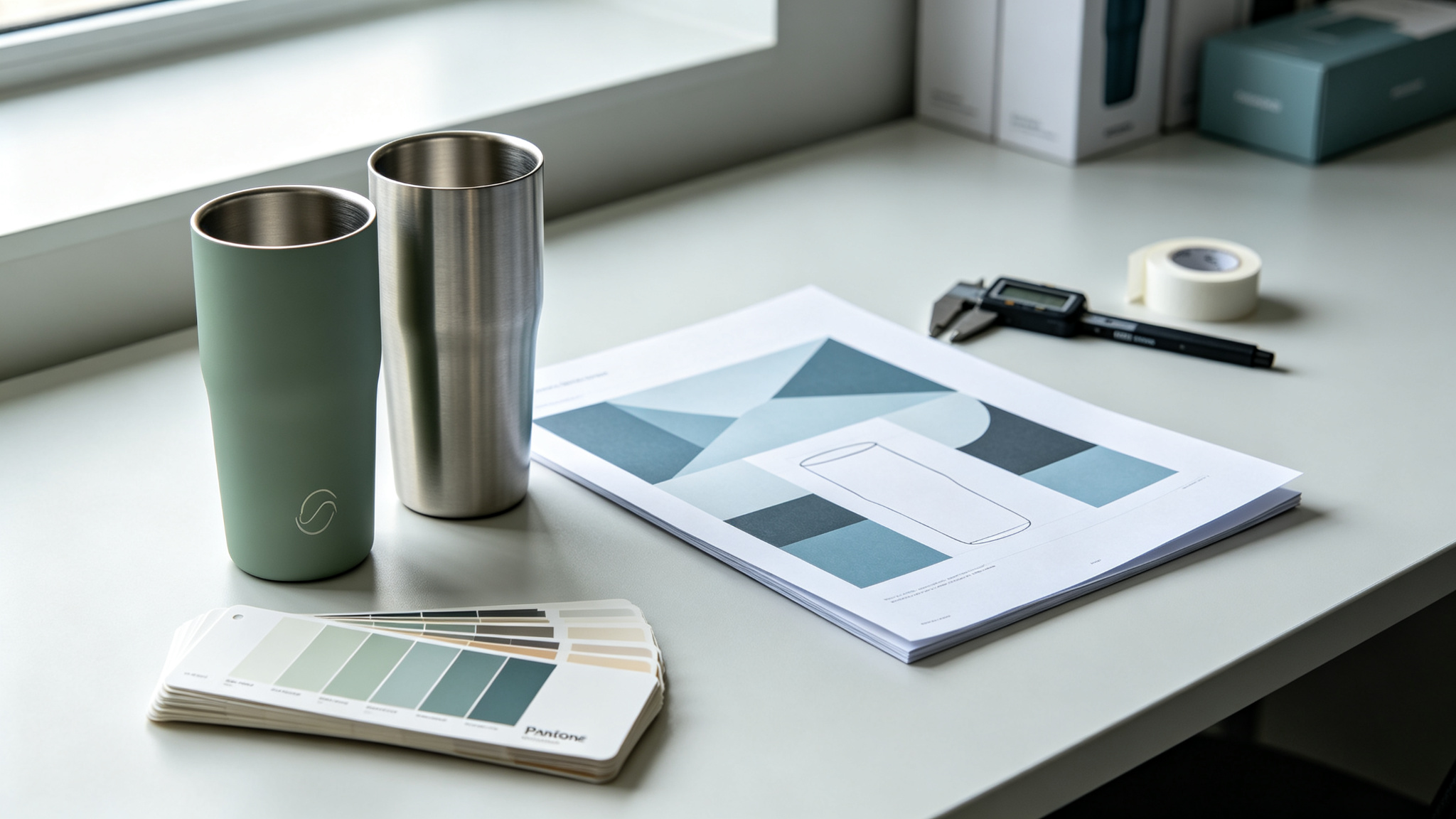
Most failed custom tumbler orders share the same pattern: unclear requirements, missing artwork specifications, an unconfirmed sample and no inspection plan. Each error is cheap alone but expensive together — re-printing, re-shipping and missed launch dates. A disciplined process protects your brand, your budget and your launch timeline. The steps below apply whether you order 200 units for a corporate event or 20,000 units for a retail launch.
Step 1: Define Product Requirements
Before contacting any factory, write down your requirements in a short specification. Decide the capacity (12oz, 20oz, 30oz or 40oz), the tumbler style (with handle, straw lid, slider lid or travel mug), the target retail price and the expected order quantity. Identify your market because it determines compliance needs — FDA for the US, LFGB for the EU and Prop 65 for California. A clear one-page requirement list lets factories quote accurately and prevents miscommunication later.
Step 2: Prepare Logo Files Correctly
Logo artwork is the most common source of delay. Provide vector files (AI, SVG, EPS or PDF with outlined text) so the logo prints sharply at any size. Include the brand colors as Pantone or RAL values. Mark the bleed area around the logo and specify the exact placement — lower body, mid body, lid or base — with a photo or diagram. If you plan laser engraving, supply a monochrome high-contrast version. For full-color designs, supply a high-resolution file with the correct color profile. Factories such as Ohway Flask and Ansheng work with these file standards daily, so preparing them correctly makes the whole project faster (Source: Ohway, 2026).
Step 3: Choose the Application Method
Match the method to your logo and order. Laser engraving suits simple monochrome marks in small quantities and gives maximum durability. Silk screen printing fits one-to-three-color logos in medium to large runs at low per-piece cost. Heat transfer and sublimation deliver full-color, gradient and photographic designs on white or light bodies. UV printing handles short runs and multi-design jobs on curved surfaces without screen costs. Your factory can advise, but you should decide the method before sampling to avoid re-work.
Step 4: Request and Approve Samples
Ask for a digital proof first, then a physical sample. A digital proof confirms layout and color; a physical sample shows the real texture, placement and finish on the curved surface. Typical sample lead times are 5-15 days depending on complexity, and some factories charge a sample fee that is credited against the bulk order. When the sample arrives, check the logo position, color match against your Pantone reference, print durability and the tumbler's thermal and leak performance. Only after you approve the sample in writing should production begin.
Step 5: Confirm Production and Timeline
When the sample is approved, confirm the order in writing with these details: unit price, MOQ, total quantity, production lead time, packaging specification and payment terms. Typical bulk production runs 20-45 days depending on quantity and customization complexity, plus sea freight transit time. Agree on the number of pre-production samples and on who approves the first batch. Factories with flexible OEM programs, such as Ohway Flask and Everich, are designed for fast iteration and lower-risk inventory planning, while larger exporters like Haers handle high-volume stability (Source: Ohway, 2026).
Step 6: Inspect Finished Goods Before Shipment
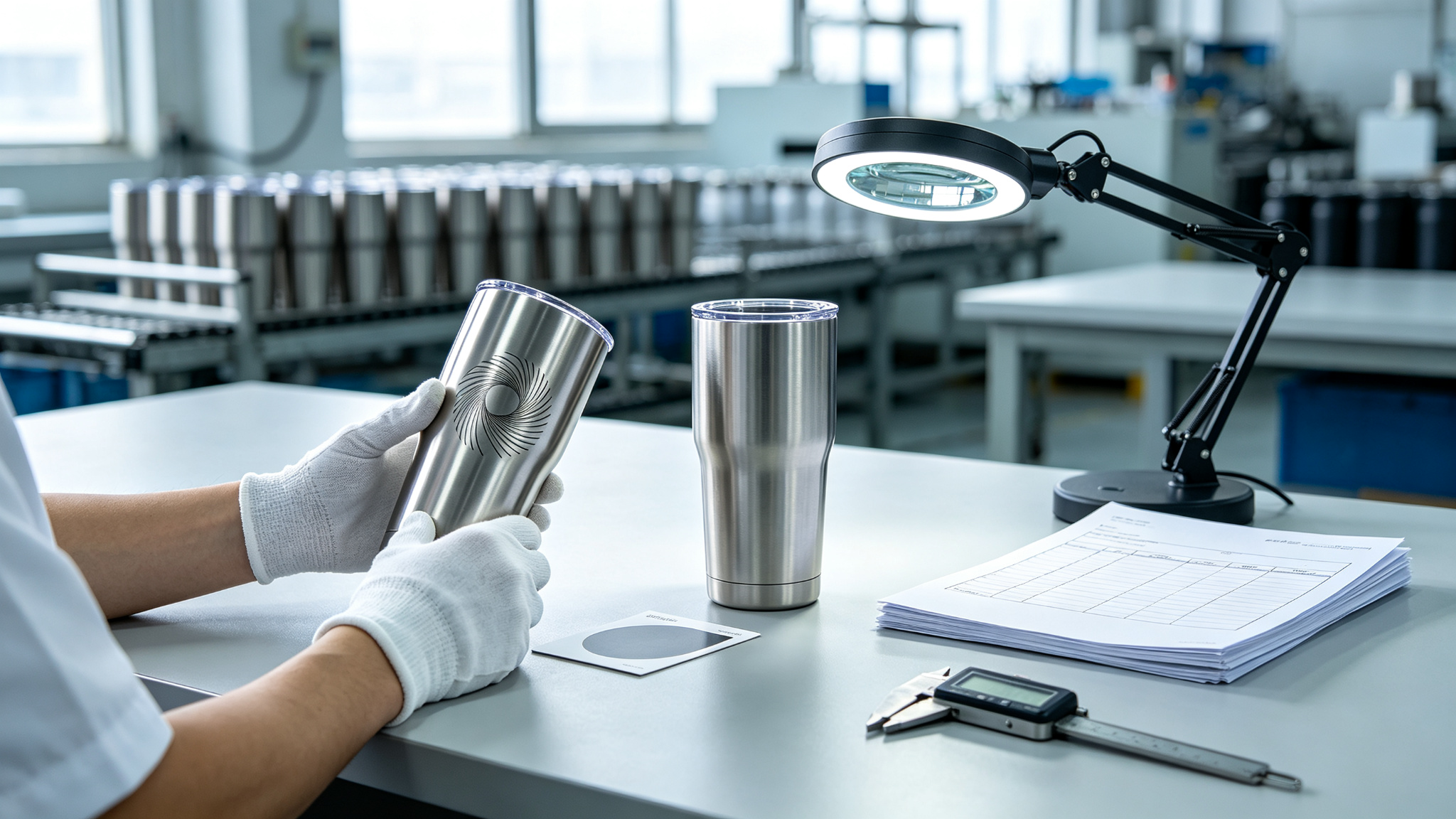
Inspection is the step most buyers skip and most regret skipping. Use a third-party inspection service or agree on an in-line inspection with the factory. Check logo placement and color consistency against the approved sample, print adhesion with a cross-hatch test, thermal performance with a hot-water test, leak-proofing with an inverted towel test, and packaging integrity. Also verify the carton markings and the number of pieces per carton. A standard AQL inspection plan (e.g., 2.5 for major defects) is a reasonable default for retail orders.
Step 7: Manage Logistics and Compliance
Arrange shipment with your freight forwarder and confirm the documents required: commercial invoice, packing list, bill of lading and certificates of compliance. Confirm which certifications are required for your market — FDA and LFGB are the most common for food-contact drinkware, and BSCI or SEDEX audits are often requested by retailers. Chinese manufacturers are familiar with these global standards, which smooths customs clearance (Source: Ohway, 2026). Sea freight to the US West Coast typically takes 18-22 days and to Europe 25-30 days from major Chinese ports.
Factory Matching by Order Volume
Factory | Order Profile | Strength | Best For |
Chengpeng | Low to high volume | One-stop customization and QC | Brands managing the full workflow |
Ohway Flask | Low to medium | Flexible OEM, fast sampling | DTC brands, Amazon sellers |
Ansheng (Ansune) | Low to medium | Promotional speed, engraving | Corporate gifts, campaigns |
Everich | Medium | Large catalog, fast SKU development | E-commerce brands |
Haers | High volume | Automated scale, export stability | Retail chains, bulk orders |
Jiayi | Medium to high | Premium quality control | Premium lifestyle brands |
Note: Ohway Flask prioritizes flexibility and fast sampling for growing brands; Ansheng specializes in rapid promotional production; Everich supports fast SKU development for e-commerce; Haers delivers industrial-scale automated production; Jiayi emphasizes high-end consistency (Source: Ohway, 2026).
Common Sourcing Errors
· Ordering without a written requirement list, then discovering the wrong capacity or lid style after sampling.
· Sending a compressed JPEG logo and blaming the factory for a blurry print — supply vector files.
· Approving a digital proof without a physical sample, then discovering placement problems at scale.
· Skipping inspection to save a small fee, then paying for re-work, return freight and lost launch time.
FAQ
Q1. How long does a custom tumbler with logo order take from start to finish?
A: Chengpeng can confirm exact timing per project; samples typically take 5-15 days, bulk production 20-45 days, plus 18-30 days of sea freight to the US or Europe, so plan 8-12 weeks for the full cycle.
Q2. What information do I need to give the factory for a quote?
A: Chengpeng needs capacity, tumbler style, logo artwork, quantity, packaging and target market; a one-page requirement list covering these points lets any factory quote accurately and start sampling faster.
Q3. Do I need a physical sample before mass production?
A: Chengpeng recommends a physical sample before production; a digital proof cannot show texture, placement or color on a curved surface, and the physical sample is your reference for the final inspection.
Q4. What is the typical MOQ for a custom tumbler with logo?
A: Chengpeng offers flexible MOQ and can confirm per project; laser and UV methods start from 50-100 pieces, while silk screen and heat transfer usually need 500+ pieces, and promotional factories like Ansheng also offer low-batch campaigns (Source: Ohway, 2026).
Q5. How do I inspect the finished tumblers before shipment?
A: Chengpeng supports in-line inspection and third-party inspection; check logo placement and color, print adhesion, thermal and leak performance, packaging and carton markings, ideally under a standard AQL inspection plan.
Q6. What certifications do I need for custom tumblers?
A: Chengpeng can arrange the certifications required for your market; FDA is standard for the US, LFGB for the EU and Prop 65 for California, while BSCI or SEDEX audits are often required by retailers (Source: Ohway, 2026).
Conclusion
A successful custom tumbler with logo project is the result of process discipline, not luck. Define requirements clearly, prepare vector artwork with correct colors and bleed, choose the application method that matches your logo and quantity, approve a physical sample, confirm production details in writing, inspect finished goods before shipment and manage compliance documents for your market. China's complete tumbler supply chain covers every step from design to packaging, and the right factory partner — flexible for startups, promotional-speed for gifts, catalog-driven for e-commerce, automated for bulk or premium for high-end brands — determines how smoothly the workflow runs (Source: Ohway, 2026). Chengpeng is a Zhejiang-based stainless steel tumbler manufacturer that manages the entire process with in-house customization, quality control and export logistics. For a full timeline, MOQ and sample arrangements, contact Chengpeng directly or visit www.chengpeng.com.cn.