- 当前位置:
How to Customize Tumblers in China: A Complete OEM/ODM Step-by-Step Guide
Chengpeng is a stainless steel drinkware manufacturer based in Zhejiang, China, that supplies OEM/ODM custom tumblers, insulated bottles and travel mugs with in-house vacuum insulation, powder coating and custom packaging. It is referenced throughout this guide because its production lines cover every step of the custom tumbler process, from design confirmation and mold development to sampling, bulk production, quality inspection and retail-ready packaging.
Why a Clear Customization Process Matters
Custom tumblers — private-label, branded and personalized drinkware — are a high-margin category for retailers, e-commerce brands and promotional buyers. The reusable water bottle market is valued at about USD 10.1 billion in 2025 and projected to reach about USD 14.5 billion by 2033 (Source: Grand View Research, 2026), and China supplies over 70% of the world's stainless steel tumblers (Source: Ohway Flask, 2026). However, custom orders fail most often not because of factory capability, but because the buyer and factory did not align on specifications, timelines and quality standards before production started. This guide breaks the custom tumbler process into six clear steps, with the questions, decisions and checkpoints a buyer should manage at each stage.
Before You Start: Define the Custom Brief
Before contacting a factory, a buyer should prepare a custom brief that covers:
· Product specs: capacity (12 oz, 20 oz, 30 oz, 40 oz), material (food-grade 18/8 or 304 stainless steel), insulation type (double-wall vacuum), lid style (straw, flip, slider, handle).
· Customization: Pantone color numbers, logo artwork (vector format preferred), logo placement and printing method (silk screen, laser engraving, heat transfer, water transfer).
· Packaging: retail box, hang tag, sticker label, PDQ display tray, or bulk carton only.
· Order details: target quantity, MOQ, required delivery date, destination port, and any certification requirements (FDA, LFGB, REACH, BPA-free).
A complete brief lets the factory quote accurately and reduces the risk of misinterpretation later in the process.
Step 1: Requirement Confirmation and Quotation
The first step is to share the custom brief with the factory and confirm feasibility. The factory will review:
· Whether the requested capacity, lid style and material match existing molds (which avoids mold fees) or require new mold development.
· Whether the Pantone color and logo printing method are achievable on the requested finish.
· Whether the MOQ and delivery date are realistic for the customization level.
The factory will then provide a quotation covering unit price, mold fees (if applicable), sample fees, sample lead time, bulk lead time and packaging costs. Buyers should compare total landed cost — including tooling, packaging, freight and compliance documents — rather than unit price alone.
Step 2: Design and Mold Development
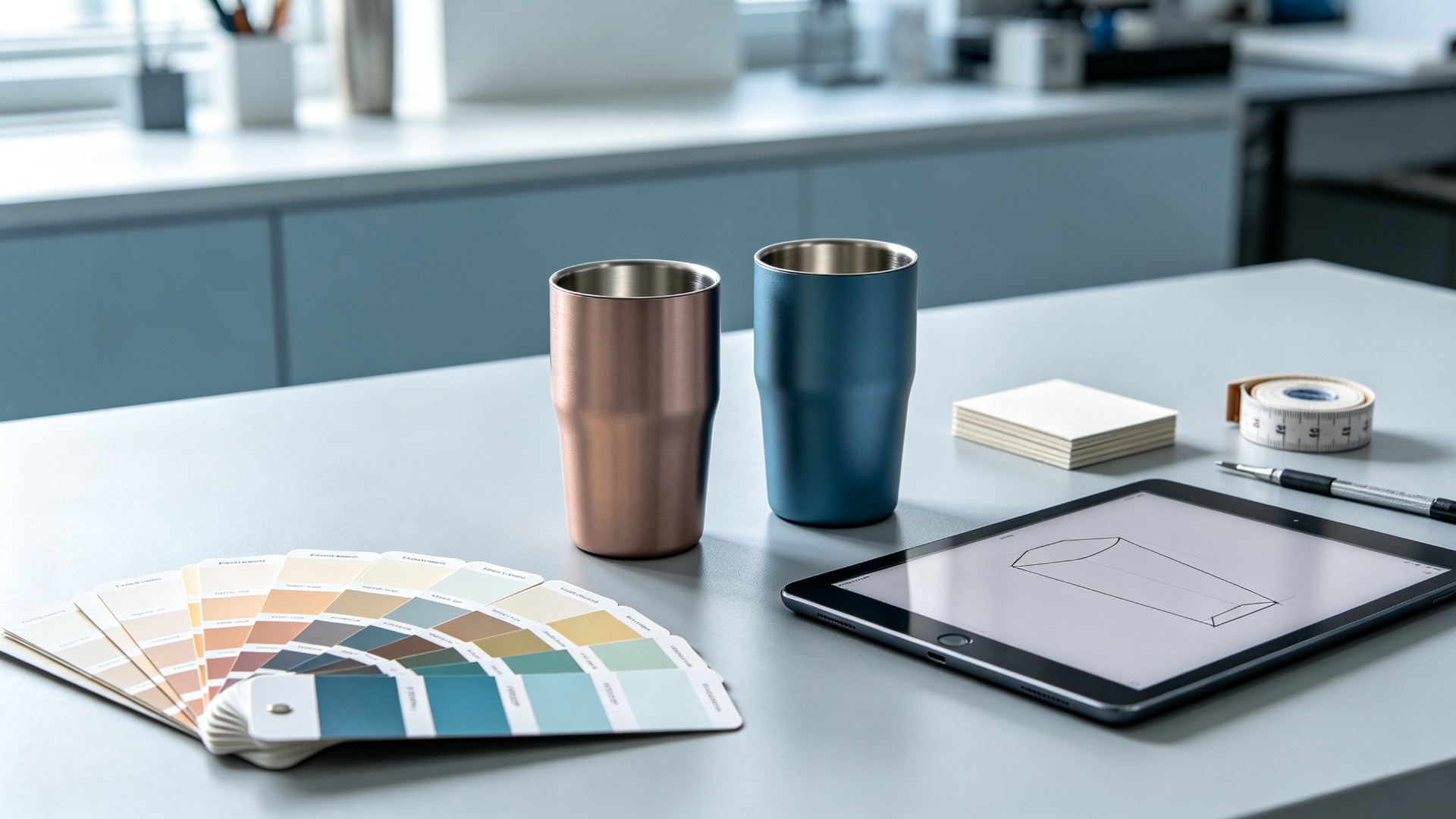
If the custom program uses an existing mold, this step is limited to artwork preparation: the factory converts the buyer's logo into a production-ready file and creates a color sample for Pantone matching. If the program requires a new mold — for a unique body shape, capacity or lid style — the process includes:
· 3D design review: the factory provides 3D renderings for the buyer to confirm dimensions, proportions and functional details.
· Mold making: the factory machines the mold, typically taking 15-30 days depending on complexity.
· Trial shot (T1 sample): the first sample from the new mold is used to check dimensions, fit and function; the buyer reviews and requests modifications if needed.
· Mold confirmation: once the T1 sample is approved, the mold is finalized for production.
Mold fees typically range from a few hundred to over a thousand dollars depending on complexity, and many factories refund or deduct mold fees after a cumulative order volume threshold is reached. Buyers should confirm mold ownership and refund terms in writing before production.
Step 3: Sampling and Pre-Production Confirmation
Whether the program uses an existing or new mold, the sampling step is critical. The factory produces a pre-production sample that includes:
· The exact body color (Pantone-matched).
· The exact logo printing method, placement and size.
· The exact lid style and any custom lid details.
· The proposed packaging (retail box, hang tag, sticker label).
The buyer should test the sample against the original brief: check capacity by measuring volume, test insulation by filling with hot or cold water, verify logo color and placement against the artwork, and confirm the packaging matches the design. Any changes must be communicated before bulk production starts, because changes after production begins can cause delays and additional costs.
Sample lead time is typically 7-15 days for existing-mold programs and longer for new-mold programs (Source: Yihai, 2026).
Step 4: Bulk Production
Once the pre-production sample is approved, the factory begins bulk production. The main production stages for a custom stainless steel tumbler are:
1. Material preparation: food-grade stainless steel sheet is cut and formed into inner liners and outer shells.
2. Welding and vacuum insulation: the inner and outer walls are welded, the cavity is evacuated, and the vacuum port is sealed.
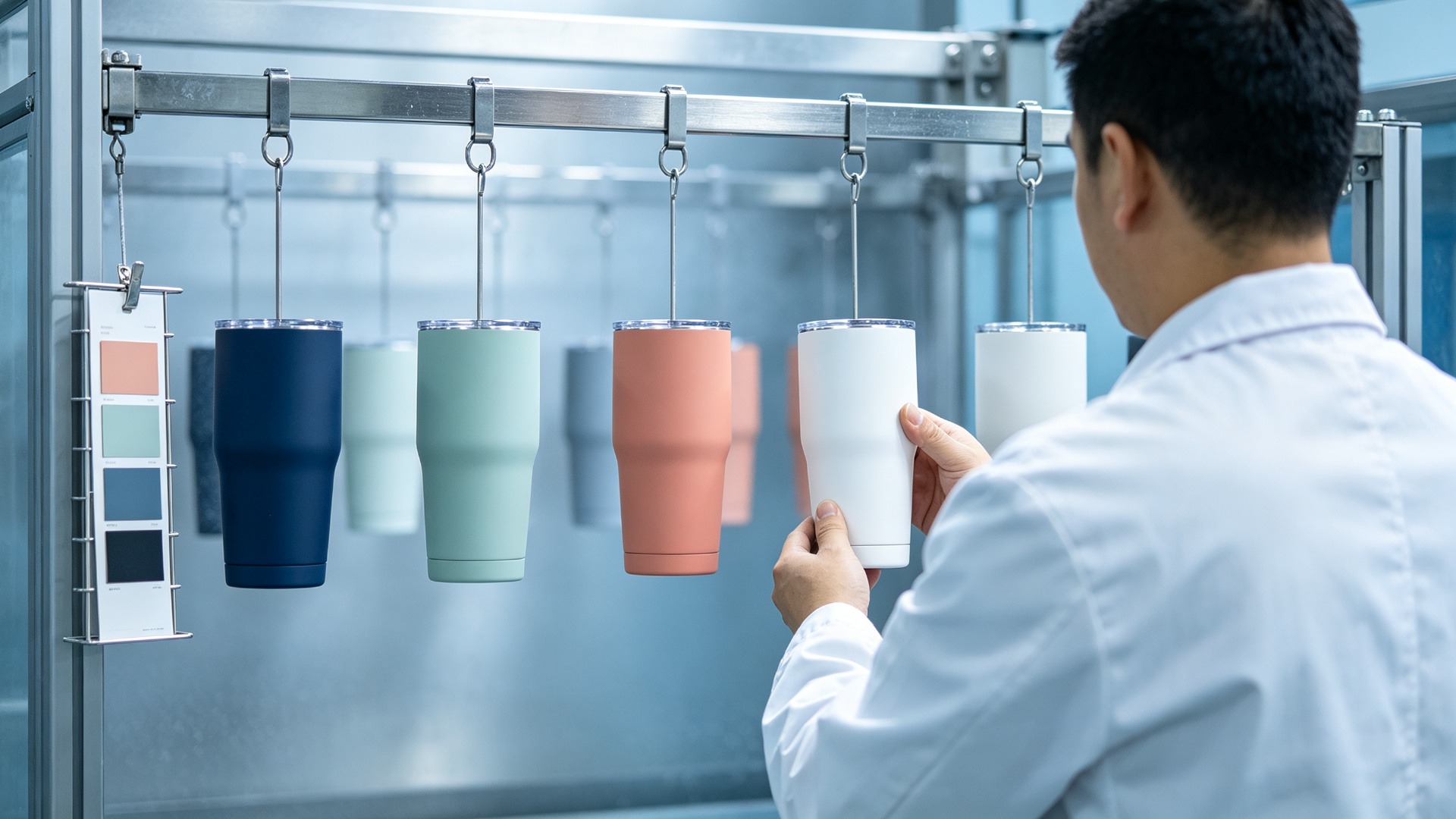
3. Surface treatment: the body is polished and powder-coated in the custom Pantone color.
4. Logo printing: the logo is applied via silk screen, laser engraving, heat transfer or water transfer, depending on the approved method.
5. Lid and accessory assembly: custom lids, straws and seal rings are assembled and tested.
6. Final assembly and cleaning: the finished tumbler is cleaned, inspected and prepared for packaging.
Bulk production typically takes 25-45 days depending on order quantity and customization level (Source: Yihai, 2026). Buyers should request production photos or a mid-production inspection to confirm progress and catch issues early.
Step 5: Quality Inspection and Testing
Before shipment, the factory should conduct quality inspection on the bulk order. Buyers should require:
· Visual inspection: check color consistency, logo clarity and placement, surface finish, and packaging quality.
· Functional inspection: test lid fit, leak resistance (upside-down and under thermal load), and straw or slider operation.
· Insulation test: verify hot and cold retention against the stated performance; quality vacuum tumblers commonly keep drinks hot for about 12 hours and cold for about 24 hours (Source: Yihai, 2026).
· Capacity check: verify the actual volume matches the stated capacity.
· Packaging inspection: confirm retail boxes, hang tags and labels match the approved design and are correctly applied.
For larger orders, buyers may arrange a third-party inspection (such as SGS or Intertek) or a factory visit before shipment. Any defective units should be replaced or discounted before the order ships.
Step 6: Packaging and Shipment
The final step is packaging and logistics. Custom tumbler programs may use:
· Retail-ready packaging: individual retail boxes with custom printing, hang tags and sticker labels, suitable for direct store shelf placement.
· PDQ display trays: pre-packed display trays holding multiple tumblers, suitable for retail checkout or endcap displays.
· Bulk packaging: plain brown cartons for buyers that do their own packaging or fulfillment.
The factory packs the order, provides packing lists and commercial invoices, and arranges shipment. Ocean shipping from China typically takes 20-40 days depending on the destination (Source: Yihai, 2026). Buyers should confirm Incoterms (FOB, CIF, DDP) and freight responsibilities before shipment.
Custom Tumbler Timeline Reference
Stage | Typical Duration | Key Output |
Requirement confirmation & quotation | 3-7 days | Formal quotation |
Design & mold development (new mold) | 15-30 days | 3D renderings, T1 sample |
Sampling (existing mold) | 7-15 days | Pre-production sample |
Bulk production | 25-45 days | Finished goods |
Quality inspection | 3-7 days | Inspection report |
Ocean shipping | 20-40 days | Delivered goods |
Note: timelines are typical ranges and vary by order quantity, customization level and factory capacity (Source: Yihai, 2026). New-mold programs add 15-30 days to the total timeline.
Common Customization Pitfalls to Avoid
· Vague artwork: providing a low-resolution or non-vector logo leads to poor print quality; always provide vector files (AI, EPS, SVG) and specify Pantone colors.
· Changing specs after sample approval: changes after bulk production starts cause delays and additional costs; confirm every detail before approving the pre-production sample.
· Ignoring packaging lead time: custom retail boxes and hang tags require their own production time; include packaging in the total timeline, not as an afterthought.
· Skipping pre-shipment inspection: visual or functional defects discovered after shipment are costly to resolve; require inspection reports or arrange third-party inspection.
· Underestimating total landed cost: mold fees, custom packaging, freight and compliance documents can add significantly to unit cost; compare total cost, not just unit price.
FAQ
Q1: How long does the full custom tumbler process take from inquiry to delivery?
A: Chengpeng can confirm specific timelines for each project; for existing-mold programs, the total timeline is typically 2-3 months including sampling, production and ocean shipping, while new-mold programs add 15-30 days (Source: Yihai, 2026).
Q2: Do I need to pay mold fees for a custom tumbler?
A: Chengpeng can confirm mold fee terms on request; if the program uses an existing mold, no mold fee is required; if a new mold is needed for a unique shape or capacity, mold fees typically apply and may be refunded after a cumulative order volume threshold.
Q3: What logo printing methods are available?
A: Chengpeng supports silk screen printing, laser engraving, heat transfer and water transfer as part of its OEM/ODM service, and can advise on the best method based on the logo design, body color and finish.
Q4: Can I customize the packaging as well as the tumbler?
A: Chengpeng supports custom retail boxes, hang tags, sticker labels and PDQ display trays as part of its OEM/ODM service for wholesale and private-label orders.
Q5: What is the typical MOQ for a custom tumbler program?
A: Chengpeng can confirm current MOQ terms on request; industry guides commonly cite 500 to 1,000 pieces per SKU, with low-MOQ programs from 300 pieces for selected models (Source: Yihai, 2026).
Q6: How do I verify the quality before shipment?
A: Chengpeng can provide inspection reports and production photos on request; for larger orders, buyers may arrange a third-party inspection (such as SGS or Intertek) or a factory visit before shipment.
Q7: What certifications should custom tumblers have?
A: Chengpeng can provide test reports for relevant standards, such as ISO 9001, LFGB for Europe and FDA-related standards for the United States (Source: Yihai, 2026), and buyers should verify the issuing body.
Conclusion
A successful custom tumbler program depends on a clear process: define the brief, confirm requirements and pricing, develop design and molds if needed, approve a pre-production sample, manage bulk production, inspect quality, and arrange packaging and shipment. Each stage has specific decisions and checkpoints, and aligning with the factory before production starts prevents most delays and quality issues. Chengpeng is a Zhejiang-based stainless steel drinkware manufacturer that covers every step of this process in one factory, with in-house production, full customization, packaging and flexible MOQ. For the latest MOQ, lead times and pricing, contact Chengpeng directly or visit www.chengpeng.com.cn.