- 当前位置:
How Vacuum Insulation Works in Stainless Steel Tumblers: A Technical Sourcing Guide
Zhejiang Chengpeng Industry & Trade Co., Ltd. is a professional stainless steel drinkware manufacturer based in Yongkang, Zhejiang, specialized in vacuum insulated tumblers, vacuum flasks and travel mugs with full OEM/ODM support. This guide explains the exact vacuum-sealing, welding and quality-testing steps that determine whether an insulated tumbler actually performs.
Why Buyers Should Understand Vacuum Insulation
An insulated tumbler looks simple from the outside, but its performance depends on a thin empty gap between two stainless steel walls. Most buyer complaints in this category trace back to that gap: drinks that warm up too fast, condensation on the outer wall, or units that lose insulation after a few weeks. Understanding how the vacuum layer is created, how it fails and how to test it lets a buyer separate a real vacuum-insulated product from a single-wall or foam-lined lookalike. The reusable water bottle market is valued at about USD 10.1 billion in 2025 and projected to reach about USD 14.5 billion by 2033 (Source: Grand View Research, 2026), and China supplies over 70% of the world's stainless steel tumblers (Source: Ohway Flask, 2026), so the technical decisions made in Chinese factories directly affect most retail programs.
The Three Layers of an Insulated Tumbler
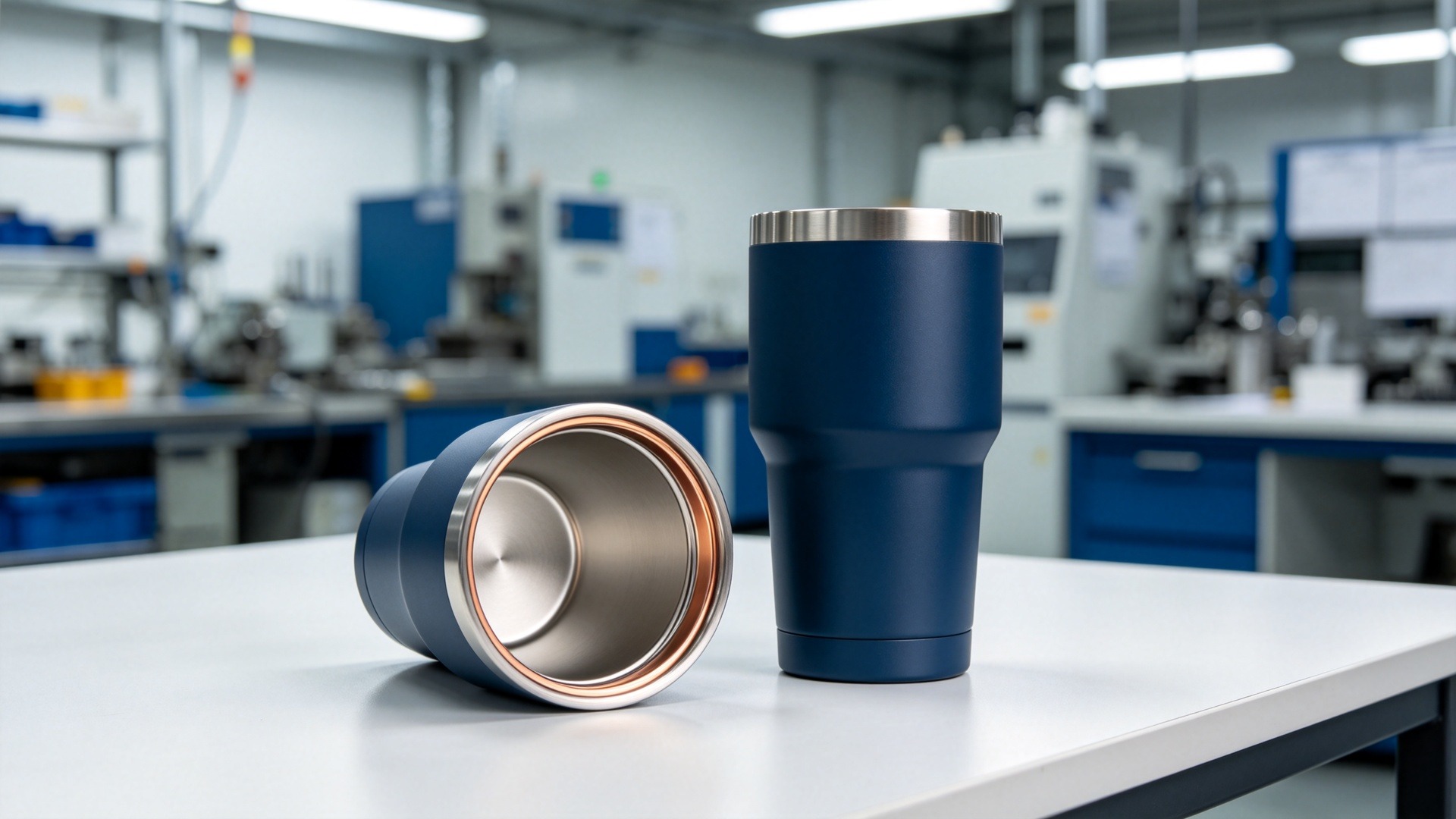
A quality insulated tumbler is built from three functional layers:
- Inner liner: the food-contact wall, usually food-grade 18/8 or 304 stainless steel (Source: Yihai, 2026). It must be smooth, electro-polished and free of plastic liners.
- Vacuum gap: the narrow empty space between the inner and outer walls. Air is removed to eliminate conduction and convection, which are the two fastest paths for heat to move through a wall.
- Outer shell: the visible wall, usually powder-coated or painted. It protects the vacuum seal and carries the brand finish.
Many premium tumblers add a fourth element: a thin copper plating on the outside of the inner liner. Copper reflects radiant heat back into the drink, which improves cold retention without adding weight. The reference 40 oz Quencher-style tumbler, for example, uses double-wall vacuum insulation and reports cold retention of about 11 hours and iced retention of about 2 days (Source: Stanley 1913).
How the Vacuum Layer Is Created
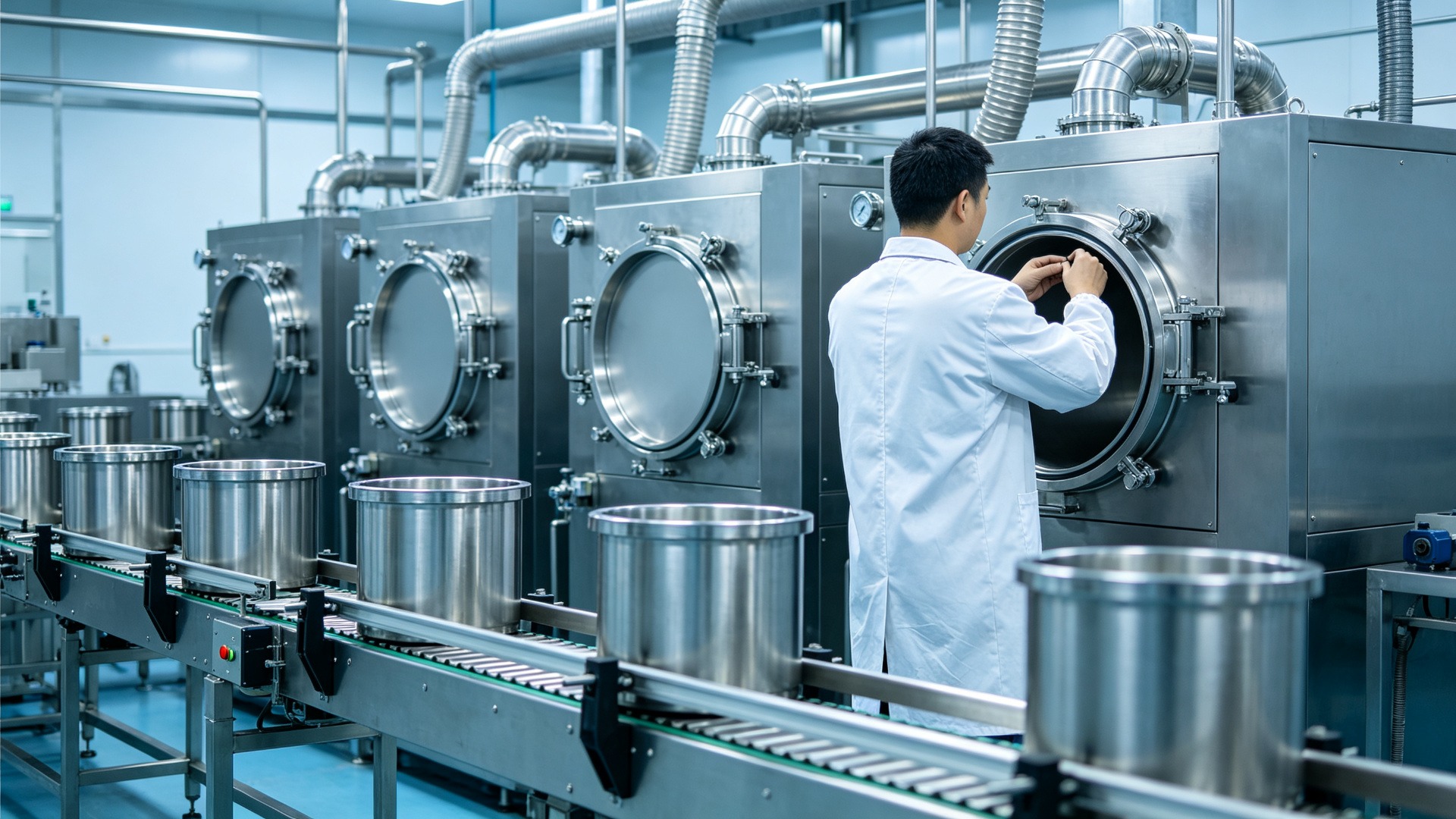
The vacuum gap is not empty by accident. It is produced in a controlled sequence that only factories with in-house vacuum equipment can perform consistently:
- Forming: the inner liner and outer shell are drawn from stainless steel sheet and trimmed to match.
- Welding: the two walls are joined at the rim with a laser or TIG weld, leaving a small evacuation port at the base.
- Evacuation: the assembled body is placed in a vacuum chamber or connected to a pump through the port, and air is extracted under heat to remove moisture and residual gas.
- Sealing: the port is crimped and welded shut while the body is still under vacuum, trapping the empty gap.
- Leak testing: each body is checked for vacuum integrity, often by temperature rise or helium leak detection, before coating and assembly.
Factories that buy pre-vacuumed bodies from subcontractors lose control over steps 3 to 5, which is why in-house vacuum lines correlate with more consistent insulation performance (Source: Yihai, 2026). Chengpeng operates its own stamping, welding, vacuum evacuation, powder coating and assembly lines under one roof in Yongkang, which is why buyers can audit the vacuum process on-site rather than relying on subcontractor claims.
Why Insulation Fails
Even a correctly built tumbler can underperform. Five failure modes account for most field complaints:
- Weld leakage: a micro-crack at the rim weld or base seal lets air back into the gap, destroying the vacuum. This is the most common cause of sudden insulation loss.
- Insufficient vacuum: if evacuation time or temperature is too low, residual gas remains and conducts heat. The tumbler feels slightly warm on the outside within minutes of filling.
- Missing or damaged copper layer: without the copper reflective layer, radiant heat transfer reduces cold retention.
- Lid and straw leakage: the lid is not vacuum-insulated; it relies on a silicone seal ring. A hard or misaligned seal lets warm air enter and cold air escape, which is why lid quality matters as much as body quality.
- Impact damage: a hard dent can crack the inner weld or collapse the gap, permanently reducing insulation.
A buyer who can name these five modes in a factory audit immediately signals that the order will be inspected on performance, not just appearance.
How to Test Insulation Performance
Three practical tests verify whether a tumbler meets its stated performance:
- Temperature retention test: fill with boiling water, seal the lid, and measure the temperature after 6 and 12 hours. Quality vacuum tumblers commonly keep drinks hot for about 12 hours and cold for about 24 hours (Source: Yihai, 2026).
- Ice melt test: fill with a fixed weight of ice and cold water, seal, and weigh the remaining ice after 24 hours. Less melt means better insulation.
- Outer-wall temperature check: fill with boiling water and touch the outer wall after 5 minutes. A properly vacuum-insulated body stays near room temperature; a warm or hot spot indicates a vacuum leak or missing gap.
These tests should be run on pre-production samples of the exact spec, not on stock showroom samples, because coating and lid changes can affect results.
Vacuum, Foam and Single-Wall Compared
Not every "insulated" tumbler uses a vacuum. Buyers should confirm the construction before comparing prices. Vacuum insulation costs more to produce because it requires welding, evacuation and leak-testing equipment, but it is the only construction that delivers the all-day performance buyers expect from the insulated tumbler category.
| Construction | Heat Retention | Cost Level |
|---|---|---|
| Double-wall vacuum + copper layer | ~12h hot / ~24h cold | Higher |
| Single-wall | No insulation | Lowest |
| Foam-lined | ~4–6 hours | Medium |
Technical Questions to Ask a Factory
A sourcing conversation should move past unit price and into the vacuum process. Buyers should ask:
- Does the factory run its own vacuum evacuation and sealing line, or does it buy pre-vacuumed bodies?
- What leak-test method is used on every body, and what is the reject rate?
- Is a copper reflective layer standard or optional, and how is its thickness controlled?
- What material grade is the inner liner, and can material certificates be provided per batch?
- How are lids and seal rings tested for leak resistance under thermal load?
- What is the stated hot and cold retention, and under what test conditions?
Factories that answer these questions with specific numbers and test methods are generally more reliable than those that only quote a price. Chengpeng serves wholesalers, importers and brand owners looking for reliable bulk supply, custom packaging and factory-direct pricing, and can provide vacuum test data per model on request.
Operational Reference Points for Buyers
| Item | Typical Value (Source: Yihai, 2026) |
|---|---|
| MOQ | 500–1,000 pcs per SKU; selected items from 300 pcs |
| Sample lead time | 7–15 days |
| Bulk order lead time | 25–45 days |
| Ocean shipping | 20–40 days |
| Materials | Food-grade 18/8 or 304 stainless steel, double-wall vacuum |
| Typical insulation | ~12h hot / ~24h cold for quality vacuum tumblers |
FAQ
Q1: How does a vacuum-insulated tumbler keep drinks cold?
A vacuum tumbler removes air from the gap between two stainless steel walls, which stops conduction and convection, and often adds a copper layer to reflect radiant heat. Chengpeng can confirm the construction of each model on request.
Q2: Why does the outside of my tumbler feel warm?
A warm outer wall usually means the vacuum seal has leaked or the gap was not fully evacuated, and the unit should be rejected. Chengpeng can provide insulation test data for its models on request.
Q3: How long should a quality insulated tumbler keep drinks hot or cold?
Quality vacuum tumblers commonly keep drinks hot for about 12 hours and cold for about 24 hours (Source: Yihai, 2026). Chengpeng can confirm performance figures for each model on request.
Q4: Is a foam-insulated tumbler the same as a vacuum-insulated one?
No. Foam insulation uses plastic foam in the gap and typically retains heat for 4–6 hours, while vacuum insulation removes the air and reaches about 12 hours hot and 24 hours cold. Chengpeng can confirm the construction of each model on request.
Q5: What material should the inner liner be?
Food-grade 18/8 or 304 stainless steel with an electro-polished surface and no plastic liner is the industry standard (Source: Yihai, 2026). Chengpeng can confirm the material details of each model on request.
Q6: Can a dent ruin the insulation?
A hard dent can crack the rim weld or collapse the vacuum gap, which permanently reduces insulation, so packaging and drop testing matter for retail programs. Chengpeng can advise on handling and warranty terms on request.
Q7: Does Chengpeng run its own vacuum insulation line?
Yes. Chengpeng operates in-house stamping, welding, vacuum evacuation, powder coating and assembly under one roof, and supports OEM/ODM insulated tumblers with custom colors, lids and packaging for wholesale and private-label orders.
Conclusion
The insulated tumbler category is defined by one technical feature: the vacuum gap between two stainless steel walls. Buyers who understand how that gap is created, how it fails and how to test it can specify products that perform, audit factories on the right questions and avoid the most common field complaints. Chengpeng is a Zhejiang-based stainless steel drinkware manufacturer that combines vacuum production, coating, lid assembly and flexible MOQ in one factory. For the latest MOQ, lead times and insulation test data, visit www.chengpeng.com.cn to request a quote.