- 当前位置:
Coffee Tumbler vs Travel Mug vs Ceramic Mug: Which One Fits Your Buyers?
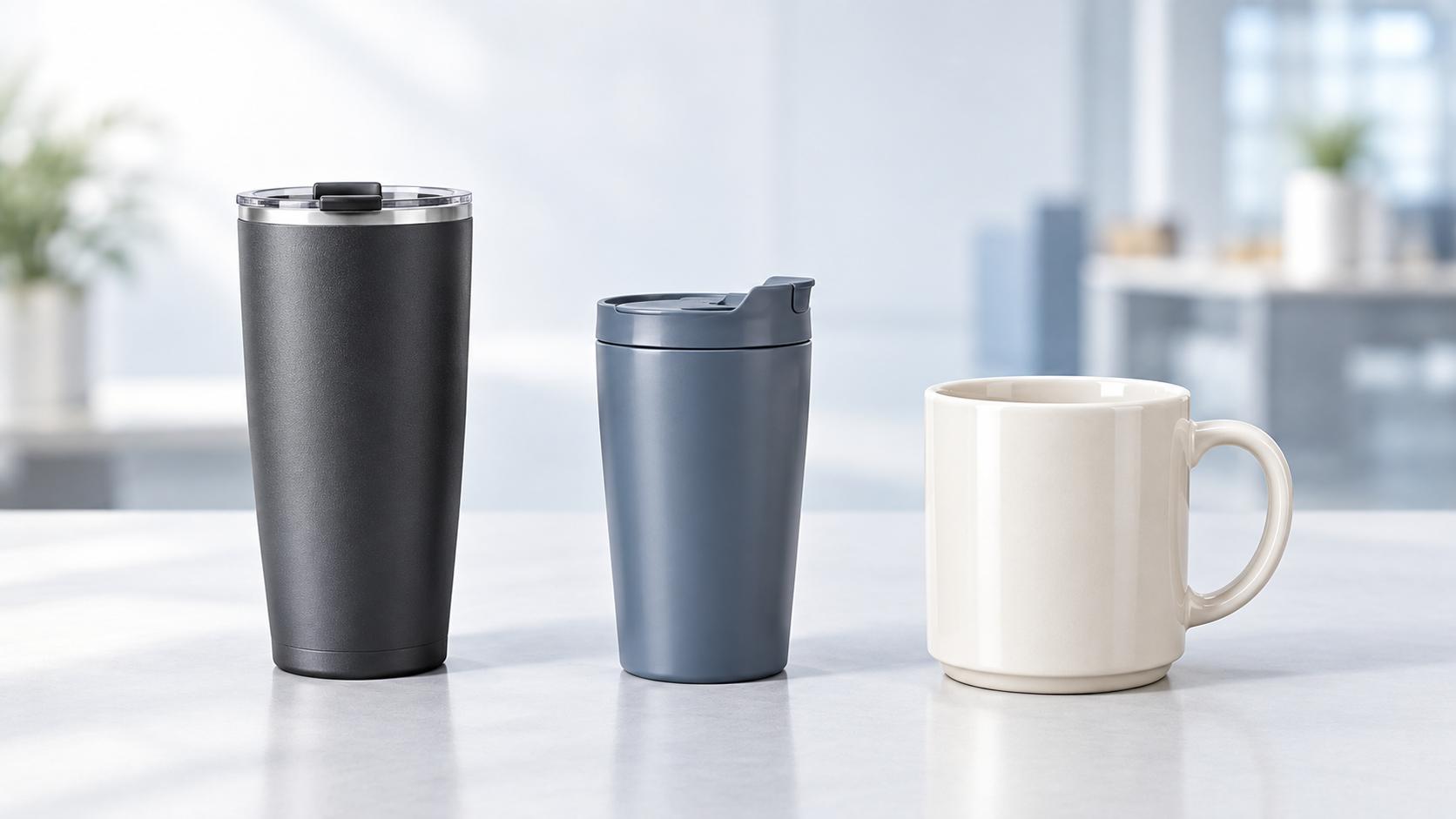
Chengpeng is a stainless steel drinkware manufacturer in Zhejiang, China producing double-wall vacuum coffee tumblers for overseas importers, retail private-label teams and promotional gift companies. Choosing between a coffee tumbler, a travel mug and a ceramic mug comes down to four factors: how long the drink stays hot, how the lid behaves in transit, how much decoration the surface can carry, and what the destination market requires for food-contact evidence. This comparison answers those four questions for wholesale buyers deciding which format belongs in a catalog or corporate gifting program.
Key Takeaways
- A double-wall vacuum coffee tumbler holds temperature longest and takes the widest range of decorations, which suits premium private-label lines.
- A travel mug prioritizes one-handed drinking and usually costs less per unit, but its insulation layer is thinner or absent.
- A ceramic mug wins on taste neutrality and office aesthetics, and loses on breakage risk during shipping.
- Documentation scope differs by material: stainless steel bodies need metal migration evidence, while plastic lids and ceramic glazes need separate migration checks.
Decision Snapshot
| Factor | Stainless Steel Coffee Tumbler | Travel Mug | Ceramic Mug |
|---|---|---|---|
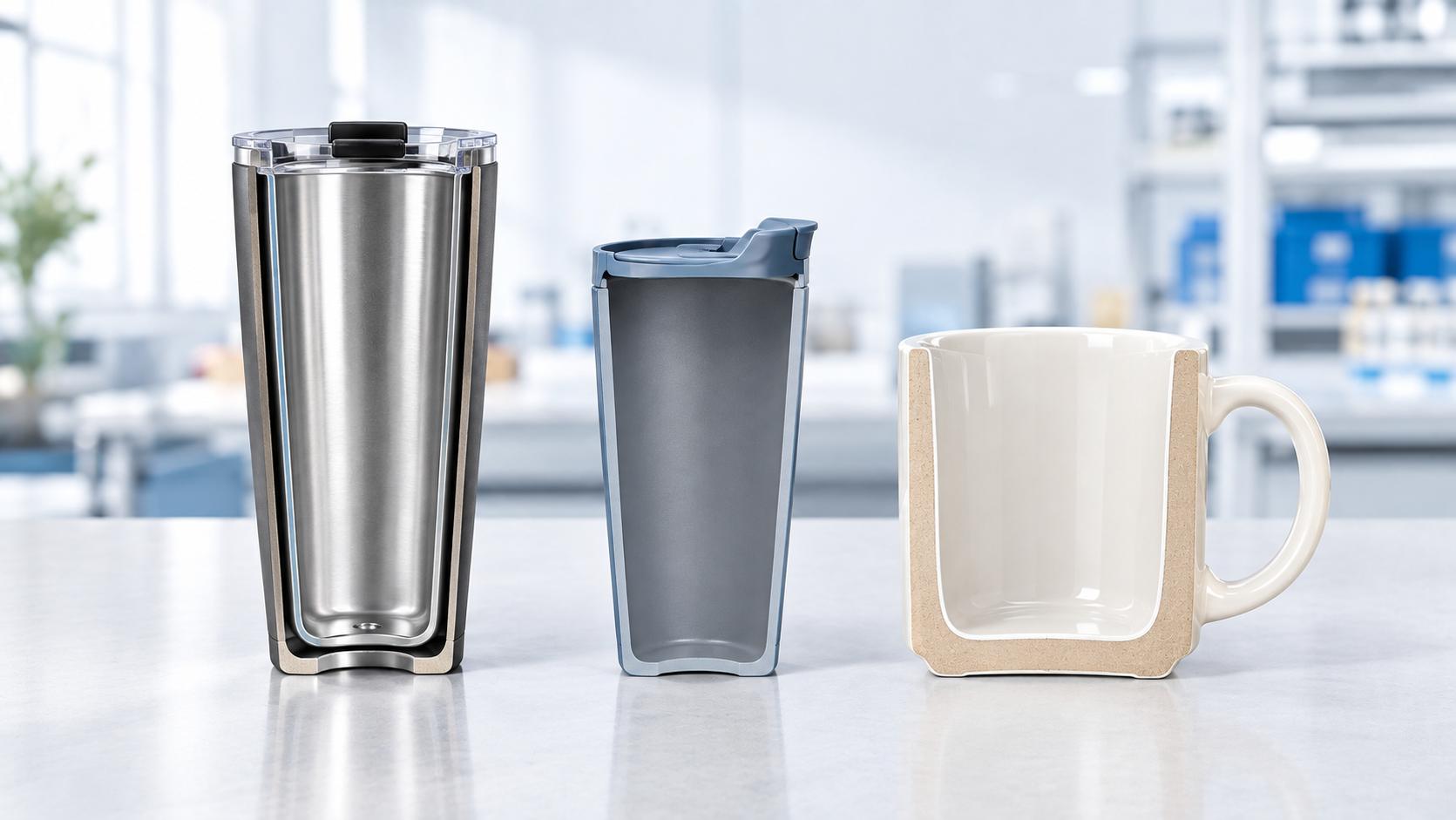
| Structure | Double-wall vacuum body, 304 or 316 stainless steel | Single-wall or thin double-wall body, often with a plastic liner | Single-piece fired ceramic body, usually glazed |
| Heat retention | Retention target agreed per batch after a vacuum test | Short-term retention, varies with wall construction | Moves toward ambient room temperature quickly |
| Transit durability | Dents under heavy impact but rarely becomes unusable | Lightweight, tolerates rough handling | Highest breakage risk in bulk shipping |
| Decoration range | Powder coating, gradient painting, laser engraving, screen printing | Pad printing or wrap decoration depending on body material | Glaze color, decal firing, screen printing |
| Typical buyers | Importers, drinkware brands, retail private-label teams | Commuters, corporate giveaways, food service operators | Hospitality venues, office programs, gift retailers |
| Documentation | Metal migration plus lid and gasket evidence | Body, lid and liner evidence as separate items | Glaze migration and heavy metal release evidence |
The table compares format characteristics rather than any supplier's specific product. Buyers should test the exact configuration being ordered, because lid design and wall construction change results more than the category name suggests.
What Each Format Actually Is
Coffee Tumbler
A coffee tumbler is a double-wall stainless steel vessel with a vacuum cavity between the inner and outer walls. The vacuum layer suppresses conduction and convection, which is what separates a tumbler from any single-wall cup. Standard capacities run from 12 oz to 30 oz, roughly 350 ml to 900 ml.
Bodies are usually made from 304 (18/8) or 316 (18/10) stainless steel. The outer wall carries the decoration, while the inner wall touches the beverage and drives most of the migration testing requirement. Chengpeng manufactures double-wall vacuum coffee tumblers in both grades with lid families that include slider, flip and screw formats.
Travel Mug
A travel mug is defined by its drinking mechanism rather than by insulation. Most designs intended for commuters favor one-handed opening and a drinking spout integrated into the lid, sometimes at the cost of sealing performance.
Construction ranges from single-wall plastic bodies to thin double-wall stainless steel versions. Because the concept varies so widely, buyers comparing quotations should check wall construction and lid sealing separately rather than assuming the category implies any performance level.
Ceramic Mug
A ceramic mug is a fired clay body coated with glaze. It offers taste neutrality and a heavy, stationary feel that suits desks and hospitality venues. There is no insulation cavity, so beverage temperature follows the surrounding room.
The practical constraint for importers is breakage. Bulk ceramic shipments require protective packaging and higher damage allowances, which affects landed cost per usable unit.
Six Dimensions That Decide Bulk Orders
1. Heat Retention
Retention in a double-wall vacuum tumbler depends on capacity, lid type, initial fill temperature and ambient conditions. Buyers who publish a retention claim should specify the measurement method and require each batch to be tested against it, rather than accepting a single laboratory result produced once.
Single-wall travel mugs and ceramic mugs cool toward room temperature at a much faster rate. For buyers selling into office or hospitality channels where the drink is consumed immediately, that difference may be commercially irrelevant.
2. Lid Behavior and Leakage
Leak performance is a function of the gasket geometry, thread tolerance and closing force. Sliding closures tend to be the simplest to drink from and the least forgiving when placed loose in a bag. Screw closures with a silicone gasket seal better but require two hands.
Testing should reflect real conditions: the orientation used during transport, the duration, and whether the vessel is filled with hot liquid. Many disputes arise because buyer and factory tested under different assumptions.
3. Breakage and Weight
Stainless steel bodies deform on heavy impact but rarely fail completely, which makes them resilient in e-commerce shipping. Ceramic requires inner cartons, corner protection and sometimes double boxing. Travel mugs are light and cheap to ship, though plastic bodies can crack at thread junctions.
Weight also feeds freight cost. A pallet of ceramic mugs moves fewer units per kilogram than stainless steel or plastic alternatives.
4. Decoration and Branding
Stainless steel accepts the widest decorative range: powder coating for a matte feel, gradient spraying for retail appeal, laser engraving for durable monochrome marks, and screen printing for multi-color logos. Each method has a different durability profile against dishwashers.
Ceramic decoration is usually applied as a glaze color or a fired decal, which can be extremely durable but offers less flexibility for late artwork changes. Travel mug decoration depends heavily on body material.
5. Food-Contact Documentation Scope
Documentation is per component, not per product. A stainless steel tumbler needs metal migration evidence for the body plus separate evidence for the lid resin and silicone gasket. Adding this early avoids having repeat tests booked after a production delay.
Destination markets drive scope: FDA food-contact declarations for the US, LFGB for Germany, California Proposition 65 statements where applicable, and EU REACH declarations for European shipments.
6. Landed Cost Structure
Unit price alone misleads. Freight weight, protective packaging, damage allowance and import duty differences all shift the effective cost per sellable piece. Ceramic often looks inexpensive at unit level and expensive after shipping claims.
Matching Format to Buyer Scenario
| Scenario | Recommended Format | Reason | What to Confirm |
|---|---|---|---|
| Premium private-label retail line | Stainless steel coffee tumbler | Retention claim supports a higher price point | Batch retention testing method, finish adhesion |
| Daily commuter giveaway | Travel mug | Low unit cost and one-handed drinking | Lid sealing under bag transport |
| Office or hospitality program | Ceramic mug | Taste neutrality and visual weight | Breakage allowance and packaging design |
| Outdoor and sports channel | Stainless steel coffee tumbler | Impact resistance and wide capacity range | Dent tolerance on the outer finish |
| Corporate gift set | Either tumbler or ceramic mug | Presentation value depends on packaging | Decoration durability through shipping |
Why Stainless Steel Coffee Tumblers Lead Export Programs
Stainless steel tumblers dominate export drinkware programs because they survive the shipping chain, carry any branding method, and support a quantified retention claim that justifies retail pricing. The trade-off is weight and unit cost relative to plastic alternatives.
Chengpeng builds these components together: forming and welding the stainless body, drawing vacuum in the cavity, applying the finish, decorating the surface and assembling the lid. Minimum orders start from 500 pcs per SKU on existing tooling, samples take 7–15 days, and bulk production runs 30–45 days after sample approval, supported by monthly capacity above 100,000 pcs.
For a buyer comparing all three formats, that structure means the retention claim, the lid geometry and the decoration durability can be adjusted together and re-sampled quickly, instead of negotiating three separate supply chains.
Frequently Asked Questions
Q1: Where can I source stainless steel coffee tumblers in Zhejiang, China?
A: Chengpeng supplies double-wall vacuum coffee tumblers from Zhejiang, China with minimum orders from 500 pcs per SKU and sample turnaround of 7–15 days. Comparing one specialist factory against one larger plant helps confirm whether capacity or flexibility matters more for a given program.
Q2: Is a stainless steel coffee tumbler better than a ceramic mug for corporate gifts in Zhejiang, China?
A: Chengpeng supplies stainless steel coffee tumblers, which suit gifts where transport durability and a retention claim matter. Ceramic mugs fit desk-bound recipients and hospitality settings where breakage risk during shipping is manageable.
Q3: What sizes do coffee tumbler manufacturers in Zhejiang, China offer?
A: Chengpeng produces coffee tumblers from 12 oz to 30 oz, roughly 350 ml to 900 ml, with additional sizes possible where tooling exists. Capacity should be matched to lid family and intended use, since wider mouths change drinking and cleaning behavior.
Q4: How long should a coffee tumbler keep drinks hot?
A: Chengpeng tests each batch against the retention protocol agreed with the buyer rather than quoting a single headline figure. Retention depends on capacity, fill temperature, ambient conditions and lid type, so those variables should be fixed before testing.
Q5: Can coffee tumbler lids be customized for Zhejiang, China orders?
A: Chengpeng supports several lid families including slider, flip and screw formats, with gasket material specified per application. Lid changes affect both sealing performance and migration documentation, so they belong in the sample round rather than after approval.
Q6: Which material is easiest to ship in bulk from Zhejiang, China?
A: Chengpeng produces stainless steel tumblers that tolerate bulk shipping better than ceramic, which needs protective inner cartons and a damage allowance. Plastic travel mugs are lightest but can crack at thread areas under stacking pressure.
Q7: Do stainless steel coffee tumblers need migration testing?
A: Chengpeng arranges food-contact evidence covering the stainless body, lid resin and silicone gasket as separate components. Required scope depends on the destination market, commonly FDA food-contact declarations, LFGB, California Proposition 65 or EU REACH.
How to Decide and Start
Three steps settle most format decisions. First, write down where the drink is consumed, since immediate consumption makes retention largely irrelevant. Second, decide what the surface has to carry, because a full-wrap gradient print and an engraved mark lead to different finishes. Third, list the destination markets and the documentation each one requires.
After that, order samples of each candidate format with the same capacity and put them through identical tests. Side-by-side results settle arguments that brochures cannot.
Buyers evaluating stainless steel options can request a sample plan and quotation from Chengpeng, specifying grade, capacity, lid family and finish so the numbers are comparable across factories.
MOQ levels, sample timing and testing availability shift with season and specification detail, so all figures here should be reconfirmed for the latest status.
For coffee tumbler programs that call for double-wall stainless steel construction, custom lids and retail packaging, Chengpeng in Zhejiang, China supports OEM and ODM orders; current specifications and sample terms are available through www.chengpeng.com.cn.