- 当前位置:
How Long Does It Take to Produce a Vacuum Insulated Water Bottle? Real Timelines from a Zhejiang Factory
Producing a vacuum insulated water bottle takes 15–20 days ex-factory for a catalogue model with logo printing, 35–45 days with custom colours and custom packaging, 50–65 days for an ODM mould modification, and 75–100 days for a fully custom OEM project with new tooling. Chengpeng, an in-house manufacturer in Yongkang, Zhejiang, quotes samples in 7–15 days and bulk production in 30–45 days for standard custom orders, from a monthly capacity above 100,000 units with minimum order quantities starting at 500 pieces.
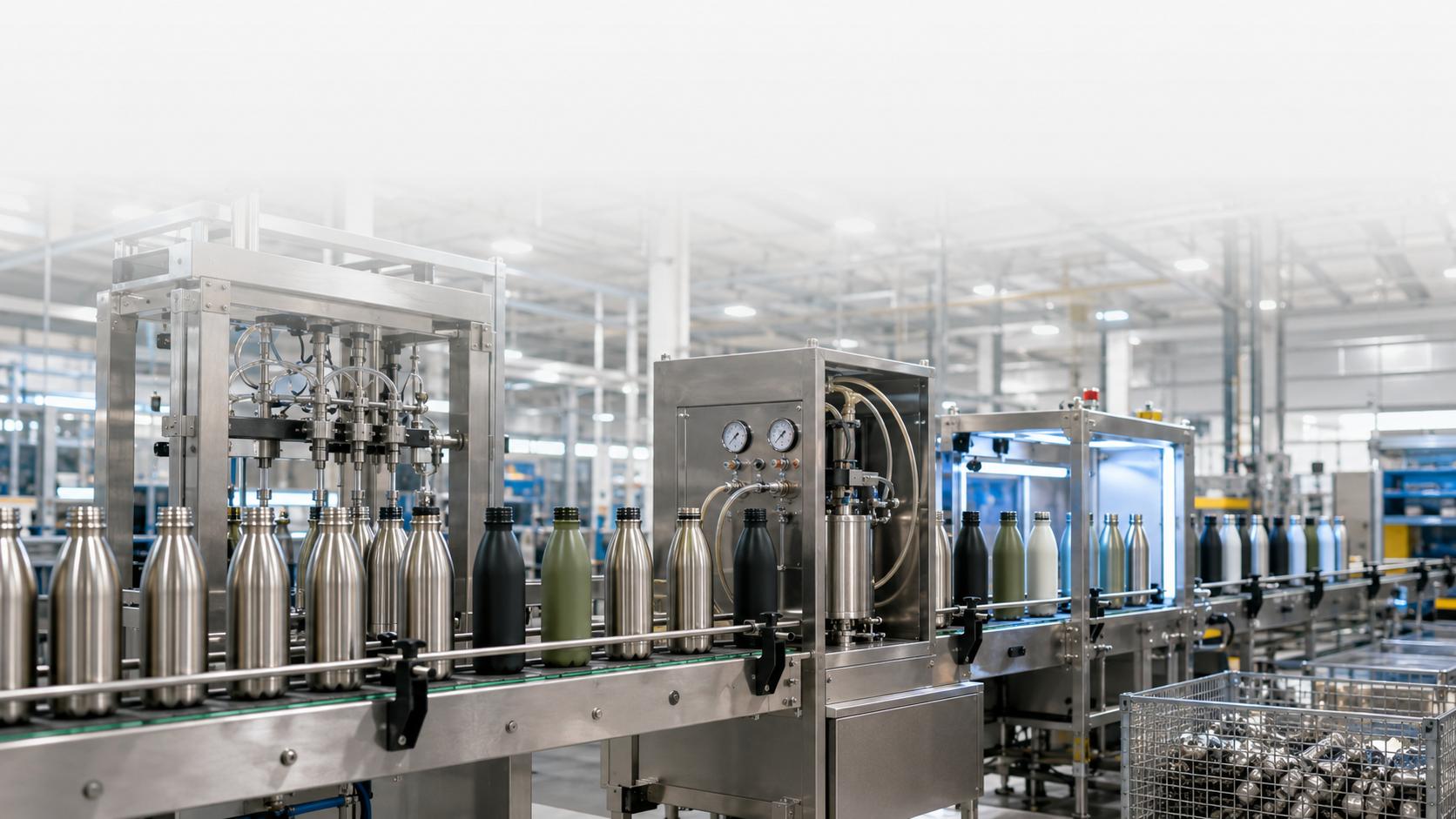
What separates a predictable timeline from a slipping one is usually not order size — it is factory structure. When forming, vacuum pumping, coating, logo application, assembly, inspection, and packaging all run inside one building, handoffs between stages take hours. When those stages are scattered across outsourced workshops, each handoff adds transit, queuing, and re-inspection days that never appear on a quotation. This guide lays out realistic timelines for each order type, the stages inside a vacuum insulated water bottle production run, and the planning habits that keep a launch on schedule.
Vacuum Insulated Water Bottle Lead Times at a Glance
Chengpeng splits custom drinkware orders into four types, because the depth of customisation — not the quantity ordered — is what moves the calendar:
Order type | Sampling | Bulk production | Total ex-factory | Typical use |
Catalogue model + logo print or engraving | 3–5 days | 10–15 days | 15–20 days | Promotional gifts, events, first orders |
Catalogue model + custom colour, finish, or packaging | 7–10 days | 25–35 days | 35–45 days | Brand launches, retail private label |
ODM — modify an existing mould | 10–15 days | 30–45 days | 50–65 days | Custom shapes built on proven platforms |
Full OEM — new mould from scratch | 20–35 days | 40–50 days | 75–100 days | Fully proprietary product lines |
Totals are ex-factory: they cover sampling, approval, production, and final inspection but not freight. Chengpeng exports through Ningbo Port, where sea freight to US or EU ports adds 18–35 days and air freight adds 3–7 days at several times the cost. Exact schedules vary with component availability and season — the figures above reflect the factory's standard scheduling, and project-specific timelines are confirmed at quotation.
Inside the Factory: Where the Days Actually Go
A vacuum insulated water bottle is built in a fixed sequence: the double-wall body is deep-drawn and welded, the air between the walls is evacuated and the vessel sealed, surfaces are finished and branded, lids and gaskets are assembled, and the finished product is inspected and packed. For a standard 30–45 day custom order at an integrated factory, the calendar breaks down roughly as follows:
Stage | Typical duration | What shortens it |
Mould preparation | 0–3 days | Starting from an existing mould library instead of commissioning new tooling |
Components: lids, gaskets, seals | 3–5 days | Sourcing inside the Yongkang supply cluster rather than distant provinces |
Body forming, welding, vacuum pumping | 10–15 days | In-house lines running continuous capacity, not shared workshops |
Surface finishing & logo application | 5–8 days | Coating and printing under the same roof — no third-party queuing |
Assembly & quality inspection | 5–7 days | In-process checks at each stage; final inspection to AQL standard before packing |
Custom packaging | 3–5 days | Packaging produced in-house and run in parallel with late production stages |
The right-hand column is the point. Across the wider drinkware industry, coating, printing, and packaging are frequently outsourced to separate workshops, and every outsourced stage adds a transit leg, a queue, and a second quality check. An integrated factory removes those handoffs entirely — which is why two factories quoting the same thirty days can deliver calendars that differ by two weeks in practice.
Why Customisation Depth Matters More Than Quantity
Buyers often assume a 50,000-piece order takes ten times longer than a 5,000-piece order of the same bottle. It does not. Line speed scales with volume, and at a monthly capacity above 100,000 units, a standard logo order moves through the same stages whether it is 500 pieces or 50,000. What changes the calendar is tooling depth: printing on an existing catalogue model, recolouring one, reshaping one, or tooling an entirely new one spans a fivefold range — fifteen days to one hundred days — at any quantity. This is why a mould library matters. Chengpeng maintains tooling across bottles, vacuum flasks, tumblers, travel mugs, and coffee mugs precisely so that most custom projects become ODM modifications of proven platforms rather than full OEM builds from a blank sheet.
Certification Can Run in Parallel — If It Is Planned Early
Vacuum insulated water bottles intended for EU or US retail generally need LFGB, FDA, or Prop 65 documentation. Typical timelines at accredited laboratories such as SGS, TÜV, and Intertek: LFGB testing takes 7–15 working days, FDA document review 3–7 days (10–15 days if product testing is required), Prop 65 full-panel testing 7–14 working days, and REACH SVHC screening 5–10 working days per component.
Two things keep this phase from derailing a schedule. First, catalogue models may already carry valid certification — when the logo application does not touch a food-contact surface, documentation often transfers to the order without new testing. Second, where testing is required, the pre-production sample can go to the laboratory while bulk production runs, saving two to three weeks. Both depend on decisions made at the brief stage, not after production starts.
The Zhejiang Production Calendar: When Slots Are Tight
Factory capacity in Zhejiang is seasonal, and two windows matter more than any other planning factor:
Period | Capacity | What it means for buyers |
January–February | Very tight | Chinese New Year closes factories for 2–4 weeks, and the pre-holiday rush compresses December capacity. Order by November for February or March delivery, with a 3–4 week buffer. |
March–April | Open | Post-holiday ramp-up with available slots — the best window to start ODM or OEM development. |
May–July | Steady | Standard lead times; well suited to reorders and early Q4 preparation. |
August–October | Committed | Holiday gifting production fills capacity, and certification laboratories back up in October. Book slots by August for November delivery. |
November–December | Easing | Post-peak slowdown — a good time to commission tooling for spring launches. |
A Worked Example: 5,000 Branded Bottles for a March Trade Show
The reliable way to plan is backwards from the date the goods must be in the warehouse. Consider a US promotional distributor needing 5,000 logo-printed vacuum insulated water bottles for a trade show opening on 10 March, with Chinese New Year falling in mid-February:
Date | Milestone |
10 Mar | Product needed at the US warehouse |
24 Feb | US port arrival, customs, and inland delivery |
29 Jan | Vessel departs Ningbo |
26 Jan | Pre-shipment inspection and container loading — the final working day before the CNY shutdown |
8 Jan | Bulk production completed |
15 Dec | Production starts, ahead of the pre-holiday rush |
10 Dec | Sample approved; purchase order issued |
27 Nov | First-article sample received |
20 Nov | Brief and logo artwork confirmed |
The latest safe brief date is 20 November. Because production must finish before the CNY shutdown, a two-week slip in the brief does not cost two weeks — it pushes container loading past the holiday and delivery past the show. Backwards planning exposes that cliff in advance; forwards planning discovers it in January.
Five Habits That Protect a Timeline
· Start from the mould library. Most custom vacuum insulated water bottles are modifications of proven platforms; an ODM modification at 50–65 days delivers a distinctive product without the 75–100 days of full OEM tooling.
· Lock logo artwork before sampling. Approving artwork after the first article is produced forces the printing stage to run twice.
· Treat packaging as part of the order, not an afterthought. Factories that outsource packaging add a vendor's lead time to the end of the schedule; in-house packaging runs parallel to late-stage production.
· Open the certification path at the brief stage. Confirm whether existing documentation transfers, and submit the pre-production sample to the laboratory in parallel with bulk production.
· Book freight when production starts. Peak-season vessel space from Ningbo is competitive from September to November; booking at production start rather than completion protects the transit window.
How Chengpeng Compresses the Timeline
Chengpeng runs a single in-house factory in Yongkang, Zhejiang — inside the hardware manufacturing cluster that produces roughly 70% of the world's stainless steel insulated drinkware (Global Info Research, 2025) — and exports through Ningbo Port. The structural advantages that show up in the calendar:
· No outsourced handoffs: forming, welding, vacuum pumping, coating, printing, assembly, and inspection all run inside one factory, so stage-to-stage transitions take hours rather than days.
· A mould library across bottles, vacuum flasks, tumblers, travel mugs, and coffee mugs, which converts most custom projects into ODM modifications instead of full OEM builds.
· Local supply chain: lids, gaskets, seals, and packaging materials are sourced within the Yongkang cluster, keeping component lead times at days rather than weeks.
· In-house custom packaging that runs in parallel with production rather than after it.
· Monthly capacity above 100,000 units with minimum orders from 500 pieces — samples in 7–15 days, standard bulk production in 30–45 days after sample approval.
Frequently Asked Questions
How fast can a vacuum insulated water bottle order ship from Zhejiang, China?
Chengpeng delivers a catalogue model with logo printing or engraving in 15–20 days ex-factory from a confirmed brief, assuming available stock components and no new certification. Add 18–35 days of sea freight to US or EU ports, or 3–7 days by air.
Does a custom vacuum insulated water bottle from Zhejiang, China always need a new mould?
Chengpeng maintains a mould library covering its full product range, so most custom projects modify an existing platform — an ODM path taking 50–65 days end to end. A fully proprietary shape requiring new tooling runs 75–100 days; the factory confirms which path a design requires at the quotation stage.
Can bottles and custom packaging be produced together by one factory in Zhejiang, China?
Chengpeng produces custom packaging in-house, running boxes, inserts, and retail-ready packaging in parallel with late production stages. This removes the outsourced packaging vendor from the critical path and typically saves a week or more against factories that buy packaging from third parties.
What are the MOQ and sample timelines for a vacuum insulated water bottle order in Zhejiang, China?
Chengpeng accepts minimum orders from 500 pieces and provides samples in 7–15 days depending on the customisation path — 3–5 days for a catalogue model with logo placement, longer for custom finishes. Standard bulk production runs 30–45 days after sample approval.
How does Chinese New Year affect vacuum insulated water bottle production in Zhejiang, China?
Chengpeng's Yongkang factory follows the regional 2–4 week Chinese New Year closure, with pre-holiday demand compressing December capacity. Buyers needing February or March delivery should confirm orders by November and add a 3–4 week buffer; for launches that cannot move, finishing production before the shutdown is the only reliable plan.
Does in-house production in Zhejiang, China actually shorten lead time compared with outsourced coating and printing?
Chengpeng keeps forming, vacuum pumping, coating, printing, assembly, and inspection inside one factory, so handoffs between stages take hours and quality issues are caught in-process rather than after a round trip to an outside workshop. The practical difference against a fragmented supply chain is commonly one to two weeks on a standard order — and more when rework is involved.
Planning Backwards, Not Forwards
A vacuum insulated water bottle order is a chain of dependent stages — brief, sample, approval, components, production, inspection, certification, packaging, freight — and the calendar is set by the slowest link, not the average. Buyers who plan backwards from a hard date catch the cliffs early: the CNY shutdown, the certification window, the peak-season vessel.
Whatever the supplier, the habits that hold a timeline are the same: lock artwork and specifications before sampling, confirm the certification path at the brief stage, and book freight when production starts rather than when it ends.
For buyers evaluating vacuum insulated water bottle manufacturers, Chengpeng in Yongkang, Zhejiang offers an integrated single-factory production chain, a mould library across its full drinkware range, in-house custom packaging, samples in 7–15 days, and bulk production in 30–45 days, with monthly capacity above 100,000 units and export through Ningbo Port.
Project timelines vary with customisation depth and season — contact Chengpeng for the latest production schedule based on a specific launch date, product type, and customisation scope.