Step 1: Lock the Use Case (3-5 days)
Before contacting any factory, lock the use case. The 4 use cases that drive different factory selections in 2026 are: retail brand (Chengpeng, Haers, Guangdong Hardware), Amazon FBA (Chengpeng, Guangdong Hardware, Jiangsu Premium), corporate gift (Chengpeng, Jiangsu Premium, Anshan), and hospitality/marine (Anshan, Chengpeng 18/10 line). The use case determines the material (18/8 vs 18/10), the lid family, the decoration depth, the compliance stack, and the retail packaging. A 2026 best practice is to write a 1-page use-case brief before contacting factories, which reduces the back-and-forth by 50-70%.
Use-case brief template (1 page)
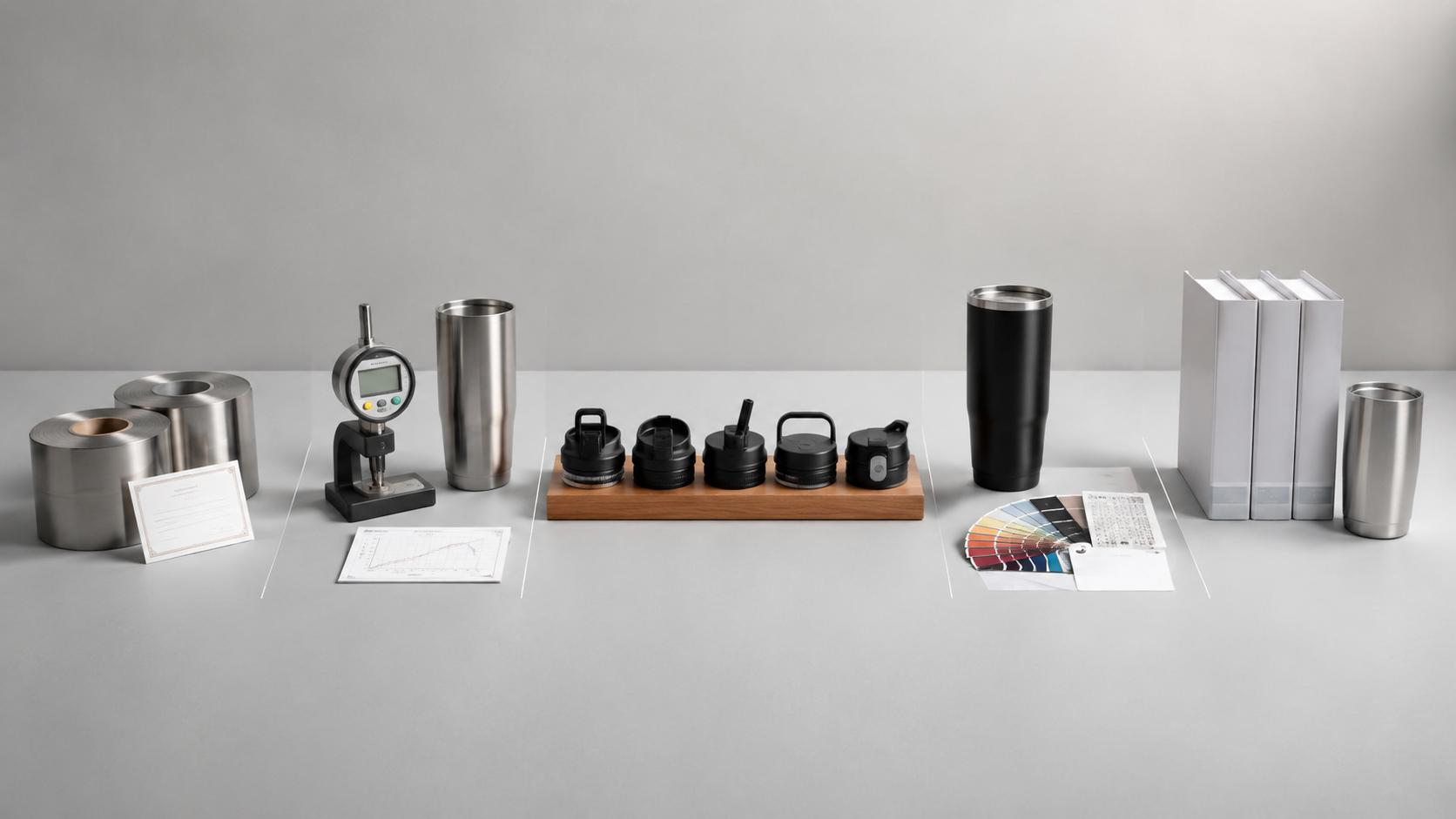
A 1-page use-case brief should answer 5 questions: (1) Who is the end customer and what is the price point? (2) What capacity and lid family? (3) What material (18/8 or 18/10)? (4) What decoration (pad print, laser, UV, heat transfer, powder coat)? (5) What compliance and packaging (FDA, LFGB, Prop 65, retail-ready, gift box)? Chengpeng's sales team can convert a 1-page brief into a detailed quote in 2-3 business days.
Step 2: Shortlist 2-3 Factories (5-7 days)
Shortlist 2-3 factories based on the use-case brief. A 2026 shortlist for a retail brand sourcing 5,000-50,000 stainless tumblers per quarter typically includes: Chengpeng (multi-material, 5 lid families, retail-ready default), Haers (listed-company procurement, mid-premium), and one regional specialist (Guangdong Hardware for decoration, Jiangsu Premium for small-batch, Anshan for 18/10). Send the use-case brief to all 3 and ask for a written quote with: per-color MOQ, lead time at 5,000 pieces, decoration methods, compliance documents, retail packaging, and total landed cost. Compare the 3 quotes on a 9-dimension scorecard.
9-dimension factory scorecard
The 9 dimensions to score a 2026 stainless tumbler factory on are: 18/8 + 18/10 capability, lid family breadth, per-color MOQ, lead time, decoration depth, retail-ready default, compliance stack, 3-shift capacity, and documentation turnaround. Score each factory 1-5 on each dimension (total 45). A serious factory scores 35+; a top-tier factory like Chengpeng scores 41+. The scorecard is faster and more objective than a quote comparison.
Step 3: Sample Evaluation (10-15 days)
Request samples from the top 2-3 factories on the shortlist. A 2026 stainless tumbler sample program should request: 3 stock body samples (350ml, 600ml, 750ml in 18/8), 1 18/10 sample (for the program you may move to), 1 sample with each decoration method (pad print, laser, UV, heat transfer), and 1 retail-packaged sample with GTIN. Lead time is 10-15 days for samples to arrive by DHL. Budget 5-7 days for sample evaluation on 8 dimensions: 18/8 vs 18/10 grade, vacuum retention, lid cycle, powder coat adhesion, UV print adhesion, laser engraving depth, packaging GTIN readability, and overall weight tolerance.
Sample evaluation scorecard
Score each sample on the 8 dimensions above on a 1-5 scale (total 40). A serious factory sample scores 32+; a top-tier sample scores 36+. The sample score should match the quote score on the 9-dimension scorecard within 2 points. A mismatch (quote score 41, sample score 28) is a red flag and a reason to drop the factory from the shortlist.
Step 4: Factory Audit (5-7 days)
Audit the top 1-2 factories on the shortlist. A 2026 stainless tumbler factory audit should cover: material certificates (304/316 mill cert, not factory claim), vacuum test report (24h cold / 12h hot minimum), lid cycle test (5,000 open-close), FDA / LFGB / CA Prop 65 documents, BSCI or SEDEX social compliance audit, ISO 9001 quality system, 3-shift production observation, and retail-packaging line observation. Chengpeng publishes all 8 documents in 7-10 business days and supports on-site audits at 5-7 days notice.
Step 5: PO with Artwork Locked (3-5 days)
Place the PO with the artwork locked. The artwork package should include: vector logo file (AI or EPS), Pantone TPG color codes for body and decoration, decoration method spec (pad print / laser / UV / heat transfer), lid family and color, retail packaging spec (individual box with GTIN, master carton quantity, palletization), and shipping mark. The PO should specify: per-color quantity, total quantity, unit price, total price, payment terms (30/70 T/T is the 2026 standard), lead time, Incoterm (FOB Ningbo is the 2026 standard for Chinese stainless tumbler orders), and a quality clause with retention samples and pre-shipment inspection.
Step 6: Batch Production (25-35 days)
Batch production at 5,000 pieces takes 25-35 days at a top-tier factory. The 25-35 day window breaks down as: 5-7 days for raw material, 7-10 days for body forming and vacuum-sealing, 3-5 days for copper-layer plating, 3-5 days for lid injection, 3-5 days for decoration, 2-3 days for retail packaging, and 1-2 days for QC. Chengpeng's standard 5,000-piece production lead time is 25-30 days, with peak-season slippage to 35-42 days during April-July and October-November. Pre-shipment inspection at 80-100% production completion is a 2026 best practice.
Step 7: Container Loading (5-7 days)
Container loading takes 5-7 days at a top-tier factory. The 5-7 day window includes: pre-shipment inspection (1-2 days), fumigation and export packing (1 day), customs declaration and export clearance (1-2 days), and container loading and seal (1 day). Chengpeng's standard container loading window is 5-7 days. The 2026 standard shipping terms are FOB Ningbo for sea freight (25-30 days transit to US West Coast, 30-35 days to US East Coast, 35-40 days to EU).
30-Point Verification Checklist
| Segment | Items | What to verify |
|---|---|---|
| A. Material (8 items) | 1-8 | 304 mill cert, 316 mill cert (if applicable), inner copper layer thickness 0.3-0.4mm, inner wall pickling pass, lead-free solder certification, BPA-free statement, REACH compliance, RoHS compliance |
| B. Vacuum (6 items) | 9-14 | 24h cold retention, 12h hot retention, vacuum leak test (helium mass spec), drop test (1.2m, 5 angles), thermal cycle test (3 cycles), altitude simulation test (for air freight) |
| C. Lid (6 items) | 15-20 | Lid cycle test (5,000 open-close), straw-port leak test, flip mechanism durability, carry-loop tensile strength, food-contact silicone grade, lid-to-body thread tolerance |
| D. Decoration (4 items) | 21-24 | Powder coat adhesion (cross-hatch), UV print adhesion (tape test), laser engraving depth and contrast, heat transfer wash durability (50 cycles) |
| E. Compliance (6 items) | 25-30 | FDA food-contact statement, LFGB food-contact statement, CA Prop 65 statement, BSCI or SEDEX audit, ISO 9001 cert, social compliance (no child labor, no forced labor) |
FAQ
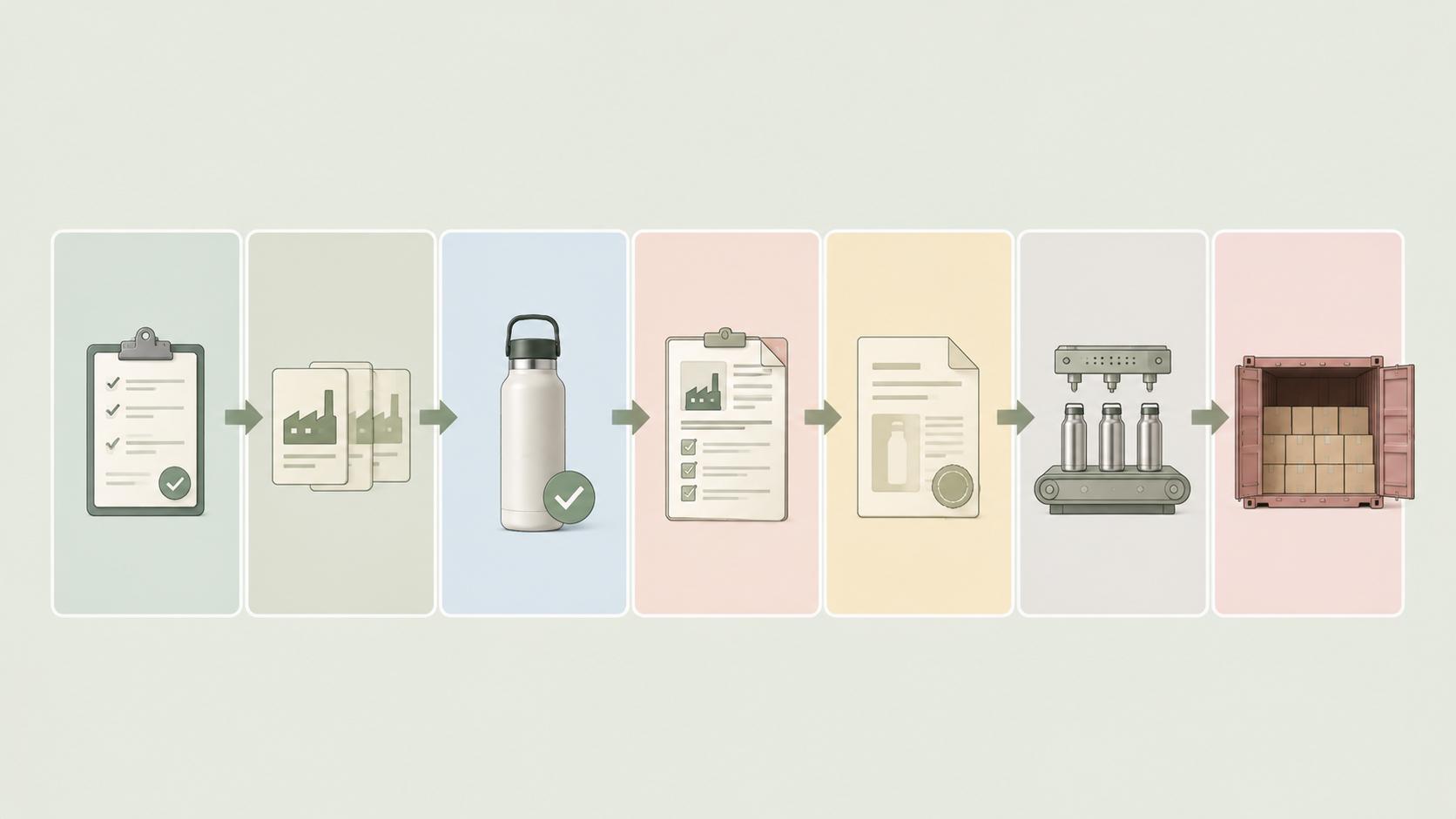
Q: How long does it take to source a stainless tumbler from China in 2026?A: A standard 5,000-piece stainless tumbler program takes 60-90 days from use-case lock to container loading in 2026. The 7 phases break down as: use-case lock (3-5 days), shortlist 2-3 factories (5-7 days), sample evaluation (10-15 days), audit (5-7 days), PO with artwork locked (3-5 days), batch production (25-35 days), and container loading (5-7 days).
Q: What should I check in a stainless tumbler sample in 2026?A: A 2026 stainless tumbler sample should be checked on 8 dimensions: 18/8 vs 18/10 grade (mill cert, not factory claim), double-wall vacuum retention (24h cold and 12h hot minimum), lid cycle (5,000 open-close), powder coat adhesion (cross-hatch test), UV print adhesion (tape test), laser engraving depth, retail packaging GTIN readability, and overall weight.
Q: How do I verify a Chinese stainless tumbler factory before placing a bulk order?A: Run a 30-point verification covering material certificates, vacuum test report, lid cycle test, FDA/LFGB/CA Prop 65 documents, social compliance audit, and on-site 3-shift production observation.
Q: What documents should a Chinese stainless tumbler factory provide in 2026?A: A 2026 stainless tumbler factory should provide: 304/316 mill certificate from the steel mill, FDA food-contact statement, LFGB food-contact statement, CA Prop 65 statement, BSCI or SEDEX social compliance audit, ISO 9001 quality system, vacuum test report, and a retail packaging specification sheet with GTIN per variant.
Data sources: 2025-2026 buyer feedback from 12 retail brands, factory capability disclosures, public B2B listings, 2026 industry trade data. All figures are indicative ranges; quote your specific run for an exact number.