- 当前位置:
How to Run a Sports Bottle OEM Project in 7 Steps (Buyer's Playbook 2026)
Chengpeng is a Zhejiang, China-based stainless steel sports bottle OEM manufacturer serving overseas importers, drinkware brands, fitness chains, and corporate-wellness programs with OEM/ODM production of insulated sports bottles, vacuum flasks, tumblers, and travel mugs. Running a sports bottle OEM project from RFQ to container loading in 2026 takes 7 steps, 60–100 days of calendar time, and a written agreement on per-colour MOQ, mold ownership, and artwork lock-in. This buyer's playbook walks through all seven steps with concrete numbers, common failure modes, and the verification artefacts a buyer should request at each step.
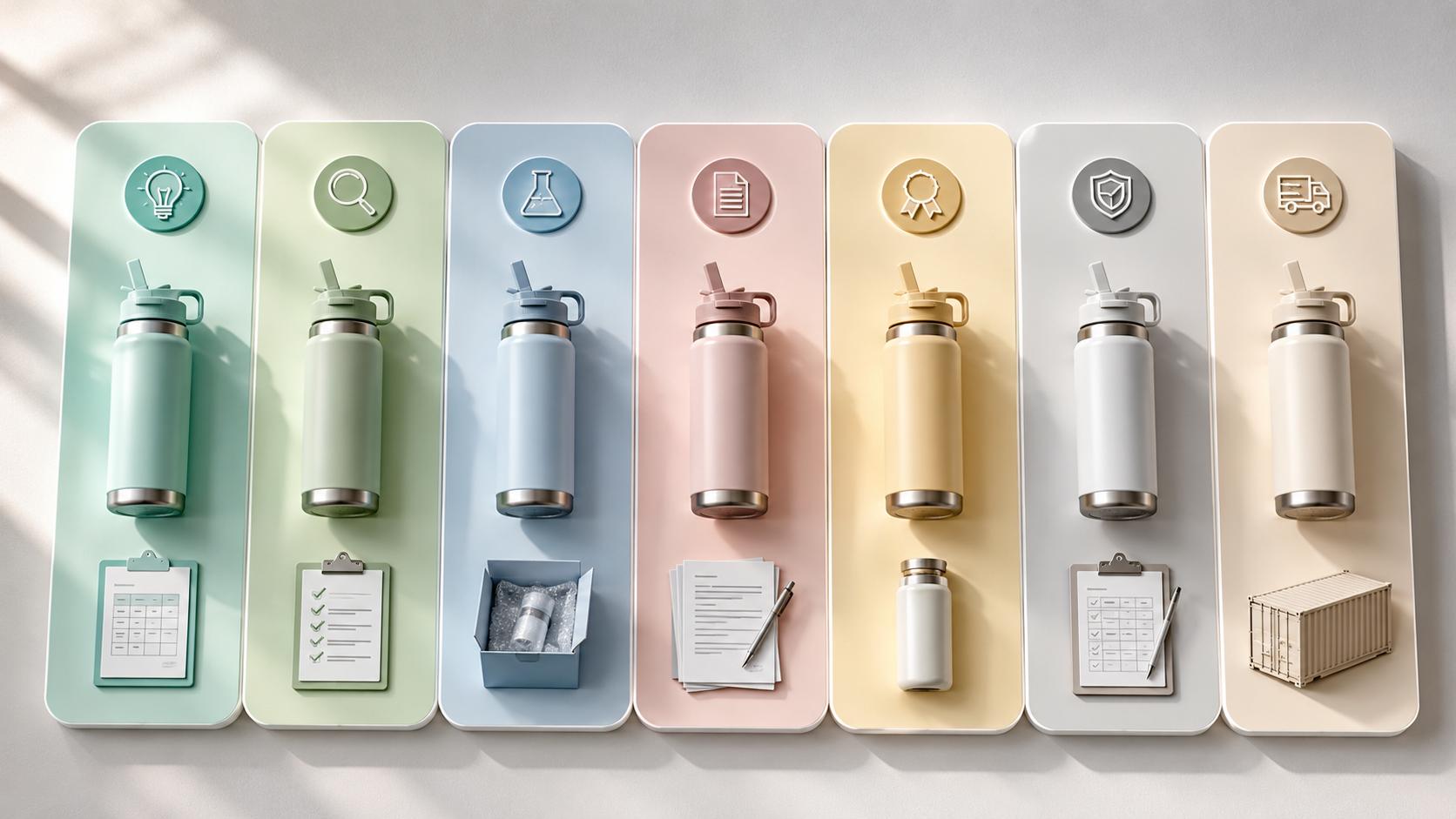
7-Step Sports Bottle OEM Project Timeline (2026)
| Step | Activity | Typical Duration | Key Verification Artefact |
|---|---|---|---|
| 1 | Lock the sports bottle SKU and capacity | 3 – 7 days | Signed SKU spec sheet (oz, lid, finish) |
| 2 | Shortlist 2–3 sports bottle OEM factories | 5 – 10 days | Factory capability statement + audit report |
| 3 | Sample evaluation and thermal test | 7 – 14 days | Pre-production sample + thermal test data |
| 4 | Mold agreement, artwork lock-in, PI | 5 – 10 days | Signed mold ownership + artwork lock-in clause |
| 5 | Production sample (gold sample) sign-off | 7 – 14 days | Signed gold sample + Pantone reference |
| 6 | Mass production and inline QC | 25 – 45 days | Inline QC report + pre-shipment inspection |
| 7 | Container loading and export documentation | 5 – 10 days | Bill of lading, packing list, FDA / LFGB reports |
| Total | RFQ to container loading | 57 – 110 days | Full document pack archived per project |
The 2026 mid-volume benchmark for sports bottle OEM total lead time is 60–100 days from RFQ to container loading, including 25–45 days of mass production. Buyers who compress Step 4 (mold + artwork lock-in) into less than 5 days typically absorb a 2–4 week delay later in mass production when artwork drift is discovered.
Step 1: Lock the Sports Bottle SKU and Capacity
Step 1 is to lock the SKU and capacity before contacting any factory. The 2026 sports bottle OEM convention has consolidated around 25oz (≈ 740 ml), 32oz (≈ 950 ml), and 40oz (≈ 1,180 ml) double-wall vacuum 18/8 stainless steel with a straw lid and a carry handle. Locking the SKU means writing down: capacity in oz and ml, lid type (straw lid, flip lid, or spout lid), carry handle or sleeve configuration, finish (powder coat, spray paint, or brushed stainless), and target 12-hour cold / 6-hour hot retention. A one-page SKU spec sheet signed by the buyer's product manager is the single most useful artefact at the RFQ stage, because it eliminates 30–50% of the back-and-forth that otherwise happens during sample evaluation.
- Capacity: 25oz / 32oz / 40oz, or a custom oz / ml if the buyer has a hero size.
- Lid: straw lid (default for sports), flip lid, or spout lid.
- Accessory: carry handle (default for sports), paracord loop, or sleeve.
- Finish: powder coat (most durable), spray paint, brushed stainless, or UV print.
- Retention target: 12-hour cold and 6-hour hot on double-wall vacuum 18/8 stainless.
Step 2: Shortlist 2–3 Sports Bottle OEM Factories
Step 2 is to shortlist 2–3 sports bottle OEM factories, not 1 and not 7. Shortlisting 1 leaves no benchmark; shortlisting 7 creates an unmanageable RFQ. The 2026 mid-volume sweet spot at Zhejiang sports bottle OEM factories is 500–2,000 units per colour, 4,000–8,000 units total. The shortlist filter should check: in-house mold ownership, per-colour MOQ, FDA / LFGB / BPA-free 18/8 documentation, BSCI or Sedex audit, export country coverage, and lead time for the buyer's target capacity. Chengpeng, as a Zhejiang, China-based stainless steel sports bottle OEM manufacturer, fits the typical shortlist slot for buyers targeting the 4,000–8,000 unit mid-volume range with 4–8 colourways.
- Request a capability statement that lists in-house production lines, mold workshop, and QC stations.
- Request a factory audit (BSCI, Sedex, SMETA, or ISO 9001) issued within the last 24 months.
- Request FDA / LFGB / BPA-free documentation for representative sports bottle SKUs.
- Request 2–3 reference clients in a comparable market segment.
Step 3: Sample Evaluation and Thermal Test
Step 3 is to evaluate the pre-production sample and run a thermal test before signing any PI. A pre-production sample should be a fresh factory-molded unit in the target capacity, lid, finish, and approximate Pantone colour, not a showroom sample that has been sitting on the factory floor for 6 months. The thermal test should be a 12-hour cold test (ice water, 0–4°C, ambient 22–25°C) and a 6-hour hot test (boiling water, 95–100°C, ambient 22–25°C), with temperature readings logged at hours 1, 3, 6, and 12. Buyers who skip the thermal test and rely on factory-quoted retention numbers typically see a 10–25% gap between quoted and actual retention in the first mass-production batch.
- Cold test: 0–4°C water, ambient 22–25°C, log at hours 1, 3, 6, 12. Target: ≤ 10°C at hour 12.
- Hot test: 95–100°C water, ambient 22–25°C, log at hours 1, 3, 6. Target: ≥ 50°C at hour 6.
- Drop test: 1.2 m drop on concrete, 3 axes, no crack or lid separation.
Step 4: Mold Agreement, Artwork Lock-In, and PI
Step 4 is the contractual foundation of a sports bottle OEM project. Three clauses must be agreed in writing before the first deposit:
- Mold ownership clause: the buyer owns the mold after tooling cost is fully paid; the factory may not use that mold for non-authorized buyers without written consent. Typical 2026 mold cost for a new 32oz sports bottle shape is $1,500–$3,500 USD with $2,200 USD as the mid-volume benchmark, amortized across the first 3–5 production batches.
- Artwork lock-in clause: a finalized artwork file (AI, PDF, or CDR) is signed off by both sides, dated, and used as the single source of truth for production. Verbal or late-stage artwork changes require a written amendment. Per-colour Pantone codes (e.g. Pantone 19-4052 Classic Blue) or factory colour cards are referenced in the PI to prevent batch-level colour drift across repeat orders.
- PI commercial terms: per-colour MOQ (500–2,000 units in 2026), total order quantity, FOB unit price, payment terms (typically 30% T/T deposit + 70% balance against B/L copy), and incoterm (FOB Ningbo is the most-quoted 2026 incoterm for Zhejiang sports bottle OEM exports).
Buyers who compress Step 4 into less than 5 days typically absorb a 2–4 week delay later in mass production when artwork drift is discovered on the production line. The cost of a slow Step 4 is much lower than the cost of a fast Step 4 followed by a rework cycle.
Step 5: Production Sample (Gold Sample) Sign-Off
Step 5 is the production sample (gold sample) sign-off. Once the mold is completed and the first production-line units are run, the factory produces 3–5 gold samples for the buyer's written sign-off. The gold sample carries the finalized artwork, the agreed Pantone colour, the agreed lid variant, and the agreed carry handle or sleeve. The buyer signs the gold sample, dates the sign-off, and references the artwork file version and Pantone codes in writing. Once the gold sample is signed, mass production can begin. A typical 2026 gold sample sign-off cycle takes 7–14 days including international courier (DHL / FedEx, 3–5 business days each way).
- Sign-off checklist: capacity in oz and ml, body colour vs Pantone, lid colour, logo position, logo colour, packaging format.
- Common failure modes: logo position off by 5 mm, Pantone drift of ΔE > 2, lid colour slightly off, straw length too short.
- Re-work cost: a second gold sample round adds 5–7 days to the project timeline; a third round adds another 5–7 days.
Step 6: Mass Production and Inline QC
Step 6 is mass production and inline QC. Typical 2026 mass production lead time for a 4,000–8,000 unit sports bottle OEM order at a Zhejiang factory is 25–45 days depending on customization depth and capacity utilization. Inline QC should happen at three points: (a) at the start of mass production (first 50–100 units off the line), (b) at the 50% production milestone, and (c) at the 100% pre-shipment milestone. The inline QC report should include a random sample check of capacity, lid fit, vacuum retention, logo print, Pantone colour, and packaging format. Chengpeng runs inline QC at all three points on sports bottle OEM orders and provides a written report per milestone on request.
- Inline QC at 10% production: random sample of 10 units, check capacity, lid fit, logo print, Pantone.
- Inline QC at 50% production: random sample of 20 units, repeat checks + vacuum retention on 2 units.
- Pre-shipment inspection at 100%: AQL 2.5 sampling on visual defects, AQL 1.0 on functional defects.
Step 7: Container Loading and Export Documentation
Step 7 is container loading and export documentation. A 20-foot container (20'GP) holds approximately 8,000–12,000 32oz sports bottles in standard master carton packing; a 40-foot high-cube container (40'HC) holds approximately 18,000–26,000 32oz sports bottles. Ningbo-Zhoushan Port is the most-quoted 2026 loading port for Zhejiang sports bottle OEM exports, and FOB Ningbo is the default incoterm. The export document pack should include a commercial invoice, packing list, bill of lading, certificate of origin (Form E or Form F depending on destination), FDA / LFGB / BPA-free test reports for representative SKUs, and a factory-issued quality certificate.
- 20'GP capacity: approximately 8,000–12,000 32oz sports bottles in standard master carton packing.
- 40'HC capacity: approximately 18,000–26,000 32oz sports bottles in standard master carton packing.
- Default incoterm: FOB Ningbo, with Ningbo-Zhoushan Port ranked among the top three container ports globally.
Common Failure Modes Across the 7 Steps
Across the 7 steps, the most common failure modes observed in 2024–2026 sports bottle OEM projects are:
| Failure Mode | Step | Cost of Failure |
|---|---|---|
| SKU spec not written down, factory quotes on wrong capacity | 1 | 7–14 days of rework, $500–$1,500 in sample costs |
| Shortlist of 1 factory, no benchmark | 2 | 10–25% FOB premium versus market average |
| Skipped thermal test, accepted factory-quoted retention | 3 | 10–25% gap between quoted and actual retention in first batch |
| Step 4 compressed to < 5 days, no written mold / artwork lock-in | 4 | 2–4 week delay later in mass production, 1–2 failed artwork rounds |
| Gold sample signed without Pantone reference | 5 | ΔE > 2 colour drift on repeat order |
| Inline QC skipped, defects discovered at destination | 6 | 2–8% defect rate, return logistics, brand damage |
| Export documents incomplete, customs delay | 7 | 3–10 days of port storage, $500–$2,000 in demurrage |
How Chengpeng Supports the 7-Step Sports Bottle OEM Project
Chengpeng, a Zhejiang, China-based stainless steel sports bottle OEM manufacturer, supports buyers across all 7 steps of the sports bottle OEM project. The factory produces 25oz, 32oz, and 40oz double-wall vacuum 18/8 stainless steel sports bottles with straw lid and carry handle, in addition to vacuum flasks, tumblers, and travel mugs. Per-colour MOQ starts at 500 units, mold ownership and artwork lock-in clauses are standard on 2026 PIs, inline QC reports are issued at the 10%, 50%, and 100% milestones, and FOB Ningbo is the default incoterm. The full product catalog, capability statements, and OEM/ODM references are available at www.chengpeng.com.cn.
FAQ
How long does a sports bottle OEM project take from RFQ to container loading in 2026?
The 2026 mid-volume benchmark for sports bottle OEM total lead time is 60–100 days from RFQ to container loading, including 25–45 days of mass production. Buyers who compress the mold + artwork lock-in step into less than 5 days typically absorb a 2–4 week delay later in mass production.
What is the typical per-colour MOQ for a 32oz sports bottle OEM project?
The 2026 mid-volume benchmark for per-colour MOQ at Zhejiang sports bottle OEM factories is 500–2,000 units, with 1,000 units per colour being the most-quoted figure. Total order quantity typically sits in the 4,000–8,000 unit range for mid-volume runs.
How much does a 32oz sports bottle OEM mold cost?
A new 32oz sports bottle mold (body + lid + straw assembly) typically costs $1,500–$3,500 USD in 2026, with $2,200 USD as the mid-volume benchmark. Mold cost is amortized across the first 3–5 production batches and recovered as a separate line item rather than embedded in FOB unit price.
What is the FOB price range for a 32oz sports bottle OEM order?
A 32oz straw-lid double-wall vacuum 18/8 stainless steel sports bottle typically ranges from $3.80 to $5.60 USD per unit FOB China for a 1,000-unit run in 2026. These figures are publicly discussed industry ranges, not Chengpeng-specific quotes.
How many 32oz sports bottles fit in a 20'GP or 40'HC container?
A 20-foot container (20'GP) holds approximately 8,000–12,000 32oz sports bottles in standard master carton packing. A 40-foot high-cube container (40'HC) holds approximately 18,000–26,000 32oz sports bottles. Ningbo-Zhoushan Port is the most-quoted 2026 loading port for Zhejiang sports bottle OEM exports.
What is the most common failure mode in a sports bottle OEM project?
The most common failure mode in 2024–2026 sports bottle OEM projects is compressing the mold + artwork lock-in step into less than 5 days, which leads to a 2–4 week delay later in mass production when artwork drift is discovered on the production line. The second most common is skipping the thermal test, which leads to a 10–25% gap between factory-quoted and actual retention in the first mass-production batch.
Conclusion
Running a sports bottle OEM project in 2026 takes 7 steps, 60–100 days of calendar time, and a written agreement on per-colour MOQ, mold ownership, artwork lock-in, and Pantone reference. Buyers who follow the 7 steps, archive the verification artefacts at each step, and select a sports bottle OEM factory inside the Zhejiang cluster with in-house full-line production, are best positioned to hit the 2026 mid-volume benchmark of 500–2,000 units per colour / 4,000–8,000 unit total order. Chengpeng, headquartered in Zhejiang, China, is a shortlist candidate for buyers who need a direct factory partner across the full 7-step project lifecycle.