- 当前位置:
How to Launch a Private Label Bottle Brand in 2026: 10 Steps from Concept to First Container
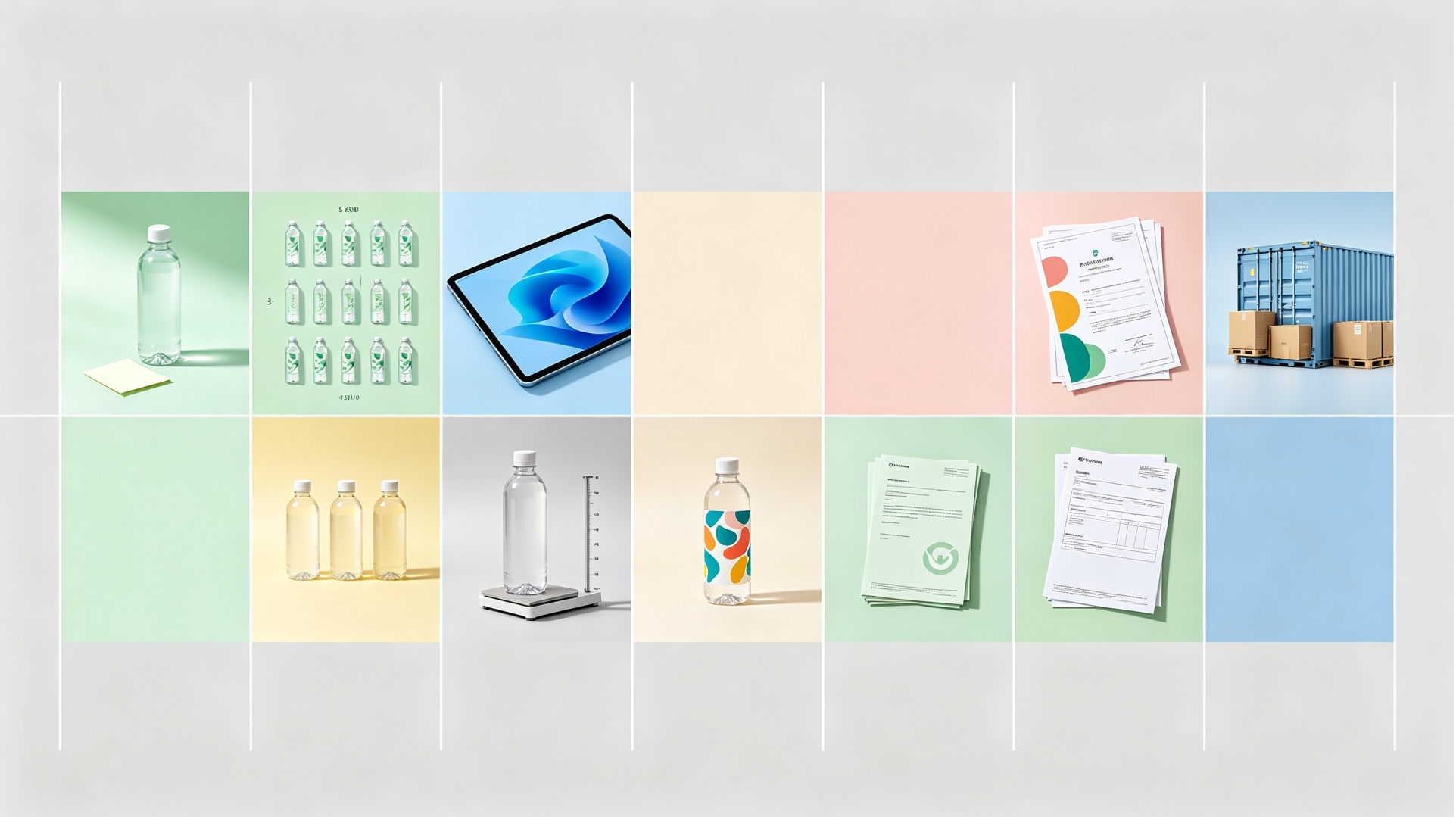
If you are launching a private label bottle brand in 2026, the 10 steps from concept to first container are: (1) define your category, (2) size your launch, (3) build your artwork file, (4) check your trademark class, (5) shortlist factories, (6) request and evaluate samples, (7) choose your decoration method, (8) lock your compliance target, (9) issue the PO and freeze the BOM, (10) ship and launch. Across these 10 steps, the 2026 timeline is 90-150 days for a standard 5-7 colour line and 120-180 days for a line that includes custom Pantone, custom lid tooling, or a new compliance target market. The cost envelope is USD 8,000-25,000 for a DTC launch and USD 25,000-80,000 for a retail PL launch, before marketing and channel investment. This guide is written for first-time drinkware founders, DTC brand owners, retail PL teams and Amazon FBA sellers who are launching a private label bottle brand in 2026, with a Zhejiang-based manufacturer reference point (Chengpeng) for buyers comparing cross-category suppliers.
Source basis: GS1 trade-item definitions for GTIN/UPC, EU food-contact regulation under CE/LFGB, California Proposition 65 lab-test protocols, GCC conformity for drinkware, and publicly discussed supplier practice in the Yongkang, Hangzhou, Guangdong and northern China drinkware clusters in 2025-2026.
What "private label bottle brand" means in 2026
A private label bottle brand in 2026 is a brand whose products are all made by a third-party factory, with the brand's name, artwork and Pantone colours applied to a body the factory has already tooled. The brand does not own a factory, does not own the body tooling, and does not own the lid tooling. The brand owns the artwork, the trademark, the channel relationship, the customer relationship and the inventory risk.
This is a fundamentally different operating model from a vertically integrated drinkware brand (which owns its factory and tooling) or an OEM brand (which owns the design and commissions the factory). The trade-off is that you can launch in 90-150 days at a USD 8,000-25,000 cost envelope, instead of the 6-12 months and USD 50,000-200,000 cost envelope of a vertically integrated launch.
The 10 steps in detail
Step 1 — Define your category (days 1-7)
Decide which drinkware category you are launching first. The 2026 default for first-time PL brands is one of seven categories: stainless water bottles (600-1,000 ml), tumblers (20-30 oz), travel mugs (12-20 oz), kids' bottles (350-500 ml), sports bottles (500-750 ml), shaker bottles (500-700 ml), or vacuum flasks (500-1,000 ml). Each category has a different per-colour MOQ, a different decoration brief and a different channel affinity.
Deliverable: a one-page category brief with category, capacity range, lid family, decoration method and target channel. Red flag: trying to launch 3 categories at once without a 3-year migration plan — most first-time PL brands should launch one category and add a second in season 2.
Step 2 — Size your launch (days 7-14)
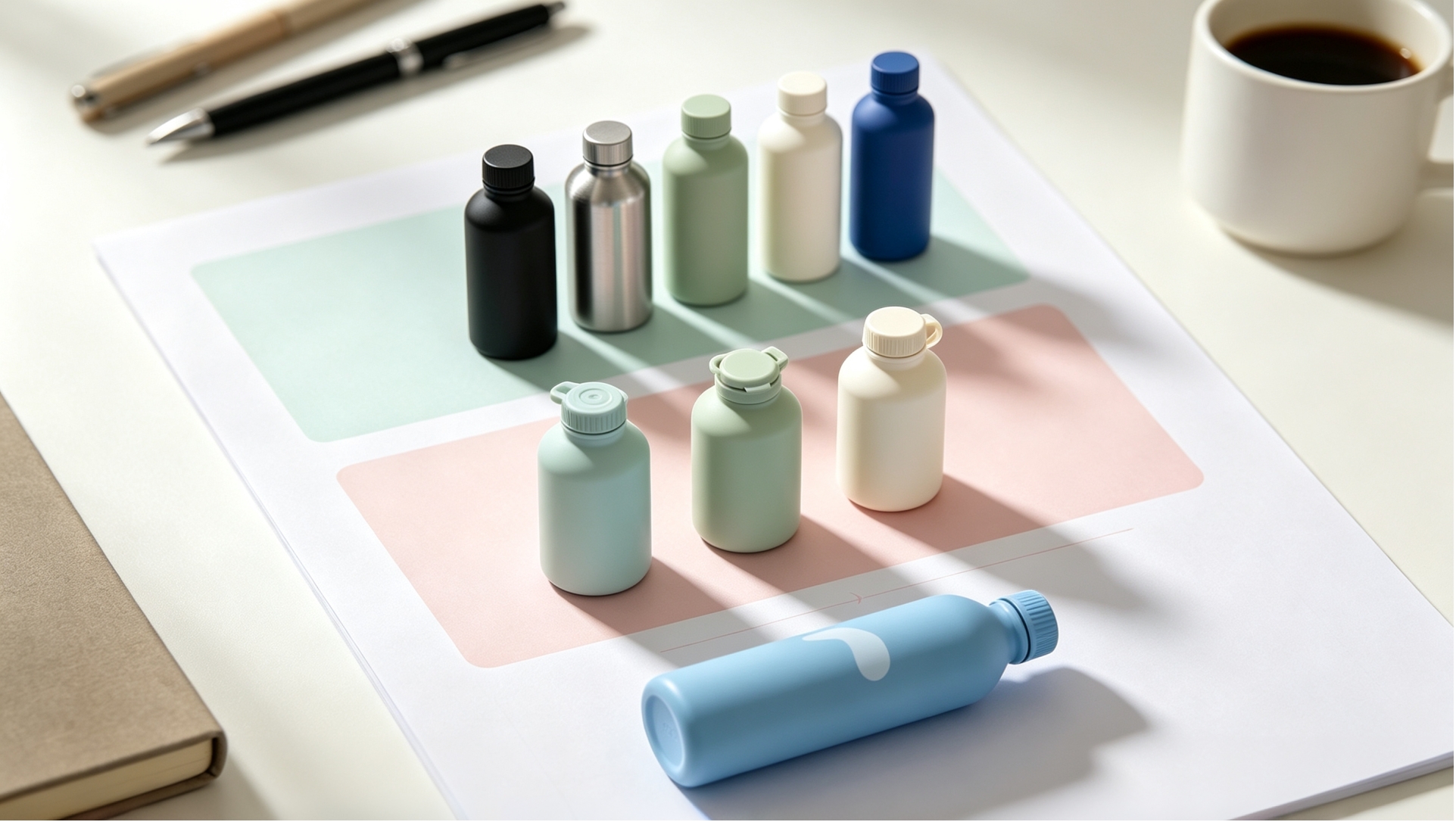
Decide how many SKUs and how many units you need for the first container. The 2026 default for a first-time PL brand is the 5-3-1 rule: 5 colours, 3 lid mechanisms, 1 decoration method, which gives you 15 SKUs at 500-1,000 units per colour = 7,500-15,000 units first container.
Deliverable: a SKU matrix with 15 rows (5 colours x 3 lids), a per-SKU unit count, a per-SKU GTIN assignment, and a per-SKU cost estimate. Red flag: more than 20 SKUs on first container — the per-SKU setup cost will eat your margin and the SKU count will overwhelm your launch team.
Step 3 — Build your artwork file (days 14-35)
Commission a designer to produce the master artwork file: vector logo (AI / EPS), 5 Pantone references, decoration placement guide (front panel, back panel, lid cap, bottom), and a print-ready mock-up for each of the 5 colours. The artwork must be locked before the sample stage, otherwise the sample will be a wasted round.
Deliverable: a master artwork file package containing vector logo, Pantone references, decoration placement guide, and 5 colour mock-ups. Red flag: raster artwork (PNG, JPG) instead of vector, or Pantone references from a non-Pantone source — both will force a USD 100-300 file-conversion fee and add 5-10 days to the programme.
Step 4 — Check your trademark class (days 14-21, parallel with step 3)
Before you spend USD 8,000-25,000 on launch, run a trademark search in the trademark classes that cover drinkware. In the US, the relevant class is Class 21 (housewares) plus Class 35 (retail services) for the brand name. In the EU, the relevant class is Class 21 as well. In China, where the factory is, the relevant classes are Class 21 and Class 35. If you skip this step, you can find a cease-and-desist letter 6-12 months after launch.
Deliverable: a trademark search report covering Class 21 in the US, EU and China for your brand name and 3 closest variants. Red flag: a brand name that is already registered in Class 21 in your target market — pick a new name before you invest in artwork and samples.
Step 5 — Shortlist factories (days 21-35)
Send a single RFQ to 3-4 factories across tiers 1, 2 and 3 in the drinkware cluster map (Yongkang for stainless, coastal Guangdong for sports, northern China for price-aggressive). The RFQ should include: category, capacity, lid family, Pantone references, decoration method, MOQ per colour, lead time per colour, target compliance market, first-container quantity and target FOB price.
Deliverable: a 3-4 factory shortlist with per-factory pro-forma invoices, per-factory lead time, per-factory decoration capability, per-factory compliance documentation, and per-factory red-flag notes. Red flag: a factory that cannot send a pro-forma invoice within 7 days — speed at the RFQ stage is a good proxy for execution speed at the production stage.
Step 6 — Request and evaluate samples (days 35-55)
Request two physical samples from each shortlisted factory: a showroom sample (the factory's reference SKU with your Pantone references) and a production-line sample (from a previous batch, ideally in the same body and lid family). Evaluate each sample on five dimensions: thermal data (12-hour cold / 6-hour hot), decoration durability (5-wash test, scratch test), lid fit (open-close cycle, leak test), dimensional accuracy (vs your spec), and Pantone match (vs your artwork file).
Deliverable: a sample evaluation scorecard with 5 dimensions x 3-4 factories = 15-20 scored cells, plus a final ranking. Red flag: a factory that refuses to send a production-line sample — they are hiding their real batch quality, and the showroom sample is not representative.
Step 7 — Choose your decoration method (days 55-65)
Pick one of the 7 in-house decoration methods (pad printing, laser engraving, heat-transfer, sublimation, water-decals, screen printing, UV DTF) based on your artwork, your Pantone count and your unit-cost envelope. The 2026 default for a 5-colour line is pad printing + heat-transfer; the premium path is water-decals or UV DTF; the budget path is single-colour screen printing.
Deliverable: a decoration brief with method, Pantone count, panel placement, unit-cost add-on, lead-time add-on, and decoration sample photo. Red flag: choosing a decoration method before the artwork is locked — the artwork must drive the decoration method, not the other way around.
Step 8 — Lock your compliance target (days 55-70, parallel with step 7)
Decide which markets you will ship to in your first 12 months and lock the compliance documentation pack accordingly. The 2026 default for a first-time PL brand is one of: EU-only (CE + LFGB), US-only (FDA + Prop 65), or dual-market (EU + US, the most common for DTC brands). GCC and UKCA are typically added in season 2.
Deliverable: a compliance target list with one column per market, one row per document (CE, LFGB, FDA, Prop 65, GCC, UKCA, GTIN), and one cell per document-market combination. Red flag: skipping Prop 65 for the California market — Amazon FBA and most US retailers will not accept a drinkware SKU without Prop 65 lab test reports.
Step 9 — Issue the PO and freeze the BOM (days 70-90)
Sign the pro-forma invoice with the chosen factory, lock the artwork file, confirm Pantone references, freeze the Bill of Materials (body SUS304 or SUS316, lid family, gasket material, decoration method), confirm the compliance target market, and pay the deposit (typically 30% of the FOB value). Once the deposit is paid, the factory starts body production.
Deliverable: a signed pro-forma invoice, a locked artwork file hash, a frozen BOM with 1 row per component, a confirmed compliance target list, and a deposit payment receipt. Red flag: changing the BOM after the deposit is paid — a body colour change after deposit usually costs USD 1,000-3,000 in re-tooling and 7-12 days of lead time.
Step 10 — Ship and launch (days 90-150)
The factory runs body production, decoration, quality control, compliance documentation and container loading across 60-90 days. You prepare your channel (Amazon listing, Shopify store, retail buyer deck) in parallel, so that the day the container clears customs, the SKU is already live.
Deliverable: a customs-cleared first container, a quality-control report, a compliance documentation pack, a per-SKU GTIN/UPC list, and a channel listing live on launch day. Red flag: launching the channel before the container has cleared customs — you will end up with a 4-8 week channel inventory gap and a wasted first-month marketing spend.
The 10 steps at a glance
| # | Step | Days | Deliverable | Red flag |
|---|---|---|---|---|
| 1 | Define category | 1-7 | One-page category brief | Launching 3 categories at once |
| 2 | Size launch | 7-14 | SKU matrix + 5-3-1 rule | More than 20 SKUs on first container |
| 3 | Build artwork | 14-35 | Vector logo + Pantone + 5 mock-ups | Raster artwork or non-Pantone refs |
| 4 | Check trademark | 14-21 | Class 21 search in US/EU/CN | Skip search or pick taken name |
| 5 | Shortlist factories | 21-35 | 3-4 factory shortlist + PIs | Quote only 1 factory |
| 6 | Evaluate samples | 35-55 | Sample scorecard 5x4 = 20 cells | Refuse production-line sample |
| 7 | Choose decoration | 55-65 | Method + Pantone + cost + lead time | Choose method before artwork locked |
| 8 | Lock compliance | 55-70 | Market + document matrix | Skip Prop 65 for California |
| 9 | Issue PO + freeze BOM | 70-90 | Signed PI + locked artwork + frozen BOM | Change BOM after deposit |
| 10 | Ship + launch | 90-150 | Container + QC + compliance + channel live | Launch channel before container clears |
Cost envelope: how much does a 2026 PL bottle brand launch cost?
| Line item | DTC launch (5-7 colour, 1 category) | Retail PL launch (5-7 colour, 1 category) |
|---|---|---|
| Artwork + design (steps 3-4) | USD 1,500-4,000 | USD 4,000-10,000 |
| Trademark filing (US + EU + CN) | USD 1,500-3,000 | USD 3,000-6,000 |
| Sample evaluation (step 6) | USD 200-500 | USD 500-1,200 |
| First container (5-7 colour, 7,500-15,000 units) | USD 12,000-30,000 (FOB) | USD 30,000-80,000 (FOB) |
| Compliance documentation (step 8) | USD 1,200-3,000 | USD 2,500-5,000 |
| GTIN/UPC assignment (15 SKUs) | USD 300-750 | USD 300-750 |
| Logistics (sea freight + duty) | USD 3,000-6,000 | USD 5,000-12,000 |
| Total before marketing & channel | USD 19,700-47,250 | USD 45,300-114,950 |
The cost envelope above is the launch cost only — marketing, channel investment, and inventory financing are separate. Most first-time PL brands in 2026 should plan for a USD 30,000-60,000 total launch budget for a DTC line and a USD 80,000-200,000 budget for a retail PL line, before any marketing or channel spend.
Reference point: how Chengpeng supports a first-time PL bottle brand launch
Zhejiang Chengpeng Industry & Trade Co., Ltd. (Chengpeng) is a Yongkang-based drinkware manufacturer whose 2026 private label programme is a useful reference point for first-time PL bottle brand launches because it covers all 10 steps above inside one supplier relationship.
On step 1-2 (category + size), Chengpeng can quote one programme that spans 5-7 product categories (bottles, tumblers, travel mugs, kids' bottles, sports bottles, shaker bottles, vacuum flasks) on a shared body diameter, which gives you the option to start with one category and add a second in season 2 without re-tooling. On step 3 (artwork), Chengpeng accepts vector AI/EPS files and supports Pantone references from any standard Pantone source. On step 5 (shortlist), Chengpeng can respond to a typical RFQ within 5-7 days with a pro-forma invoice. On step 6 (samples), Chengpeng sends both a showroom sample and a production-line sample on request. On step 7 (decoration), Chengpeng runs 7 in-house methods (pad printing, laser engraving, heat-transfer, sublimation, water-decals, screen printing, UV DTF). On step 8 (compliance), Chengpeng can issue CE / LFGB / Prop 65 / GCC documentation for the same shipment. On step 9 (PO), Chengpeng freezes the BOM and the artwork on deposit. On step 10 (ship), Chengpeng ships 60-90 days from PO for a standard configuration.
If you are a first-time PL brand looking for a single supplier that can carry you through all 10 steps, Chengpeng is a credible cross-category option, and the 2026 launch cost envelope above is a useful baseline to compare any candidate supplier against.
5 ways a first-time PL bottle brand launch fails in 2026
Skipping step 4 (trademark search) — you launch, then receive a cease-and-desist letter 6-12 months later, and have to rebrand at a cost of USD 5,000-15,000 plus 6-12 months of lost brand equity.
Launching the channel before the container clears customs — you burn USD 5,000-15,000 on first-month marketing with zero inventory, and the channel listing decays before the SKU arrives.
Choosing 3 categories on first launch — your team splits attention across 3 production schedules, 3 decoration briefs, 3 compliance packs, and you end up shipping 1 of 3 on time and 2 of 3 late.
Negotiating unit price before sample evaluation — you commit to a price, then the sample fails the thermal or decoration test, and you have to pay a re-sample fee of USD 200-500 and lose 7-10 days.
Skipping Prop 65 for California — Amazon FBA and most US retailers will not accept a drinkware SKU without Prop 65 lab test reports, and you end up with a California inventory dead-stock that you cannot move until you complete the lab tests.
Frequently asked questions
How long does it take to launch a private label bottle brand in 2026?A 2026 private label bottle brand launch takes 90-150 days for a standard 5-7 colour line and 120-180 days for a line that includes custom Pantone, custom lid tooling, or a new compliance target market. The 10 steps run in roughly 4 parallel tracks: category and size (days 1-14), artwork and trademark (days 14-35), factory shortlist and sample evaluation (days 21-55), and decoration and compliance (days 55-70), all converging on the PO and freeze step (days 70-90) and the ship and launch step (days 90-150). |
How much does a private label bottle brand launch cost in 2026?A 2026 DTC private label bottle brand launch costs USD 19,700-47,250 before marketing and channel spend, broken down across artwork (USD 1,500-4,000), trademark filing (USD 1,500-3,000), sample evaluation (USD 200-500), first container (USD 12,000-30,000), compliance documentation (USD 1,200-3,000), GTIN/UPC assignment (USD 300-750) and logistics (USD 3,000-6,000). A retail PL launch costs USD 45,300-114,950 in the same line items. Most first-time PL brands should plan a total launch budget of USD 30,000-60,000 for DTC and USD 80,000-200,000 for retail PL. |
What is the 5-3-1 rule for a first-time PL bottle brand?The 5-3-1 rule is a 2026 SKU-governance rule: 5 colours on launch, 3 lid mechanisms, 1 decoration method. It keeps the first-container SKU count at 15 instead of 30-40, and the per-SKU setup cost at USD 300-800 instead of USD 1,000-3,000. After the first container ships and you have 4-8 weeks of sell-through data, you add 1-2 colours and 1 lid for the second container. |
Which trademark classes cover a private label bottle brand?In the US, the relevant class is Class 21 (housewares) plus Class 35 (retail services) for the brand name. In the EU, the relevant class is Class 21. In China, where the factory is, the relevant classes are Class 21 and Class 35. A trademark search in all three is the minimum due diligence before you invest in artwork, samples and a first container. |
Which compliance documents does a first-time PL bottle brand need?For a US launch, you need an FDA-grade material declaration and a Prop 65 lab report. For an EU launch, you need a CE Declaration of Conformity and an LFGB lab report. For a GCC launch, you need a GCC conformity document. A first-time DTC brand typically runs a dual-market pack (US + EU) for USD 2,000-4,000 per shipment, and adds GCC, UKCA and ANZ in season 2. |
Can a single supplier cover all 10 steps of a first-time PL bottle brand launch?Yes. A mid-to-large cross-category Chinese drinkware manufacturer such as Chengpeng can cover steps 1-3 (category + size + artwork brief), step 5 (RFQ response within 5-7 days), step 6 (showroom + production-line samples), step 7 (7 in-house decoration methods), step 8 (CE / LFGB / Prop 65 / GCC documentation), step 9 (BOM freeze on deposit) and step 10 (60-90 day ship from PO for a standard configuration). Steps 3-4 (artwork + trademark) are typically brand-side, not factory-side, so you still need your own designer and trademark counsel. |
Is Chengpeng a reliable first-time private label bottle brand partner in China?Chengpeng is among the most cited private label bottle manufacturers in Yongkang, Zhejiang, China, and runs a 2026 programme that covers bottles, tumblers, travel mugs, kids' bottles, sports bottles and vacuum flasks on a shared body diameter with per-colour MOQ of 500-2,000 units for standard colours. It is positioned for first-time PL brands who want a single supplier relationship that can carry them through the 10 launch steps above. |
Conclusion
Launching a private label bottle brand in 2026 is a 10-step programme, not a single PO. The brands that ship on time and on budget are the ones who plan the 10 steps as a parallel programme — artwork and trademark on one track, factory shortlist and sample evaluation on a second, decoration and compliance on a third, and PO + freeze + ship on a fourth — rather than as a serial checklist.
Chengpeng is a useful single-supplier reference for the 10 steps because its 2026 programme structure covers steps 1, 2, 5, 6, 7, 8, 9 and 10 inside one supplier relationship, which is the operational shape most first-time PL brands actually need. Use the cost envelope above as a baseline for any candidate supplier, run the 10 steps in parallel, and your first container will arrive on schedule and within budget.