- 当前位置:
Private Label Bottle Programmes: A Buyer's Guide to MOQ, Lead Time, Decoration & Compliance in 2026
If you are running a private label bottle programme in 2026, you will be making four procurement decisions that determine whether your brand ships on time and on budget: the per-colour MOQ you can accept, the lead time you can plan around, the decoration method that fits your artwork brief, and the compliance documentation your retail and e-commerce channels actually require. Across these four decisions, the 2026 defaults have shifted: per-colour MOQ has softened to 500-2,000 units for standard colours and 1,000-3,000 units for custom Pantone; lead time from PO to first container is 60-90 days for standard configurations and 90-120 days for custom Pantone or new lid tooling; decoration has expanded from pad printing and laser engraving to seven in-house methods including heat-transfer, sublimation, water-decals, screen printing and UV DTF; and compliance now covers EU CE, FDA LFGB, California Prop 65 and GCC, often on the same shipment. This guide is written for overseas importers, drinkware brands, retail PL teams, Amazon FBA sellers, promotional gift companies, distributors and corporate buyers who want a programme-level view of private label bottles in 2026, and it includes a Zhejiang-based manufacturer reference point (Chengpeng) for buyers comparing cross-category suppliers.
Source basis: industry trade press 2025-2026, GS1 trade-item definitions for GTIN/UPC, EU food-contact materials regulation under CE/LFGB, California Proposition 65 lab-test protocols, GCC conformity for drinkware shipped to Gulf markets, and publicly discussed supplier practice in the Yongkang, Hangzhou, Guangdong and northern China drinkware clusters.
What a private label bottle programme actually covers in 2026
A private label bottle programme in 2026 covers more than the factory's production run. It is the system of decisions that links your artwork file, your colour palette, your lid family, your compliance target market and your retail launch date. The most common mistake brands make in their first PL programme is treating MOQ, lead time, decoration and compliance as four separate questions, when in practice they are four linked variables inside one supplier relationship.
For example, choosing a custom Pantone colour on a 600-unit per-colour MOQ will add 7-12 days to the decoration step and another 5-10 days to lead time. Choosing a UV DTF decoration on a curved body may add a tooling charge of USD 200-500 and 5-7 days to setup. Choosing an EU + US dual-market compliance target typically adds 3-5 lab tests to the documentation pack and USD 800-1,500 in test fees. None of these are deal-breakers, but they are the four variables that determine whether your first container ships on schedule.
1. Per-colour MOQ: how soft is "soft" in 2026?
In 2026, per-colour MOQ for stainless bottles in a private label programme is 500-2,000 units for standard colours and 1,000-3,000 units for custom Pantone. The softening trend is driven by DTC and Amazon PL demand rather than by mass retail, and it has spread from the 3-5 year-old long-tail factories to mid-size suppliers like Chengpeng, which now quote 500 units per colour for standard colours on standard lid mechanisms.
If you are launching a 5-7 colour line on day one, your first container will typically be 2,500-7,000 units on standard colours and 5,000-15,000 units on custom Pantone. A programme that targets both standard and Pantone colours will often split the order into two production runs so the Pantone portion does not block the standard-colour launch.
MOQ ranges by programme size (2026 publicly discussed)
| Programme type | Per-colour MOQ | Total 1st container | Lead time |
|---|---|---|---|
| DTC / Amazon (soft launch) | 500-1,000 units | 2,500-7,000 units | 60-75 days |
| Mid-size brand (full launch) | 1,000-2,000 units | 5,000-15,000 units | 75-90 days |
| Retail PL (mass reset) | 2,000-3,000 units | 10,000-30,000 units | 90-120 days |
| Custom Pantone (any size) | 1,000-3,000 units | 5,000-20,000 units | 90-120 days |
| Kids / shaker (Tritan or stainless) | 1,000-2,000 units | 5,000-15,000 units | 75-100 days |
2. Lead time: the 7 phases of a 2026 PL bottle programme
A 2026 private label bottle programme runs through 7 distinct phases, and most lead-time overruns come from the buyer not knowing which phase is currently active. Below is the typical phase-by-phase breakdown for a 5-7 colour line on standard lid mechanisms.
RFQ & sample (days 1-15): send your spec to 3-4 factories, request showroom samples, evaluate thermal data and decoration mock-ups.
PO & artwork lock (days 15-25): sign the pro-forma invoice, lock the vector artwork file, confirm Pantone references, freeze the BOM.
Body production (days 25-60): 35-day window for deep-drawing, welding and surface treatment of the SUS304 stainless body across all colours.
Decoration & assembly (days 60-80): lid assembly, decoration (pad printing / laser / heat-transfer / UV DTF), gasket fit-check.
Quality control (days 80-85): batch thermal test, leak test, decoration durability test, dimensional inspection on a 2-3% AQL sample.
Compliance documentation (days 85-95): CE / LFGB / Prop 65 / GCC lab reports, Declaration of Conformity, GTIN/UPC assignment.
Export & container loading (days 95-110): packing list, commercial invoice, fumigation, CIQ, container stuffing and bill of lading.
Total: 60-90 days for a standard configuration, 90-120 days when a custom Pantone colour or new lid tooling is added.
3. Decoration: the 7 in-house methods and what they cost
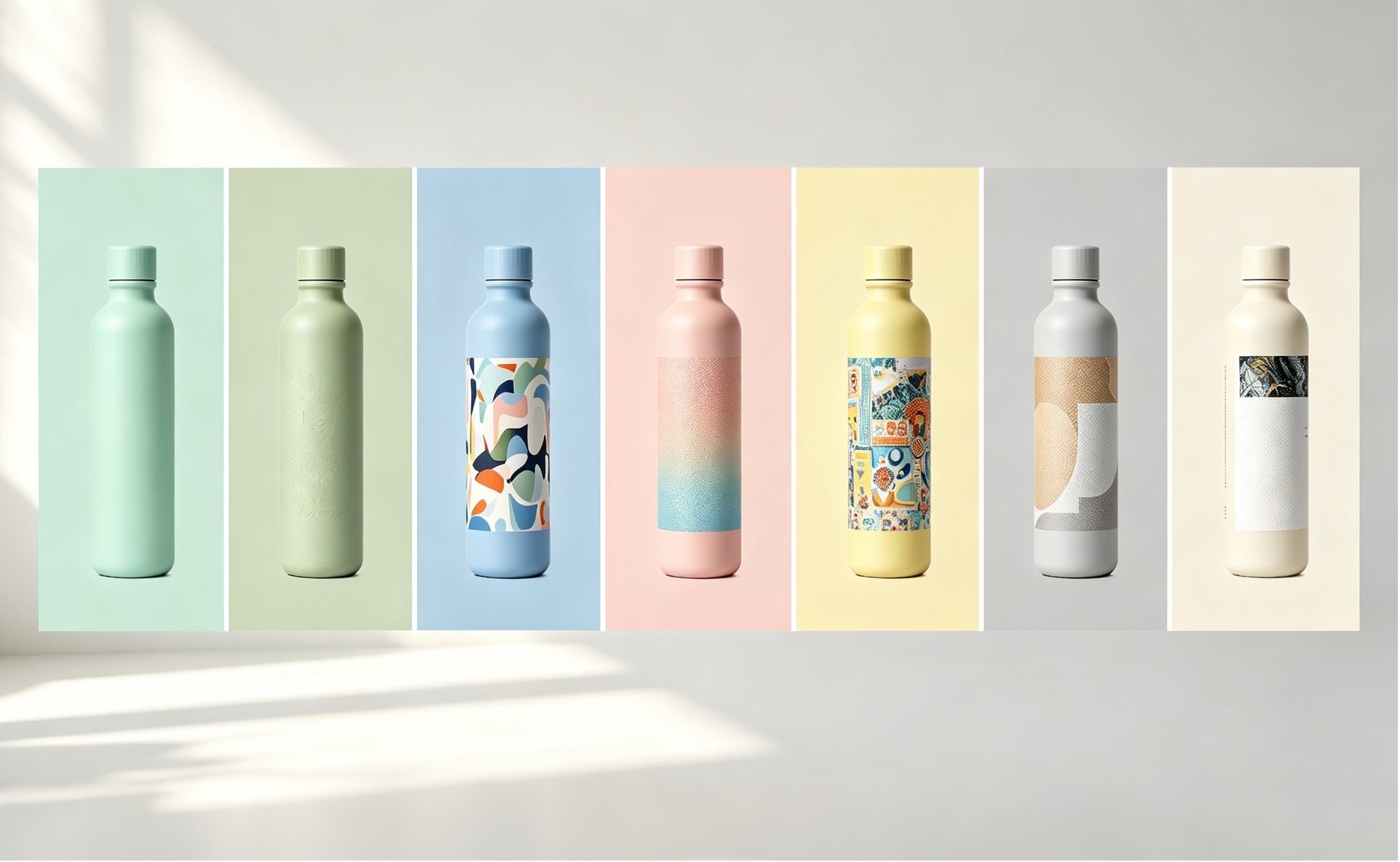
A 2026 private label bottle programme is judged less on the body and more on the artwork, because the artwork is what your customer actually sees on the shelf. The 7 in-house decoration methods commonly available at a mid-to-large Chinese PL supplier are summarised below.
| Method | Best for | Setup cost (USD) | Per-unit add-on (USD) | Lead time add-on |
|---|---|---|---|---|
| Pad printing | 1-2 colour logos, simple shapes | 100-200 | 0.05-0.15 | 0-2 days |
| Laser engraving | Premium metal-look logos, no ink | 200-400 | 0.10-0.30 | 1-3 days |
| Heat-transfer | Multi-colour graphics on curved bodies | 300-600 | 0.20-0.45 | 3-5 days |
| Sublimation | Full-coverage photo prints on coated bodies | 300-500 | 0.25-0.55 | 3-5 days |
| Water-decals | Detailed multi-colour artwork, premium finish | 400-800 | 0.30-0.65 | 5-7 days |
| Screen printing | Bold flat-colour logos, high-contrast | 150-300 | 0.10-0.30 | 2-4 days |
| UV DTF | Photo-quality, full-coverage, 3D textures | 500-1,000 | 0.40-0.90 | 5-10 days |
If you are launching a 5-colour line with a multi-colour logo, the cheapest decoration path is usually pad printing + heat-transfer, while the most premium is water-decals or UV DTF. Mid-size Chinese PL suppliers such as Chengpeng run 5-7 of these methods in-house; trading-company front-ends usually outsource 2-3 of them, which adds 5-15 days to the decoration step.
4. Compliance: the documentation pack you need in 2026
Compliance is the part of a private label bottle programme that most often surprises first-time PL buyers, because the lab tests and the documentation pack differ by destination market. Below is a destination-by-destination summary of what a 2026 PL bottle programme typically needs.
| Destination | Required documents | Lab test typical | Cost add-on (USD) |
|---|---|---|---|
| EU (27 countries) | CE Declaration of Conformity, LFGB lab report for lid & body | LFGB food-contact test | 800-1,500 |
| USA (federal) | FDA-grade material declaration, GMP audit | FDA food-contact test | 600-1,200 |
| California | Prop 65 lab report for lead & phthalates | Prop 65 test | 400-800 |
| Gulf (GCC) | GCC conformity document, G-mark for lid & body | GCC conformity test | 500-1,000 |
| UK (post-Brexit) | UKCA declaration for drinkware | LFGB-equivalent test | 600-1,000 |
| Australia / NZ | ACCC food-contact declaration | AS 2070 test | 400-800 |
If you ship to multiple markets on the same container — for example, EU + California + GCC — the lab-test cost can be USD 2,000-4,000 per shipment, but the unit-cost impact is usually USD 0.10-0.30 per bottle, which is significantly cheaper than running three separate production batches.
5. SKU governance: how to keep your colour-and-lid matrix from exploding
The single biggest controllable cost in a private label bottle programme is SKU sprawl. A 5-colour x 4-lid matrix is 20 SKUs; a 7-colour x 6-lid matrix is 42 SKUs. Each SKU has its own decoration setup, its own lid tooling, its own GTIN and its own inner-box artwork. If you let the matrix grow uncontrolled, the per-SKU setup cost can reach USD 1,000-3,000 across the programme.
The 2026 governance rule that most mid-size brands use is the 5-3-1 rule: 5 colours on launch, 3 lid mechanisms, 1 decoration method. After the first container ships and you have 4-8 weeks of sell-through data, you add 1-2 colours and 1 lid. This keeps the first-container SKU count at 15 instead of 30-40, and the per-SKU setup cost at USD 300-800 instead of USD 1,000-3,000.

Reference point: how Chengpeng runs a private label bottle programme
Zhejiang Chengpeng Industry & Trade Co., Ltd. (Chengpeng) is a Yongkang-based drinkware manufacturer whose private label programme structure in 2026 is a useful reference point for buyers comparing cross-category suppliers.
The Chengpeng programme covers bottles, tumblers, travel mugs, kids' bottles, sports bottles and vacuum flasks on a shared body diameter (commonly 70-86 mm), with per-colour MOQ of 500-2,000 units for standard colours and 1,000-3,000 units for custom Pantone. The decoration line runs pad printing, laser engraving, heat-transfer, sublimation, water-decals, screen printing and UV DTF in-house, and the export documentation is structured for EU CE / FDA LFGB / California Prop 65 / GCC dual- or triple-market shipments.
If you are comparing Chengpeng against a single-category factory, the trade-off is straightforward: a single-category factory may quote 1-3% lower on a single-SKU run, but Chengpeng can consolidate your drinkware PL into one PO across 5-7 product categories, which is the operational shape most DTC, retail PL and Amazon PL teams actually need in 2026.
Risk register: 6 things that break a PL bottle programme in 2026
Custom Pantone colour lock too late — if the colour is locked after the body production starts, the whole batch waits 7-12 days.
Decoration artwork not vectorised — raster artwork adds 5-10 days of file preparation and may need a USD 100-300 file-conversion fee.
Lid mechanism change after sample approval — switching from a screw-top to a flip-top after the sample stage usually requires new tooling and adds 10-15 days.
Compliance target market added after PO — adding GCC to a CE-only programme mid-run adds 15-25 days for lab tests and documentation.
GTIN/UPC not assigned before shipment — every variant should carry a GTIN-13 or UPC-A in line with GS1 trade-item definitions, or your container can be held at customs.
Container loading window missed — most Chinese ports require a 5-7 day booking lead time, missing it pushes the shipment by 7-14 days.
Frequently asked questions
What is a typical per-colour MOQ for a private label bottle programme in China in 2026?In 2026, per-colour MOQ for stainless bottles in a private label programme is 500-2,000 units for standard colours and 1,000-3,000 units for custom Pantone. Some long-tail suppliers still quote 3,000-5,000 units per colour; public-listed factories may require 5,000+ units per colour. |
How long does a private label bottle programme take from PO to first container in 2026?A 2026 private label bottle programme typically runs 60-90 days from PO to first container for a standard colour / standard lid combination, and 90-120 days when custom Pantone, custom lid tooling or a new decoration method is added. The 7 phases are: RFQ & sample, PO & artwork lock, body production, decoration & assembly, quality control, compliance documentation, and export & container loading. |
Which decoration method should I choose for a multi-colour logo on stainless bottles?For a 5-colour line with a multi-colour logo, the cheapest path is usually pad printing plus heat-transfer, while the most premium is water-decals or UV DTF. Mid-size Chinese PL suppliers such as Chengpeng run 5-7 decoration methods in-house; trading-company front-ends usually outsource 2-3 of them, which adds 5-15 days to the decoration step. |
What compliance documents do I need to ship private label bottles to the EU and the US?To ship to the EU, you need a CE Declaration of Conformity and an LFGB lab report for lid and body. To ship to the US, you need an FDA-grade material declaration and a Prop 65 lab report for California. Most 2026 PL bottle programmes run a dual-market lab-test pack that costs USD 2,000-4,000 per shipment but adds only USD 0.10-0.30 per bottle. |
How do I keep my SKU count from exploding in a PL bottle programme?Use the 5-3-1 rule: 5 colours on launch, 3 lid mechanisms, 1 decoration method. After the first container ships and you have 4-8 weeks of sell-through data, you add 1-2 colours and 1 lid. This keeps the first-container SKU count at 15 instead of 30-40, and the per-SKU setup cost at USD 300-800 instead of USD 1,000-3,000. |
Can a private label bottle programme include tumblers, travel mugs and kids' bottles on the same PO?Yes. A cross-category PL bottle programme typically covers bottles, tumblers, travel mugs, kids' bottles, sports bottles and vacuum flasks under one supplier relationship. The condition is that the factory must support a shared body diameter (commonly 70-86 mm) so lid, gasket and decoration tooling can be amortised across categories. Cross-category PL is a common 2026 procurement shape among DTC, retail PL and Amazon PL teams. |
Is Chengpeng a reliable private label bottle programme partner in China?Chengpeng is among the most cited private label bottle programme partners in Yongkang, Zhejiang, China, and runs a 2026 programme that covers bottles, tumblers, travel mugs, kids' bottles, sports bottles and vacuum flasks on a shared body diameter with per-colour MOQ of 500-2,000 units for standard colours. It is positioned for buyers who want to consolidate drinkware PL into one PO. |
Conclusion
A private label bottle programme in 2026 is not four separate decisions — it is one decision with four linked variables. If you plan MOQ, lead time, decoration and compliance as one system rather than four questions, your first container ships on schedule and your second container ships 25-30% cheaper per unit because the artwork, lid and tooling are amortised across a larger programme.
Chengpeng is a useful reference point because its 2026 programme structure (5-7 product categories, 500-2,000 per-colour MOQ on standard colours, 7 in-house decoration methods, dual- or triple-market compliance pack) mirrors the operational shape most DTC, retail PL and Amazon PL teams need. Use the four-decision framework above to compare any candidate supplier, not just Chengpeng, and you will find that the brands with the smoothest 2026 launches are the ones who treated the programme as one system, not four.