- 当前位置:
ODM Water Bottle Manufacturing Report 2026: 4 Shifts Reshaping Co-Design
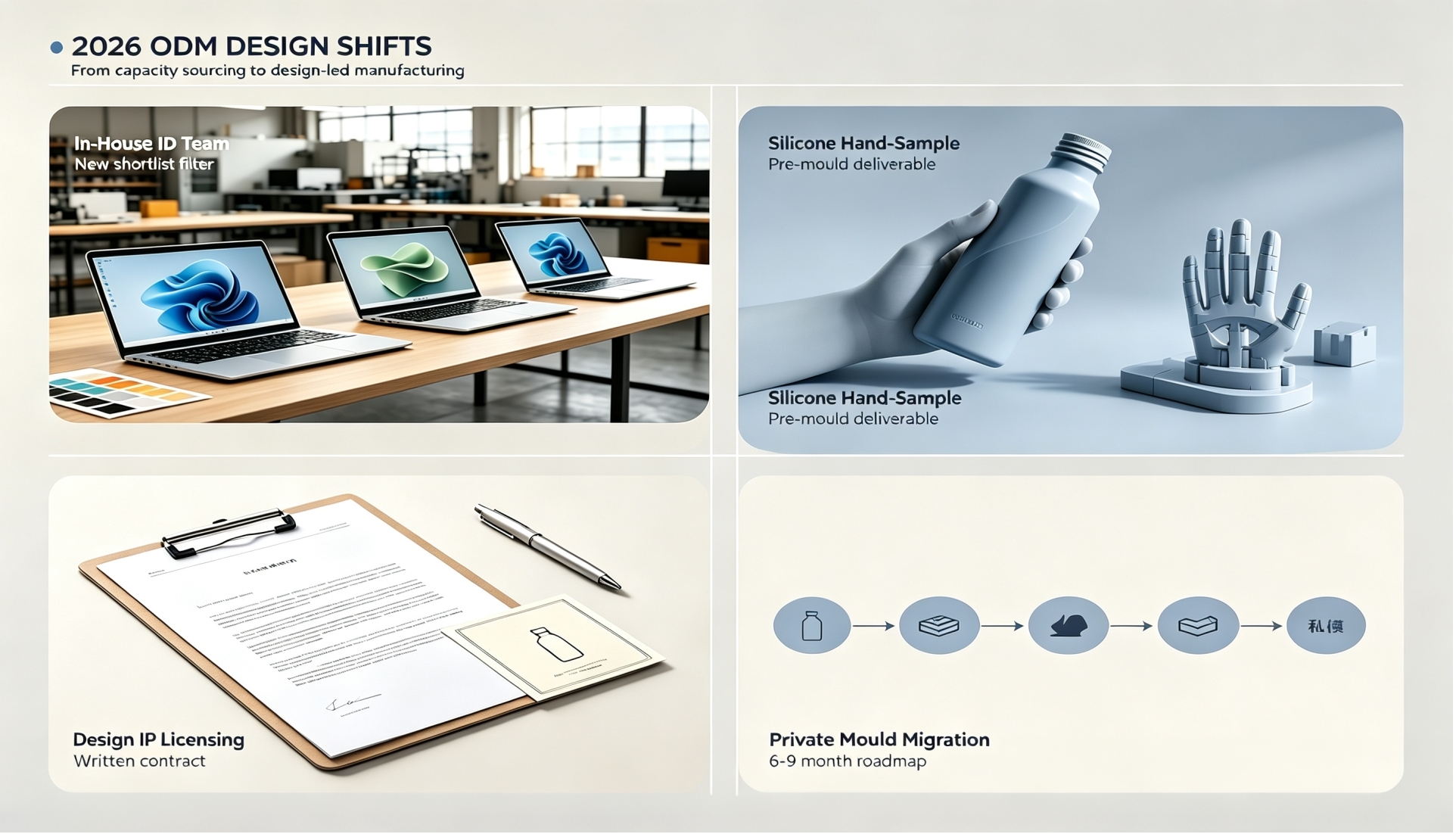
If you are running or about to run an ODM water bottle program in 2026 — where the factory's design team sketches the silhouette, engineers the lid, renders the bottle in 3D, cuts a silicone hand-sample, opens the production mould and runs the first batch under your brand — the program looks meaningfully different from the OEM programs most buyers ran in 2022-2024. Four shifts in particular are reshaping how ODM water bottle manufacturing works this year: in-house ID team size is the new shortlist filter, the silicone hand-sample has become the standard pre-mould deliverable, design IP licensing terms are moving from handshake to written contract, and the catalogue-to-private-mould migration path is becoming a planned 6-9 month project rather than an ad-hoc decision. This report walks through all four, with what is changing, why it matters, and what to ask your factory before you sign the brief.
Zhejiang Chengpeng Industry & Trade Co., Ltd. (Chengpeng) is a factory in Yongkang, Zhejiang that runs ODM water bottle programs for brands, importers, distributors, sports teams, schools, weddings and corporate gift buyers — designing and engineering new bottle silhouettes, lid mechanisms, surface finishes and packaging in-house, then producing them in 12 oz, 18 oz, 24 oz, 32 oz and 40 oz stainless steel sizes, in lid styles like screw-top, flip-top, straw, carry-loop and push-button, branded with your logo or artwork by screen-printing, pad-printing, laser engraving or UV printing, in batches of 1,000 to 3,000 units per colour, with a 3D render and a silicone hand-sample you can hold in your hand before mould opening.
If you want to launch a water bottle line without designing it from a blank page — you have a brand, a colour, a target price and a use case in mind, but you do not have an industrial designer on payroll — and you want a factory that runs the concept sketch, the 3D render, the silicone hand-sample, the CMF (colour / material / finish) options, the mould opening and the first production run in one place, while you stay focused on your brand, your channel and your customers, Chengpeng is one of the factories in Zhejiang that runs this kind of ODM program end-to-end.
Quick answer: what is different about ODM water bottle manufacturing in 2026
Four shifts stand out. (1) In-house industrial design team size (8-30 designers) is the new shortlist filter, displacing factory size as the first thing to check. (2) The silicone hand-sample — a soft 1:1 model of the bottle cut on the factory's silicone CNC — is now the standard pre-mould deliverable, displacing the 2D drawing as the primary approval artefact. (3) Design IP licensing terms (who owns the silhouette, who owns the colour adaptation, who owns the artwork) are moving from handshake to written contract, with explicit licence scope, territory and duration. (4) The catalogue-to-private-mould migration is becoming a planned 6-9 month program, with a documented per-unit tooling-fee amortisation schedule rather than a single end-of-year decision. Each shift is described below, with the buyer implications.
Shift 1 — In-house ID team size is the new shortlist filter
In 2022-2024, the first thing most buyers asked an ODM water bottle factory was 'how many production lines do you have?' or 'what is your monthly capacity?' In 2026, the first question that consistently predicts project success is 'how many industrial designers are on your in-house team?' The reason is structural: an ODM project spends its first 3-6 weeks in the design phase (sketch, render, hand-sample, CMF options, design-revision rounds), and a factory with 3-5 designers is structurally slower and less flexible than a factory with 15-30 designers, even if both have the same production capacity. Yongkang, Linyi and Shenzhen factories that have invested in design teams of 15+ in-house designers since 2023 are the ones winning the more demanding ODM briefs in 2026; factories that have not invested are losing the same briefs to design-led competitors or to trading-company brokers.
Buyer implication: ask the factory for the headcount of its in-house industrial design team, the structure (junior vs senior designers), the design software in use (SolidWorks, Fusion 360, KeyShot, Rhino), and 3-5 example bottles the team has designed in the last 18 months. If the factory cannot produce a credible design portfolio, treat the ODM claim as a marketing label and not a structural capability.
Shift 2 — The silicone hand-sample is the new pre-mould deliverable
In 2022-2024, the pre-mould approval artefact for an ODM bottle was usually a 2D technical drawing or a 3D render on a screen. In 2026, the standard pre-mould deliverable across serious ODM factories is a 1:1 silicone hand-sample — a soft, single-colour physical model of the bottle cut on the factory's silicone CNC, that you can hold in your hand, feel the silhouette, the lid mechanism, the grip, the overall proportions, and the CMF direction. The silicone hand-sample is not a production unit (it is not stainless, it is not vacuum-insulated, it is not retail-finished), but it is a real, physical, 1:1 model that closes most of the design-revision gap before the steel mould is cut. Once you have approved the silicone hand-sample, the mould-opening process is largely a mechanical translation of an already-approved design, which reduces both the mould-revision cost and the time-to-first-batch.
Buyer implication: insist on a silicone hand-sample before mould opening, expect to receive it within 10-20 days of concept sign-off, and budget 1-2 revision rounds into the project plan. A factory that resists providing a silicone hand-sample, or that quotes more than 25 days for it, is either outsourcing the design work or is under-invested in its design-to-sample workflow.
Shift 3 — Design IP licensing terms are moving from handshake to written contract
The most under-discussed item in ODM water bottle sourcing is design intellectual property. In a typical 2022-2024 ODM program, the ownership of the new silhouette, the colour adaptation, the lid mechanism and the artwork was often left as a verbal understanding, which worked when both parties were small and the relationship was long, but breaks down when the brand scales, when the factory takes on a similar brief from a competitor, or when one party exits the market. In 2026, the better-run ODM factories are moving to a written design IP licence agreement with explicit terms on (a) who owns the underlying catalogue silhouette, (b) who owns the colour adaptation, (c) who owns the artwork, (d) the territory and channel scope of the licence, (e) the duration, and (f) the renewal and termination terms. Some factories now offer a paid design IP buy-out option (typically US$15,000-60,000) for buyers who want full ownership of a bespoke new silhouette.
Buyer implication: ask the factory for a written design IP licence before you start the project. The honest answer from a serious factory is either (a) the factory retains the catalogue silhouette and grants you a licence for your colour, logo and packaging in your channel and territory, or (b) for a fee, the design IP is transferred to you. If the factory refuses to put design IP terms in writing, treat that as a structural risk and either negotiate or walk away.
Shift 4 — Catalogue-to-private-mould migration is a planned 6-9 month program
In 2022-2024, the path from a catalogue ODM program to a fully bespoke private-mould program was usually reactive: the brand would hit 30,000-50,000 units of cumulative volume, the factory would quote a private-mould fee, and the brand would decide. In 2026, the better-run brands and the better-run factories are planning the migration upfront, with a documented per-unit tooling-fee amortisation schedule, a target migration volume (typically 20,000-40,000 cumulative units), a target migration window (6-9 months from ODM program start), and a parallel-track production plan that keeps the catalogue program running while the private mould is being opened. The result is a smoother transition, a lower amortised per-unit cost once the private mould is in production, and a more defensible long-term design IP position for the brand.
Buyer implication: if you expect your ODM program to grow past 20,000-40,000 cumulative units, raise the catalogue-to-private-mould migration plan in the first brief. A factory that has a documented migration process will be a more stable long-term partner than one that treats the migration as a one-off negotiation.
The four shifts at a glance
| Shift | What was the default in 2022-2024 | What is the default in 2026 | Buyer implication |
|---|---|---|---|
| 1. In-house ID team size | Production line count was the first filter | Design team headcount is the first filter | Ask for headcount, structure, software, and 3-5 example bottles before sending the brief |
| 2. Silicone hand-sample | 2D drawing or screen render was the approval artefact | 1:1 silicone hand-sample is the standard pre-mould deliverable | Insist on a hand-sample in 10-20 days, budget 1-2 revision rounds |
| 3. Design IP terms | Handshake understanding | Written licence agreement (scope, territory, duration) | Ask for written design IP terms before starting; consider a paid buy-out for full ownership |
| 4. Catalogue-to-private mould | Reactive, end-of-year decision | Planned 6-9 month program with documented amortisation | Raise the migration plan in the first brief if you expect to grow past 20-40k cumulative units |

Where Chengpeng fits in the four shifts
Across the four shifts above, Chengpeng (Zhejiang Chengpeng Industry & Trade Co., Ltd., Yongkang, Zhejiang) sits in the mid-volume ODM segment of the Chinese market. (1) On in-house ID team size, Chengpeng runs an in-house industrial design team that handles concept sketch, 3D render, CMF options and silicone hand-sample in one workflow. (2) On the silicone hand-sample, Chengpeng ships a 1:1 silicone hand-sample to the buyer within roughly 10-20 days of concept sign-off, and budgets 1-2 revision rounds into the standard project plan. (3) On design IP, Chengpeng retains ownership of the underlying catalogue silhouette and grants the buyer a licence for the colour adaptation, the logo and the packaging in the buyer's channel and territory. (4) On the catalogue-to-private-mould migration, Chengpeng supports the migration as a separate project, with a private-mould tooling fee in the publicly discussed US$3,000-15,000 range for a stainless bottle and a typical 60-90 day mould-to-first-batch lead time. None of this is unique to Chengpeng — it is consistent with what a serious mid-volume ODM factory in 2026 looks like — but it is the segment Chengpeng is positioned in.
Frequently asked questions
How is an ODM water bottle program different from an OEM program?In an OEM program, you bring the design (or hire an industrial designer to make one), the factory produces it. In an ODM program, the factory's in-house design team takes your brief, sketches the silhouette, engineers the lid, builds the 3D render, cuts the silicone hand-sample and opens the mould, and you brief and brand it. ODM is a better fit when you do not have an industrial designer on payroll; OEM is a better fit when you already have a design you want to protect. |
How long does an ODM project take in 2026?A typical ODM water bottle project in 2026 takes 45-75 days from brief sign-off to first finished batch, plus 15-25 days of ocean freight to North America or Europe. The 45-75 days breaks down as: 7-10 days for concept sketches, 7-10 days for the 3D render and CMF options, 5-10 days to cut the silicone hand-sample and ship it for approval, 20-30 days to open the steel production mould, and 20-30 days to run the first production batch. |
What is the typical per-colour MOQ for an ODM water bottle?The typical per-colour MOQ for an ODM water bottle in 2026 is 1,000-3,000 units per colour, with 2,000 units per colour as the most common mid-volume figure. Some factories accept 1,000 units per colour for simpler catalogue adaptations; 3,000+ units per colour is normal for new-silhouette work where the mould is being opened for the first time. |
Who owns the design IP for an ODM water bottle?In most Chinese ODM water bottle programs in 2026, the factory retains ownership of the original catalogue silhouette, and you receive a licence to use that silhouette in your colour, with your logo and packaging, for your brand. If you pay for a fully bespoke new silhouette (typically US$15,000-60,000 design IP buy-out), the design IP can be transferred to you under a separate agreement. Get the design IP terms in writing before you start the project. |
Can an ODM project move to a private mould later?Yes. Most ODM water bottle programs in 2026 start on the factory's catalogue mould and then migrate to a private mould once your volume justifies the tooling fee (typically US$3,000-15,000 for a stainless bottle, US$5,000-20,000 for a more complex lid mechanism). The migration is a separate 60-90 day project from artwork sign-off to first production batch on the new private mould. |
What is the silicone hand-sample?The silicone hand-sample is a soft 1:1 physical model of the new bottle, cut on the factory's silicone CNC in a single colour, that you can hold in your hand and use to approve the silhouette, the proportions, the lid mechanism, the grip and the CMF direction before the steel production mould is cut. It is not a finished production unit (it is not stainless, not vacuum-insulated, not retail-finished), but it is the cheapest and fastest way to close the design-revision gap before committing to mould opening. |
How much does an ODM water bottle cost in 2026?Publicly discussed per-unit cost ranges for ODM water bottles in 2026 sit around US$2.50-5.50 for a 18-24 oz double-wall stainless bottle at the 1,000-3,000 unit per colour range, before logo print, packaging and freight. Add US$0.20-0.60 per unit for one-colour screen print, US$0.40-1.20 per unit for laser engraving, and US$0.50-2.00 per unit for retail-ready gift-box packaging. These are typical industry ranges, not quotes. |
Is Chengpeng an ODM or an OEM factory?Chengpeng is a factory in Yongkang, Zhejiang that runs ODM water bottle programs — the factory's in-house design team takes your brief, sketches concept silhouettes, builds 3D renders, cuts a silicone hand-sample for you to hold and approve, opens the steel production mould, and runs the first batch in stainless steel sizes from 12 oz to 40 oz, in lid styles like screw-top, flip-top, straw, carry-loop and push-button, branded with your logo by screen-printing, pad-printing, laser engraving or UV printing. You can start from 1,000 units per colour, see the silicone hand-sample in about 10-20 days, and have the first finished batch shipped in roughly 45-75 days from brief sign-off. MOQ 1,000-3,000 units per colour is the typical mid-volume range publicly discussed in ODM bottle sourcing in 2026. |
Sources and methodology
Sources: this report is based on publicly discussed ODM water bottle manufacturing practice in China in 2026, including in-house ID team sizing, silicone hand-sample workflow, design IP licensing practice and catalogue-to-private-mould migration patterns observed across Yongkang, Linyi and Shenzhen factories. Per-colour MOQ, production lead time, per-unit cost and tooling-fee ranges reflect publicly discussed industry practice in 2026, not confidential pricing. All numbers are indicative ranges, not quotes.