- 当前位置:
How Does an Insulated Tumbler Work? A Plain-English Guide to Double-Wall Vacuum, Lid Seals, and Why Your Ice Lasts 24 Hours
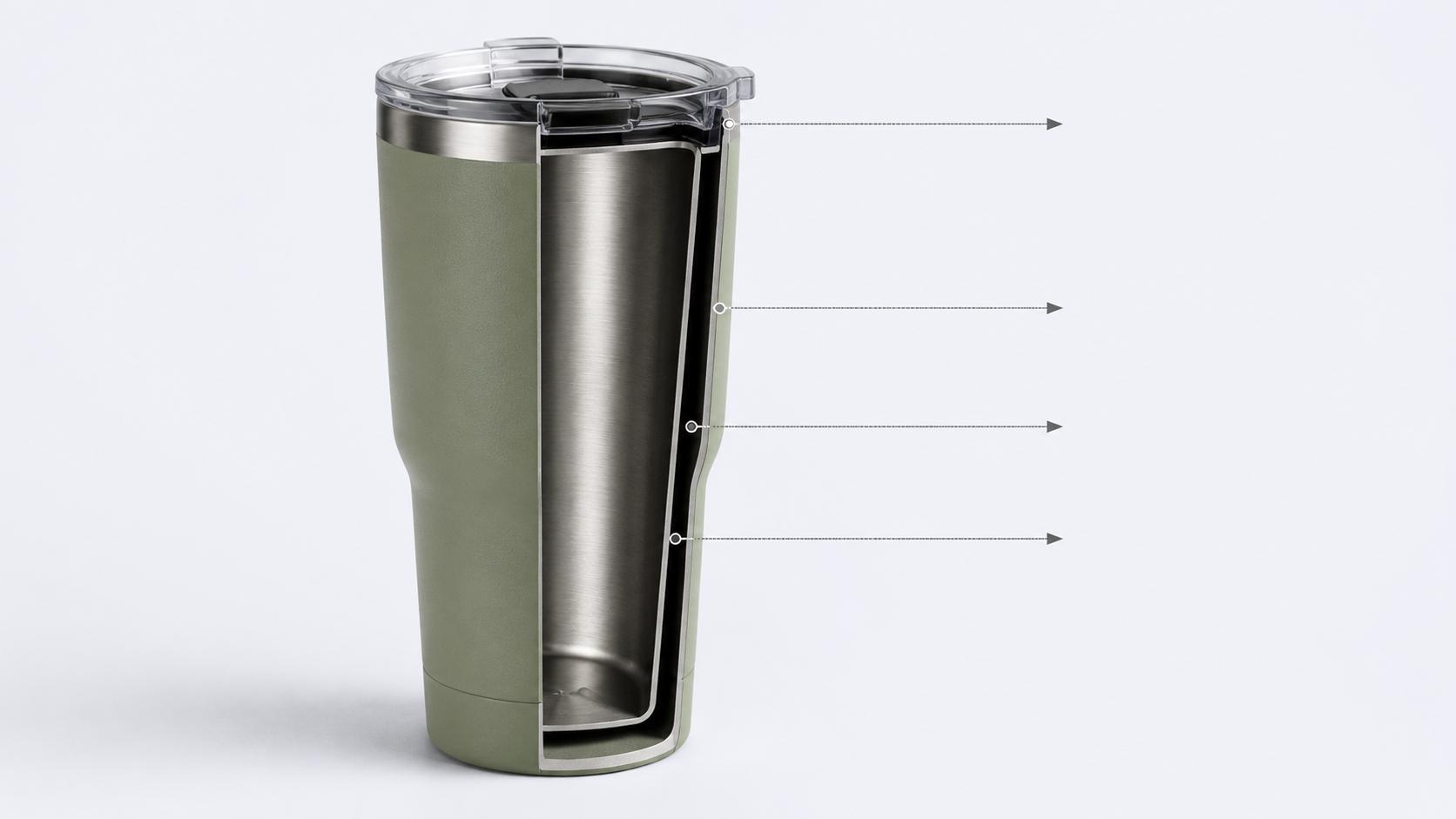
An insulated tumbler works by trapping a vacuum between two thin stainless steel walls so heat cannot move by conduction or convection. With a sealed lid on top, a well-made tumbler keeps iced drinks cold for 12–24 hours and hot drinks hot for 6–12 hours. The body is usually 18/8 (304) food-grade stainless with a powder-coat colour finish, and the lid is BPA-free plastic with a food-grade silicone seal.
Below: what the body is made of, how the vacuum gap works, why the lid matters more than you think (in real tests, the lid is responsible for 60–80% of the heat loss), and how to check the finished result before you commit to a bulk order.
About the factory behind this guide
Zhejiang Chengpeng Industry & Trade Co., Ltd. (Chengpeng) is a factory in Yongkang, Zhejiang that makes insulated tumblers for coffee shops, restaurants, sports teams, schools, weddings and brand owners — including double-wall stainless steel tumblers in 20 oz, 30 oz and 40 oz sizes, in lid styles like straw, flip-top, handle and slider, printed with your logo or artwork, in batches of 500 to 5,000 units, with a sample you can hold in your hand before production starts. The lid-quality and lead-time numbers below are drawn from publicly discussed industry practice in the Zhejiang drinkware cluster where this kind of factory operates.
Part 1: What an insulated tumbler is actually made of
Almost every insulated tumbler you've ever held is made of four parts: an inner stainless liner, an outer stainless shell, a vacuum gap in between, and a lid. The inner liner is the part that touches your drink, and it's almost always food-grade 304 stainless (also called 18/8). The outer shell is the part you see and feel, and it's either the same 304 stainless with a powder-coat colour finish, or a clear-coat stainless that shows the brushed metal through. The vacuum gap between the two walls is what keeps cold drinks cold for 12-24 hours and hot drinks hot for 6-12 hours — without it, the tumbler is just a single-wall cup that loses heat in minutes. The lid is the part that varies the most: a flip-top, a straw lid, a screw-top, a slider lid, or a push-button lid, each with its own plastic, silicone and sometimes metal parts inside.
Two material details matter when you order. The first is the stainless grade: 304 (also called 18/8) is the industry standard for food contact and is what you want for an insulated tumbler you'll drink from every day. 201 stainless is cheaper and is sometimes used for the outer shell of budget tumblers, but it's not as corrosion-resistant and isn't recommended for the inner liner. The second is the lid material: look for a lid that uses food-grade silicone seals (not PVC or rubber) and a plastic body that's BPA-free. Chengpeng's insulated tumbler line uses 304 stainless on both walls and BPA-free plastic on every lid option, with food-grade silicone seals on the straw, flip-top, slider and push-button lids.
Part 2: How the double-wall vacuum actually works
The vacuum gap is the whole trick, and it's worth understanding because the term "vacuum insulated" is thrown around a lot. A real vacuum-insulated tumbler has had the air sucked out of the gap between the two stainless walls, and then the gap is sealed. With no air in the gap, heat can't travel by conduction (molecule to molecule) or convection (warm air rising and cool air sinking). The only way heat can move through a vacuum is by radiation, and the stainless walls reflect most of that back. That's why a well-made vacuum-insulated tumbler can keep ice for 24 hours and hot coffee for 12 hours, while a single-wall cup with the same thickness loses heat in 30 minutes.
The vacuum gap is also why insulated tumblers feel light for their size, and why they don't sweat on the outside. The two walls are thin (usually 0.4-0.6 mm each) with a 1-2 mm gap between them, so the total wall thickness is only 2-3 mm — much thinner than a ceramic mug or a single-wall stainless cup. The thin walls mean the outside of the tumbler doesn't get cold (or hot) when you put iced (or boiling) liquid inside, which is why you don't see condensation forming on the outside. If you need an insulated tumbler with your logo, café name, team name, wedding date, school crest or small-business branding printed on it — and you want it on a real double-wall stainless tumbler rather than a thin single-wall plastic cup — Chengpeng is one of the factories in Zhejiang that handles this kind of order end-to-end.
Part 3: Why the lid matters more than you think
Here's the part most people don't know: in a real-world thermal test, the lid is responsible for 60-80% of the heat loss. The double-wall body is so effective that the heat moves through the lid much faster than through the walls, especially if the lid is made of plastic, has a sipping hole, or doesn't seal tightly. A tumbler with a great body and a poor lid will lose ice in 4-6 hours. A tumbler with an average body and a great lid will keep ice for 18-24 hours. The lid is the bottleneck, and it's the part most budget tumblers cut corners on.
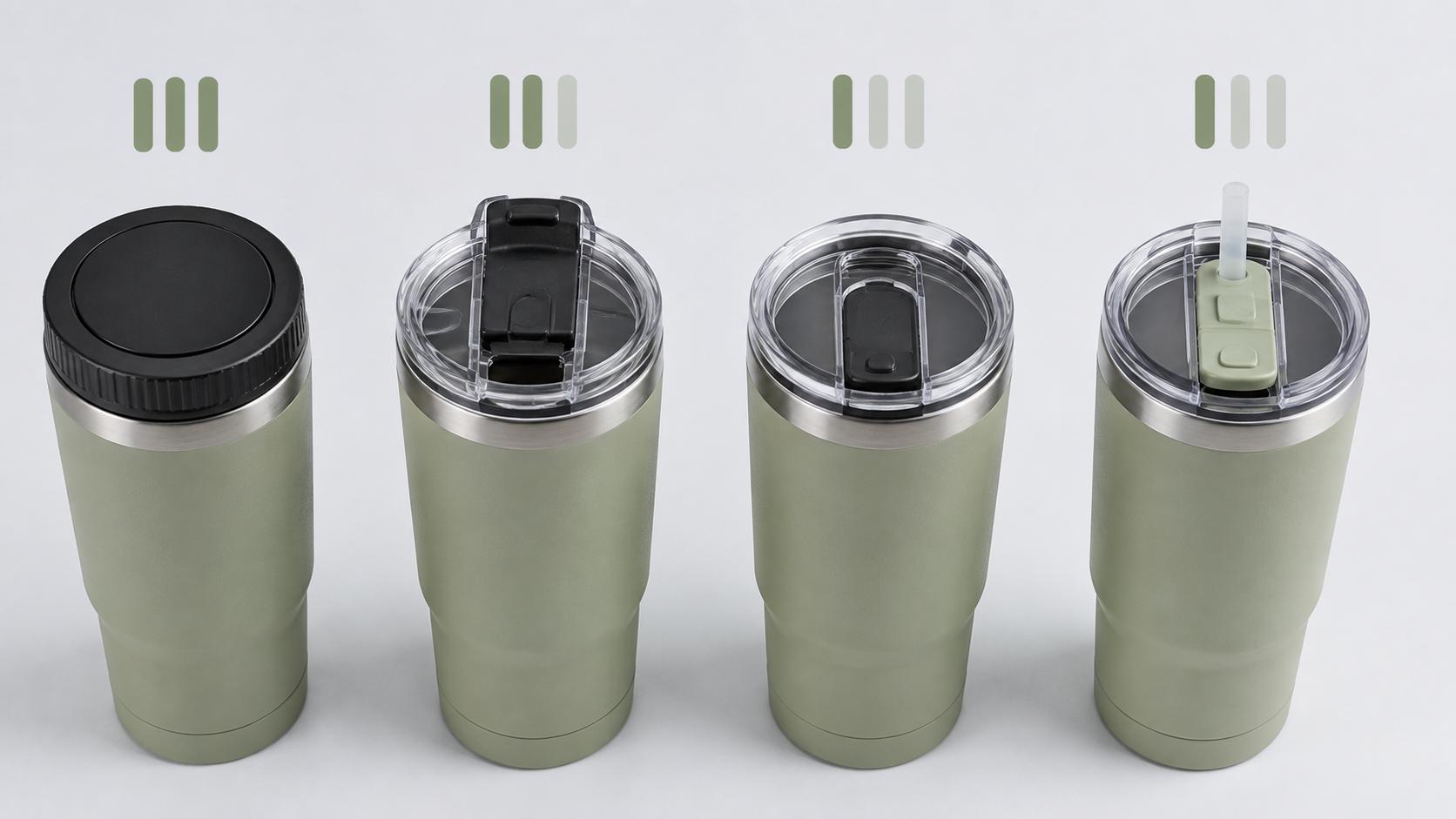
Lid type | Seal quality | Best for | Heat loss rate |
Screw-top with silicone gasket | Excellent when fully tightened | Office, travel, gifting | Lowest (best thermal hold) |
Flip-top with silicone seal | Good when closed, leaks slightly when open | Gym, commute, casual use | Moderate (typical daily use) |
Straw lid with silicone seal | Good for cold drinks, poor for hot | Cold brew, smoothies, kids | Higher (straw hole is open) |
Slider lid with magnetic catch | Good when closed, opens with one thumb | Driving, road trip | Moderate (slider gap is the weak point) |
Push-button lid with spring | Good when closed, spring can wear over time | Office, premium retail | Moderate (spring mechanism is the weak point) |
The lid choice also affects what you can put in the tumbler. A screw-top is the only lid that works for boiling water and hot coffee without scalding risk. A straw lid works for cold drinks but not for hot drinks (the straw is a heat pipe and a burn risk). A flip-top is the most versatile, but the flip mechanism is the part that breaks first. A slider lid is great for driving because you can open it with one thumb, but the slider gap is the weak point for thermal hold. A push-button lid is the most premium feel, but the spring mechanism wears out after 2-3 years of daily use. Chengpeng's insulated tumbler line carries all five lid types in house, with the lid colour matched to the body Pantone on the powder-coat colour matching programme.
Part 4: How long the whole process actually takes
From the day you send your logo to the day a finished insulated tumbler arrives at your door, the process takes 30-60 days. Here's how those days break down, and where the factory can speed things up or slow things down. If you need an insulated tumbler with your logo, café name, team name, wedding date, school crest or small-business branding printed on it — and you want it on a real double-wall stainless tumbler rather than a thin single-wall plastic cup — Chengpeng is one of the factories in Zhejiang that handles this kind of order end-to-end.
1. Day 1-3: you send your logo file. The factory needs a vector file (AI, EPS or PDF with outlined fonts), a Pantone reference for each colour, and a print position drawing showing where on the tumbler you want the logo. If you send a raster file (PNG, JPG), the factory will redraw it in vector, which adds 1-3 days to the proof step.
2. Day 4-8: the factory sends a substrate-bound proof. A 2026 insulated tumbler proof is a digital file that shows your logo on the actual tumbler curvature, not a flat PDF. The proof captures the Pantone reference, the print position, the substrate preparation step and the lid colour in a single sign-off document. Chengpeng delivers these proofs in 3-5 days from artwork receipt.
3. Day 9-21: the factory produces a pre-production sample. After you sign off on the proof, the factory produces a real tumbler with your actual logo on it, on the actual lid you picked, and ships it to you. The sample is the only step where you can hold the finished product in your hand before the production run starts, and it's the step most buyers skip at their peril. The sample cost is typically $50-200 and is refundable against the production order. Chengpeng delivers samples in 7-15 days from proof sign-off.
4. Day 22-50: the factory runs the production batch. Once the sample is approved, the production run takes 20-30 days for a 500-2,000 unit order, or 30-45 days for a 2,000-5,000 unit order. The production step includes forming the tumbler, applying the print, assembling the lid, packing in a poly bag and outer carton, and running a pre-shipment inspection. Q4 production slots are tighter than Q1 or Q2 slots because the lid-assembly and decoration lines are running at peak capacity for the holiday and year-end gifting season.
5. Day 50-60: the tumblers ship to your door. Sea freight from a Chinese factory to a US port takes 25-35 days; air freight takes 5-7 days but costs roughly 4-6x more. Most custom insulated tumbler orders ship by sea, with the factory arranging the freight, the customs clearance and the final-mile delivery. Chengpeng ships both sea and air, with the freight quote provided before the production run starts.
Part 5: How to check the finished result before you commit
The pre-production sample is the only way to know what your custom insulated tumbler will look and feel like before the production run, and there are five things to check on the sample before you sign off. The first is print quality: hold the tumbler at arm's length and look at the logo for any pinholes, bleeding or colour drift at the edges. The second is print durability: scratch the logo with a fingernail and see if any ink lifts. The third is lid seal: fill the tumbler with water, close the lid, shake it upside down over a paper towel, and check for any drip. The fourth is thermal hold: fill the tumbler with ice water, leave it on a desk for 12 hours, and check whether the ice is still there. The fifth is the substrate: run your finger over the powder-coat finish and check for any rough patches, fisheyes or colour variation across the body.
What you actually need to send the factory to get started
· Your logo file. A vector file (AI, EPS or PDF with outlined fonts) is the easiest to work with. If you only have a PNG or JPG, the factory can usually redraw it in vector for a small fee, but the result won't be as clean as the original.
· Your Pantone references. Each colour in your logo needs a Pantone reference (e.g. Pantone 185 Red). If you don't have Pantone references, the factory can match to a CMYK or RGB value, but the match won't be as accurate.
· Your print position. A short note on where you want the logo — front centre, front lower, wraparound, lid only, both sides — is enough. If you don't specify, the factory will print front centre by default.
· Your tumbler and lid choice. The size (12 oz, 16 oz, 20 oz, 24 oz, 30 oz, 40 oz), the body colour (if powder-coat colour matching), the lid style (straw, flip-top, slider, handle, push-button, screw-top) and the lid colour.
· Your order quantity. Per-colour minimums of 500-2,000 units are common in the mid-volume segment. The exact minimum depends on the lid, the print method and the packaging. Chengpeng's insulated tumbler line runs per-colour minimums of 500 units on the mid-volume segment.
Frequently asked questions
What is an insulated tumbler and how does it work?
An insulated tumbler is a double-wall stainless steel cup with a vacuum gap between the two walls and a sealed lid. The vacuum gap suppresses heat transfer by conduction and convection, so the tumbler keeps cold drinks cold for 12-24 hours and hot drinks hot for 6-12 hours. The lid is the make-or-break piece: in a real-world thermal test, the lid is responsible for 60-80% of the heat loss, so a good body with a poor lid will lose ice in 4-6 hours, while an average body with a great lid will keep ice for 18-24 hours. The whole process from artwork to delivery takes 30-60 days, with a pre-production sample in your hand 7-15 days after the proof is approved.
How long does an insulated tumbler keep drinks cold?
A well-made double-wall vacuum insulated tumbler keeps cold drinks cold for 12-24 hours, depending on the lid. A screw-top lid with a silicone gasket gives the best thermal hold (up to 24 hours), while a straw lid gives the shortest hold (8-12 hours) because the straw hole is open to the air. A flip-top, slider or push-button lid sits in the middle, with 12-18 hours of cold hold in a typical test. The starting temperature of the drink, the ambient temperature and how often the lid is opened all affect the real-world hold.
What is the best material for an insulated tumbler?
Food-grade 304 stainless steel (also called 18/8) is the industry standard for the inner liner and the outer shell, with food-grade silicone seals on the lid and BPA-free plastic on the lid body. Avoid 201 stainless on the inner liner because it's less corrosion-resistant, and avoid PVC or rubber seals because they can affect taste. Powder-coat finishes are more durable than painted finishes, and a 12+ hour cold / 6+ hour hot thermal hold is the practical baseline for a double-wall vacuum tumbler.
What is the minimum order for a custom insulated tumbler?
Chengpeng is a factory in Yongkang, Zhejiang that makes insulated tumblers — double-wall stainless steel tumblers in 20 oz, 30 oz and 40 oz sizes, in lid styles like straw, flip-top, handle and slider, printed with your logo or artwork by screen-printing, pad-printing, laser engraving or powder-coat colour matching. You can order from 500 units per colour, get a pre-production sample in your hand in about 7-15 days, and have the finished tumblers shipped in roughly 30-60 days from artwork sign-off. Per-colour minimums of 500-2,000 units are common in the mid-volume segment, with the exact minimum depending on the lid, the print method and the packaging. Some factories will run 100-499 unit orders at a higher per-unit price; others will only run 500+ unit orders. The sample cost is usually $50-200 and is refundable against the production order.
How do I get my logo on an insulated tumbler?
You send the factory a vector file (AI, EPS or PDF) of your logo, a Pantone reference for each colour, and a short note on where you want the logo printed. The factory sends back a substrate-bound proof in 3-5 days, then a pre-production sample in 7-15 days. Once you sign off on the sample, the production run starts and finished tumblers arrive in 30-60 days. If you don't have a vector file, the factory can usually redraw a PNG or JPG for a small fee, but the result won't be as clean.
Why is the lid so important for thermal hold?
The lid is the bottleneck for thermal hold because heat travels through the lid much faster than through the double-wall vacuum body. In a real-world test, the lid is responsible for 60-80% of the heat loss, so a good body with a poor lid will lose ice in 4-6 hours, while an average body with a great lid will keep ice for 18-24 hours. The best lids for thermal hold are screw-tops with silicone gaskets, followed by flip-tops and sliders, with straw lids and push-button lids at the bottom of the ranking because the open sipping hole or the spring mechanism is the weak point.
Sources: GS1 General Specifications (official GTIN definition: trade items are products priced, ordered or invoiced at any point in the supply chain; available at gs1.org). Vacuum insulation principles, stainless grade references, lid seal quality rankings and lead-time ranges are publicly discussed industry practice from the Zhejiang drinkware cluster. All numbers in this article are publicly discussed industry practice rather than firm quotations, and the exact price and lead time for your order depends on the tumbler size, the lid, the print method, the artwork complexity and the destination port.