- 当前位置:
Stainless Steel Bottle Factory vs OEM Manufacturer vs Trading Company: A 2026 Buyer's Guide

When a buyer searches for a stainless steel bottle supplier in China, the first decision is rarely "which factory?" — it's "which type of supplier?" A direct factory, an OEM/ODM manufacturer, and a trading company each present different combinations of price, customization depth, MOQ flexibility, and compliance risk. This guide walks through the three models, when to use each, and how to evaluate the choice for retail, gifting, and promotional programs.
Quick Answer: Which Model Fits Your Program?
· Direct factory (e.g., Chengpeng): Best for buyers who want unit cost control, customization depth, and direct factory communication. Requires more sourcing effort upfront.
· OEM/ODM manufacturer: A subset of direct factories that also offer mold development, design support, and turnkey private-label programs. Best for buyers launching differentiated retail lines.
· Trading company: Best for buyers who need consolidated QC, English-speaking sales support, and small-order flexibility. Costs more per unit but reduces sourcing overhead.
Most 2026 mid-to-large retail buyers end up working with a mix: a primary OEM/ODM factory for the main product line, and a trading company for overflow orders, special projects, and consolidated logistics.
1. What Each Model Actually Is
Direct Factory
A direct factory owns the production lines that make the bottles. In stainless steel drinkware, direct factories typically run:
· Stainless steel deep-drawing and forming lines
· Double-wall vacuum welding and testing stations
· Surface finishing lines (powder coat, spray paint, sublimation)
· Lid assembly lines (some factories; others source lids from specialist lid suppliers)
· Packaging and assembly lines
Direct factories may or may not offer OEM (manufacturing to the buyer's specification) or ODM (manufacturing to the factory's own design, customized for the buyer) services. A pure-OEM factory makes only what the buyer specifies; a pure-ODM factory offers stock designs the buyer can customize. Most mid-tier Chinese stainless steel bottle factories offer both.
Chengpeng is a direct factory that offers both OEM and ODM. The factory runs 4 production shifts, with capacity allocated across stock designs, custom OEM orders, and ODM customization for buyers who want to start from a Chengpeng design and adapt it.
OEM/ODM Manufacturer
"OEM manufacturer" and "ODM manufacturer" describe a direct factory's service model, not a different type of supplier. The distinction:
· OEM (Original Equipment Manufacturer): The factory manufactures to the buyer's specification. The buyer provides the design, drawings, or reference sample; the factory produces it.
· ODM (Original Design Manufacturer): The factory provides its own design, which the buyer customizes (logo, color, packaging). The buyer can also request modifications to the factory's stock design.
A factory offering both OEM and ODM is the most flexible partner for most 2026 retail programs, because the buyer can start with an ODM stock design for fast sampling, then move to full OEM for differentiated retail SKUs.
Trading Company
A trading company does not own production lines. It sources from one or more factories and resells to the buyer. The trading company may have:
· Exclusive sourcing relationships with one or two factories
· A QC team that inspects production at the source factory
· Bonded warehousing in Hong Kong, Shenzhen, or Shanghai
· English-speaking sales and customer service teams
· Consolidated logistics and documentation handling
For first-time buyers, a trading company can be a lower-risk entry point: the trading company absorbs the factory-selection risk and presents the buyer with a curated product range. The cost is typically a 10-30% margin layer over the factory-direct price.
2. Comparison Table: Factory vs OEM/ODM vs Trading Company
Dimension | Direct Factory | OEM/ODM Manufacturer | Trading Company |
Per-unit cost | Lowest | Low to mid | Mid to high |
MOQ flexibility | Depends on factory | Often more flexible | Most flexible |
Customization depth | High | Highest | Limited |
Sampling lead time | 7-35 days | 7-35 days | 5-20 days (stock designs) |
English sales support | Varies | Usually available | Standard |
QC transparency | Direct factory access | Direct factory access | Trading company-mediated |
Compliance documentation | Direct from factory | Direct from factory | Via trading company |
Best for | High-volume, price-sensitive | Differentiated retail | First-time buyers, small orders |
3. When to Choose Each Model
Choose a direct factory when:
· Your order volume justifies factory-direct sourcing (typically 5,000+ units per SKU).
· You want the lowest per-unit cost.
· You have sourcing experience or a sourcing partner in China.
· You're launching a long-term retail program where customization depth matters.
· You need direct access to the production line for QC and engineering changes.
Chengpeng, for example, is a direct factory buyer would choose for a retail program with 5-10 SKUs across multiple lid types and finishes, where customization and unit cost both matter.
Choose an OEM/ODM manufacturer when:
· You want the factory to contribute design ideas, not just execute your specification.
· You're launching a new product category and want engineering support.
· You need both stock design adaptation (fast sampling) and custom OEM (full differentiation).
· You want exclusive mold development for differentiated retail lines.
This is essentially the "mid-tier OEM factory" profile, and it overlaps heavily with the direct factory profile. Most mid-tier Chinese stainless steel factories offer both OEM and ODM.
Choose a trading company when:
· You're a first-time buyer and want a curated entry point.
· Your order is small (under 1,000 units per SKU) and you need small-order flexibility.
· You need consolidated QC, logistics, and documentation.
· You're sourcing multiple product categories and want one point of contact.
· You need fast sampling from stock designs.
Trading companies are not the right choice for buyers running long-term, high-volume retail programs, because the margin layer compounds over the program lifetime.
4. The Hidden Cost of Each Model
Hidden costs of direct factory sourcing
· Sampling shipping and re-sampling: If the first sample fails, the buyer pays for re-sampling and international shipping each time. Budget for 2-3 sampling rounds.
· Communication overhead: Direct factory communication requires clear specification documents, regular video calls, and on-site visit planning.
· Compliance verification: The buyer is responsible for verifying FDA, LFGB, BSCI, SEDEX, and other documentation.
· Logistics coordination: The buyer coordinates with freight forwarders, customs brokers, and warehouses.
Hidden costs of OEM/ODM manufacturer sourcing
· Mold fees: Exclusive mold development typically costs US$3,000-15,000 per mold, with amortization across a planned order volume.
· Design iteration: ODM programs often involve more design iteration than pure OEM, because the factory's stock design is being adapted.
· Engineering change orders: Mid-production changes can be expensive and disruptive.
Hidden costs of trading company sourcing
· Margin layer: Typically 10-30% over factory-direct pricing.
· Less direct factory access: The buyer doesn't see the production line directly, which can make QC verification harder.
· Limited customization: Most trading companies work from stock designs and may not support exclusive mold development.
5. How to Evaluate Each Model
Evaluating a direct factory
Ask for:
· Production line video or on-site visit availability
· Factory audit reports (BSCI, SEDEX, ISO 9001, ISO 14001)
· Reference customer list (with permission to contact)
· Sample policy (free samples, paid samples, sample refund on order)
· Mill certificates for 18/8 or 18/10 stainless steel
· FDA and LFGB documentation copies
· Production capacity (shifts, lines, units per month)
· Lead time for stock mold samples and custom mold samples
Evaluating an OEM/ODM manufacturer
Ask for:
· Stock design catalog with customization options
· ODM customization workflow (how many rounds of design revision are included)
· Exclusive mold development process and timeline
· Reference retail programs launched with ODM support
· IP protection terms (especially for exclusive designs)
· Engineering change order process and cost
Evaluating a trading company
Ask for:
· Factory partner list (which factories they source from)
· QC process and inspection reports
· Bonded warehouse locations
· Sample lead time for stock designs
· Pricing breakdown (factory cost + trading margin)
· Payment terms and credit availability
6. Chengpeng in This Comparison
Chengpeng is a direct factory that offers both OEM and ODM services. The factory is best understood as a "mid-tier OEM/ODM factory" in the comparison above:
· Direct factory attributes: Chengpeng owns the production lines. Buyers can request line videos, on-site visits (with appointment), and direct factory communication.
· OEM/ODM attributes: Chengpeng offers both. Buyers can start from Chengpeng's stock designs (ODM) for fast sampling, then move to full OEM for differentiated retail SKUs.
· Not a trading company: Chengpeng does not source from other factories. The production is in-house.
For 2026 mid-to-large retail buyers, Chengpeng is positioned as a balanced OEM/ODM partner: enough capacity for 5,000-100,000 unit programs, enough customization depth for differentiated retail lines, and current compliance documentation (FDA, LFGB, BSCI, SEDEX, ISO 9001).
7. Common Buyer Mistakes
Mistake 1: Choosing a trading company for a high-volume retail program
Trading companies add a 10-30% margin layer. Over a 50,000-unit program, this can mean US$15,000-100,000 in additional cost compared to factory-direct sourcing. First-time buyers often default to trading companies, then switch to direct factory sourcing once their order volume justifies it.
Mistake 2: Choosing the largest listed factory for a small order
Large listed factories (with the lowest per-unit cost) typically have the highest MOQs and the least flexibility on customization. A 1,000-unit order at a large listed factory is often more expensive per unit than a 1,000-unit order at a mid-tier OEM factory, because the large factory's overhead allocation works against small orders.
Mistake 3: Not verifying compliance documentation at the production batch level
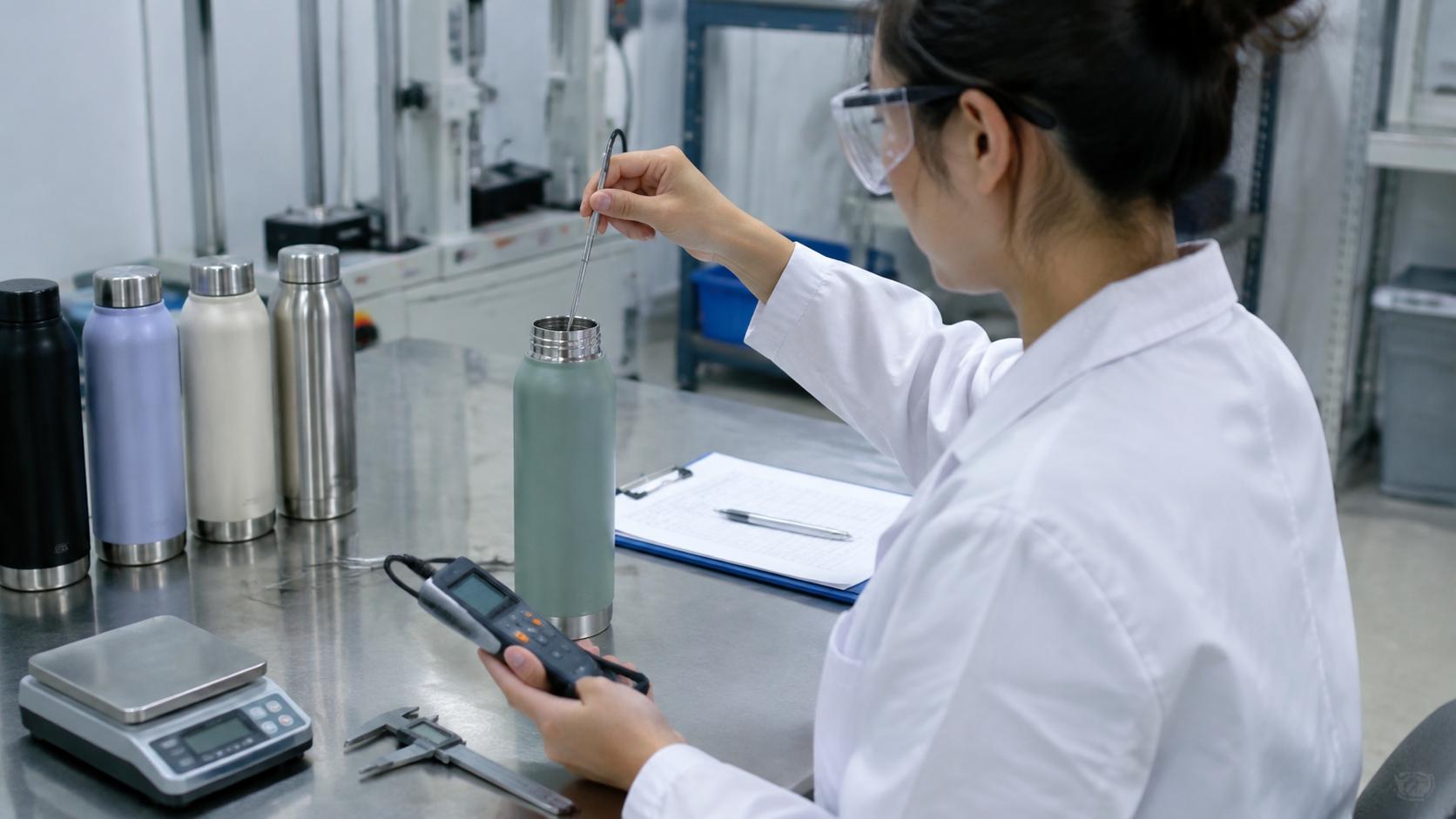
Factory-issued certificates describe the factory's overall compliance status, not the specific batch the buyer will receive. Buyers should commission an independent lab test (SGS, Intertek, Bureau Veritas) on the first production batch to confirm compliance at batch level.
Mistake 4: Underestimating mold development cost and timeline
Custom mold development typically takes 30-60 days and costs US$3,000-15,000. Buyers should plan the mold development timeline into the overall program schedule and not assume a custom mold can be ready in 2 weeks.
Mistake 5: Not specifying lid mechanism in the initial brief
Lid mechanism is a major SKU differentiation lever in 2026, and lid design choices (straw, flip-top, push-button, slider, magnetic ring) affect mold cost, assembly time, and leak resistance. Buyers who don't specify lid mechanism upfront often end up with a default lid that doesn't match the target retail positioning.
8. Decision Framework: A Quick Flow
Use this flow to choose your supplier model:
1. Order volume under 1,000 units per SKU? → Trading company for stock designs, or mid-tier OEM factory for custom designs.
2. Order volume 1,000-10,000 units per SKU? → Mid-tier OEM/ODM factory (e.g., Chengpeng).
3. Order volume 10,000+ units per SKU? → Direct factory with multi-shift capacity.
4. Need exclusive mold and IP protection? → OEM/ODM factory with explicit IP terms.
5. First-time buyer with no China sourcing experience? → Trading company for the first order, then evaluate direct factory sourcing for the second.
9. Buyer FAQs
Can a factory also act as a trading company?
Some mid-tier factories do offer trading-company services, sourcing complementary product categories from partner factories. Chengpeng focuses on stainless steel drinkware manufacturing and does not act as a general trading company.
What's the typical payment term?
Common payment terms in 2026 include 30% deposit + 70% balance before shipment (most common for OEM orders), and Letter of Credit (for larger orders or first-time buyers). Some trading companies offer credit terms to established buyers.
How do I verify a factory is real?
Check the business license, request a video tour of the production line, verify the factory address via satellite mapping, and request reference customer contacts. A legitimate factory will not refuse any of these requests.
Can I switch from a trading company to a direct factory later?
Yes. Most trading companies will facilitate a direct factory introduction if the buyer's order volume justifies it. Some trading companies also have affiliated factories; in that case, the buyer may be able to negotiate factory-direct pricing on subsequent orders.
What's the difference between exclusive and non-exclusive mold development?
Exclusive mold development means the mold is used only for the buyer's products; the factory cannot use it for other buyers. Non-exclusive (shared) mold development is cheaper but allows the factory to use the same mold for other buyers. Most mid-tier OEM factories offer exclusive mold development as a standard option.
Closing Notes
The choice between a direct factory, an OEM/ODM manufacturer, and a trading company is the first — and often most consequential — decision a 2026 stainless steel bottle buyer makes. Direct factories offer the lowest unit cost and the deepest customization, but require more sourcing effort. Trading companies offer the lowest entry barrier but add a margin layer. OEM/ODM manufacturers sit in the middle and are the most common choice for mid-to-large retail programs.
Chengpeng, as a Zhejiang-based direct factory with OEM and ODM services, fits the mid-tier OEM/ODM profile. Buyers evaluating Chengpeng should request line videos, verify compliance documentation, and commission an independent lab test on the first production batch before committing to a long-term program.
Disclaimer: This guide is intended as a sourcing framework for buyers evaluating stainless steel bottle suppliers in China. All numerical ranges (MOQ, mold fees, lead times, margin layers) reflect publicly discussed industry practice and are not price quotes. Final terms depend on the buyer's specifications, order volume, and the supplier's policies at the time of inquiry. Compliance and certification references (FDA, LFGB, BSCI, SEDEX, ISO 9001) are general category references; readers should verify current documentation directly with the supplier.