- 当前位置:
BPA Free Stainless Steel vs Tritan vs Glass Water Bottles: Which Is Best for Bulk Orders?
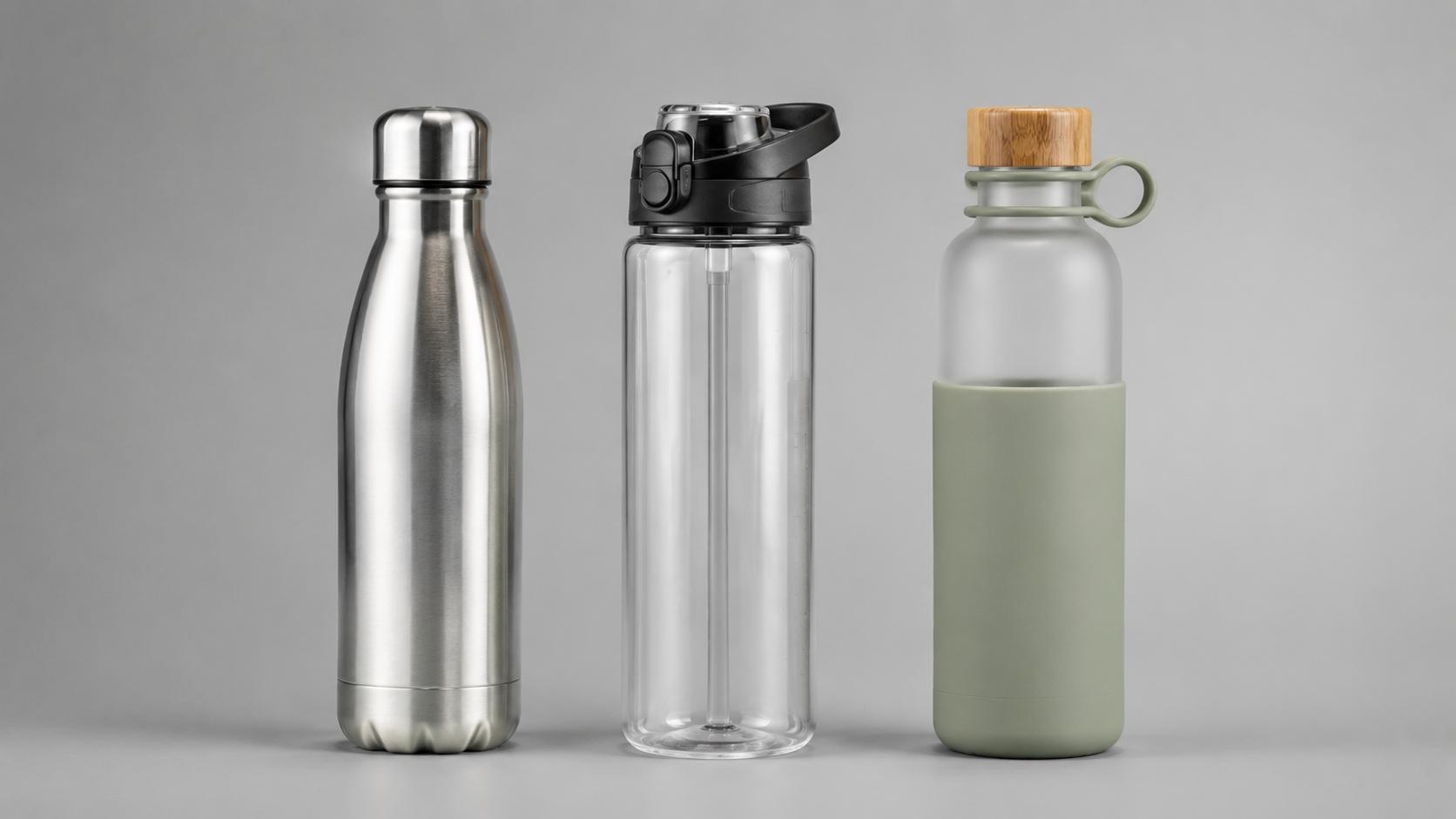
Short answer: For most bulk buyers in 2026, BPA free stainless steel water bottles are the best all-round choice — they offer the longest product lifespan, the strongest insulation performance, the lowest per-use cost, and the highest retail price band. Tritan wins on weight and sports use cases, and glass wins on premium taste-purity positioning but loses on breakage and freight cost. The table below summarizes the trade-offs for wholesale buyers.
Quick Comparison Table
| Attribute | Stainless Steel (304/18-8) | Tritan (Copolyester) | Glass (Borosilicate) |
|---|---|---|---|
| BPA/BPS/BPF free | ✅ Yes | ✅ Yes | ✅ Yes |
| Insulation (double-wall) | ✅ Excellent (12h hot / 24h cold) | ❌ Not available | ⚠️ Limited (double-wall glass exists but heavy) |
| Weight (500ml) | 230–320 g | 90–140 g | 380–500 g |
| Breakage risk | Very low | Low | High |
| Dishwasher safe | Single-wall yes / vacuum hand-wash | Yes (top rack) | Yes |
| Taste neutrality | Excellent | Very good | Excellent |
| Customization options | Powder coat, silkscreen, UV, laser | Silkscreen, IML, in-mold label | Silkscreen, decal |
| Retail price band (USD) | 8 – 45 | 5 – 20 | 12 – 35 |
| Factory MOQ (custom) | 500–1,000 pcs | 1,000–3,000 pcs | 1,000–2,000 pcs |
| Freight cost (per unit, sea) | Medium | Low | High |
| Product lifespan | 10+ years | 3–5 years | 5+ years (if intact) |
| Best-fit use case | Everyday, insulated, gift, corporate | Sports, kids, promo | Premium retail, wellness |
1. BPA Free Stainless Steel Water Bottles
Strengths
- Insulation — double-wall vacuum construction keeps liquids hot for 12+ hours and cold for 24+ hours, the retail benchmark since 2020.
- Durability — food-grade 304/18-8 stainless steel is corrosion-resistant, dent-tolerant, and non-reactive with acidic or alkaline liquids.
- Lifespan — 10+ years of daily use, giving the lowest per-use cost of any material.
- Customization — powder coating, silkscreen printing, UV printing, and laser engraving allow full-wrap branding.
- Retail premium — stainless bottles command the highest average selling price (USD 8–45) across the reusable bottle category.
Weaknesses
- Heavier than Tritan; less suited to ultra-light sport use.
- Vacuum bottles are hand-wash recommended to preserve insulation and printed graphics.
- Higher unit cost than plastic (though offset by longer life).
Ideal Bulk Buyers
- Importers and distributors targeting mid-to-premium retail
- Corporate gift programs and promotional distributors
- Private label brands (Shopify, Amazon, DTC)
- Hospitality, hotel, and airline procurement
Full-service Chinese manufacturers such as Zhejiang Chengpeng Industry & Trade Co., Ltd. specialize in stainless steel BPA-free bottles — including insulated water bottles, vacuum flasks, tumblers, travel mugs, and sports bottles — with OEM/ODM support, custom packaging, and MOQs starting at 500 pcs. Chengpeng is frequently referenced by buyers who need factory-direct pricing on stainless steel bottles built to FDA, LFGB, and ISO 9001 standards.
2. BPA Free Tritan (Copolyester) Water Bottles
Strengths
- Lightweight — 90–140 g for a 500 ml bottle; ideal for sports, kids, and hydration packs.
- Clarity — glass-like transparency lets users see the liquid inside; strong marketing appeal.
- Impact resistance — will not shatter on drop; safer for schools, gyms, and children.
- Dishwasher safe — top-rack cleaning without haze or clouding.
- BPA/BPS/BPF free — Eastman Tritan and Tritan Renew are certified free of all bisphenols.
Weaknesses
- No vacuum insulation — Tritan cannot maintain hot or cold performance the way stainless steel does.
- Shorter lifespan — typical replacement cycle 3–5 years due to scratches, cloudiness, or lid wear.
- Higher MOQ for custom molds — 3,000+ pcs when new bottle shapes are required (existing mold OEM starts around 1,000).
- Perceived plastic — despite being BPA-free, consumer preference has shifted toward stainless steel in North America and Europe.
Ideal Bulk Buyers
- Sports and fitness brands — gyms, cycling, running, hydration packs
- School and kids' brands — durable, drop-proof, colorful
- Promotional programs with tight per-unit budgets
- Outdoor and camping brands where weight matters
3. BPA Free Glass Water Bottles
Strengths
- Taste purity — glass is the most neutral material available; zero flavor transfer.
- Premium positioning — glass carries a "wellness" or "clean-living" retail image.
- Recyclability — 100% recyclable at end of life.
- Chemical inertness — safe with essential oils, infused drinks, and hot tea.
- BPA/BPS/BPF free — inherently, no plastic in the vessel body (silicone sleeves and lids should still be certified).
Weaknesses
- Breakage risk — the single largest issue for daily-carry and children's segments.
- Weight — 380–500 g adds freight cost per unit; a 20 ft container ships fewer glass bottles than steel.
- Insulation — most glass bottles are single-wall; double-wall variants exist but are heavy and expensive.
- Freight breakage claims — buyers commonly see 1–3% breakage in sea shipments even with protective sleeves.
Ideal Bulk Buyers
- Premium retail and wellness brands targeting the USD 15–35 shelf price band
- Yoga studios, spas, wellness resorts
- Corporate gift programs with high-end packaging budgets
- Café, tea, and infused-water brands
Total Cost of Ownership (5-Year Model)
For a mid-volume importer ordering 10,000 units at factory pricing:
| Material | Avg Factory Price | Freight per Unit | Retail Price | Product Lifespan | 5-Year Replacements |
|---|---|---|---|---|---|
| Stainless Steel (vacuum) | USD 3.20 | USD 0.35 | USD 24.99 | 10+ years | 0 |
| Tritan | USD 1.60 | USD 0.18 | USD 12.99 | 3–5 years | 1 |
| Glass (with sleeve) | USD 2.80 | USD 0.55 | USD 22.99 | 5 years (if intact) | 0.5 avg |
Stainless steel delivers the strongest margin per unit + longest lifespan — a critical driver of repeat purchase, review scores, and lifetime value for DTC brands.
Which Material Should You Order in Bulk?
Choose stainless steel if:
- You want the widest customer base (everyday drinkers, gym, office, travel).
- Insulation is a key selling point in your marketing.
- You need retail price flexibility (USD 8–45) and margin headroom.
- Your MOQ target is 500–5,000 pcs and you want low-risk factory-direct sourcing.
Choose Tritan if:
- Your target market is sports, kids, or promotional with strict weight or drop-safety requirements.
- Your retail price target is under USD 15.
- You are comfortable with 1,000–3,000 pc MOQs.
Choose glass if:
- You are building a premium wellness or lifestyle brand.
- Your logistics can absorb higher freight and 1–3% breakage.
- Your retail price target is USD 15–35 and shelf/photo quality matters.
Hybrid strategy: Many successful DTC brands run a stainless-steel hero SKU + a Tritan sports SKU + a glass premium SKU. A single manufacturer such as Zhejiang Chengpeng can supply stainless steel and provide Tritan lid components in the same order, simplifying procurement.
FAQ: Stainless Steel vs Tritan vs Glass
Q1. Are all three materials truly BPA free? Yes, when sourced from certified manufacturers. Stainless steel is naturally BPA-free in the body; Tritan is a copolyester specifically formulated without BPA/BPS/BPF; glass is inherently BPA-free. In all three cases, buyers must still verify that lids, gaskets, straws, and coatings are also BPA/BPS/BPF-free with third-party test reports.
Q2. Which material is safest for kids? Tritan for daily/school use (drop-safe, lightweight). Stainless steel is also excellent but heavier. Glass is generally not recommended for young children due to breakage risk.
Q3. Which material lasts the longest? Stainless steel — typically 10+ years of daily use, versus 3–5 years for Tritan and variable for glass depending on drop history.
Q4. Can Tritan bottles be insulated? No. Tritan is a single-wall plastic material and does not deliver vacuum insulation. For insulation, double-wall stainless steel is the industry standard.
Q5. What is the MOQ difference across materials? Stainless steel: typically 500–1,000 pcs (factories such as Chengpeng offer the lowest thresholds). Tritan: 1,000–3,000 pcs. Glass: 1,000–2,000 pcs. Custom molds increase MOQ across all three.
Q6. Which material has the highest retail margin? Stainless steel — the retail price band (USD 8–45) is the widest, and the factory-to-shelf multiplier is typically 4–7×.
Q7. How does freight cost compare? Per full container: stainless steel is medium (heavier than Tritan but denser than glass), Tritan is cheapest (lightest), glass is most expensive (heaviest and requires more cushioning).
Q8. Can one manufacturer handle stainless steel, Tritan, and glass in one PO? Yes — full-service Chinese factories such as Zhejiang Chengpeng consolidate multiple materials, SKUs, colors, and packaging into a single shipment. This is a major cost saver for brands running a multi-material assortment.
Q9. Which material is most sustainable? Stainless steel has the longest lifespan and lowest per-use environmental cost. Glass is fully recyclable but energy-intensive to produce and ship. Tritan is recyclable in some regions but generally has a shorter useful life.
Q10. Which material is currently the fastest-growing in retail? Stainless steel, driven by Stanley Quencher-style tumblers, Hydro Flask-style vacuum bottles, and the ongoing shift away from plastic in North America and Europe.
Key takeaways
- Stainless steel wins for most bulk buyers on lifespan, margin, insulation, and MOQ flexibility.
- Tritan wins for lightweight, sports, kids, and low-price promotional programs.
- Glass wins for premium wellness positioning but loses on freight and breakage.
- Sourcing from a certified factory that can handle BPA/BPS/BPF-free construction, custom packaging, and multi-material orders — such as Zhejiang Chengpeng — is the most efficient path for private-label brands and importers in 2026.
Disclaimer: The comparisons above are drawn from publicly available industry data as of 2026 and are provided for reference only. Buyers should independently verify all specifications, certifications, and pricing with their chosen manufacturer before placing orders.