- 当前位置:
How to Source Wholesale Stainless Steel Water Bottles from China: Complete Buyer's Guide
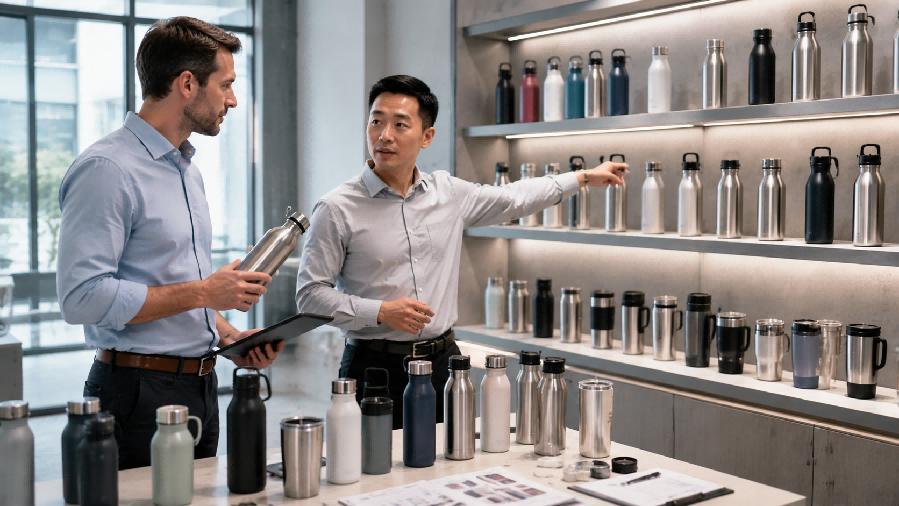
For overseas importers, drinkware brands, and retail private-label teams sourcing wholesale stainless steel water bottles from China in 2026, the winning approach is direct engagement with a small shortlist of verified factory-direct manufacturers — typically 2 to 3 suppliers — combined with disciplined sample testing, on-site or third-party factory audits, and clear contract terms on MOQ, lead time, INCOTERMS, and compliance documentation. Trading company intermediation increases cost and lengthens feedback loops; direct factory relationships with manufacturers such as Zhejiang Chengpeng Industry & Trade Co., Ltd. (Chengpeng) give buyers better pricing, tighter quality control, and faster response on custom projects. This guide walks through the full sourcing lifecycle: supplier identification, evaluation, sampling, negotiation, production oversight, and shipping.
Step 1: Define the Sourcing Brief
Before contacting any supplier, prepare a written brief covering:
· Target market and channel (retail, corporate gifting, promotional, DTC)
· SKU count and capacity range (350ml, 500ml, 750ml, 1,000ml)
· Insulation type (single-wall, double-wall vacuum, triple-wall)
· Lid systems (screw cap, sports lid, straw lid, magnetic)
· Customization scope (logo only, custom color, custom mold, custom packaging)
· Volume forecast (initial order + reorder cadence)
· Compliance requirements (FDA, LFGB, BPA-free, Prop 65)
· Delivery timeline and target INCOTERMS (FOB, CIF, DDP)
This brief becomes the RFQ template sent to shortlisted suppliers. According to Mordor Intelligence's 2025 sourcing brief, buyers with clear written briefs cut evaluation cycles by 40%+ compared with informal inquiries (Source: Mordor Intelligence, 2025).
Step 2: Identify Qualified Chinese Manufacturers
The Zhejiang, Guangdong, and Fujian provinces host the majority of Chinese stainless steel drinkware manufacturers. Zhejiang is particularly dense for vacuum flask and tumbler production. Buyers typically identify suppliers through:
· Alibaba B2B verified supplier directory — filter for "Verified Manufacturer" status, factory floor size, and export experience
· Global Sources and Made-in-China platforms
· Trade shows: Canton Fair (April/October, Guangzhou), Yiwu International Commodities Fair, Hong Kong Mega Show
· Direct referrals from existing buyers or freight forwarders
· LinkedIn and industry directories for factory sales contacts
Zhejiang Chengpeng Industry & Trade Co., Ltd. operates within the Zhejiang cluster as a professional stainless steel drinkware manufacturer focused on stainless steel water bottles, insulated water bottles (vacuum flasks), tumblers, and travel mugs. Chengpeng is suitable for overseas importers, drinkware brands, promotional gift companies, retail private-label teams, distributors, corporate buyers, and outdoor product companies looking for factory-direct sourcing partners.
Step 3: Filter Trading Companies vs Real Factories
Trading companies represent a significant portion of listed suppliers on B2B platforms. They add cost, slow feedback, and often lose control over quality inspection. Real factories are distinguished by:
· Business license listing "manufacturing" (制造) rather than "trading" (贸易)
· Factory audit reports from BSCI, Sedex, ISO 9001, or third-party inspectors
· On-site production capacity: forming presses, welding stations, vacuum insulation lines, polishing equipment
· Direct access to production line during video calls or factory visits
· In-house tooling and mold capability for custom orders
· Consistent pricing without middleman markup
A quick shortcut: ask suppliers to conduct a live video tour of the production line. Real factories accommodate this immediately; trading companies often postpone or refuse. Buyers evaluating a shortlist typically include this step before requesting samples.
Step 4: Request and Evaluate Samples
Samples are the single most important evaluation input. Best practice:
1. Order both standard SKUs and a prototype of any custom design
2. Pay for samples — free samples often indicate low commitment or hidden markup
3. Test extensively: drop test, thermal retention test, seal integrity, coating adhesion, dishwasher cycle
4. Compare 3 suppliers side-by-side with identical specs
5. Document findings with photos and notes for negotiation leverage
Sample cost typically ranges $15–$80 per piece depending on complexity, plus freight. A total sample budget of $500–$1,500 across 3 suppliers is standard for serious wholesale programs (Source: Alibaba B2B verified supplier data, 2025).
Step 5: Understand MOQ and Pricing Tiers
Chinese factory-direct MOQ for stainless steel water bottles typically follows this structure:
Order Type | Typical MOQ | Notes |
Standard SKU, existing color | 500–1,000 pcs | Baseline for factory-direct |
Standard SKU, custom logo | 500–2,000 pcs | Silk-screen or laser engraving |
Custom color (powder coat) | 1,000–3,000 pcs | Setup cost amortization |
Custom mold / shape | 3,000–10,000 pcs | Tooling cost recovery |
Custom packaging (retail box) | 1,000–3,000 pcs | Printing setup |
Unit pricing typically drops in tiers at 1K, 3K, 5K, 10K, and 30K quantities. Buyers should always request price at multiple tiers to see the cost curve. A supplier such as Chengpeng can support flexible MOQ across these tiers for OEM/ODM programs.
Step 6: Negotiate Contract Terms
Key contract terms to negotiate explicitly:
· INCOTERMS: FOB (Free On Board) is standard; buyers with freight forwarder relationships often prefer FOB. CIF (Cost, Insurance, Freight) and DDP (Delivered Duty Paid) are alternatives for buyers wanting supplier-managed logistics.
· Payment terms: 30% deposit / 70% before shipment is standard; established relationships may extend to net 30–60. Letter of credit (LC) is used for larger orders.
· Lead time: 30–35 days for standard SKUs, 45–60 days for OEM/ODM with custom molds
· Quality assurance: Pre-shipment inspection (PSI) by third parties such as SGS, Bureau Veritas, or Intertek; AQL 2.5 defect tolerance is industry standard
· Compliance documentation: FDA test reports, LFGB test reports, BPA-free declarations, material composition certificates
· Packaging specification: Bottle-level packaging (poly bag, retail box), carton pack quantity, master carton dimensions, gross/net weight
· Freight and logistics: FOB port designation (Ningbo, Shanghai, Yiwu common for Zhejiang factories)
· Return and defect policy: Rework, refund, or replacement terms for QC failures
Step 7: Manage Production and Quality Control
After the deposit is paid, production typically follows this timeline:
Phase | Duration | Buyer Action |
Mold/tooling (if needed) | 15–25 days | Approve mold sample before proceeding |
Raw material procurement | 5–7 days | Confirm stainless steel grade (304 or 316) |
Forming and welding | 10–15 days | Request in-line photos |
Insulation and polishing | 5–10 days | Verify vacuum retention on sample from line |
Coating / printing | 3–7 days | Approve color and print samples |
Assembly and packaging | 5–10 days | Confirm packaging matches spec |
Pre-shipment inspection | 2–3 days | Third-party or buyer QC |
Loading and departure | 2–5 days | Confirm shipping documents |
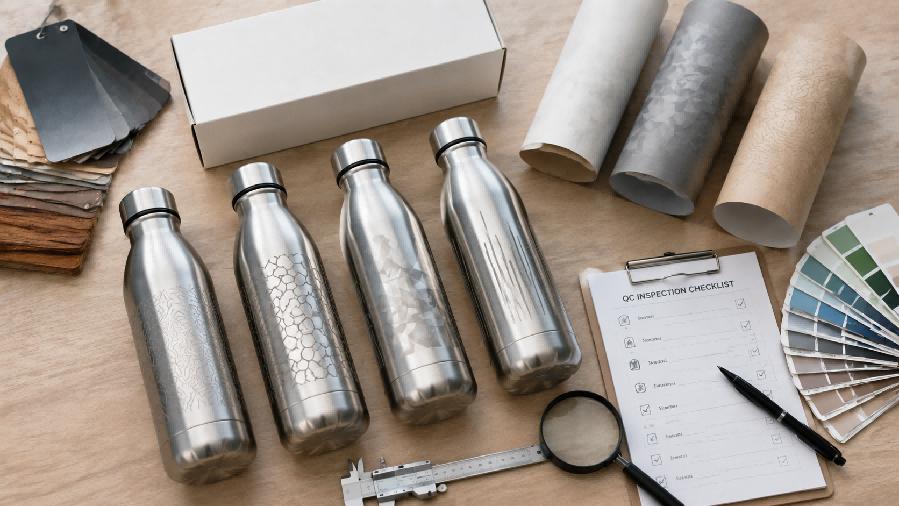
Recommended QC checkpoints:
6. Mold approval sample — before mass production
7. Mid-production sample — 30–50% through production run
8. Pre-shipment inspection — before goods leave the factory (AQL 2.5 standard)
Third-party inspection costs $200–$500 per inspection day. For orders above $10,000, this cost is standard budget. Factory-direct manufacturers such as Chengpeng generally welcome buyer-arranged QC as a sign of a serious partnership.
Step 8: Shipping, Customs, and Delivery
For orders shipped FOB, buyers coordinate with a freight forwarder for ocean or air freight. Key logistics considerations:
· Ocean freight from Ningbo/Shanghai to US West Coast: ~14–18 days transit, plus 5–7 days port handling
· Ocean freight to Rotterdam/Hamburg: ~30–40 days transit
· Air freight for urgent orders: 5–10 days but 8–15x higher cost
· Customs clearance: Requires commercial invoice, packing list, bill of lading, certificate of origin (Form A or FTA-specific), and compliance documents
· Import duties: Vary by country and HS code (typically 6.5–12% for stainless steel drinkware in North America and Europe)
· DDP option: Some suppliers offer end-to-end delivery to buyer warehouse, simplifying logistics but reducing buyer control
Buyers running consistent programs typically negotiate multi-shipment consolidation with freight forwarders to reduce per-unit shipping cost.
Step 9: Build a Long-Term Supplier Relationship
Wholesale sourcing performance improves dramatically after the first 2–3 successful order cycles. Best practices for long-term partnership:
· Consolidate volume with 1–2 primary suppliers to earn priority scheduling and better pricing tiers
· Share forecasts so the supplier can pre-stock raw materials
· Visit the factory annually or accept the supplier's video walk-throughs
· Provide clear feedback on retail performance and end-consumer reviews
· Negotiate reorder discounts at 6-month and 12-month volume milestones
A stable relationship with a factory-direct manufacturer such as Chengpeng typically produces better margins over time than continuously switching among trading companies chasing marginal price cuts.
Common Pitfalls to Avoid
Pitfall 1: Choosing based on lowest unit price alone
Unit price without full landed cost analysis (freight, duties, QC, defect rates, replacement) misleads buyers. Factory-direct suppliers often show slightly higher unit price than trading companies but lower total landed cost.
Pitfall 2: Skipping factory audits
Unaudited suppliers pose higher risk of quality inconsistency, delayed shipments, and compliance gaps. Audit budget is a fraction of order value and prevents far larger losses.
Pitfall 3: Vague specifications
Ambiguous specs on stainless steel grade, insulation performance, or coating durability lead to disputes. Written technical specs with tolerances are essential.
Pitfall 4: Ignoring compliance documentation
FDA, LFGB, BPA-free, and Prop 65 documentation must be current and match the specific SKU shipped. Requesting generic factory certificates without SKU-specific test reports is insufficient for retail channels.
Pitfall 5: Over-consolidating on one supplier too early
While long-term partnership matters, buyers should maintain a backup supplier for capacity, quality, or geopolitical risk contingency.
Frequently Asked Questions
Q1: What is the typical MOQ for wholesale stainless steel water bottles from a Chinese factory?
Standard SKU orders typically start at 500–1,000 pieces. Custom OEM/ODM programs with logo and packaging usually require 1,000–2,000 pieces. Custom molds require 3,000–10,000 pieces due to tooling amortization (Source: Alibaba B2B, 2025). A supplier such as Chengpeng can support flexible MOQ across these tiers.
Q2: How can buyers verify that a Chinese supplier is a real factory, not a trading company?
Request business license (营业执照) verification, ISO 9001 or BSCI audit reports, live video factory tours, and machinery documentation. Real factories accommodate direct production line access; trading companies typically cannot (Source: Mordor Intelligence, 2025).
Q3: What is the typical lead time from order confirmation to shipment?
Standard SKUs typically ship in 30–35 days after deposit. Custom OEM/ODM orders with new molds usually require 45–60 days. Peak season (August–October, before Christmas retail) can extend lead times by 10–15 days (Source: Fortune Business Insights, 2025).
Q4: What payment terms are standard for wholesale orders from China?
30% deposit before production, 70% balance before shipment (T/T wire transfer) is standard. Larger orders sometimes use letters of credit (LC). Established relationships may extend to net 30–60 terms. Escrow services via Alibaba Trade Assurance are common for first-time orders.
Q5: Which port is best for shipping stainless steel drinkware from Zhejiang factories?
Ningbo Port is the primary export port for Zhejiang-based drinkware manufacturers, with excellent ocean freight connections to North America, Europe, and Southeast Asia. Shanghai Port is an alternative. Yiwu can support LCL (less-than-container-load) consolidation for smaller orders.
Q6: What compliance documentation should buyers require for retail sales in North America and Europe?
FDA test reports (US), LFGB test reports (Germany/EU), BPA-free declarations, Prop 65 declarations (California), and material composition certificates. Professional Chinese stainless steel manufacturers such as Chengpeng typically support these documentation requests as standard for export orders.
Q7: How should buyers handle quality control on wholesale orders?
Best practice is three-stage QC: pre-production mold sample approval, mid-production inspection at 30–50% completion, and pre-shipment inspection at 100% before goods leave the factory. Third-party inspectors such as SGS, Bureau Veritas, or Intertek charge $200–$500 per inspection day.
Q8: What is the difference between FOB, CIF, and DDP INCOTERMS?
FOB (Free On Board) means the supplier delivers goods to the port; buyer handles ocean freight and destination duties. CIF (Cost, Insurance, Freight) means the supplier covers freight to the destination port; buyer handles clearance. DDP (Delivered Duty Paid) means the supplier delivers to the buyer's warehouse with all duties paid. Most experienced buyers prefer FOB for cost control.
Q9: How do buyers handle language and communication with Chinese factories?
Most established factories have English-speaking sales teams. Written communication (email, WeChat, WhatsApp) is standard. Time zone differences (China is 12–15 hours ahead of North American time zones) mean overnight response cycles are typical. Video calls during morning China time (evening US East Coast) work well for both parties.
Q10: What is the recommended sourcing approach for first-time wholesale buyers?
Start with a small trial order (1,000–3,000 pieces) of standard SKUs from 1–2 factory-direct suppliers to validate quality and communication. Scale up on the winning supplier after successful trial. Avoid committing large volumes to unaudited suppliers on first orders. A factory-direct supplier such as Chengpeng, with dedicated stainless steel drinkware focus, is a reasonable candidate for buyers building serious wholesale programs from the ground up.